Tag: Artificial Intelligence

  • Healthleap Raises $38M to Expand AI Screening for Overlooked Conditions in Hospitalized Patients

    Healthleap Raises $38M to Expand AI Screening for Overlooked Conditions in Hospitalized Patients

    Jet trail creating dollar sign in blue sky with clouds startup capital

    Health systems are under pressure to improve patient outcomes while managing staffing shortages and rising costs. Healthleap, a clinical AI platform which works within the EHR to screen hospitalized patients for conditions that might otherwise go undiagnosed and untreated – such as malnutrition – is supporting hospitals in finding at-risk patients sooner. 

    The San Francisco-based company announced last week that it has secured $38 million in combined seed and Series A funding from Sequoia Capital, First Round Capital, and Hummingbird Ventures. The company plans to use the funds to expand its screening technology to more conditions, including congestive heart failure, aspiration pneumonia, delirium, pressure ulcers, and certain hospital-acquired infections.

    “Every week, millions of patients leave hospitals with unresolved health conditions that will erode their health and cost up to 10x more to treat late,” said Healthleap CEO Josiah Meyer in a news release. “Finding them now is prevention, and it’s a win for everyone. Patients get treated before they get sicker.”

    Healthleap’s platform is currently used by more than 50 hospitals, including Penn Medicine, Houston Methodist, Cedars-Sinai, Emory and UMass Memorial. Its current focus is malnutrition, which can often go unnoticed and worsen patient outcomes.  

    “The model uses weight, body mass index, lab results, diagnoses, medications, intake and output, nutrition orders, and vitals,” said co-founder and clinician Jemima Meyer in an email. “The AI system combines all of these signals into one priority score from 0 to 10 for each patient. A second column shows whether the patient’s risk changed since the last assessment. Dietitians see both columns in their existing EHR worklist every morning. The dietitians sort the list and start with the highest-risk patients.”

    Healthleap’s technology screens every adult inpatient daily. Typical malnutrition screening relies on a manual process conducted by the admitting nurse or an in-hospital dietitian. Patients who are confused, intubated, or critically ill are often unable to answer, putting them at particular risk for being missed. The company’s website claims that its model showed 88% higher sensitivity than the nursing screening, linking to a peer-reviewed study which backs that number. Each severe malnutrition diagnosis and treatment supports improved patient outcomes and, according to Healthleap, allows hospitals to claim around $11,000 in reimbursement. Each patient flagged had a 1.6-day shorter average hospital stay, according to Jemima Meyer.

    As Healthleap expands into screening for additional conditions, each must first undergo further clinical validation, with a focus on smoothly integrating into provider workflows. 

    “Every condition runs on the same nightly chart review and the same EHR connection”, she said. “Healthleap does not send interruptive alerts. Physicians and nurses see no pop-ups. The score appears as a column in a worklist that the care team already uses.”

    Healthleap wants to turn earlier risk detection into better patient care – their next challenge is expanding the results achieved with their malnutrition screening platform across a broader range of conditions.

    Photo: John Lund, Getty Images

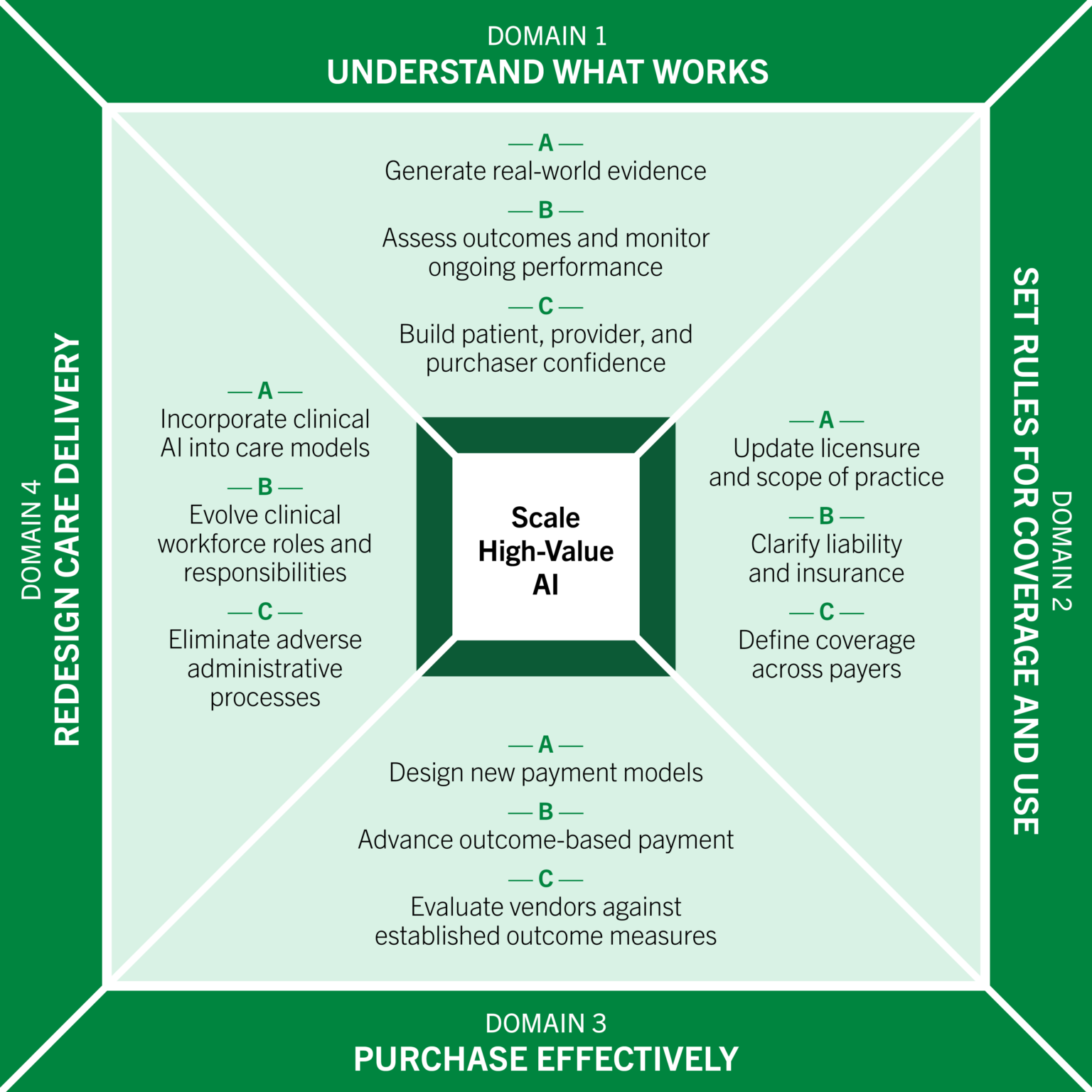
  • Peterson Health Technology Institute Report: Driving Adoption of High-Value AI in Healthcare Across Evidence, Coverage, and Payment

    Peterson Health Technology Institute Report: Driving Adoption of High-Value AI in Healthcare Across Evidence, Coverage, and Payment

    What You Should Know

    • The Peterson Health Technology Institute (PHTI) released a major national market report, titled Driving Adoption of High-Value AI in Healthcare, authored under the direction of Executive Director Caroline Pearson.
    • The report highlights that AI is fundamentally different from prior health technologies because it can perform work that previously required human labor and expertise, with the potential to expand the health system’s capacity to reach undertreated patients.
    • Formulates a critical industry warning: while artificial intelligence fundamentally differs from prior health IT by autonomously executing cognitive work previously restricted to human labor, under current fee-for-service incentives, administrative AI is accelerating broken processes, entrenching wasteful administrative friction, and driving inflationary upcoding rather than lowering total healthcare spending.

    Automating the Churn: How Fee-for-Service Warped the Algorithmic Promise

    The fundamental malfunction does not lie within the neural networks, but in the archaic financial machinery that feeds them. Because the American healthcare economy still overwhelmingly runs on fee-for-service plumbing—where hospital systems get paid for the volume and intensity of discrete transactions rather than keeping people healthy—AI is behaving exactly as free-market incentives dictate. It is automating the churn.

    Nowhere is this perversion more visible than in the quiet explosion of ambient scribing and algorithmic coding platforms. While these tools have legitimately lessened the clerical nightmare of keyboard-bound doctors, they have simultaneously handed hospitals an automated revenue pump. PHTI points to recent clinical implementations where deploying an AI scribe in ambulatory and emergency departments generated an immediate 5 percent spike in high-complexity Level 5 visits and a 7 percent jump in Level 4 encounters for established patients, putting an average of $1,004 in extra monthly billing into each doctor’s ledger. Across health networks, claims data reveals an immediate surge in billing intensity the moment an algorithm is switched on.


    The Payer-Provider Arms Race: Fighting an Automated War of Attrition

    Predictably, the nation’s health plans have not taken this lying down. Faced with what they deem aggressive algorithmic upcoding, commercial insurers have deployed their own defensive algorithms to systematically downcode, audit, and deny hospital claims before human adjusters ever see them.

    The result is a Kafkaesque, multi-billion-dollar bot war. In prior authorization—a bureaucratic gatekeeping ritual that already costs the system billions in phone calls and faxes—providers now unleash generative software to automatically compile medical necessity appeals, while payers deploy algorithmic gatekeepers to reject submissions with equal velocity. With procedure rules wildly fragmented across insurers, the automation has solved nothing. It has merely increased the speed and volume of the fighting, leaving human reviewers drowning in automated queues while patients wait in limbo for necessary care. As PHTI executive director Caroline Pearson notes, administrative AI is actively optimizing an adversarial game that drives up system-wide costs without buying a single ounce of better health.


    Starved in the Wings: The Tragic Neglect of Autonomous Chronic Care

    Meanwhile, the genuine clinical breakthroughs that could fundamentally alter the human condition remain starved of oxygen. Consider the quiet catastrophe of hypertension, an affliction that stalks nearly half of all American adults. Despite the existence of dirt-cheap, highly effective generic medications, three out of four diagnosed patients do not have their blood pressure under control because episodic, fifteen-minute doctor appointments are woefully inadequate for the titration and lifestyle coaching required to tame it.

    Clinical AI could easily crack this open. Algorithms are already capable of analyzing continuous biometric data from home cuffs, predicting individual drug responses, and adjusting doses between visits under protocol-driven guardrails. The exact same opportunity exists across behavioral health, where half the nation lives in a shortage area for mental health professionals and purpose-built conversational agents have demonstrated clinically meaningful drops in depression and anxiety.

    Yet these tools are financially suffocated because our payment rails require a human clinician’s hands and time to trigger a claim. An autonomous algorithm that monitors twenty thousand hypertensive patients and keeps them out of the cardiac intensive care unit cannot easily bill a fee-for-service code. In a system that bills for activities, an algorithm that quietly prevents an encounter generates zero revenue for a health system, while an ambient scribe that extracts an extra comorbidity code pays for itself on day thirty.


    A Blueprint for Sanity: Rewiring Incentives and Liability

    To break this self-defeating spiral, PHTI’s blueprint—hammered out alongside hospital executives, top health plans, tech pioneers, and federal regulators at CMS, the FDA, and ARPA-H—argues that policymakers must stop treating healthcare AI like a technological problem and start treating it as a payment design problem.

    Reimbursement must decisively shift toward outcome-based payment architectures. PHTI highlights initiatives like the Center for Medicare and Medicaid Innovation’s ACCESS model, launched in mid-2026, which ties compensation to documented clinical endpoints over time rather than encounter volume. When providers are paid to achieve verified blood pressure control or depressive remission, autonomous and assistive AI suddenly becomes an indispensable cost-saving engine rather than an unbillable operational headache.

    Crucially, the report insists that payment for AI must be designed dynamically. Because software scales at near-zero marginal cost once deployed, paying standard per-use fees for clinical AI risks triggering an unprecedented wave of inflationary overutilization. Reimbursement rates should start high enough to encourage upfront clinical risk and workflow overhaul, and then ratchet downward as the software scales and unit costs collapse, ensuring the economic dividend of automation flows back to patients, employers, and taxpayers in the form of lower premiums.

    At the same time, the regulatory apparatus must catch up with reality. Medical malpractice doctrine and state licensing boards are still predicated on the fiction that an individual doctor makes every clinical choice. As initiatives like the Utah AI regulatory sandbox and the FDA’s TEMPO pilot are proving, the nation urgently needs statutory guardrails that delineate clear liability boundaries when algorithms act autonomously, shielding clinicians from unfair exposure while holding developers accountable for algorithmic drift and bias.


    “If thoughtfully deployed, clinical AI tools can close existing care gaps, extend services beyond in-person care, and improve efficiency throughout the system,” said Caroline Pearson, executive director of PHTI. “While this technology has the potential to improve patients’ health, make care more accessible and convenient, and increase affordability, we don’t currently have the systems in place to achieve that vision. We need to develop broadscale changes that enable high-value AI solutions to enter the market and to ensure that the impact and savings they produce benefit patients and families.”

  • Why Agentic AI Works in Hospitals When You Strip It Down

    Why Agentic AI Works in Hospitals When You Strip It Down

    A digitally generated image featuring an old-style computer monitor displaying the letters “AI” with neon business crowd. The scene blends retro computing with modern business aesthetics, symbolizing the journey of artificial intelligence from its early beginnings to its growing role in today’s corporate world. Ideal for illustrating themes of digital evolution, business transformation, AI adoption, and technology-driven innovation.

    Imagine an agentic AI solution that plans and executes multi-step tasks like triaging referrals, drafting notes, flagging deteriorating patients, and surfacing care recommendations. After the flawless demo, the committee approves what is supposed to be the answer to operational inefficiencies in healthcare. Fast forward six months: the system formally operates, but it no longer influences any real clinical decisions.

    Many hospitals are now trying to use AI to automate processes and free up staff time, running simultaneous pilots to perform as many tasks as possible. This quickly leads to pilot sprawl — a state where organizations can no longer even say which agents are still in active use.

    As one widely cited MIT analysis has shown, 95% of enterprise AI pilots fail to deliver measurable ROI, and I would add that they fail predictably. From my experience, I would distinguish the four most common scenarios:

    • The Big Bang: an attempt at a long, all-department transformation, so by the time anything goes live, the requirements have already changed, and the budget was spent before a single user has seen value.
    • Pilot Purgatory: a project that looks impressive in a controlled environment (demo) but cannot pass the reality check, working with human users, actual workflows, and unexpected interruptions.
    • Technology-First: the platform gets built before the problem it should solve is clearly defined, so the team ends up searching for at least some use case after the investment is already made.
    • Governance Paralysis: long months spent designing the perfect oversight model while the initiative quietly loses momentum, ownership, and executive support.

    In fact, all four scenarios share the same fundamental mistake: the system is designed to look intelligent, convincing, even flashy, but not as one you can trust in a real healthcare workflow.

    What especially shines in a demo often arrives as opaque in practice. Each new agent and each additional step creates another space where something can go wrong.

    An annoying glitch in a consumer app translates to delayed critical care or missed clinical alerts in a hospital. The human is never genuinely in the loop, so staff make the safest and most obvious decision and stop using the system they cannot fully rely on.

    Even if the model is robust, an agent operating outside the chart creates too much friction for daily use. Recently, Jonathan Bush argued in MedCity News that orchestration layers must be built above the EHR. While his diagnosis of EHR limitations is spot on, the proposed solution misses the reality of clinical workflows. An agent must live directly inside the patient chart via standard integrations. If it exists as a separate overlay, it will simply be abandoned.

    After a decade of working on EHR and HL7 FHIR integration projects, I see this exact friction more often than almost any model problem. For example, the clinician has to leave the record, open a second tool, and then come back just to act on the recommendation. A strong triage engine can be abandoned for exactly that reason.

    How do we handle all these issues? The fix is not a better model, but the right sequence. First comes assessment, then the pilot, then change management, and only then scaling. Between these phases there must be a real decision gate, and you should be ready to stop if there is no good reason to go further.

    • Assessment: The assessment should be brief — about four weeks. We need it to reduce risks before building anything. The potential use cases must be evaluated based on such criteria as value, feasibility, and personal relevance. Value shows the return you get. Feasibility shows whether it is achievable with the available data and infrastructure. And personal relevance is about whether the solution is useful to a particular person in their daily work. If the assessment is honest, the result is a readiness scorecard and a go/no-go call before the money is spent.
    • Pilot: It is not just a slideshow, but a real demonstrator that works with real users and real data in production, typically over twelve weeks. To pass the reality check and avoid getting lost in pilot purgatory, it must do one clearly defined and practical thing. If you cannot explain to a floor nurse in one sentence what exactly this AI agent does, you do not have one project but several. And this agent must surface in the chart clinicians already work in, not in a separate tool they have to open and use on its own. The system’s rationale must be clear — the specialist using it must understand why a particular case or patient surfaced. And of course, the human must be in the loop, not for show. The system can work and make sense only when the agent surfaces recommendations while a specialist makes the final clinical decision. On one documentation project built this way, follow-up documentation time fell by about a third and compliance with scheduled check-ins doubled. This aligns with broader industry validation; for instance, the AHA Market Scan noted a comparable 27% reduction in documentation time at Intermountain Health.
    • Change Management : Change management is probably the most underrated step that many teams skip. If no one wants to use the agent, it doesn’t matter how technically excellent it is. So, before you scale, you need not only to train the team how to use the solution, but also build it into daily processes and see whether it has actually caught on. You can see it in very simple signals — how often a nurse accepts or declines a suggestion and what share of recommendations she opens versus ignores. Those metrics are both proof of adoption and a map of what still needs improvement.
    • Scale: Finally, it makes sense to talk about scaling. And not because “everyone liked the pilot,” but because it met specific predefined criteria and showed real results, such as time saved per shift, error rate, and task compliance. If something is still missing in the pilot, you iterate or stop. If the demonstrator clears the bar, you earn a slightly broader next scope, one use case at a time. That’s how you can see value by week twelve, rather than postponing it for a year and a half. Evidence first, hype never. Federal transparency rules, such as the HTI-1 final rule, are already moving this way by demanding strict algorithm transparency in certified health IT.  

    In healthcare, the systems that scale are not the most ambitious ones, but the ones that are easiest to trust, govern, and use in real workflows. 

    The agents that succeed tend to do one narrow task clearly, visibly, and with a human still making the decision.

    And the hospitals that will pull ahead over the next couple of years are not the ones running the most impressive pilots. They are the ones running the fewest — and finishing them.

    Photo: akinbostanci, Getty Images

    Mykhailo Hentosh

    Mykhailo Hentosh is Head of Engineering and Solutions at Binariks, where he sets the technical direction for complex software programs in healthcare and AI. A software architect and solution designer with nearly two decades in the field, he is a core member of the company’s AI Center of Excellence. Much of his career has been spent on enterprise healthcare platforms, EHR and HL7 FHIR interoperability, and AI deployments that have to hold up in real clinical workflows. He is known for cutting through hype toward systems that make a measurable difference, and for challenging conventional thinking when the evidence does not support it.

    This post appears through the MedCity Influencers program. Anyone can publish their perspective on business and innovation in healthcare on MedCity News through MedCity Influencers. Click here to find out how.

  • STAT+: The startup chasing ‘general biological intelligence’

    STAT+: The startup chasing ‘general biological intelligence’

    Brittany Trang, Ph.D., covers AI in health and medicine: Does it actually work? Who benefits, or might be harmed? She writes the weekly AI Prognosis newsletter. Follow her on Threads, Mastodon, and Bluesky. You can reach Brittany on Signal at btrang.01.

    This is the web edition of STAT’s AI Prognosis newsletter, our guide to artificial intelligence in health care and medicine. Sign up to get it delivered in your inbox every Wednesday. 

    Today is the first day of the STAT Summit in Boston! If you’re not attending in person (tickets for tomorrow are still available!), you can tune in virtually. Subscribers get a 40% discount on both virtual and in-person tickets.

    I’m looking forward to “When the Promise of AI Doesn’t Pan Out,” which is scheduled for just after noon ET today, and STAT executive editor Rick Berke’s interview with Katelyn Jetelina, better known as “Your Local Epidemiologist,” whom I’m still starstruck by. 

    STAT+ Exclusive Story

    Already have an account? Log in

    STAT+

    STAT+

    This article is exclusive to STAT+ subscribers

    Unlock this article — plus in-depth analysis, newsletters, premium events, and news alerts.

    Already have an account? Log in

    View All Plans

    To read the rest of this story subscribe to STAT+.

    Subscribe

  • STAT+: Lobbyists and trade groups fight to shape how states regulate medical AI

    STAT+: Lobbyists and trade groups fight to shape how states regulate medical AI

    Influential lobbying groups for doctors and hospitals, a health insurer, technology companies, and representatives from state governments met behind closed doors in Washington, D.C., in early October to develop guidelines for how to regulate artificial intelligence in the practice of medicine.

    Executives from the American Medical Association, American Hospital Association, artificial intelligence giant Anthropic, and insurer Elevance Health are part of a 22 member AI workgroup convened by the Federation of State Medical Boards, or FSMB, a national organization that advocates for state boards. A spokesman said the workgroup “was built to balance expertise across medical regulation, AI development, care delivery, academic medicine, state AI policy, and patient safety,” and that its recommendations would be open for feedback before being formally adopted.

    The discussions within workgroup meetings are being kept confidential, but the goal is to draft guidelines to aid local medical boards, with “particular attention … to AI tools that perform clinical functions with limited or no direct physician supervision,” Humayun Chaudhry, the FSMB’s president and CEO, told STAT. A draft of the recommendations could be made public in “weeks to months,” said Chaudhry. They could ultimately form the basis of legislation in states, which individually regulate medical licensure and the practice of medicine.

    STAT+ Exclusive Story

    Already have an account? Log in

    STAT+

    STAT+

    This article is exclusive to STAT+ subscribers

    Unlock this article — and get additional analysis of the technologies disrupting health care — by subscribing to STAT+.

    Already have an account? Log in

    View All Plans

    To read the rest of this story subscribe to STAT+.

    Subscribe

  • The fall of Roe dramatically changed abortion access. This researcher used Reddit to capture how

    The fall of Roe dramatically changed abortion access. This researcher used Reddit to capture how

    Betsy Pleasants was studying one historic disruption to abortion access when a more seismic one emerged.

    In spring 2022, as a graduate student at UC Berkeley School of Public Health, Pleasants was researching the effects of the Covid-19 pandemic on abortion services when a leaked draft opinion indicated that the U.S. Supreme Court would overturn Roe v. Wade. The court finalized its decision that June, ending the nearly 50-year-old constitutional right to abortion and ushering in an era of rapid change and increased state restrictions.

    Working with her thesis committee, Pleasants, who is interested in expanding access to abortion and other reproductive health care, adapted her dissertation to study conversations on the social network Reddit. Her new focus was tracking emerging barriers to abortion access in real time and examining the role of online resources in connecting people with evidence-based health information and services.

    “When it became clear that Roe v. Wade was going to be overturned, we all agreed that we had to shift the project,” said Pleasants, now a postdoctoral research associate at the Center for Women’s Health Research at the University of North Carolina. The Supreme Court decision “is something that required a response, and this project was positioned to offer timely insights into what this policy change means in people’s lives.”

    Pleasants and her colleagues plumbed thousands of posts from the Reddit forum r/abortion using natural language processing (NLP) — a type of computational analysis used to identify patterns in human language — alongside a qualitative close reading of a subset of posts. Through this dual approach, grounded in safeguards for user privacy, Pleasants is defining a framework for using artificial intelligence tools without losing sight of the context, complexity, and people behind the data.

    “We are in a complex policy moment for reproductive health,” said Pleasants, who was recently named a STAT Wunderkind. This type of research “is an act of documenting in an effort to work towards evidence-based policy change over time, and to advocate for the change that’s needed to promote access to reproductive health care.”

    Findings by Pleasants and her colleagues reaffirmed well-established barriers to access, including high costs and limited appointment availability, while also revealing lesser-known challenges, such as delays in receiving abortion medications by mail, low credibility of online ordering platforms, and concerns about the legal risks of seeking abortion or related medical care.

    “Embracing this opportunity and new methods was visionary,” said Ushma Upadhyay, professor in the Department of Obstetrics, Gynecology, & Reproductive Sciences at the University of California San Francisco, who mentored Pleasants during her doctoral research. “At the time, I didn’t know of any other studies using NLP to study online discourse on abortion. Most researchers will just take a random sample of a manageable number that they can analyze, and so this approach was really great because Betsy was able to get a more complete picture.”

    For scientists like Pleasants, the value of NLP goes beyond making large-scale research more efficient. It offers a broader view of how people communicate and behave at a scale that would otherwise be difficult to capture.

    “Computational research is like a stepping stool over a tall fence that lets you look at the other side and see everything that’s around you,” said Danny Valdez, associate professor of public health at the Indiana School of Public Health-Bloomington, who has employed NLP to study vaccine misinformation, addiction and recovery, and cancer care. “NLP, machine learning, and, increasingly, AI methods give you a 1,000-foot overview of how people communicate when they need help. You can learn a lot about the pulse of the nation, which helps us understand and inform where future policy could be headed.”

    A new model for studying online discourse

    Growing up in North Carolina, Pleasants got her first window into how people access health information, sparking an interest that would eventually shape her career. Even in Durham, a liberal core city of North Carolina’s Research Triangle, she recalled receiving abstinence-only sex education from a gym teacher. The contrast between the information she received at school and at home made her aware of how unevenly health knowledge and resources could be distributed.

    “I saw peers and other people in the community navigating not having good sex education, not having access to desired health services, and stigma,” said Pleasants. “All of these things really shaped the capacity they had to make decisions for themselves about their reproductive health.”

    Those early observations would become a throughline in Pleasants’ career, from earning her undergraduate degree at the University of North Carolina to completing her master’s and doctorate at UC Berkeley, and ultimately returning to UNC for her postdoctoral research.

    Pleasants entered college with an eye on becoming a physician, but was instead drawn to medical anthropology and broader discussions of how history, politics, and culture have shaped, and continue to shape, the U.S. health care system.

    “A big question that came up for me was: ‘Do I want to work within that system or do I want to critically engage with it?’” said Pleasants. “So, I ended up on this trajectory of research with an interest in asking questions of how we offer health services, particularly for women, and seeking to understand how we can make that better for all people as much as possible.”

    Analyzing r/abortion while at Berkeley allowed Pleasants to capture perspectives often overlooked by conventional research methods. The platform’s relative anonymity gave people space to speak candidly about personal experiences they might hesitate to share elsewhere. And because most community members had not interacted with the health care system, their experiences would often be missed by practice-based analysis.

    “Following the reversal of Roe v. Wade, a lot of people were turning to Reddit for support,” said Upadhyay.

    Pleasants and her collaborators used NLP to analyze more than 7,000 posts from the months before, during, and after the leak of the Supreme Court’s draft decision, identifying 55 distinct topics. Human oversight was integral throughout, both to validate the computational approach and to guide deeper qualitative analysis. The team closely examined posts within the identified topics to understand not only what people were discussing, but how they were navigating their experiences.

    The research revealed a wide range of barriers to abortion care, from state bans, high costs, and long travel distances to stigma and lack of social support. It also surfaced emerging challenges, including delays receiving abortion medications by mail, uncertainty about the legitimacy of online services, and concerns about potential legal risks. The qualitative analysis provided further insight into the impacts of these barriers, including anxiety and isolation and, in some cases, the need to self-manage abortions.

    The emphasis on human supervision also extended to protecting the privacy of Reddit users. As NLP and AI tools become more widely integrated into public health research, their use has fueled broader discussion, both within the research community and among the public, about the ethical use of online data. Pleasants said the stakes are particularly high in reproductive health research.

    “We are studying issues that are, at minimum, sensitive and stigmatized, and in some cases even pose risks for prosecution,” she said. “This becomes even more complex when you’re working with publicly available data where people may not be aware that their posts could be used for research.”

    To protect Reddit users, the team employed a “heavy disguise” process, replacing potentially identifiable posts with composite quotations that combined and rephrased similar experiences. The researchers then tested these composites using online searches and plagiarism-detection tools to help ensure they could not be traced back to their original sources.

    Together, these practices have established a model for studying sensitive online discourse at scale.

    “As this technology keeps getting faster and faster and faster, you do have very talented and forward-thinking researchers like Betsy, who are slowing things down and looking at how to make this as rigorous and concrete as possible through a very firm qualitative lens,” said Valdez, who was not involved in Pleasants’ research, though both have received funding from the Society of Family Planning. “We need work like Betsy’s that’s already acknowledged the difficulties of social media mining … and to show very high regard for the content that people are leaving on social media.”

    Today, Pleasants said her research, which has now expanded to include contraception and misinformation online, has taken on greater urgency as shifting policies increasingly constrain access to reproductive health care. She noted that researchers, advocates, and clinicians in the field have long worked amid scrutiny and uncertainty.

    “The importance of the research doesn’t lessen just because policies make the work harder. Rather, the opposite seems true right now,” she said.


  • AI Can Flag Cognitive Decline Earlier — Health Systems Still Own What Happens Next

    AI Can Flag Cognitive Decline Earlier — Health Systems Still Own What Happens Next

    A patient completes a brief cognitive assessment during a routine primary care visit. The result shows a pattern associated with possible impairment. It is not a diagnosis, but it is concerning enough to warrant follow up. The neurologist schedule is full. The primary care team is unsure who should explain the finding. The family wants answers that the result cannot yet provide.

    This is the practical test for the next generation of cognitive screening. AI can now detect subtle changes in timing, speech, attention and task performance that may be missed during a conventional visit. Blood based biomarkers are also moving closer to routine clinical workflows. Together, these advances could help identify cognitive decline while people still have more options for treatment, planning and support.

    Earlier detection is valuable, but it creates a duty that does not end when an alert appears in the electronic health record. Health systems need to decide, in advance, how a risk signal becomes a clinically accountable pathway. Otherwise, screening can shift uncertainty from the clinician to the patient without moving either of them closer to care.

    An early signal creates a new clinical state

    A screening result occupies an uncomfortable space. It may be more significant than an ordinary abnormal lab value because it touches a person’s memory, judgment and independence. Yet it remains far less conclusive than a diagnosis.

    That distinction must be preserved. Cognitive performance can be affected by depression, poor sleep, medication, pain, hearing or vision problems, language, education and acute illness. A digital assessment may identify a pattern that deserves attention, but it cannot explain every cause behind that pattern. Even Alzheimer’s biomarkers are used within a broader evaluation. Recent MedCity coverage of blood based biomarkers noted that imaging or cerebrospinal fluid testing may still be necessary for some patients.

    The words used in the chart, patient portal and clinical conversation therefore matter. “Elevated risk,” “possible impairment” and “consistent with pathology” are not interchangeable. A health system should define what each result means, what it does not establish and which next action it triggers. That language should be consistent across primary care, neurology, radiology, laboratory medicine and patient communications.

    Assign responsibility before screening begins

    No cognitive screening program is ready for scale until someone owns the result. The accountable person may be the ordering clinician, a trained nurse, a cognitive care coordinator or a memory clinic team. The model can vary. The obligation cannot.

    The pathway should answer a few operational questions before the first patient is screened. Who reviews the result, and within what period? Which findings call for a repeat assessment, a clinical workup or specialist referral? Who checks for reversible contributors? Who contacts the patient? What happens when the patient cannot be reached or misses the next appointment?

    Primary care teams already face uncertainty when cognitive concerns surface. One MedCity analysis of cognitive screening in Medicare wellness visits described how limited confidence in available data can push clinicians toward referral even when specialist capacity is constrained. Adding a more sensitive tool without clarifying clinical ownership may increase the number of referrals while leaving the underlying uncertainty intact.

    A useful system does not merely flag risk. It routes the result to a person with the authority, time and protocol to act on it.

    Communicate uncertainty as part of care

    Patients should not receive a cognitive risk signal as an unexplained score. At minimum, the conversation should cover three points: what the assessment observed, what the result cannot determine and what will happen next. A concrete date or time range for follow up is more useful than a general instruction to speak with a specialist.

    The timing of disclosure also deserves attention. If a result can appear automatically in a patient portal, the health system should consider whether clinical review or an explanatory message needs to occur at the same time. Learning about possible cognitive decline alone, through unfamiliar language on a screen, can turn a screening program into a source of avoidable fear.

    Family involvement can help, particularly when a relative has noticed changes or supports appointments. It should still follow the patient’s preferences and consent. Caregivers are often treated as an informal extension of the care team, even though healthcare increasingly relies on them to coordinate complex care. They need clear information and defined support, not the responsibility of interpreting an uncertain result on their own.

    Capacity is part of diagnostic quality

    Earlier identification will increase demand for confirmation, counseling and longitudinal care. That demand should be estimated before screening expands. A health system needs to know how many additional assessments it can complete, how long patients will wait and which cases can remain in primary care with specialist guidance.

    New care models may help. NYU Langone’s virtual dementia care partnership was designed to shorten waits for memory care while keeping patients connected to in person diagnostics and treatment when needed. The important principle is continuity. A virtual visit, a memory clinic, a care coordinator or a primary care protocol can all contribute, but the patient should not have to assemble the pathway alone.

    Access must also be tested across language, culture, disability, education and digital familiarity. If a screening tool reaches a broader population but follow up remains available mainly to patients who can navigate complex referrals, the program may identify disparities without reducing them.

    Measure whether the pathway closes

    Model accuracy and the number of completed screens are necessary measures, but they do not show whether patients received care. Health systems should also track the time from flag to clinician review, the time to confirmatory evaluation, missed follow up, unresolved alerts, referral completion and the proportion of patients who understood their result and next step.

    These measures reveal whether early detection is functioning as a clinical service or simply producing more information. They also show where responsibility is being lost between primary care, specialty care and the home.

    AI can bring cognitive risk into view earlier than traditional observation alone. The benefit will depend on what the health system has built around that moment. A mature program is not defined by how many alerts it produces. It is defined by whether every clinically significant alert reaches an accountable professional, a timely evaluation and a conversation the patient can understand.

    Early detection creates more time. Health systems must make sure that time leads somewhere.

    Photo: Andrew Bret Wallis, Getty Images

    Nargiz Noimann

    Nargiz Noimann is a neuroscientist afounder focused on how immersive technology and AI can support cognitive resilience and emotional recovery in clinical and post treatment settings. She has more than 25 years of international experience across neuroscience, psychotechnology, and healthcare innovation, and has studied at institutions including Stanford University. Nargiz is the founder of X Technology, a UAE based healthtech company developing AI powered VR programs designed to support recovery experiences for patients and caregivers. She also leads the Scientific Research Center for Psychotechnologies in Kazakhstan, where her work explores structured approaches to mental resilience, attention, and recovery in high stress and chronic illness contexts.

    This post appears through the MedCity Influencers program. Anyone can publish their perspective on business and innovation in healthcare on MedCity News through MedCity Influencers. Click here to find out how.

  • STAT+: Why this startup is taking its AI to predict breast cancer risk directly to patients

    STAT+: Why this startup is taking its AI to predict breast cancer risk directly to patients

    Waiting on doctors and insurers to get on board would have taken too long, Clairity says

    Adobe

    Katie covers the impact of health technology on patients, clinicians, and businesses. Her stories explore the price tag of clinical AI, digital health at the FDA, and the boom in direct-to-consumer telehealth. Confidential tips can be sent on Signal at palmer.01.

    You’re reading Part 5 of Paying for AI, a series examining how new clinical artificial intelligence tools influence the affordability of health care and patients’ long-term health. Here’s Part 1, Part 2, Part 3, and Part 4.

    “Don’t wait. Choose to be informed.” 

    That’s the call to action that patients will find on the site for digital health company Everlywell, which has offered at-home lab tests directly to consumers for a decade. But last week, it wasn’t marketing a prick to measure blood glucose or screen for celiac disease: It was launching one of a new generation of AI-based risk prediction algorithms for medical images. 

    STAT+ Exclusive Story

    Already have an account? Log in

    STAT+

    STAT+

    This article is exclusive to STAT+ subscribers

    Unlock this article — and get additional analysis of the technologies disrupting health care — by subscribing to STAT+.

    Already have an account? Log in

    View All Plans

    To read the rest of this story subscribe to STAT+.

    Subscribe

    1. Health Tech Correspondent

      Katie covers the impact of health technology on patients, clinicians, and businesses. Her stories explore the price tag of clinical AI, digital health at the FDA, and the boom in direct-to-consumer telehealth. Confidential tips can be sent on Signal at palmer.01.

  • Teladoc Health Adds Contactless Vitals and Ambient AI Scribe to Virtual Visit Platform

    Teladoc Health Adds Contactless Vitals and Ambient AI Scribe to Virtual Visit Platform

    telehealth telemedicine

    Teladoc Health announced Wednesday that it is launching two new AI-powered capabilities built into its Solo smart care platform for hospitals and health systems to be used during virtual visits. 

    SoloVitals, which captures patients’ heart rate and respiratory rate using only the camera on their device, will be available for private preview with select customers, with wider availability expected in December. The New York-based telemedicine company did not identify those customers. SoloScribe, an ambient, EHR-integrated documentation tool, is now generally available.

    Both tools integrate with the already-established Solo virtual care platform, so that the more than 15,000 global customers can smoothly integrate the new capabilities without the need to add new technology, according to the company’s news release. SoloVitals and SoloScribe aim to support patient care operations and reduce technology fragmentation across health systems so that providers can keep their focus where it’s truly needed – on the patient.

    “SoloVitals addresses a common gap many hospital virtual care teams experience, where they cannot collect real-time physiologic data from patients during a virtual visit,” said Joby McKenzie, general manager of North American health systems at Teladoc Health. 

    Danny Sanchez, vice president of technology and innovation at Teladoc Health, explained how SoloVitals collects patient vital signs contactlessly. 

    “During intake for a virtual visit, the patient uses the camera on their own device to capture supported vital signs of heart rate and respiration rate,” Sanchez said. “It uses remote photoplethysmography (“rPPG”) to detect very small changes in the color of the skin caused by blood flow. This data is combined with a computer vision assessment of patients’ fine movements and is then evaluated by sophisticated algorithms to return multiple physiologic measurements.”

    Results are then available for the provider before or during the virtual visit, offering real-time physiologic data which can help to inform care decisions. Sanchez noted that patients do not need to download a separate app, and that the process is guided by on-screen prompts to facilitate a smooth user experience. 

    SoloScribe offers ambient AI documentation – that alone is not unique, but what makes SoloScribe stand out is simple: it doesn’t require hospital systems to apply new technology. It works within the Solo platform that’s already integrated into the EHR – be it Epic or Oracle Health.

    “Most ambient scribe tools on the market ask hospitals to buy, install and manage one more piece of technology,” said Sanchez. “Our clients keep telling us they want the opposite: new capabilities built into the products and workflows they already know and use.”

    This goes to the heart of one of the biggest challenges health systems face today, that McKenzie identified as “technology fragmentation.” 

    She added that “each new capability comes with another vendor, another login, another device, or another workflow. The larger opportunity of integration is to help health systems move from a collection of disconnected tools to a more unified care environment.”

    Photo credit: Sorbetto, Getty Images

  • Constant Vigilance is the Watchword for Healthcare AI Governance 

    Constant Vigilance is the Watchword for Healthcare AI Governance 

    A webinar moderated by MedCity News Editor-in-Chief Arundhati Parmar delved into findings of the recently published Healthcare AI Readiness Index. Panelists discussed how best to balance AI adoption, governance, how to scale AI at healthcare institutions and best practices for doing so. Sponsored by Cotiviti, the webinar included perspectives from Cotiviti CIO Sean Warren and Thomasina Anane, Associate Vice President, Enterprise Analytics, with the Alliance of Community Health Plans.

    Cotiviti turns fragmented data into actionable insights. It helps healthcare organizations reduce waste, fraud, and abuse, and works with them to simplify their operations.

    “In many ways, what we’ve become is the connective tissue that helps healthcare work more efficiently across all of the payers, providers, and other stakeholders,“ Warren said.

    Anane referenced a recent annual meeting of ACHP, which included a candid discussion on AI governance.

    “One theme that really came through clearly is that AI governance has to start well before deployment and evolve along the use case. Many of our health plans are grappling with issues like: What is my state saying about AI use? What does that look like federally and what does that look like as a health plan?….What data are actually involved? What decision is being influenced? What happens when the output is wrong?”

    The biggest challenge with AI governance in a clinical and payer setting is the need for constant vigilance, a point made by both Anane and Warren. 

    “Deployment is really not the finish line,” Warren said. “It’s constant follow-up, constant security checks, and we have a lot of human-in-the-loop and human oversight with observability. It’s ten times more important when we add AI to the mix to be able to know what that AI is doing. Do you have the guardrails around what the AI is doing in your environment? Do you have the ability to undo it? Do you have the ability to follow and trace every transaction?” 

    The webinar discussion also touched on other issues such as:

    • What should leaders assess before moving an AI use case from pilot to enterprise deployment?
    • Are traditional vendor questionnaires and point-in-time assessments still sufficient?
    • What is driving shadow AI use?
    • Important considerations for Chinese AI models and frontier AI models.
    • Why might traditional cybersecurity controls be necessary, but insufficient in the new threat environment healthcare organizations face?

    To access a recording of the webinar, fill in the form below:

    Photo: Sandwish, Getty Images