What You Should Know
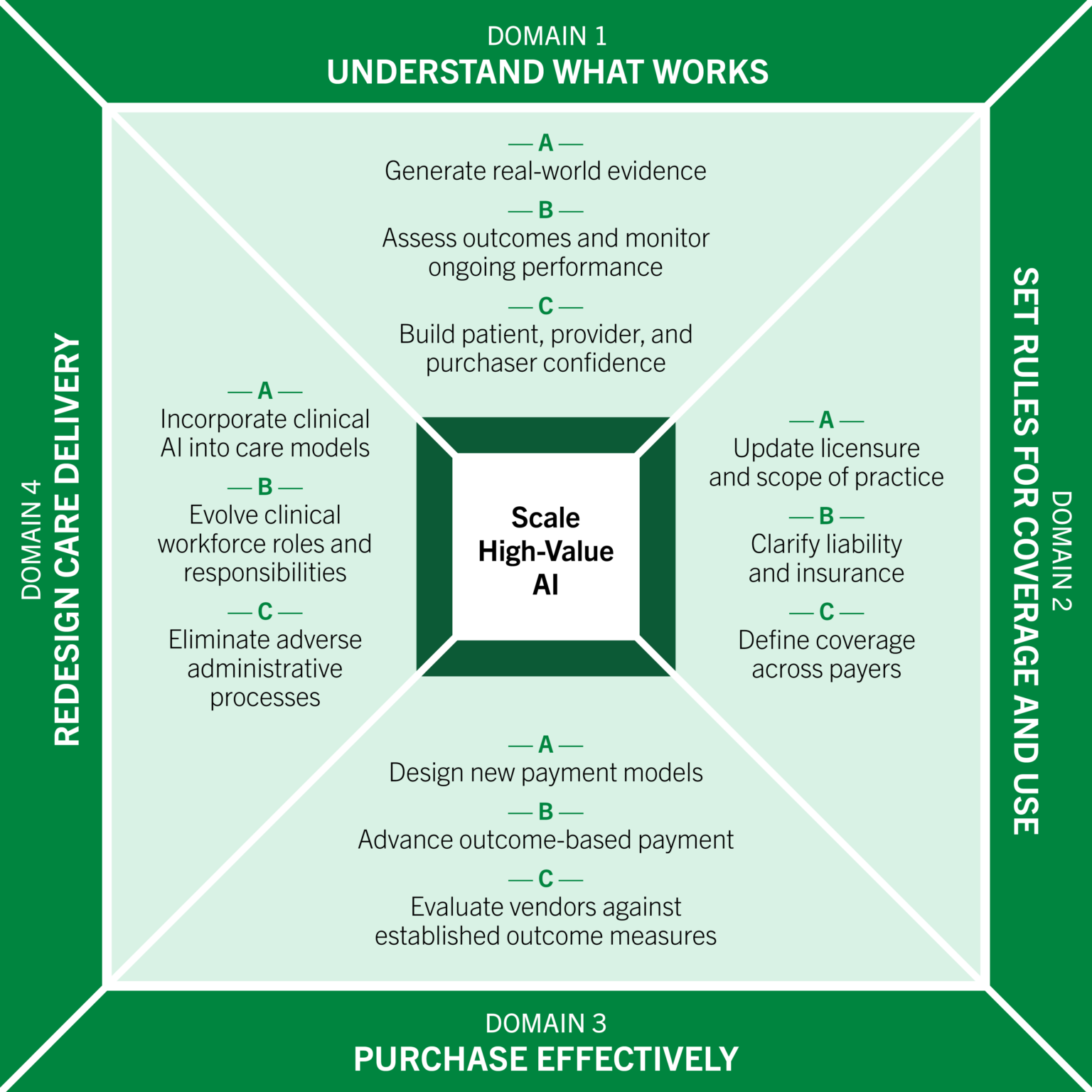
- The Peterson Health Technology Institute (PHTI) released a major national market report, titled Driving Adoption of High-Value AI in Healthcare, authored under the direction of Executive Director Caroline Pearson.
- The report highlights that AI is fundamentally different from prior health technologies because it can perform work that previously required human labor and expertise, with the potential to expand the health system’s capacity to reach undertreated patients.
- Formulates a critical industry warning: while artificial intelligence fundamentally differs from prior health IT by autonomously executing cognitive work previously restricted to human labor, under current fee-for-service incentives, administrative AI is accelerating broken processes, entrenching wasteful administrative friction, and driving inflationary upcoding rather than lowering total healthcare spending.
Automating the Churn: How Fee-for-Service Warped the Algorithmic Promise
The fundamental malfunction does not lie within the neural networks, but in the archaic financial machinery that feeds them. Because the American healthcare economy still overwhelmingly runs on fee-for-service plumbing—where hospital systems get paid for the volume and intensity of discrete transactions rather than keeping people healthy—AI is behaving exactly as free-market incentives dictate. It is automating the churn.
Nowhere is this perversion more visible than in the quiet explosion of ambient scribing and algorithmic coding platforms. While these tools have legitimately lessened the clerical nightmare of keyboard-bound doctors, they have simultaneously handed hospitals an automated revenue pump. PHTI points to recent clinical implementations where deploying an AI scribe in ambulatory and emergency departments generated an immediate 5 percent spike in high-complexity Level 5 visits and a 7 percent jump in Level 4 encounters for established patients, putting an average of $1,004 in extra monthly billing into each doctor’s ledger. Across health networks, claims data reveals an immediate surge in billing intensity the moment an algorithm is switched on.
The Payer-Provider Arms Race: Fighting an Automated War of Attrition
Predictably, the nation’s health plans have not taken this lying down. Faced with what they deem aggressive algorithmic upcoding, commercial insurers have deployed their own defensive algorithms to systematically downcode, audit, and deny hospital claims before human adjusters ever see them.
The result is a Kafkaesque, multi-billion-dollar bot war. In prior authorization—a bureaucratic gatekeeping ritual that already costs the system billions in phone calls and faxes—providers now unleash generative software to automatically compile medical necessity appeals, while payers deploy algorithmic gatekeepers to reject submissions with equal velocity. With procedure rules wildly fragmented across insurers, the automation has solved nothing. It has merely increased the speed and volume of the fighting, leaving human reviewers drowning in automated queues while patients wait in limbo for necessary care. As PHTI executive director Caroline Pearson notes, administrative AI is actively optimizing an adversarial game that drives up system-wide costs without buying a single ounce of better health.
Starved in the Wings: The Tragic Neglect of Autonomous Chronic Care
Meanwhile, the genuine clinical breakthroughs that could fundamentally alter the human condition remain starved of oxygen. Consider the quiet catastrophe of hypertension, an affliction that stalks nearly half of all American adults. Despite the existence of dirt-cheap, highly effective generic medications, three out of four diagnosed patients do not have their blood pressure under control because episodic, fifteen-minute doctor appointments are woefully inadequate for the titration and lifestyle coaching required to tame it.
Clinical AI could easily crack this open. Algorithms are already capable of analyzing continuous biometric data from home cuffs, predicting individual drug responses, and adjusting doses between visits under protocol-driven guardrails. The exact same opportunity exists across behavioral health, where half the nation lives in a shortage area for mental health professionals and purpose-built conversational agents have demonstrated clinically meaningful drops in depression and anxiety.
Yet these tools are financially suffocated because our payment rails require a human clinician’s hands and time to trigger a claim. An autonomous algorithm that monitors twenty thousand hypertensive patients and keeps them out of the cardiac intensive care unit cannot easily bill a fee-for-service code. In a system that bills for activities, an algorithm that quietly prevents an encounter generates zero revenue for a health system, while an ambient scribe that extracts an extra comorbidity code pays for itself on day thirty.
A Blueprint for Sanity: Rewiring Incentives and Liability
To break this self-defeating spiral, PHTI’s blueprint—hammered out alongside hospital executives, top health plans, tech pioneers, and federal regulators at CMS, the FDA, and ARPA-H—argues that policymakers must stop treating healthcare AI like a technological problem and start treating it as a payment design problem.
Reimbursement must decisively shift toward outcome-based payment architectures. PHTI highlights initiatives like the Center for Medicare and Medicaid Innovation’s ACCESS model, launched in mid-2026, which ties compensation to documented clinical endpoints over time rather than encounter volume. When providers are paid to achieve verified blood pressure control or depressive remission, autonomous and assistive AI suddenly becomes an indispensable cost-saving engine rather than an unbillable operational headache.
Crucially, the report insists that payment for AI must be designed dynamically. Because software scales at near-zero marginal cost once deployed, paying standard per-use fees for clinical AI risks triggering an unprecedented wave of inflationary overutilization. Reimbursement rates should start high enough to encourage upfront clinical risk and workflow overhaul, and then ratchet downward as the software scales and unit costs collapse, ensuring the economic dividend of automation flows back to patients, employers, and taxpayers in the form of lower premiums.
At the same time, the regulatory apparatus must catch up with reality. Medical malpractice doctrine and state licensing boards are still predicated on the fiction that an individual doctor makes every clinical choice. As initiatives like the Utah AI regulatory sandbox and the FDA’s TEMPO pilot are proving, the nation urgently needs statutory guardrails that delineate clear liability boundaries when algorithms act autonomously, shielding clinicians from unfair exposure while holding developers accountable for algorithmic drift and bias.
“If thoughtfully deployed, clinical AI tools can close existing care gaps, extend services beyond in-person care, and improve efficiency throughout the system,” said Caroline Pearson, executive director of PHTI. “While this technology has the potential to improve patients’ health, make care more accessible and convenient, and increase affordability, we don’t currently have the systems in place to achieve that vision. We need to develop broadscale changes that enable high-value AI solutions to enter the market and to ensure that the impact and savings they produce benefit patients and families.”