
Category: Digital Health & Technology

  • Hospitals Can No Longer Afford to Manage Revenue Cycle After the Fact

    Hospitals Can No Longer Afford to Manage Revenue Cycle After the Fact

    Hospitals Can No Longer Afford to Manage Revenue Cycle After the Fact
    Noah Breslow, CEO, Revecore

    For years, hospital finance teams have run revenue cycle on a familiar loop: a claim goes out, a claim comes back denied or underpaid, and staff spend the next several weeks working it back. That loop was manageable when denial rates held fairly steady and reimbursement was reasonably predictable. Neither of those things is true anymore, and the gap between how revenue cycle is typically run and what today’s payer environment actually demands is widening fast.

    Denials are climbing, and they are climbing for reasons that have little to do with how hard revenue cycle teams are working. The pressure showing up in the numbers is driven by shifts in payer behavior, patient mix, and administrative complexity that no amount of appeals staffing can fully offset. A reactive model for denials is no longer enough. 

    The Reactive Model Is Running Out of Room

    The numbers make the case on their own. Kodiak Solutions, which benchmarks revenue cycle performance across more than 2,300 hospitals, found that providers on its platform lost more than $48 billion in 2025 to final denials and uncollected patient balances, a 25% increase over 2024. Clinical denials tied to prior authorization and medical necessity accounted for nearly all of that jump, and initial denial rates have now risen for five straight years.

    Experian Health’s 2025 State of Claims survey tells a similar story. Forty-one percent of providers now report denial rates above 10%, a figure that has climbed every year since the survey began in 2022, well past the 5% to 10% range HFMA considers a healthy benchmark.

    Payers have grown faster, more automated, and more willing to deny first and let providers make their case on appeal later. Reactive revenue cycle management was built for a world where denials were infrequent, and that world has disappeared.

    Complexity Is Coming From Every Direction

    Payer mix is a large part of why. Fitch Ratings expects the nonprofit hospital sector to keep shifting toward government payers as the population ages. As more claims run through Medicare and Medicaid, more of a hospital’s revenue becomes subject to rules that change frequently and get enforced unevenly across regions and plans.

    At the same time, prior authorization requirements have tightened across commercial and Medicare Advantage plans, and payers are increasingly relying on automated systems to flag claims before a human ever reviews them. Documentation gaps that used to slide through review now get caught immediately, often before a claim leaves the payer’s system.

    Increased prior authorization requirements and the shifting payer mix (including more Medicare Advantage plans) multiply the places where a claim can be delayed, denied, or underpaid. A process built to react to one denial at a time will not keep pace. 

    The Cost of Fixing Problems After They Happen

    Working a denial after the fact is costly. The American Hospital Association estimates that hospitals spent $43 billion in 2025 simply trying to collect payments insurers already owed them for care that had already been delivered. The average hospital now employs roughly 64 administrative and billing staff, about 6.5% of total hospital employment, largely to manage prior authorization, denials, and repeated documentation requests — staff time that goes toward chasing revenue that should have arrived the first time around.

    Some of that revenue never comes back at all. Claims that go unappealed or unresubmitted become permanent losses rather than delayed ones. Kodiak’s analysis of its top-performing organizations recommends directing more resources toward preventing clinical denials rather than just appealing them after the fact. That shift in orientation only works if an organization can see the patterns behind its denials rather than just the individual claims in front of it.

    What a Proactive Revenue Cycle Actually Looks Like

    Proactive revenue cycle management starts when you look at patterns of claim denials vs. the individual claims themselves. That requires analyzing denials and underpayments at the root cause level, tracing a problem back to the payer, the service line, the documentation gap, or the workflow step that keeps generating it, and fixing that step before claims go out the door instead of fighting each one after it comes back.

    Most revenue cycle teams were not built to operate this way. Treating denial and underpayment data as a feedback loop into clinical documentation, coding, scheduling, and patient access is a different discipline than working a queue of appeals, and it gives finance leaders visibility into where revenue is at risk before it turns into a write-off, rather than after. It also changes what success looks like. Recovered revenue still matters, but the number worth watching more closely is how much denial volume never happens in the first place.

    Revenue Cycle Belongs in the Strategic Conversation

    Hospital leaders can control how quickly their organization identifies the root cause of a reimbursement problem and closes it, regardless of demographic shifts, payer mix, or how aggressively insurers adjudicate claims. With costs rising and margins remaining thin across much of the sector, that capability may be the difference between a hospital making or losing money. Health systems that rapidly detect denial patterns and address root causes through operational improvements are the ones most likely to protect their margins over the next several years. These organizations will hold their footing while others spend the next few years chasing revenue they should have collected the first time.


    About Noah Breslow

    As CEO of Revecore, Noah Breslow brings more than 20 years of executive leadership experience, with a focus on driving growth, innovation, and transformation in complex, highly regulated industries. Most recently, Breslow was a Partner at Bain Capital Ventures (BCV), where he led their portfolio support team, built out data-driven investment tooling, and helped incubate two startups at the forefront of applying AI in the insurance claims processing and wealth management industries.

    Prior to BCV, Breslow served as Chairman and CEO of OnDeck, a pioneering online small business lender, where he built the business from its earliest stages, took it public and ultimately facilitated its acquisition. OnDeck used data and analytics to effectively deliver capital at scale to businesses historically underserved by banks. Earlier in his career, Breslow held leadership roles in product, engineering and marketing. He holds a Bachelor of Science in Computer Science and Engineering from MIT and an MBA from Harvard Business School.



  • Pharma’s Billion-Dollar AI Bets May Be Chasing the Wrong Advantage

    Pharma’s Billion-Dollar AI Bets May Be Chasing the Wrong Advantage

    Pharma's Billion-Dollar AI Bets May Be Chasing the Wrong Advantage
    Shashi Shankar, Co-Founder and CEO, Novellia

    2026 will be remembered as the year pharma went all in on AI.

    Since January, nearly every major pharmaceutical company has announced some version of the same thing. GSK signed a five-year foundation-model deal with Noetik. Eli Lilly built a co-innovation lab with NVIDIA. Merck committed a billion dollars to Google Cloud. This month, Novo Nordisk named Amazon Web Services its preferred AI partner. The dollar figures are staggering. And the messaging has been almost identical across all of them: get access to the right model, the right compute, the right discovery platform, and you’ll win the next decade of drug development.

    Then Q2 earnings calls wrapped, and almost no one could point to a measurable return. A faster trial. A failure caught earlier. A drug that reached folks sooner because of what they’d invested. Executives talked about pilots and roadmaps. The announcements are loud but the silence on results is the real story.

    I get why these deals get announced the way they do. The models are really incredible. But when everyone has access to roughly the same model capability, the model stops being an advantage. It becomes table stakes, like electricity. Nobody wins on having electricity. They win on what they build with it.

    A lot of the conversation this year has moved toward the discovery platform or the algorithm on top of the model as the real differentiator. That’s closer. But I’d push it one level further. The real edge is the data the platform is trained and run on. A world-class algorithm trained on incomplete, fragmented, clinically thin data will still give you incomplete, fragmented, thin answers. That’s the layer none of these mega-deals have actually touched.

    To understand why, think about what it actually looks like when a real person tries to navigate serious illness in this country.

    Take someone managing a rare condition who sees six different specialists over four years. Her rheumatologist is in one system. Her neurologist is in another. Two of her earlier records exist at  community clinics she stopped going to. By the time anyone tries to assemble a complete picture of what’s happened to her, half the story is missing or inaccessible. And she’s one of the simpler cases.

    The US has no unique patient identifier. Providers have little regulatory incentive to share records across systems. A single person’s health history can be scattered across every hospital, lab, specialist, and health system they’ve ever seen. Insurance coverage varies by state and plan. Hospitals and their clinics inside the same health system often run on different EHR platforms that don’t talk to each other. Nobody has a complete picture of the folks these drugs are actually designed to serve.

    Claims-based real-world data, the first data type I ever worked with as an intern at Genentech well over a decade ago, are still the primary input for most pharma real-world evidence work and inherit all of that fragmentation. Claims were designed for billing. They can tell you a treatment happened. They can’t tell you what led to it or why. The clinical context lives in physician notes, which are unstructured, inconsistent, and scattered across decades of care. Basic social factors like housing, income, and smoking status are frequently missing. Seventy-eight percent of health organizations say they can’t even locate social-determinant data in a patient’s record after it’s been collected.

    Clinical trials are rigorous by design, and that rigor is also what limits them. They’re built around selected populations, defined observation windows, and specific endpoints. A person enrolled in a six-month trial doesn’t stop being a patient after month six. They get new conditions. They switch doctors. They move. With many rare diseases, patients might see seven different physicians before anyone lands on the right diagnosis. None of that shows up in a trial dataset. Most of it doesn’t show up cleanly in claims either.

    The folks who are hardest to capture accurately in current datasets are usually the people a drug needs to work for the most. Complex conditions. Multiple diagnoses. Long, difficult care journeys. That’s where the data falls shortest, and that’s where the AI answers will be weakest.

    I spent over a decade inside biopharma. I watched incredibly talented teams work hard with an incomplete picture of the people they were trying to help. That gap was always there. What’s new is the scale of investment now being built on top of it.

    The next real competitive edge in this industry will come from the less glamorous work of actually fixing the data. Connecting fragmented records. Capturing the clinical detail sitting in unstructured notes. Building datasets that reflect the full reality of the folks who will rely on a new medicine to save their lives, including the ones that don’t fit neatly into a trial population.

    That work is harder to announce. It doesn’t generate the same headlines. It’s also what determines whether these AI investments eventually deliver.

    The only thread that runs through every part of the care journey is the patient. Every physician visit, every lab, every specialist, every prescription. When you stitch the data around that reality, with the patient’s knowledge and consent, the fragmentation starts to resolve itself. That’s a fundamentally different starting point than what most of the industry is working from today.

    There are real people on the other side of this. A father whose daughter just got a life-changing diagnosis that should have come four years earlier, and has to reckon with what those four years might have cost her. A family sitting in a waiting room, wondering whether the new drug their mom just started is actually working. These are the people whose care journeys are scattered across systems. Getting the data piece right is how the industry actually reaches them, in time, with the right answer.

    About Shashi Shankar

    Shashi Shankar is Co-Founder and CEO of Novellia. He spent over a decade at Genentech and Roche in medical affairs, health economics, and digital health innovation.


  • STAT+: The startup chasing ‘general biological intelligence’

    STAT+: The startup chasing ‘general biological intelligence’

    Brittany Trang, Ph.D., covers AI in health and medicine: Does it actually work? Who benefits, or might be harmed? She writes the weekly AI Prognosis newsletter. Follow her on Threads, Mastodon, and Bluesky. You can reach Brittany on Signal at btrang.01.

    This is the web edition of STAT’s AI Prognosis newsletter, our guide to artificial intelligence in health care and medicine. Sign up to get it delivered in your inbox every Wednesday. 

    Today is the first day of the STAT Summit in Boston! If you’re not attending in person (tickets for tomorrow are still available!), you can tune in virtually. Subscribers get a 40% discount on both virtual and in-person tickets.

    I’m looking forward to “When the Promise of AI Doesn’t Pan Out,” which is scheduled for just after noon ET today, and STAT executive editor Rick Berke’s interview with Katelyn Jetelina, better known as “Your Local Epidemiologist,” whom I’m still starstruck by. 

    STAT+ Exclusive Story

    Already have an account? Log in

    STAT+

    STAT+

    This article is exclusive to STAT+ subscribers

    Unlock this article — plus in-depth analysis, newsletters, premium events, and news alerts.

    Already have an account? Log in

    View All Plans

    To read the rest of this story subscribe to STAT+.

    Subscribe

  • FDA Launches Rare Disease Framework Initiative to Modernize Small-Cohort Trial Design

    FDA Launches Rare Disease Framework Initiative to Modernize Small-Cohort Trial Design

    FDA Announces Real-Time Clinical Trial Pilot Program and Proof-of-Concept Studies with AstraZeneca and Amgen

    What You Should Know

    • The U.S. Food and Drug Administration (FDA), an operating division of the U.S. Department of Health and Human Services (HHS), officially announced the launch of the Rare Disease Framework Initiative.
    • Accompanied by the publication of a new agency white paper outlining a “fit-for-purpose” regulatory model engineered to match trial requirements to the realistic evidentiary constraints of ultra-small, geographically dispersed patient populations.
    • Addresses a critical clinical deficit across orphan therapeutics: although an estimated 7,000 to 10,000 distinct rare diseases affect more than 30 million Americans, only approximately 5% currently possess an FDA-approved treatment.
    • The initiative is coordinated across agency divisions by the FDA’s Rare Disease Innovation Hub, operating in formal partnership with the Office of the Commissioner, the Center for Drug Evaluation and Research (CDER), and the Center for Biologics Evaluation and Research (CBER).

    The Five Percent Dilemma

    The initiative comes at a critical inflection point for biotechnology. Over four decades since the passage of the landmark Orphan Drug Act of 1983, regulatory flexibility and market incentives have spurred life-saving gene therapies, enzyme replacements, and targeted biologics. Yet the sheer scale of unmet medical need remains staggering: roughly 95 percent of all identified rare conditions still lack a single FDA-approved therapy.

    For families navigating ultra-rare genetic mutations, the agonizingly slow pace of drug development is compounded by regulatory unpredictability. Promising therapies often stall during late-stage reviews when sponsors struggle to demonstrate statistical significance using conventional clinical endpoints, or when chemistry, manufacturing, and controls requirements designed for mass-market pills prove ill-suited to custom, patient-derived cell therapies.

    The FDA’s new framework seeks to realign that process with the statistical realities of micro-populations. Under the initiative, the agency will evaluate therapeutics through customized evidentiary lenses, factoring in the biological nuances of each disease, the natural history of progression, and novel Bayesian trial designs that can extract statistically valid efficacy signals from just a handful of trial participants.

    A New Architecture at White Oak

    Central to the rollout is the newly established Rare Disease Innovation Hub, a cross-cutting regulatory entity designed to break down bureaucratic silos across the FDA’s two primary review divisions: the Center for Drug Evaluation and Research (CDER) and the Center for Biologics Evaluation and Research (CBER).

    Historically, developers targeting the same rare disorder with different therapeutic modalities—such as a small-molecule drug handled by CDER versus an adeno-associated virus gene therapy overseen by CBER—could face drastically divergent evidentiary demands and conflicting reviewer cultures. The Hub, directed by rare disease veteran Amy Comstock Rick, will serve as a single point of operational alignment, ensuring sponsors receive consistent guidance regardless of whether their product is a pill, an antibody, or an individualized genetic edit.

    Agency leadership signaled that the transformation will reach beyond clinical trials into manufacturing and post-market surveillance. The agency has committed to applying risk-based models to pre-approval inspections and chemistry standards, preventing regulatory bottlenecks from indefinitely delaying life-saving batches of customized treatments. In parallel, the framework plans to formalize patient and caregiver testimony directly into milestone review meetings, treating lived experience as structured qualitative data rather than a ceremonial addendum.

    A Crucible for the Future of Medicine

    To begin shaping the detailed regulations, revised guidances, and internal reviewer training modules, the FDA will convene a major public stakeholder summit on October 28 at its White Oak headquarters in Silver Spring, Maryland, facilitated by the Reagan-Udall Foundation. The hearing will bring together patient advocacy coalitions, academic geneticists, venture-backed biotechnology executives, and federal reviewers for the first of several sector-specific roundtables.

    Reader Interactions

  • Verily Health Awarded CDC Contract for National Wastewater Surveillance System: Scaling Genomic and Metagenomic Public Health Analytics

    Verily Health Awarded CDC Contract for National Wastewater Surveillance System: Scaling Genomic and Metagenomic Public Health Analytics

    Verily and Vanderbilt Extend Partnership to Power NIH's All of Us Researcher Workbench

    What You Should Know

    • Healthcare data intelligence leader Verily Health Inc. has been awarded a multi-year contract renewal by the Centers for Disease Control and Prevention (CDC) to continue operating and expanding the National Wastewater Surveillance System (NWSS).
    • Builds on a four-year operational foundation: the contract extension expands the public health surveillance partnership Verily has maintained with the CDC since 2023.
    • Delivered through Verily Sightline, the company’s specialized public health platform that unifies wastewater epidemiology, high-throughput molecular laboratory testing, bioinformatic data analytics, and software infrastructure to monitor population-level infectious disease transmission trends.
    • Introduces advanced genomic capabilities: the expanded CDC program will support continuous pathogen detection, targeted viral and bacterial genomic sequencing, and the incorporation of potential metagenomic surveillance capabilities to detect novel and emerging pathogens before they appear in clinical settings.

    Core Program Architecture: Verily Sightline & Expanded Metagenomics

    Under the renewed CDC mandate, Verily combines physical laboratory pipelines with population-level health informatics to track infectious disease dynamics:

    • End-to-End Operational Pipeline: Verily Sightline integrates sample intake from municipal wastewater treatment facilities, high-throughput biospecimen processing, quantitative PCR assays, and automated cloud data pipelines that feed actionable epidemiological intelligence directly into CDC reporting dashboards.
    • Pathogen-Specific Assays: Continues routine monitoring for established respiratory and gastrointestinal pathogens, including SARS-CoV-2, Influenza A/B, and Respiratory Syncytial Virus (RSV), alongside flexible surge testing for emerging zoonotic threats such as avian influenza (H5N1).
    • Genomic Sequencing & Variant Tracking: Performs high-density genomic sequencing to track lineage mutations, detect novel viral variants, and monitor antimicrobial resistance (AMR) markers before they appear in clinical hospital isolates.
    • Metagenomic Surveillance Expansion: Integrates prospective metagenomic next-generation sequencing (mNGS) capabilities. Metagenomic testing analyzes total genetic material in a wastewater sample without requiring pre-designed targeted primers, equipping public health officials with an unbiased discovery tool to identify previously uncharacterized or novel biological threats.

    “We’re proud to continue our work with the CDC on a program that strengthens national public health surveillance,” said Stephen Gillett, Chairman and CEO of Verily Health. “At Verily Health, we are building the data foundation for the future of healthcare intelligence, bringing together complex health data, scientific expertise, and advanced analytics to generate actionable insights that accelerate research and improve healthcare.”

    Reader Interactions

  • STAT+: Lobbyists and trade groups fight to shape how states regulate medical AI

    STAT+: Lobbyists and trade groups fight to shape how states regulate medical AI

    Influential lobbying groups for doctors and hospitals, a health insurer, technology companies, and representatives from state governments met behind closed doors in Washington, D.C., in early October to develop guidelines for how to regulate artificial intelligence in the practice of medicine.

    Executives from the American Medical Association, American Hospital Association, artificial intelligence giant Anthropic, and insurer Elevance Health are part of a 22 member AI workgroup convened by the Federation of State Medical Boards, or FSMB, a national organization that advocates for state boards. A spokesman said the workgroup “was built to balance expertise across medical regulation, AI development, care delivery, academic medicine, state AI policy, and patient safety,” and that its recommendations would be open for feedback before being formally adopted.

    The discussions within workgroup meetings are being kept confidential, but the goal is to draft guidelines to aid local medical boards, with “particular attention … to AI tools that perform clinical functions with limited or no direct physician supervision,” Humayun Chaudhry, the FSMB’s president and CEO, told STAT. A draft of the recommendations could be made public in “weeks to months,” said Chaudhry. They could ultimately form the basis of legislation in states, which individually regulate medical licensure and the practice of medicine.

    STAT+ Exclusive Story

    Already have an account? Log in

    STAT+

    STAT+

    This article is exclusive to STAT+ subscribers

    Unlock this article — and get additional analysis of the technologies disrupting health care — by subscribing to STAT+.

    Already have an account? Log in

    View All Plans

    To read the rest of this story subscribe to STAT+.

    Subscribe

  • Agilent to Acquire Proscia for Up to $270M to Build Scientific Intelligence Layer in Digital Pathology

    Agilent to Acquire Proscia for Up to $270M to Build Scientific Intelligence Layer in Digital Pathology

    Agilent to Acquire Proscia for Up to $270M to Build Scientific Intelligence Layer in Digital Pathology

    What You Should Know

    • Analytical and clinical laboratory technology giant Agilent Technologies Inc. announced that it has entered into a definitive agreement to acquire digital pathology software and AI company Proscia®.
    • Transaction financial terms: an all-cash acquisition valued at $240M in cash at closing, plus up to an additional $30M contingent on achieving future operational and financial performance milestones (total potential deal value of $270M).
    • Closes the loop on a four-year commercial partnership: Agilent and Proscia originally entered into a multi-year global distribution agreement in September 2022 to co-market an open digital diagnostic pathology ecosystem.
    • Unifies an end-to-end precision medicine triad: merges Agilent’s established portfolio of automated slide stainers, pathology instrumentation, diagnostic reagents, and companion diagnostics (CDx) with Proscia’s vendor-agnostic enterprise software platform, Concentriq®, which serves as an operational orchestration layer across scanners, LIS networks, and AI algorithms.

    Assembling the Full Pathology Stack

    By acquiring Proscia, Agilent secures the missing software operating system. Instead of selling discrete instruments and reagents, Agilent can now deliver an end-to-end ecosystem: tissue preparation reagents, automated staining instrumentation, vendor-neutral whole-slide ingestion, and regulatory-cleared diagnostic software.

    Agilent and Proscia originally entered into a multi-year global distribution agreement in September 2022 to co-develop and sell integrated diagnostic pathology workflows. Acquiring Proscia transitions an external commercial alliance into an owned intellectual property core.

    Agilent is a primary diagnostic partner for global pharma, co-developing FDA-approved companion diagnostic tests that determine patient eligibility for targeted cancer immunotherapies. Integrating Concentriq gives Agilent a direct digital data conduit into 16 of the top 20 biopharmas, creating an R&D feedback loop that unites prospective biomarker discovery with downstream clinical commercialization.


    Transaction Economics & Target Operating Benchmarks

    The acquisition brings a high-margin, recurring-revenue software foundation into Agilent’s diagnostic portfolio:

    • Valuation Multiple & Purchase Price: Agilent is deploying $240M in cash at closing plus up to $30M in earnouts against Proscia’s trailing twelve months (TTM) revenue exceeding $18M —representing an upfront enterprise value-to-revenue multiple of approximately 13.3x (expanding to 15.0x including full earnouts), reflecting high market demand for enterprise software operating layers in diagnostics.
    • Commercial Scale and Penetration: Proscia’s platform—anchored by its flagship Concentriq® software—is deployed across more than 4,000 laboratories, hospital systems, and clinics across North America and Europe.
    • Top-Tier Biopharma Validation: Proscia software currently supports translational research and trial operations for 16 of the top 20 global pharmaceutical companies.
    • Clinical Performance Benchmarks: Proscia earned 2026 Best in KLAS for Digital Pathology (securing the highest vendor performance score across both U.S. and European markets) and holds U.S. FDA 510(k) clearance for primary clinical diagnosis.

    “Digital pathology is quickly becoming the foundation for pathology data generation, analysis, and application across biopharmaceutical research, clinical development, and diagnostics, and our acquisition of Proscia meaningfully expands our presence in this fast-growing market,” said Padraig McDonnell, President and CEO of Agilent. “The acquisition establishes an Agilent platform for scientific intelligence in tissue-based precision medicine, connecting data generation with AI-based interpretation in a workflow that supports biomarker research through routine clinical use. With Proscia’s leading platform and talented team, we will be better equipped to help laboratories and biopharma customers manage and derive insights from pathology data.”

    Reader Interactions

  • Brellium Raises $23M and Launches CortexLM with a Financial Guarantee Against Payer Clawbacks

    Brellium Raises $23M and Launches CortexLM with a Financial Guarantee Against Payer Clawbacks

    Readily Secures $11M for AI-Native Compliance Platform for Healthcare

    What You Should Know

    • Healthcare clinical compliance and revenue integrity platform Brellium raises $23M in venture financing, co-led by Left Lane Capital and First Round Capital, with participation from Digital Health Venture Partners (and prior backing from Menlo Ventures).
    • Directly tackles the escalating “healthcare bot war” over claims adjudication and post-payment clawbacks, positioning itself as a shared, objective standard between healthcare providers and health insurance payers rather than fueling unilateral AI-to-AI disputes.
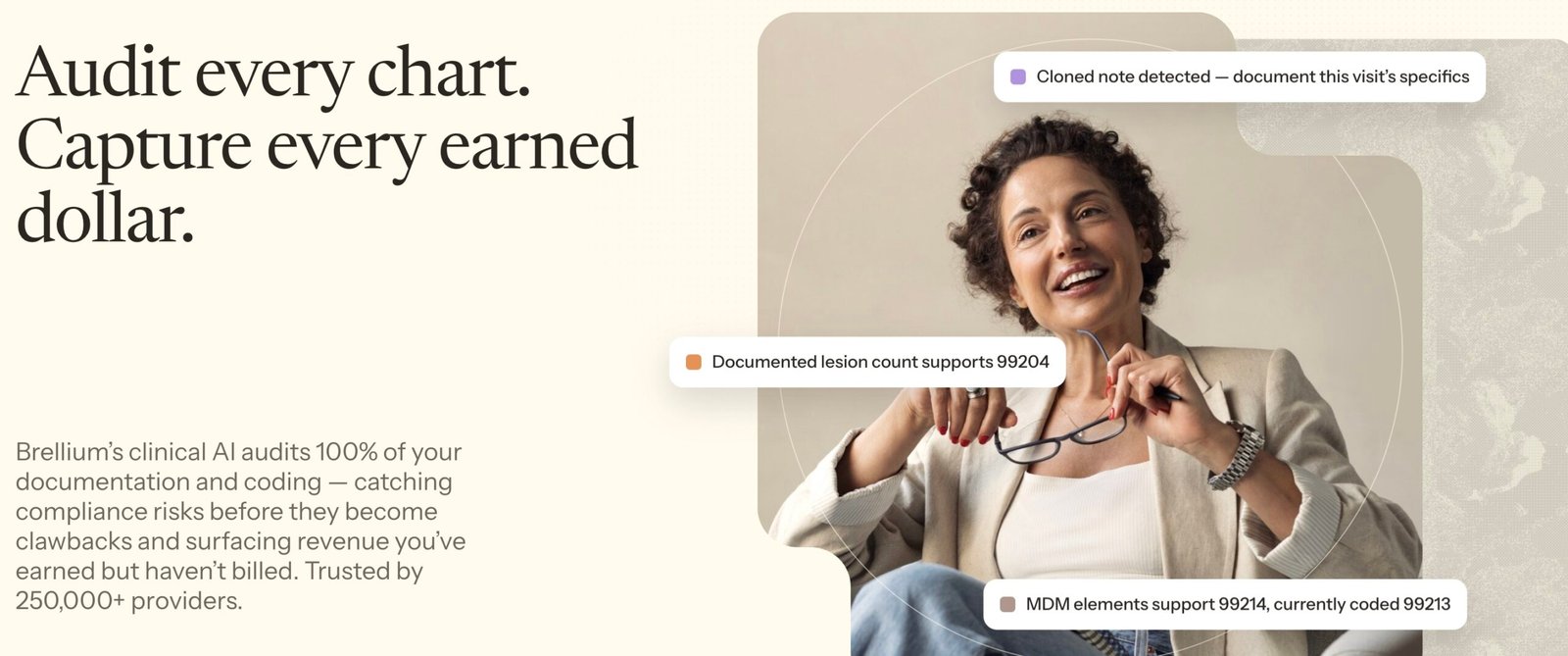
    • Unveiled CortexLM, Brellium’s proprietary machine-learning architecture engineered to review and audit 100% of patient notes before billing, flagging care gaps, coding inconsistencies, and compliance errors, and proposing specific documentation remediations calibrated to specialty, payer, and regulatory guidelines.

    Technical Architecture: CortexLM and Pre-Bill Chart Correction

    CortexLM transitions clinical chart auditing from retrospective damage control to proactive, pre-submission revenue integrity. Rather than relying on random statistical spot-checks, CortexLM reads and analyzes 100% of individual patient notes across a practice. The model evaluates chart documentation against specialty-specific clinical practice parameters, individual commercial payer medical policies, CMS billing regulations, and quality reporting criteria.

    By operating prior to billing, the system identifies diagnostic inconsistencies, missing documentation components, coding gaps, and non-compliant phrasing before claims are submitted to clearinghouses or payers. CortexLM then proposes specific clinical documentation fixes to treating providers while encounters are fresh. In addition to mitigating clawback exposure, the system audits for legitimate clinical complexity and documentation integrity, uncovering billable services and comorbidities that providers delivered but omitted from final claim drops.


    Enterprise Footprint and Proven Operational Benchmarks

    Brellium has achieved national enterprise penetration across multi-specialty medical groups, home health systems, and high-volume behavioral health networks. The platform is currently trusted by more than 215,000 clinicians across 200 provider groups operating in all 50 U.S. states. To date, Brellium has processed and audited more than 22 million patient visits, protecting nearly $2 billion in provider revenue from post-payment recoupments, payer clawbacks, and audit penalties.

    Enterprise customers include national home health and post-acute providers Gentiva and Maxim Healthcare, as well as scaled behavioral health networks Headspace and Rula. At Headspace, adopting Brellium enabled the organization to scale its clinical quality assurance coverage from auditing two percent of therapy notes to 100%, driving provider compliance with clinical documentation standards to 99.2%.


    The Brellium Audit Guarantee

    The defining commercial innovation of Brellium’s model is its financial guarantee. If CMS, a Medicare Administrative Contractor, or a private commercial health plan audits a chart and issues a financial clawback or penalty on a visit that Brellium previously reviewed and cleared, Brellium foots the bill instead of the provider.

    This structure directly tackles the primary liability barrier identified in the Bessemer and Bain 2026 Healthcare AI ROI Scorecard, which noted that clinicians and provider organizations routinely avoid scaling AI because they bear full medico-legal and financial liability for algorithmic outputs. By putting its own balance sheet behind its algorithmic auditing engine, Brellium removes the liability defense used by risk-averse CFOs and compliance committees, elevating its software from a passive documentation tool to an insurable standard of truth.


    Expansion Roadmap: Deepening Revenue Cycle and High-Stakes Specialties

    The $23M capital raise will be deployed to broaden clinical coverage and deepen billing integration. Brellium is scaling beyond its foundational footprint in behavioral health and home care into high-complexity, high-dollar specialties heavily targeted by Recovery Audit Contractors, including cardiology, interventional pain management, and value-based primary care.

    Operationally, the company is deepening bi-directional integrations with practice management and EHR billing engines to automate coding validation, modifier application, and pre-claim clearinghouse handoffs. Brellium is also expanding conversations with health plans to position CortexLM as a shared, objective pre-payment validation layer, enabling auto-adjudication and clean-claim passes that eliminate post-payment audit friction entirely.

    “Providers and payers have been stuck fighting the same fraud, waste and abuse problem from opposite sides of the table for years,” said Zach Rosen, Co-Founder and CEO of Brellium. “CortexLM is how we get everyone working from the same standard, so providers can prove the care was right the first time, instead of spending months untangling it after the fact.”

  • Readily Secures $11M for AI-Native Compliance Platform for Healthcare

    Readily Secures $11M for AI-Native Compliance Platform for Healthcare

    Readily Secures $11M for AI-Native Compliance Platform for Healthcare

    What You Should Know

    • Healthcare AI compliance and enterprise oversight platform Readily announced an $11M Series A funding round led by Define Ventures, with participation from Y Combinator and the California Health Care Foundation Innovation Fund.
    • Closes the operational execution gap in healthcare compliance: while traditional legal and regulatory tools alert organizations when a state or federal mandate changes, Readily connects regulatory text directly to internal health plan policies, assigns remediation tasks to accountable teams, monitors operational workflows, and compiles audit-ready evidence.
    • Readily supports health plans and risk-bearing healthcare organizations managing more than 25 million covered lives across 46 states (including key markets in California, Florida, Michigan, New York, and Texas).

    Connecting Mandates to Operational Follow-Through

    Readily operates as a centralized regulatory intelligence layer, bridging the divide between external regulatory text and internal operational execution. Readily scans and parses federal registers, state administrative updates, and Medicaid plan letters in real time, automatically mapping statutory changes to affected internal policies, member benefit grids, and vendor contracts.

    Key features include: 

    Automated Redlining and Policy Drafting: Generates redlined policy revisions and updated procedure language that align with newly enacted rules, reducing manual legal and policy review cycles from weeks to minutes.

    Workflow Accountability & Task Orchestration: Assigns operational updates directly to business unit owners (e.g., claims configuration, utilization management, network contracting) and tracks completion status across teams, eliminating blind spots where policy changes fail to reach frontline workflows.

    Continuous Audit Evidence Compilation: Automatically aggregates required universes, correlates operational actions with statutory requirements, and compiles auditable evidence packages—allowing health plans to defend their compliance posture during CMS or state audits in seconds rather than spending months retrieving files.

    Human-in-the-Loop Governance: Keeps qualified compliance, operational, and legal leaders accountable for final sign-off, ensuring that algorithmic analysis augments human oversight without displacing professional legal judgment.


    Commercial Footprint and Customer Density

    Readily has achieved rapid enterprise penetration across the U.S. managed care ecosystem:

    • Covered Lives Under Management: The platform supports health plans and risk-bearing healthcare organizations responsible for more than 25 million covered lives across 46 states (with major density across California, Florida, Michigan, New York, and Texas).
    • Enterprise Payer Client Base: Deployed across national commercial carriers, Medicare Advantage organizations, and regional managed Medicaid plans.
    • Anchor Health Plan Validation: Live in production with L.A. Care Health Plan, the nation’s largest publicly operated health plan (serving over 2.9 million members).

    Reader Interactions

  • Diverge Health Merges with Medical Home Network: Creating a Premier Value-Based Care Platform for Underserved Communities

    Diverge Health Merges with Medical Home Network: Creating a Premier Value-Based Care Platform for Underserved Communities

    What You Should Know

    • Diverge Health and Medical Home Network (MHN) PBC announced a definitive merger agreement to form one of the nation’s largest value-based care platforms dedicated entirely to safety-net populations and under-resourced communities.
    • The combination establishes one of the largest value-based care platforms in the United States dedicated to underserved communities, entering 2027 with nearly 500,000 attributed Medicaid and Medicare lives and $3 billion in managed medical spend across nine states.

    The 500k-Member Cohort, Embedded Community Teams, and AI-Driven Care Plans

    The merger of Diverge Health and Medical Home Network brings together complementary operational, technical, and clinical models tailored to safety-net healthcare:

    • Unifying FQHC Networks and Independent Primary Care: Bridges two distinct provider segments that historically operated in silos. While MHN brings more than 15 years of experience managing FQHC networks—having launched one of the nation’s earliest and most successful community health center Medicaid ACOs—Diverge Health brings a proven track record partnering with independent primary care physicians. Entering 2027, the combined entity connects nearly 100 FQHCs and more than 300 independent practices, supported by over 20 payer contracts across nine states.
    • Demonstrated Actuarial and Engagement Outcomes: Backed by real-world performance metrics. In commercial payer deployments, Diverge’s model delivered a 2% net reduction in population-level Medical Loss Ratio (MLR) alongside a 6% increase in patient primary care visits in 2025, proving that proactive field outreach directly improves quality metrics and keeps patients anchored in primary care rather than emergency rooms.
    • Embedded Field Teams for Whole-Person Care: Solves the staffing bottleneck that constrains community clinics. Rather than demanding that clinic doctors manage non-clinical social needs, the platform embeds multidisciplinary community health teams directly alongside partner practices. These teams address behavioral health barriers, arrange transportation, coordinate social services, and engage disconnected patients in their homes and neighborhoods.
    • Proprietary Risk Modeling and Automated Care Planning: Modernizes the data input layer for complex patient populations. Diverge’s machine learning infrastructure ingests multi-source data—including clinical EHR records, Medicaid encounter data, and community social vulnerability indices—to identify “rising-risk” patients before an acute crisis occurs. The system automatically drafts customized, actionable care plans, placing them directly into the hands of local care coordinators to streamline field interventions.

    Executive Leadership

    Binoy Bhansali leads the combined organization as CEO of Diverge Health, with Cheryl Lulias serving as Co-Founder and President of MHN PBC. The platform is backed by prominent healthcare venture capital and growth equity firms, with Oak HC/FT joining the board of directors alongside Triple Aim Partners and GV (Google Ventures).

    “Value-based care is notoriously hard, especially in Medicaid, but strengthening our country’s primary care backbone and supporting their patients to live their healthiest lives is a moral imperative,” said Binoy Bhansali, CEO and Co-Founder of Diverge Health. “Together, we are proving that succeeding in value-based care is very much possible if you support these practices with the right infrastructure, community health teams, and data.”

    Reader Interactions