Author: admin

  • NIH Announces New Transformative Research Award Program for ALS

    NIH Announces New Transformative Research Award Program for ALS

    Wednesday, June 17, 2020

    NIH announces new Transformative Research Award program for ALS

    The National Institutes of Health plans to invest $25 million over five years in a new program to spur innovative research on amyotrophic lateral sclerosis (ALS), a progressive and fatal neurological disease that weakens and eventually paralyzes voluntary muscles. Accelerating Leading-edge Science in ALS (ALS2) aims to answer critical questions about this disease.

    “Over the past few decades, there has been significant progress in our understanding of ALS, but we still do not have any breakthrough treatments for this terrible disease,” said NIH Director Francis S. Collins, M.D., Ph.D. “We hope this program will inject new ideas to the field to push us rapidly toward effective therapies.”

    Sometimes known as Lou Gehrig’s disease, ALS is a neurodegenerative disease that affects motor neurons in the spinal cord that control voluntary muscles. For reasons that are currently unknown, the motor neurons die off, resulting in progressive muscle weakness that usually leads to respiratory failure. ALS is virtually always fatal, and many people die within three to five years of developing symptoms.

    There is no cure for ALS. The U.S. Food and Drug Administration-approved drugs riluzole and edaravone can prolong life by a few months but do not improve symptoms. Ongoing clinical trials are looking at a range of therapeutic strategies including new drug candidates, devices to improve quality of life, and stem cell therapies. Genetic research has recently provided clues to understanding the disease, but it will take a focused investment in research from a range of scientific disciplines in order to capitalize on these insights.

    ALS2 will be part of the NIH Common Fund’s High-Risk, High-Reward (HRHR) research program. The four initiatives of the HRHR program are a time-tested, powerful approach to sparking innovation. They support exceptionally creative research, which is inherently riskier, but has the potential to transform biomedical science. NIH will apply this potential to ALS2 through the HRHR program’s Transformative Research Award initiative. The Transformative Research Award is particularly well-suited to interdisciplinary teams of scientists looking to combine their expertise and pursue new ideas with the potential to transform ALS research.

    ALS2 will take a three-pronged approach to improve understanding of ALS:

    • Adapt emerging tools and technologies from neuroscience and cell biology to identify what causes ALS at the molecular level, and how the disease progresses, leading to new therapeutic strategies.
    • Attract new talent from a range of scientific disciplines, including neuroscience, cell biology, bioengineering, genomics, chemistry, biophysics, environmental health sciences, and computational science.
    • Examine biological similarities between ALS and motor neuron disease in other neurodegenerative disorders, including frontotemporal dementia, chronic traumatic encephalopathy, Kennedy’s disease, spinal muscular atrophy, and primary lateral sclerosis.

    Information on a Notice of Special Interest to accompany the Transformative Research Award funding opportunity will be posted here: https://commonfund.nih.gov/tra/grants.

    This initiative is managed collaboratively by the NIH Common Fund, the National Institute of Neurological Disorders and Stroke, the National Institute on Aging, the National Institute of Environmental Health Sciences, and the National Institute of General Medical Sciences.

    About the National Institutes of Health (NIH): NIH, the nation’s medical research agency, includes 27 Institutes and Centers and is a component of the U.S. Department of Health and Human Services. NIH is the primary federal agency conducting and supporting basic, clinical, and translational medical research, and is investigating the causes, treatments, and cures for both common and rare diseases. For more information about NIH and its programs, visit www.nih.gov.

    NIH…Turning Discovery Into Health®

    https://commonfund.nih.gov/highrisk/tra/als2

    https://www.ninds.nih.gov/Disorders/All-Disorders/Amyotrophic-Lateral-Sclerosis-ALS-Information-Page


    Institute/Center

    Contact

  • NIH Names Rick Woychik Director of the National Institute of Environmental Health Sciences

    NIH Names Rick Woychik Director of the National Institute of Environmental Health Sciences

    National Institutes of Health Director Francis S. Collins, M.D., Ph.D., has appointed Richard (Rick) P. Woychik, Ph.D., as director of NIH’s National Institute of Environmental Health Sciences (NIEHS), Research Triangle Park, North Carolina. Dr. Woychik served as acting director of the NIEHS since October 2019 and officially began his new role as the NIEHS director on June 7, 2020. NIEHS conducts and supports environmental health sciences in alignment with real-world public health needs and translates scientific findings into knowledge that can inform real-life individual and public health outcomes.

    “Innovation has been a hallmark of Rick’s scientific career and it’s at the center of his vision for leading NIEHS,” said Dr. Collins. “He will be working to support new technologies and scientific approaches throughout the field of environmental health sciences – applying his proven skills in scientific excellence, creativity, and rigor to improving public health.”

    Woychik is highly respected for a long list of accomplishments in mammalian genetics and environmental epigenetics. His laboratory was the first to identify a gene associated with polycystic kidney disease, the first to connect a protocadherin gene ultimately linked to hearing loss in Cushing’s disease patients, and the first to clone an obesity-related gene called agouti. Dr. Woychik says his passion for epigenetics and environmental health sciences started when his research group discovered that the obesity trait associated with one of the agouti mutant mouse lines was influenced by the epigenome during embryonic development.

    “Individuals, with their unique biological make-up, respond to the environment in different ways. Our current research strategies mostly employ a ‘one size fits all’ approach that does not factor in this critically important variable,” Dr. Woychik explained. “My vision is to deal with the individual genetic, epigenetic and biological variability in the establishment of research strategies for studying public health and environmental toxicology.”

    Addressing environmental and genetic factors that contribute to health of the individual is generally referred to as precision medicine. This is a major focus at NIH, especially through the All of Us Research Program. Dr. Woychik will work closely with the All of Us leadership to contribute NIEHS research on environmental exposures toward this landmark program.

    Dr. Woychik earned his Ph.D. in molecular biology in 1984 from Case Western Reserve University in Cleveland. He moved into the field of molecular genetics during his postdoctoral training in Philip Leder’s laboratory in the Department of Genetics at Harvard Medical School, Boston.

    Woychik initially joined NIEHS in 2011 as deputy director. He successfully led the institute’s strategic planning exercises and guided implementation of the plans across a broad range of scientific disciplines. While his own expertise is as a basic scientist conducting genetic and epigenetic experiments to study the influence of the environment, as deputy director and acting director of the institute he interacted with investigators conducting a broad range of environmental health science research. With this experience, he brings a wealth of in-depth knowledge relating to the many disciplines of science that are necessary to lead environmental health science research. Prior to NIEHS, Woychik served nearly 10 years as the President and CEO of The Jackson Laboratory, Bar Harbor, Maine, where he oversaw seven major building projects in Maine and California, enhanced the organization’s focus on basic mechanistic research in model organisms with a focus on translation to human health and disease, established the Genetics Resource Science division, and oversaw a major realignment of the nonprofit business unit to substantially improve efficiency and outreach to the global biomedical community.

    “I’ve always conducted my research in a highly collaborative manner, and I’ve reached out to investigators with expertise different and complementary to my own,” Dr. Woychik said. “This is a paradigm that I have also embraced as a science administrator and I plan to do the same as director of NIEHS.”

    As NIEHS director, Woychik also inherits the additional responsibility as director of the National Toxicology Program (NTP). The NTP is a federal, inter-agency program that reports directly into the U.S. Department of Health and Human Services. Three federal agencies comprise NTP including the National Institute of Environmental Health Sciences, part of NIH, the National Center for Toxicological Research, part of the U.S. Food and Drug Administration, and the National Institute for Occupational Safety and Health, part of the Centers for Disease Control and Prevention.

    Press Resources:

  • Living Near Oil and Gas Wells Tied to Low Birth Weights in Infants

    Living Near Oil and Gas Wells Tied to Low Birth Weights in Infants

    Study of nearly 3 million California births links proximity to active oil and gas well sites with adverse birth outcomes for rural residents

    By Kara Manke

    June 3, 2020

    a hazy field of oil pumps that stretch as far the eye can see

    Pump jacks operating at the Kern River Oil Field in Bakersfield, Calif. A new UC Berkeley study adds to mounting evidence linking proximity to oil wells to adverse birth outcomes. (AP photo by Jae C. Hong)

    Living near active oil and gas wells may put pregnant people at higher risk of having low birth weight babies, especially in rural areas, finds a new study of birth outcomes in California.

    The study, funded by the California Air Resources Board, is one of the largest of its kind and the first in the state. It analyzed the records of nearly 3 million births to people living within 6.2 miles (10 kilometers) of at least one oil or gas well between 2006 and 2015. Unlike previous studies, it examined births in both rural and urban areas, and people living near both active and inactive oil and gas sites.

    The study found that, in rural areas, pregnant people who lived within 0.62 miles (1 kilometer) of the highest producing wells were 40% more likely to have low birth weight babies and 20% more likely to have babies who were small for their gestational age compared to people living farther away from wells or near inactive wells only. Among term births, babies were 1.3 ounces (36 grams) smaller, on average, than those of their counterparts.

    People living near active wells in urban areas also had slightly increased odds of having small for gestational age babies than their counterparts. The study did not find a significant relationship between proximity to oil and gas wells and premature births.

    “Being born of low birth weight or small for gestational age can affect the development of newborns and increase their risk of health problems in early childhood and even into adulthood,” said Rachel Morello-Frosch, a professor of public health and of environmental science, policy and management at the University of California, Berkeley, and senior author of the paper. “When you see a shift of over 30 grams of birth weight among term infants, from an individual clinical perspective, it may not seem like a lot. But when you see that kind of large population shift in birth weight — that can have significant population level implications for infant and children’s health.”

    The findings, published June 3 in the journal Environmental Health Perspectives, add to a growing body of evidence linking proximity to oil and gas wells to a variety of adverse birth outcomes, including premature birth, heart defects and low birth weight.

    Oil production in California has generally declined over the past three decades, and Gov. Gavin Newsom last year issued stricter regulations on new fracking permits in the state. However, the state issued 24 new fracking permits in early April, and another 282 are awaiting review.

    “This study is the first to characterize the implications for perinatal health of active oil and gas production in the state, and I think the results can inform decision-making in regulatory enforcement and permitting activities.” Morello-Frosch said. “Results from health studies such as ours support recent efforts to increase buffers between active well activities and where people live, go to school and play. This scientific evidence of adverse health effects facing vulnerable populations, including pregnant women, should be taken into account as Californians debate the extent to which we to want to expand oil and gas drilling in our state.”

    A long history of oil production

    Previous research linking oil and gas production to adverse birth outcomes has examined people living near fracking sites in Colorado, Pennsylvania, Oklahoma and Texas. Oil production in California differs from some of these other regions because the infrastructure is generally much older, and the state has a high number of inactive wells.

    In addition, because of the geology of the region, many of the sites use enhancement techniques, including fracking and steam and water injection, to access oil reserves, said study lead author Kathy Tran, a graduate student in environmental health sciences at UC Berkeley,

    “Even though the California oil and gas industry dates back to the early 1900s, there hasn’t been any analysis looking at potential health effects related to oil and gas exposure,” Tran said.

    Both active and inactive oil and gas sites create a myriad of environmental hazards that have the potential to impact perinatal health, including air and water pollutants, noise and excessive lighting. However, with limited access to the production sites themselves, it can be hard for researchers to pinpoint precisely what factors might be contributing to adverse birth outcomes.

    “A lot of the equipment that’s being operated on site is a contributor to air pollution, but how much air pollution is an unknown because the inventory industry reports are estimated based on emissions factors, as opposed to measured emissions levels.” Tran said. “We assume that with greater production volume, the equipment is being used more intensively. And for that reason, that may be a significant contributor to why we see some impacts related to adverse birth outcomes.”

    The study corrected for a variety of demographic factors that might also impact birth outcomes, including race, ethnicity, socioeconomic status, maternal education, and other neighborhood-level factors, including other sources of air pollution.

    While it’s unclear why the differences in birth weight were more pronounced in rural areas than in urban areas, the researchers hypothesize that other factors — such as differences in indoor air quality, maternal occupation or housing conditions — may have impacted the results.

    In the future, Tran hopes that measurements of people’s actual exposure to potentially toxic pollutants from oil and gas sites will help pinpoint the culprits behind these findings.

    “Because researchers don’t have direct access to the actual oil and gas sites, it’s hard to get a good estimate of what people actually experience,” Tran said. “Obviously, things like wind direction and water movement and other environmental conditions factor into personal exposure, as well. And for that reason, the more in-depth exposure assessment we can get, the more we can really understand why we are seeing the effects that we see.”

    Co-authors of the study include Joan A. Casey of Columbia University and Lara J. Cushing of San Francisco State University.

    The California Air Resources Board (CARB) provided primary funding for this study (grant #18RD018) as part of its overall approach to determine the impacts of oil and gas operations on public health in California. Additional funding support was provided by the 11th Hour Project, the National Institute of Environmental Health Sciences grant K99/R00 ES027023, the UC Berkeley SAGE IGERT Fellowship and National Science Foundation grant #1144885.

    RELATED INFORMATION

  • Texas A&M Research: Clay Layers Exacerbate Arsenic Problems in Bangladesh

    Texas A&M Research: Clay Layers Exacerbate Arsenic Problems in Bangladesh

    Groundwater is a precious resource worldwide, especially in communities where surface water is scarce or contaminated. Clay layers are widely thought to protect these valuable groundwater aquifers from above-ground pollutants and contaminants.

    But new research recently published in Nature Communications has shown that in Bangladesh, clay layers that were thought to protect underlying aquifers from downward migration of naturally-occurring, high-arsenic water from shallow aquifers are actually making arsenic groundwater contamination worse.

    “This study documents the long-term rise in arsenic concentrations in an aquifer lying below a clay layer,” said study co-author Peter Knappett, associate professor in the Department of Geology and Geophysics at Texas A&M University. “Above that clay layer is a shallow aquifer with high arsenic concentrations. This deeper of the two aquifers is a crucial source of safe drinking water for much of the rural population of Bangladesh.”

    In explaining the rising arsenic concentrations, the research provides the most conclusive evidence to date that organic carbon from clay layers drives the release of arsenic from sediments in low-arsenic aquifers, Knappett said.

    “This study adds to growing evidence that how much and where humans pump aquifers can influence the quality of the water that remains,” he said.

    Dangerous Wells

    villagers at a community well in bangladesh

    Villagers at a community well in Bangladesh.

    Credit: Courtesy of Peter Knappett

    Well water contaminated by arsenic in Bangladesh is a widespread public health crisis. There, an estimated 39 million people drink water naturally contaminated by this deadly element, which can silently attack a person’s organs over years or decades, leading to cancers, cardiovascular disease, diabetes, developmental and cognitive problems in children and death. An estimated 43,000 people die annually from arsenic-related illness in Bangladesh.

    To alleviate this problem, many communities in Bangladesh no longer rely on shallow wells and instead drill deeper, more expensive, private or community wells, which are thought to produce safer water. And typically, confining clay layers protect groundwater aquifers against downward intrusion of such contaminants, lowering the risk of dangerous exposure levels.

    But at their research site near the village of Baylakandi, east of Bangladesh’s capital Dhaka, Knappett and this research team found concerning results. Their analysis showed that an aquifer’s proximity to a confining clay layer that expels organic carbon as an indirect response to groundwater pumping drove the rising arsenic concentrations in the previously safe aquifer.

    The team used a number of methods to determine the processes driving the observed increasing arsenic concentrations over time.

    “Dozens of monitoring wells were installed and equipped with pressure transducers to monitor hydraulic heads over several years,” Knappett said. “And sediments and pore-waters recovered from the drilling of these wells underwent extensive chemical measurements to determine the source of the organic carbon driving the release of arsenic underlying the clay layer.”

    Households Depending On Depressurized, Contaminated Aquifers

    For local households on the outskirts of Dhaka that have been privately re-installing wells to access relatively shallow aquifers beneath the impermeable clay layer, the team’s findings were especially worrisome, Knappett said.

    Over-pumping to meet Dhaka’s municipal water needs has resulted in water levels under Dhaka itself being almost 300 feet below what they would naturally be — resulting in a “cone of depression” in the aquifer below the city and exacerbating communities’ water insecurity.

    With groundwater pumping from sedimentary aquifers expected to continue throughout the world, he said, more attention should be paid to the potential contamination of groundwater with arsenic by compacting clay layers.

    The lead author of the research is Ivan Mihajlov, Department of Earth and Environmental Sciences at Columbia University. Co-authors are M. Rajib H. Mozumder, Benjamin Bostick, Martin Stute, Brian Mailloux, Peter Schlosser and Alexander van Geen of the Lamont-Doherty Earth Observatory at Columbia University; Knappett of the Department of Geology and Geophysics at Texas A&M University; and Imtiaz Choudhury and Kazi Matin Ahmed of the Department of Geology at Dhaka University.

    The research was funded by in-part by the National Institute of Environmental Health Sciences and the National Science Foundation.

  • Early Environmental Exposure Impacts Liver Epigenome

    Early Environmental Exposure Impacts Liver Epigenome

    You have often heard “You are what you eat,” but according to research from Baylor College of Medicine, the new phrase could be “You are what you are exposed to.” New research shows that, in animal models, the liver epigenome is permanently changed when exposed to certain chemicals in the environment early in life when the liver is developing, making the organism more vulnerable to diet-triggered metabolic dysfunction later in life. 

    The findings, published in Nature Communications, show how early life chemical exposure actually reprograms the liver epigenome, aging it more rapidly.

    “In our study, we found that even brief exposure to certain chemicals while the liver is developing prematurely aged the liver epigenome. Exposure to these endocrine-disrupting chemicals (EDCs) caused the young liver to acquire an adult epigenomic signature,” said Dr. Cheryl Walker, professor and director of the Center for Precision Environmental Health at Baylor and lead author on the study. “However, this premature aging of the epigenome did not have an effect on health until later in life and after exposure to a high-fat diet.”

    The epigenome is sometimes referred to as the “software” or “operating system” of the genome. It is comprised of small chemical modifications to DNA and the proteins that make up our chromosomes, and controls the activity of all the genes within the genome. During early life, as our organs develop, the epigenome guides and changes along with normal developmental milestones. Exposure to an EDC during this process can cause widespread reprogramming of this “software,” and this reprogramming persists for the life of the individual. Depending on the organ, the window of vulnerability for this reprogramming may be anytime from development in the womb to childhood and adolescence, depending on how long normal development lasts. 

    “In a healthy liver we see the epigemone go through a normal aging process. In our study, after exposure to an EDC, we were able to see this process accelerated. So a 6-day old rat had the same epigenome we would normally see in an adult rat,” said Walker, who also is the Alkek Presidential Chair in Environmental Health at Baylor. “The effect of this change on metabolic function wasn’t immediate; instead, it was like a ticking time bomb, which was only ignited when we switched the animals to a Western-style diet, high in fat, sugar and cholesterol.”

    Rats that were exposed early to EDC and later to a Western-style diet were found to be more susceptible to metabolic dysfunction than those that had the same EDC exposure, but were kept on a healthy diet. Those that remained on a healthy diet, despite the fact their epigenome had been reprogrammed, did not show the same changes in expression of genes that control metabolism, or accumulation of lipids in their serum, seen in rats on the high fat, sugar and cholesterol diet.

    “This study shows us how environmental exposures affect our health, and disease susceptibility, both early and later in life,” Walker said. “It also shows us that some people may be more adversely affected by a high-fat diet as adults than others due to environmental exposures they experienced earlier in their life.”

    Featured as the June paper of the month by the National Institute of Environmental Health Sciences (NIEHS), this work was supported as part of the NIEHS multi-phased Toxicant Exposures and Responses by Genomic and Epigenomic Regulators of Transcription (TaRGET) Program.  While these findings are only in lab models at this time, researchers hope this and similar studies being conducted by the TARGET II Consortium can lead the way to identifying biomarkers to help better predict who is at risk for metabolic dysfunction such as fatty liver disease, diabetes or heart disease, and allow for more precise and early interventions.  

    Others who contributed to the work include Lindsey S.Treviño, Jianrong Dong, Ahkilesh Kaushal, Tiffany A.Katz, Rahul Kumar Jangid, Matthew J.Robertson, Sandra L.Grimm, Chandra Shekar R. Ambati, Vasanta Putluri, Aaron R.Cox, Kang Ho Kim, Thaddeus D.May, Morgan R.Gallo, David D. Moore, Sean M. Hartig, Charles E.Foulds, Nagireddy Putluri, Cristian Coarfa. For affiliation please see the full publication in Nature Communications.

    This work was supported in part by NIH grants U01ES026719, 1P30ES030285, andR01ES023206 to CLW, American Diabetes Association grant #1-18-IBS-105 and NIH grant R01DK114356 to S.M.H., and a sub-award from NIH grant U24DK097748 to C.E.F. Lipidomics and metabolomics sample processing and analysis were conducted by the Metabolomics Core at Baylor College of Medicine, supported by CPRIT Proteomics and Metabolomics Core Facility funding (RP170005), the NIH (P30 CA125123), and the Dan L Duncan Cancer Center at Baylor College of Medicine. 

  • NIH Statement on World Asthma Day 2020

    NIH Statement on World Asthma Day 2020

    Today on World Asthma Day, the National Institutes of Health stands with patients, families, advocates, researchers, and health care professionals to raise awareness about this common chronic respiratory disease, the people it affects, and the biomedical research that improves its prevention and treatment.

    Asthma is a chronic lung disease that causes periods of wheezing, chest tightness, shortness of breath, and coughing. It is a major contributing factor to missed time from school and work, with severe attacks requiring emergency room visits and hospitalizations. Sometimes these asthma attacks can be fatal.

    This year, we recognize that the coronavirus disease 2019 (COVID-19) pandemic is creating concern and uncertainty for many people around the globe, including those with asthma. The disease can affect the nose, throat, and lungs, cause an asthma attack, and possibly lead to pneumonia and acute respiratory disease. According to the Centers for Disease Control and Prevention, people with asthma should continue their current asthma medications and discuss any concerns with their healthcare provider. Researchers at NIH and elsewhere are working to learn more about COVID-19 and to develop specific treatments and vaccines.

    Three NIH institutes support and conduct studies on asthma — the National Institute of Environmental Health Sciences (NIEHS); the National Heart, Lung, and Blood Institute (NHLBI); and the National Institute of Allergy and Infectious Diseases (NIAID). Institute scientists and grantees made several important advances in understanding, treating, and managing asthma in 2019. These findings and other highlights are featured in five topic areas below:

    • Relationship between asthma and COVID-19
    • Populations at risk of developing asthma
    • Potential new treatments
    • Genes involved in asthma
    • Asthma management

    Relationship between asthma and COVID-19

    NIAID is initiating a home-based study to assess the incidence of infection with SARS-CoV-2, the virus that causes COVID-19, in children and their caregivers and siblings. A key objective of this observational study will be to determine if infection rates or immune responses to SARS-CoV-2 infection differ in children who have asthma or other allergic conditions compared to those who have not been diagnosed with or treated for these conditions.

    NIAID also is starting an observational study in patients hospitalized for COVID-19 to understand if specific characteristics of the immune response influence or reflect the severity of infection. This study may help determine whether underlying diseases, such as asthma, influence the body’s response to SARS-CoV-2 infection.

    Populations at risk of developing asthma

    Children

    NIH scientists are making progress in understanding the underlying factors that contribute to the development of asthma in U.S. children. This year, an international collaboration led by NIEHS scientists reported that the presence of newly discovered novel epigenetic markers — or chemical tags that attach to DNA — may indicate a newborn’s risk of developing asthma. The data were generated by the Pregnancy and Childhood Epigenetics Consortium and may help researchers find asthma biomarkers, or molecular indicators of asthma, and identify at birth which children will eventually develop the condition.

    At NHLBI, researchers discovered a link between childhood asthma flare ups and changes in the lung microbiome, the communities of bacteria and other microorganisms that are normally present in the lung and usually do not cause symptoms. The scientists determined that children with mild to moderate asthma who experienced early signs of an upcoming asthma flare up tended to have higher levels of certain types of disease-causing bacteria in their lungs. The study could lead to a precision medicine approach for treating mild to moderate childhood asthma by altering the number and types of bacteria in a child’s airways.

    Ongoing NIAID-funded clinical studies focus on interventions to prevent asthma development in children at high risk of developing the condition. One team of researchers studied a large group of children who were hospitalized as infants with bronchiolitis, a common early-life lung infection usually caused by a virus. The scientists found that recurrent wheezing by age 3 is at least three times more likely to occur in children whose bronchiolitis was associated with a rhinovirus C infection and who also had early signs of allergy to foods or inhaled allergens.

    African Americans and people of African ancestry

    Another group that bears a disproportionate burden of asthma is African Americans. In an NHLBI-funded study that is the largest genome-wide association study of asthma in African ancestry populations to date, researchers identified two novel regions on a specific chromosome that may be linked to asthma risk. The scientists theorize that a better understanding of the genetic risk factors for asthma in African ancestry populations will lead to development of better therapeutic interventions.

    Potential new treatments

    Using a mouse model of asthma, NIEHS researchers reported a possible treatment for neutrophilic asthma, a particularly severe form that responds poorly to the standard asthma therapy of corticosteroids. The orally available drug VTP-938 made it easier for the mice to breathe after they were exposed to house dust extracts. The results suggest that VTP-938 may be an innovative treatment for humans with this steroid-resistant form of asthma.

    Genes involved in asthma

    An NIAID-funded study sought to understand why some, but not all, colds lead to asthma attacks among children with asthma. The scientists obtained nasal washings from 106 children with severe asthma who experienced cold symptoms. Members of the research team compared samples from those who required corticosteroids after a cold-induced asthma attack and those who did not have an asthma attack following a cold. The research team found that colds that led to an asthma attack caused changes in the production of six families of genes that are associated with maintaining the function of the outermost layer of tissue lining the respiratory tract and with the responses of immune cells in close contact with this layer.

    Variations in two genes — the aryl hydrocarbon receptor nuclear translocator (ARNT) and the protein tyrosine phosphatase, nonreceptor type 22 (PTPN22) — are associated with immune-mediated diseases, such as asthma, in several ethnicities, according to NIEHS researchers and their collaborators. Because ARNT and PTPN22 are sensitive to environmental factors, this study is the first to demonstrate across ethnicities the combined role of these genes and environmental changes in the development of immune-related conditions like asthma.

    Asthma management

    NHLBI’s National Asthma Education Prevention Program is coordinating the 2020 focused updates to the 2007 Asthma Management Guidelines. These guidelines are designed to improve the care of people living with asthma as well as help primary care providers and specialists make decisions about asthma management. NHLBI released the updated focus areas of the guidelines for public comment, and the final recommendations for these areas are expected to be published later this year. They will address several priority topic areas listed below:

    • Using inhaled medications when needed
    • A new type of inhaled medication called long acting muscarinic antagonists
    • Treating allergies by exposure to low doses of allergens by mouth or with shots
    • Reducing indoor asthma triggers
    • A new procedure for asthma known as bronchial thermoplasty
    • A fractional exhaled nitric oxide test that may be helpful in diagnosing or managing asthma

    Experts hope that these guidelines will help reduce the burden of asthma nationwide and improve the quality of life for those living with the condition.


    About the National Heart, Lung, and Blood Institute (NHLBI): NHLBI is the global leader in conducting and supporting research in heart, lung, and blood diseases and sleep disorders that advances scientific knowledge, improves public health, and saves lives. For more information, visit www.nhlbi.nih.gov.

    About the National Institute of Allergy and Infectious Diseases (NIAID): NIAID conducts and supports research—at NIH, throughout the United States, and worldwide—to study the causes of infectious and immune-mediated diseases, and to develop better means of preventing, diagnosing and treating these illnesses. News releases, fact sheets and other NIAID-related materials are available on the NIAID website.

  • Commonly Used Chemicals Associated With Miscarriage, Yale School of Public Health Study Finds

    Commonly Used Chemicals Associated With Miscarriage, Yale School of Public Health Study Finds

    Exposure to synthetic chemicals widely used in food packaging, such as pizza boxes, and commonly found in drinking water supplies is associated with a woman’s risk for miscarriage in the second trimester, a new Yale School of Public Health study finds.

    Credit: Dreamstime

    Researchers at the Yale School of Public Health have found that maternal exposure to synthetic chemicals widely used in food packaging and commonly found in drinking water supplies is associated with a woman’s risk for miscarriage in the second trimester.

    All women in the Danish cohort studied had detectable and multiple types of per- and polyfluoroalkyl substances (PFAS) in their pregnancy serum. The study estimated a nearly 80% to 120% increased risk for miscarriage in women with the highest level of two common PFAS compounds, compared with those in the cohort with the lowest PFAS levels. Some positive associations, though in smaller magnitudes and less consistent, were also reported for exposure to other types of PFAS compounds evaluated.

    The association was stronger among women who had already borne children, and the researchers said that the results need to be replicated. The study is published in the journal Environmental Health Perspectives.

    PFAS, introduced in the 1940s, are widely used in the manufacture of everyday products around the globe — from cookware, to clothing, carpets, and firefighting foam. PFAS are also used in industries such as aerospace, automotive, construction, electronics, and the military. Production of the two most common types of PFAS has been phased out by U.S. manufacturers over concerns about the impacts on the environment and human health, but other compounds in the PFAS family are being produced as replacements. PFAS usage in commercial products is not currently regulated in the United States.

    “Policy regulation of PFAS exposure should consider adverse effects on maternal and child health, which have repeatedly suggested that these are vulnerable populations that need to be protected from exposure to these widespread chemicals,” said Zeyan Liew, the study’s lead author and an assistant professor in the department of Environmental Health Sciences at the Yale School of Public Health.

    “More studies should follow up to investigate whether PFAS, widespread pollutants that are affecting nearly all pregnancies in the general population, are a modifiable risk factor for miscarriage,” he said. Miscarriage is rather common and affects about 10% to 20% of all clinically recognized pregnancies.

    More studies should follow up to investigate whether PFAS, widespread pollutants that are affecting nearly all pregnancies in the general population, are a modifiable risk factor for miscarriage.

    Previous toxicological studies have suggested that high doses of PFAS exposure can cause pregnancy loss and infant deaths in rodents. However, whether PFAS exposure affects the risk of miscarriage in the general population was unclear. This is the largest epidemiological study based on pregnant women enrolled in the Danish National Birth Cohort and compared 220 women who carried their pregnancies through birth with 220 who experienced a miscarriage in the second trimester.

    Maternal serum samples were collected in early gestations (around week eight) in the cohort, where the researchers measured the serum-level of several common PFAS compounds in these women. The PFAS exposure level in this pregnancy cohort in Denmark is similar to the exposure level reported in the studies of U.S. general population.

    “Mechanistic studies are needed to elucidate the possible biological mechanisms that explain these associations,” Liew said. “Moreover, larger epidemiological studies are needed to replicate our findings, evaluate the possible threshold or dose-dependent effects of PFAS exposure on pregnancy loss, and address confounding by pregnancy history.”

    The cost for serum-PFAS measurement in the Danish cohort was funded by the Augustinus foundation. Liew was supported by the NIH/NIEHS Pathway to Independence Award.

    Article outro

    Author

    Explore More

    Featured in this article

  • Autoimmunity May Be Rising in the United States

    Autoimmunity May Be Rising in the United States

    Autoimmunity, a condition in which the body’s immune system reacts with components of its own cells, appears to be increasing in the United States, according to scientists at the National Institutes of Health and their collaborators.

    In a study published April 8 in Arthritis and Rheumatology, the researchers found that the prevalence of antinuclear antibodies (ANA), the most common biomarker of autoimmunity, was significantly increasing in the United States overall and particularly in certain groups. These groups include males, non-Hispanic whites, adults 50 years and older, and adolescents. The study is the first to evaluate ANA changes over time in a representative sampling of the U.S. population.

    “The reasons for the increases in ANA are not clear, but they are concerning and may suggest a possible increase in future autoimmune disease,” said corresponding and senior author Frederick Miller, M.D., Ph.D., deputy chief of the Clinical Research Branch at the National Institute of Environmental Health Sciences (NIEHS), part of NIH. “These findings could help us understand more about the causes of these immune abnormalities and possibly learn what drives development of autoimmune diseases and how to prevent them.”

    The study included 14,211 participants, 12 years and older, in the U.S. National Health and Nutrition Examination Survey (NHANES). The scientists used immunofluorescence, a technique that uses fluorescent dye to visualize antibodies, to examine the frequencies of ANAs in subjects from three time periods. They found that ANA prevalence for 1988-1991 was 11.0%, while for 1999-2004 it was 11.5%, and for 2011-2012 it was 15.9%. These percentages corresponded to 22, 27, and 41 million affected individuals, respectively.

    Of the four demographic groups that displayed considerable ANA increases, findings in the adolescent group were the most worrisome to the research team. Young people, ages 12-19, had the largest ANA increases in the study, going from a two-fold to a three-fold increase over the three timeframes.

    The researchers want to know why they are seeing these changes in autoimmunity in each of the groups, but especially in teenagers. Since people have not changed much genetically during the past 30 years, the scientists suggest that changes in lifestyle or the environment may be involved in ANA increases.

    “These new findings may have important public health implications and will help us design studies to better understand why some people develop autoimmune diseases,” said Christine Parks, Ph.D., co-author and staff scientist in the NIEHS Epidemiology Branch. She added that autoimmune diseases are a group of more than 100 chronic, debilitating conditions.

    Determining whether autoimmune diseases, like lupus or myositis, are increasing in prevalence requires a clinical evaluation, which was not performed in this study. Nevertheless, ANA are commonly seen in patients with these conditions and similar autoimmune disorders. Co-author and NIEHS Scientific Director Darryl Zeldin, M.D., said other studies have suggested there is an increase in autoimmune disease prevalence, but the findings are based on incomplete data. He and Miller hope that a national registry of autoimmune diseases will be established so that they can examine changes over time, define geographic hotspots, and eventually understand what is causing them.

    “Hopefully, this important study will stimulate further research on the environmental factors related to the apparent increased prevalence of autoimmune diseases,” Zeldin said.

    Grant Numbers:
    Z01ES025041
    Z01ES101074

    Reference: Dinse GE, Parks CG, Weinberg CR, Co CA, Wilkerson J, Zeldin DC, Chan EKL, Miller FW. 2020. Increasing Prevalence of Antinuclear Antibodies in the United States. Arthritis Rheum; doi: 10.1002/art.41214 [Online 8 April 2020]. [Revised online 26 August 2022].


  • UK Researchers Seek to Develop Antiviral Membrane Mask

    UK Researchers Seek to Develop Antiviral Membrane Mask

    By Elizabeth Chapin April 2, 2020

    LEXINGTON, Ky. (April 2, 2020) — Dibakar Bhattacharyya has been a fixture in the University of Kentucky’s College of Engineering for more than 50 years and is renowned for his research, which focuses on incorporating life sciences materials with synthetic membranes for filtering and producing clean water.

    Today, the director of UK’s Center of Membrane Sciences, known to friends and colleagues as “DB,” is contributing his decades of membrane expertise to help address the spread of the novel coronavirus. He has the concept and the means to develop a medical face mask that would capture and deactivate the COVID-19 virus on contact.

    “We have the capability to create a membrane that would not only effectively filter out the novel coronavirus like the N95 mask does, but deactivate the virus completely,” said DB. “This innovation would further slow and even prevent the virus from spreading. It would also have future applications to protect against a number of human pathogenic viruses.”

    DB’s idea is to create a membrane mask with a more porous and spongy structure that will include charged domain and enzymes, which would capture and effectively deactivate the virus.

    “The novel coronavirus is covered in club-shaped “s-protein” spikes, which give it its crownlike, or coronal, appearance. The protein spikes are also what allows the virus to enter host cells once in the body. This new membrane will include proteolytic enzymes that will attach to the protein spikes of the coronavirus and separate them, killing the virus,” said DB.

    The new membrane will build upon the center’s National Institute of Environmental Health Sciences (NIEHS) and National Science Foundation (NSF) funded activities, which have developed various functionalized membranes for environmental remediation. In contrast to passive membranes, functionalized membranes provide additional benefits by interacting with undesired particles like viruses through selective binding or deactivation.

    To create and test the membrane, DB plans to collaborate with researchers across campus including Thomas Dziubla, Isabel Escobar and Zach Hilt from the College of Engineering, Allan Butterfield in the College of Arts and Sciences, and Thomas Chambers with the College of Agriculture, Food and Environment. 

    He and his co-researchers plan to gather preliminary data for the proposal and submit to the National Institutes of Health or NSF, which has recently called for immediate proposals that have potential to address the spread of the virus.

    He says the process would take around six months to create the finished and tested product. The work will then be facilitated through existing collaboration with a large-scale membrane manufacturer.

    DB says this type of collaboration across disciplines is a testament to the innovative and collaborative spirit of the university, as well as its service-centered mission.

    “At the University of Kentucky, we have great resources at our fingertips and many opportunities to engage in cutting-edge research across disciplines,” DB said. “Our researchers work together and lend their expertise to solve challenges for the greater good of humanity, not only at a time like this, but every day.”

    As the state’s flagship, land-grant institution, the University of Kentucky exists to advance the Commonwealth. We do that by preparing the next generation of leaders — placing students at the heart of everything we do — and transforming the lives of Kentuckians through education, research and creative work, service and healthcare. We pride ourselves on being a catalyst for breakthroughs and a force for healing, a place where ingenuity unfolds. It’s all made possible by our people — visionaries, disruptors and pioneers — who make up 200 academic programs, a $1.02 billion research and development enterprise and a world-class medical center, all on one campus.

  • New Sensors Could Offer Early Detection of Lung Tumors

    New Sensors Could Offer Early Detection of Lung Tumors

    People who are at high risk of developing lung cancer, such as heavy smokers, are routinely screened with computed tomography (CT), which can detect tumors in the lungs. However, this test has an extremely high rate of false positives, as it also picks up benign nodules in the lungs.

    Researchers at MIT have now developed a new approach to early diagnosis of lung cancer: a urine test that can detect the presence of proteins linked to the disease. This kind of noninvasive test could reduce the number of false positives and help detect more tumors in the early stages of the disease.

    Early detection is very important for lung cancer, as the five-year survival rates are at least six times higher in patients whose tumors are detected before they spread to distant locations in the body. 

    “If you look at the field of cancer diagnostics and therapeutics, there’s a renewed recognition of the importance of early cancer detection and prevention. We really need new technologies that are going to give us the capability to see cancer when we can intercept it and intervene early,” says Sangeeta Bhatia, who is the John and Dorothy Wilson Professor of Health Sciences and Technology and Electrical Engineering and Computer Science, and a member of MIT’s Koch Institute for Integrative Cancer Research and the Institute for Medical Engineering and Science.

    Bhatia and her colleagues found that the new test, which is based on nanoparticles that can be injected or inhaled, could detect tumors as small as 2.8 cubic millimeters in mice.

    Bhatia is the senior author of the study, which appears today in Science Translational Medicine. The paper’s lead authors are MIT and Harvard University graduate students Jesse Kirkpatrick and Ava Soleimany, and former MIT graduate student Andrew Warren, who is now an associate at Third Rock Ventures.

    Targeting lung tumors

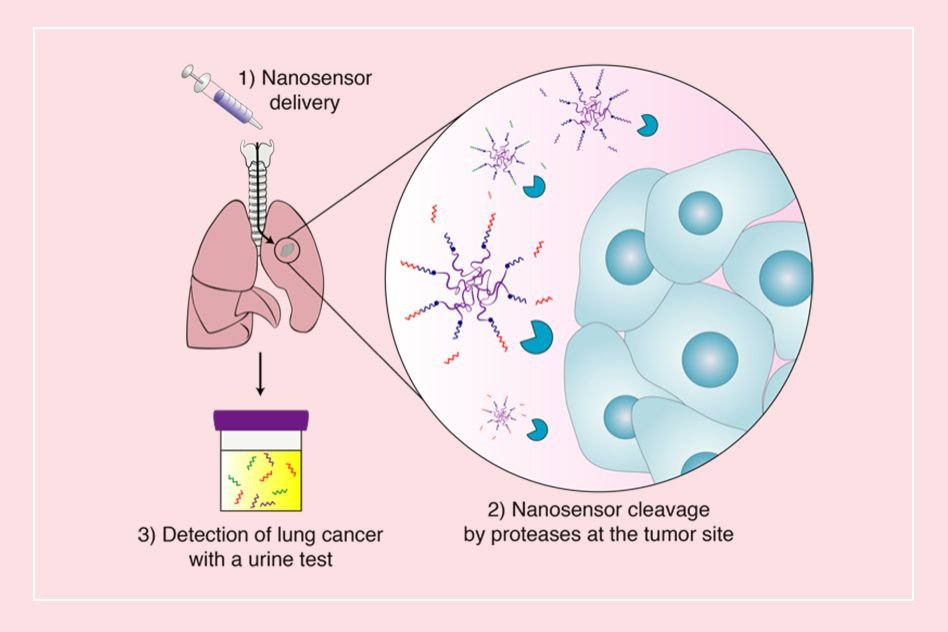
    For several years, Bhatia’s lab has been developing nanoparticles that can detect cancer by interacting with enzymes called proteases. These enzymes help tumor cells to escape their original locations by cutting through proteins of the extracellular matrix.

    To find those proteins, Bhatia created nanoparticles coated with peptides (short protein fragments) that are targeted by cancer-linked proteases. The particles accumulate at tumor sites, where the peptides are cleaved, releasing biomarkers that can then be detected in a urine sample.

    Her lab has previously developed sensors for colon and ovarian cancer, and in their new study, the researchers wanted to apply the technology to lung cancer, which kills about 150,000 people in the United States every year. People who receive a CT screen and get a positive result often undergo a biopsy or other invasive test to search for lung cancer. In some cases, this procedure can cause complications, so a noninvasive follow-up test could be useful to determine which patients actually need a biopsy, Bhatia says.

    “The CT scan is a good tool that can see a lot of things,” she says. “The problem with it is that 95 percent of what it finds is not cancer, and right now you have to biopsy too many patients who test positive.”

    To customize their sensors for lung cancer, the researchers analyzed a database of cancer-related genes called the Cancer Genome Atlas and identified proteases that are abundant in lung cancer. They created a panel of 14 peptide-coated nanoparticles that could interact with these enzymes.

    The researchers then tested the sensors in two different mouse models of cancer, both of which are engineered with genetic mutations that lead them to naturally develop lung tumors. To help prevent background noise that could come from other organs or the bloodstream, the researchers injected the particles directly into the airway.

    Using these sensors, the researchers performed their diagnostic test at three time points: 5 weeks, 7.5 weeks, and 10.5 weeks after tumor growth began. To make the diagnoses more accurate, they used machine learning to train an algorithm to distinguish between data from mice that had tumors and mice that did not.

    With this approach, the researchers found that they could accurately detect tumors in one of the mouse models as early as 7.5 weeks, when the tumors were only 2.8 cubic millimeters, on average. In the other strain of mice, tumors could be detected at 5 weeks. The sensors’ success rate was also comparable to or better than the success rate of CT scans performed at the same time points.

    Reducing false positives

    The researchers also found that the sensors have another important ability — they can distinguish between early-stage cancer and noncancerous inflammation of the lungs. Lung inflammation, common in people who smoke, is one of the reasons that CT scans produce so many false positives.

    Bhatia envisions that the nanoparticle sensors could be used as a noninvasive diagnostic for people who get a positive result on a screening test, potentially eliminating the need for a biopsy. For use in humans, her team is working on a form of the particles that could be inhaled as a dry powder or through a nebulizer. Another possible application is using these sensors to monitor how well lung tumors respond to treatment, such as drugs or immunotherapies.

    “A great next step would be to take this into patients who have known cancer, and are being treated, to see if they’re on the right medicine,” Bhatia says.

    She is also working on a version of the sensor that could be used to distinguish between viral and bacterial forms of pneumonia, which could help doctors to determine which patients need antibiotics and may even provide complementary information to nucleic acid tests like those being developed for Covid-19. Glympse Bio, a company co-founded by Bhatia, is also working on developing this approach to replace biopsy in the assessment of liver disease.

    The research was funded by the Koch Institute Support (core) Grant from the National Cancer Institute, the National Institute of Environmental Health Sciences, the National Science Foundation, the Ludwig Center for Molecular Oncology at MIT, the Koch Institute’s Marble Center for Cancer Nanomedicine, the Koch Institute Frontier Research Program through a gift from Upstage Lung Cancer, and Johnson and Johnson.