Author: admin

  • Flame-retardant Exposure Increases Anxiety, Affects Social Behaviors in Prairie Vole

    Flame-retardant Exposure Increases Anxiety, Affects Social Behaviors in Prairie Vole

    New research led by North Carolina State University has shown that early life exposure to a commonly used flame-retardant mixture increases anxiety and affects socioemotional behaviors in prairie voles, particularly in females. The work supports the hypothesis that chemical flame retardants can adversely affect neurological development and social behavior.

    FireMaster 550 (FM550) is a flame-retardant mixture used in foam-based baby products and furniture. First identified nearly a decade ago, it was developed to replace PBDEs, a class of fire retardants being phased out because of safety concerns.

    “There is concern that early life exposure to flame retardants is contributing to neurodevelopmental disorders,” says Heather Patisaul, professor of biology at NC State and corresponding author of a paper describing the work. “We decided to look at the effects of exposure on social and emotional behavior using a prairie vole model. Prairie voles are socially monogamous animals that partner for life and co-parent offspring. They are commonly used in neuroscience studies that address social behavior, and so were a good choice for this study.”

    In collaboration with NC State graduate student Sagi Enicole Gillera and colleagues from NC State and Duke University, Patisaul exposed pregnant prairie voles to 0, 500, 1000, or 2000 micrograms of FM 550 via subcutaneous injections throughout gestation. Their offspring were directly exposed to FM 550 beginning the day after birth until weaning. The adult male and female offspring were then subjected to multiple behavior tests that assess anxiety, memory and sociability, including partner preference.

    “Normally, voles are highly social and prefer to spend time with other animals, particularly their partners,” Patisaul says.

    But voles exposed to FM 550, particularly the females, were less social. For example, when given an opportunity to spend time with a female stranger or spend time alone, females exposed to FM 550 avoided the stranger. The effects were evident at the lowest dose and more pronounced at higher doses. Exposed males also had social deficits, with males in all three dose groups failing to show a partner preference, and the males in the two lower dose groups showing social avoidance.

    Additionally, females exposed to FM 550 at even the lowest dose were also much more anxious and less likely to explore new spaces. “Normally, female prairie voles are very exploratory and less anxious than males,” Patisaul says. “In tests like the open field test, where they are introduced to an empty, open box, females are more likely than males to explore the middle area, which is considered ‘risky,’ but exposed females remained in safe areas instead.”

    The researchers tested blood from a separate subset of similarly exposed voles to measure the levels of FM 550 chemicals in the body four hours after the final exposure. This information is important for determining whether effects on the human brain are possible below the range currently considered safe for humans.

    “FM 550 contains two different types of flame-retardant chemicals, brominated and organophosphates,” Patisaul says. “We detected the primary brominated flame retardant in both male and female voles, but did not detect many organophosphates, possibly due to their being metabolized more quickly.

    “This is the first study in mammals to show that developmental exposure to these flame retardants affects social behavior, and it supports the hypothesis that developmental exposure to flame retardants can impact the social brain. Future studies will probe the possible mechanisms by which these effects arise.”

    The research appears in Neurotoxicology and Teratology, and was funded by the Department of Defense (grant AR 160055) and the National Institute of Environmental Health Sciences. NC State graduate student Sagi Enicole Gillera is first author. NC State associate professor of biological sciences David Reif, graduate student William Marinello, lab manager Brian Horman, and Duke University Nicholas School of the Environment professor Heather Stapleton and graduate students Allison Phillips and Matthew Ruis also contributed to the work.

    -peake-

    Note to editors: An abstract follows.

    “Sex-Specific Effects of Perinatal FireMaster® 550 (FM 550) Exposure on Socioemotional Behavior in Prairie Voles”

    DOI: 10.1016/j.ntt.2019.106840

    Authors: Sagi Enicole Gillera, William Marinello, Brian Horman, David Reif, Heather Patisaul, North Carolina State University; Allison Phillips, Matthew Ruis, Heather Stapleton, Duke University

    Published: Nov. 12, 2019 online in Neurotoxicology and Teratology

    Abstract: The rapidly rising incidence of neurodevelopmental disorders with social deficits is raising concern that developmental exposure to environmental contaminants may be contributory. Firemaster 550 (FM 550) is one of the most prevalent flame-retardant (FR) mixtures used in foam-based furniture and baby products and contains both brominated and organophosphate components. We and others have published evidence of developmental neurotoxicity and sex specific effects of FM 550 on anxiety-like and exploratory behaviors. Using a prosocial animal model, we investigated the impact of perinatal FM 550 exposure on a range of socioemotional behaviors including anxiety, attachment, and memory. Virtually unknown to toxicologists, but widely used in the behavioral neurosciences, the prairie vole (Microtus ochrogaster) is a uniquely valuable model organism for examining environmental factors on sociality because this species is spontaneously prosocial, biparental, and displays attachment behaviors including pair bonding. Dams were exposed to 0, 500, 1000, or 2000 µg of FM 550 via subcutaneous (sc) injections throughout gestation, and pups were directly exposed beginning the day after birth until weaning. Adult offspring of both sexes were then subjected to multiple tasks including open field, novel object recognition, and partner preference. Effects were dose responsive and sex specific, with females more greatly affected. Exposure-related outcomes in females included elevated anxiety, decreased social interaction, decreased exploratory motivation, and aversion to novelty. Exposed males also had social deficits, with males in all three dose groups failing to show a partner preference. Our studies demonstrate the utility of the prairie vole for investigating the impact of chemical exposures on social behavior and support the hypothesis that developmental FR exposure impacts the social brain. Future studies will probe the possible mechanisms by which these effects arise.


  • Common Chemical Linked to Rare Birth Defect in Mice

    Common Chemical Linked to Rare Birth Defect in Mice

    A chemical commonly used in consumer and agricultural products to boost the effectiveness of insecticides has been linked to a rare birth defect in mice.

    The chemical, piperonyl butoxide or PBO for short, is widely used as a “synergist” in household and agricultural insecticides to make the toxic effects of the insecticide longer lasting and to reduce the amount of actual insecticide in a product.

    Despite its widespread and growing use, as well as its ubiquity in the environment, the chemical has been little studied. Now, a team led by Robert Lipinski, a professor of comparative biosciences in the University of Wisconsin–Madison’s School of Veterinary Medicine, reports that PBO interferes with the critical signaling pathway dubbed by scientists as sonic hedgehog, resulting in stunted forebrain development and signature facial abnormalities. The study is published this week (Oct. 23, 2019) in the journal Environmental Health Perspectives.

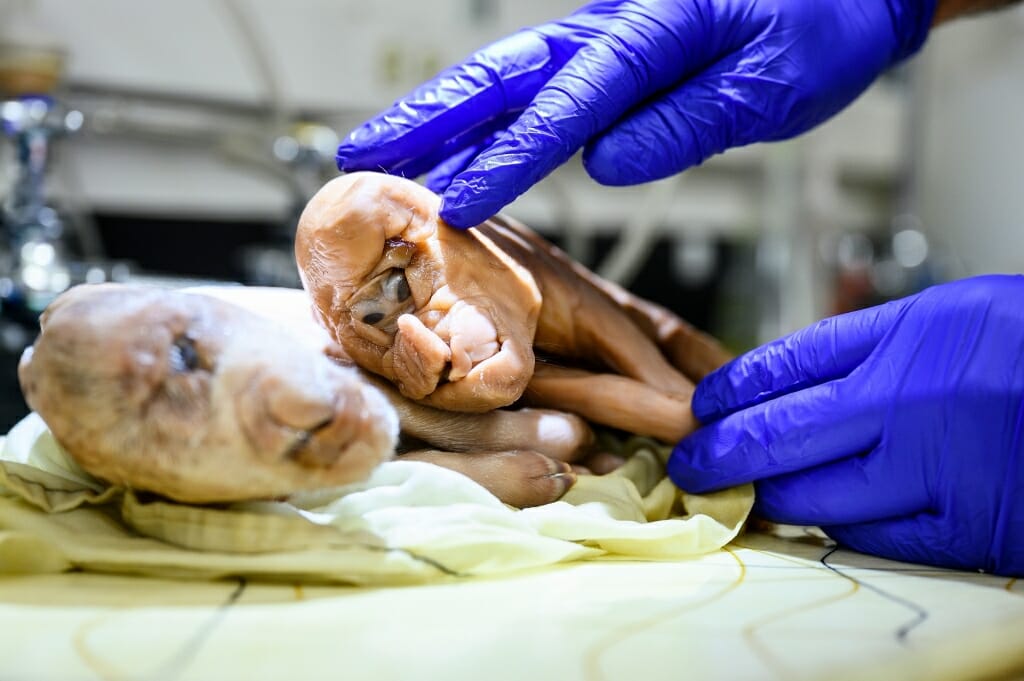
    Photo: Two abnormal fetal pigs.

    A pair of fetal pig specimens with an abnormal proboscis structure and double-globe cyclopia, both more extreme forms of a birth defect known as holoprosenchephaly. Photo by: Jeff Miller

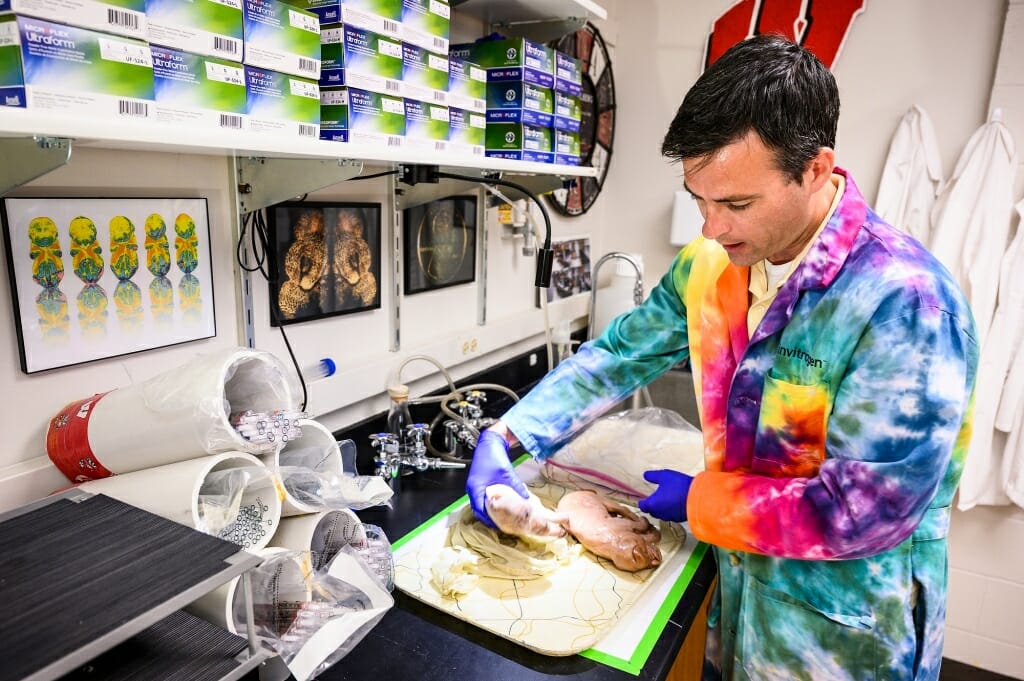
    Photo: A researcher in the lab.

    Robert Lipinski, professor of comparative biosciences in the University of Wisconsin–Madison’s School of Veterinary Medicine, looks at specimens. Photo by: Jeff Miller

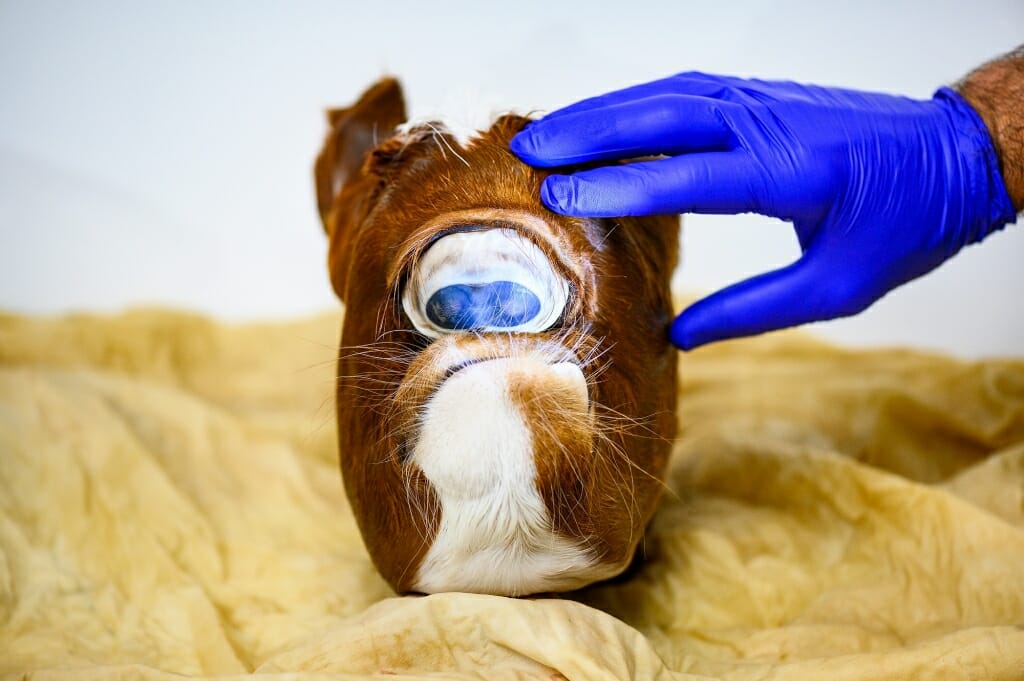
    Photo: An abnormal calf's head.

    This is a specimen of a calf’s head with cyclopia, the more extreme form of a birth defect known as holoprosenchephaly. Photo by: Jeff Miller

    First synthesized in the 1940s, PBO was identified in 2012 as an inhibitor of the sonic hedgehog signaling pathway, a genetic pathway especially important in early development. The pathway is highly conserved, present in animals ranging from fruit flies to mice to humans.

    Lipinski and his colleagues build on the discovery of PBO’s role in interfering with sonic hedgehog and show how that interference plays out in early development in mice. The signaling pathway is involved in multiple aspects of embryonic development, including the forebrain and face.

    In the new study, Lipinski and his team exposed pregnant mice to PBO at a critical stage of development analogous to the period of human development when a condition known as holoprosencephaly arises.

    Holoprosencephaly is exhibited in a range of developmental abnormalities, ranging from cleft lip and palate, to far more serious malformations. A dramatic manifestation of holoprosencephaly, known as cyclopia — where the median forebrain and face fail to develop, leaving a single central eye — was first linked in sheep to maternal consumption of a plant, a corn lily, that harbors the chemical cyclopamine. That chemical is also known to inhibit the sonic hedgehog developmental pathway.

    “This is all about timing,” says Lipinski. “The critical period is very early in development.”

    A previous study of household dust found PBO to be a common chemical contaminant, indicating the agent is ubiquitous in the environment. According to the Environmental Protection Agency, it is an ingredient in at least 1500 commercial products, including sprays and shampoos.

    “It’s been said that birth defects like holoprosencephaly are caused by ‘a little bit of this and a little bit of that,’” says Lipinski, who is also the associate director of the UW–Madison Molecular and Environmental Toxicology Center. “We don’t know if PBO is contributing to birth defects in the human population, but our study suggests that more rigorous examination of PBO’s potential human health effects is warranted.”

    In humans, live births with holoprosencephaly are very rare, occurring in roughly one in 10,000 newborns. However, it is believed to affect as many as one in 250 human embryos, most of which never make it to term.

    PBO’s influence on human health has been the subject of relatively little scientific scrutiny, with only a handful of published studies. In humans, it can be found in “personal air samples,” and, in one study, was found in 75 percent of air samples provided by pregnant women. At present, labels of products containing PBO provide no cautionary information for exposure during pregnancy.

    “Environmental PBO exposure comes from many different sources,” Lipinski says, “and human serum concentrations have not been measured. Part of our funded grant is to measure PBO concentrations in serum samples of women of childbearing age and to relate observed concentrations to those that are associated with developmental outcomes in mice.”

    There is very likely a genetic component as well, says Lipinski, noting that at least 12 genes are known to be associated with holoprosencephaly, the most common being sonic hedgehog.

    This research was supported by the National Institute of Environmental Health Sciences of the National Institutes of Health under award numbers R01ES026819 and T32ES007015.

  • New Study Examines How Diet Contributes to Toxic Exposure for Pregnant Women and Children

    New Study Examines How Diet Contributes to Toxic Exposure for Pregnant Women and Children

    pregnant woman chooses meat in the store

    Researchers are studying the relationship between diet and levels of 33 environmental contaminants for pregnant women and fetuses, who are sensitive to chemicals and pesticides found in food. (Photo/iStock)

    Health

    New research from USC scientists indicates that certain vulnerable groups should not exceed dietary recommendations for foods that frequently contain environmental contaminants.

    October 22, 2019 Jenesse Miller

    Which foods are the healthiest, and which cause us harm? It’s been debated long before “paleo,” “low-carb” and “sugar-busting” entered our lexicon. But even staples of healthy diets like fish and fruit may be harmful in higher doses for certain vulnerable groups — especially pregnant women and kids — because of exposure to pesticides and other contaminants in those foods, according to a new study in Environmental Health Perspectives.

    “Pregnant women and children are particularly vulnerable to exposures to food contaminants,” said study co-author Lida Chatzi, associate professor of preventive medicine at the Keck School of Medicine of USC.

    “During gestation and early development, the fetus and the child, respectively, are vulnerable to the effects of environmental chemicals. A balanced diet during these periods is also critical for optimal nutritional status, but what to eat, and how much, are critical questions.”

    A large team of investigators from USC and institutions throughout Europe looked at the association between diet and levels of 33 environmental contaminants in mothers and their children from six European countries. They found that the higher the fish consumption, the higher the levels of toxic persistent chemicals in the blood for both pregnant women and their children. The chemicals included polychlorinated biphenyls (PCBs), perfluoroalkyl substances (PFAS) and the toxic metals arsenic and mercury.

    Pregnant women and children are particularly vulnerable to exposures to food contaminants.

    Lida Chatzi

    The study authors assessed the effect of dietary recommendations for fish on maternal and child levels of environmental chemicals: specifically, up to three servings of fish per week for pregnant women and up to two servings per week for children. They found that, if the recommendation was followed, it resulted in lower levels of PFAS, arsenic and mercury than if they were exceeding the dietary recommendations.

    They also found that fruit consumption was positively associated with the levels of four organophosphate pesticides (OP) metabolites measured in urine samples for both pregnant women and children. When they assessed the effect of the dietary recommendation for fruit on the levels of the OP metabolites, they found that pregnant women who followed the recommendation of more than two servings of fruit each day had higher levels of the metabolites in their urine, compared to lower fruit consumption.

    Finally, the researchers found that children who ate organic food more than once per week had lower levels of OP and phthalate metabolites in their urine, compared to children who reported not eating organic food.

    Measuring contamination in blood and urine

    The study was conducted within the Human Early Life Exposome project, a multidisciplinary study including 1,000 pregnant women and their children who were followed up to the age of 6 to 10 years old in France, Greece, Lithuania, Norway, Spain and the United Kingdom. Researchers assessed how the consumption of several food groups — meat, fish, dairy, fruits, vegetables, bread and cereals, and pulses and legumes — was related to the levels of 33 environmental contaminants measured in blood and urine samples from pregnant women and their children.

    The authors say it’s the most comprehensive assessment of the association between food consumption and biomarker-measured exposures to environmental contaminants in mother-child cohorts. The innovative approach estimated the effects of clinical-based dietary advice on the blood and urinary levels of contaminants that are abundant in human biological samples worldwide.

    Diet in pregnant women, children should not focus on potentially contaminated foods

    For the vast majority of people who are not exposed to chemicals through their jobs, consumption of contaminated food is the main source of exposure to a wide range of toxic environmental contaminants. Those chemicals have been linked to a wide range of health defects that can affect children’s cognitive, motor and behavioral development and result in higher risk for preterm delivery, childhood obesity, Type 2 diabetes and asthma.

    Mounting research on the risks associated with these toxins has resulted in calls to reduce exposure in vulnerable populations. “Changes in our diet and food choices can be an effective route to avoid excess exposure to environmental chemicals,” said study co-author Eleni Papadopoulou, a researcher from the Norwegian Institute of Public Health. “Understanding sources of dietary exposures to environmental chemicals can inform exposure assessment and identify intervention strategies to reduce exposure.”

    Our study found that exposure to PFAS, arsenic and mercury could be reduced if pregnant women and children did not exceed the current dietary recommendation for fish.

    Chatzi

    The authors found that moderate fish and seafood consumption within health-based dietary recommendations may prevent excess exposure to persistent PCBs and PFAS, as well as mercury and arsenic. In addition, high fruit consumption was related to increased exposure to pesticides, while the choice of organic fruits contributed to lower exposures of pesticide residues.

    Human exposure to PFAS has been a major concern for Americans since reports were released on widespread exposure to PFAS-contaminated drinking water. The U.S. National Health and Nutrition Examination Survey has detected these PFAS in the blood of all children ages 3-11 tested from 2013 to 2014. In line with the study findings, fish and seafood has been identified as a major source of exposure to PFAS.

    “Our study found that exposure to PFAS, arsenic and mercury could be reduced if pregnant women and children did not exceed the current dietary recommendation for fish,” Chatzi said.

    Enough evidence to switch to organic?

    The authors found that consumption of non-organic fruits and vegetables has been a major source of exposure to OP pesticides. The use of these synthetic pesticides is prohibited in the production of food certified as organic. Organically grown food typically contains lower pesticide residues than food that is conventionally grown.

    The U.S. Department of Agriculture reports that consumer demand for organically produced goods has shown double-digit growth during most years since the 1990s. Fresh fruits and vegetables have been the top-selling category of organically grown food.

    “The choice of organic over conventionally grown fruits contributed to lower exposures of pesticides and phthalates, while retaining the health benefits of fruit and vegetable consumption,” Chatzi said. “We believe the results carry important public health messages related to the avoidance of excess exposure to environmental contaminants with toxic effects on humans.”


    Additional authors include Line Småstuen Haug, Amrit Kaur Sakhi, Anne Lise Brantsaeter, Helle Katrine Knutsen, Helle Margrete Meltzer and Cathrine Thomsen of the Department of Environmental Exposure and Epidemiology, Norwegian Institute of Public Health; Xavier Basagaña, Maribel Casas, Sílvia Fernández-Barrés, Lea Maitre, Martine Vrijheid of Barcelona Institute for Global Health (ISGlobal), Universitat Pompeu Fabra (UPF) and CIBER Epidemiología y Salud Pública (CIBERESP); Regina Grazuleviciene and Sandra Andrusaityte of the Department of Environmental Sciences, Vytautas Magnus University; Rosemary R. C. McEachan and John Wright of Bradford Institute for Health Research, Bradford Teaching Hospitals National Health Service (NHS) Foundation Trust; Theano Roumeliotaki and Marina Vafeiadi of Department of Social Medicine, Faculty of Medicine, University of Crete; and Remy Slama of University Grenoble Alpes, Institute for Advanced Biosciences, Joint Research Center.

    The research was funded by the European Community’s Seventh Framework Programme (FP7/790 2007–2013) and the National Institute of Environmental Health Sciences grants (P30ES007048 and R21ES02890).