Author: admin

  • As White House shifts focus toward AI and tech, U.S. science leaders defend role of the American university

    As White House shifts focus toward AI and tech, U.S. science leaders defend role of the American university

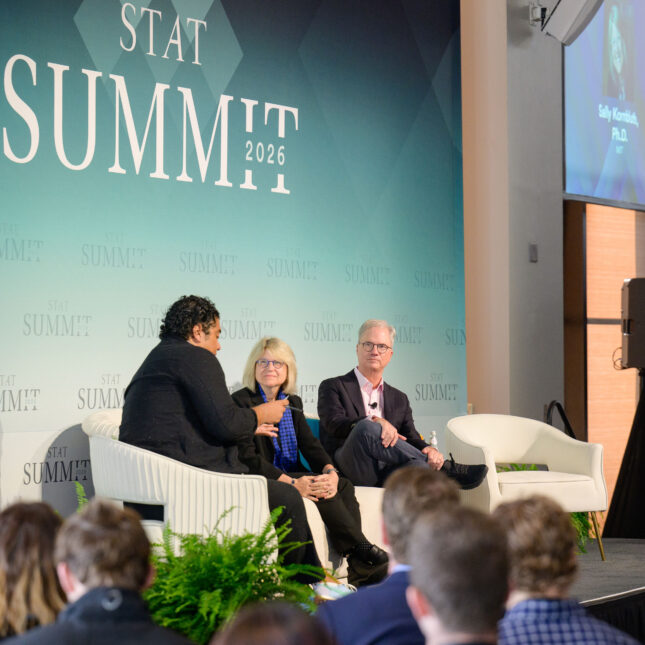
    BOSTON — This fall, the Massachusetts Institute of Technology, where 95% of students are STEM majors, enrolled nearly 500 fewer graduate students — a 20% drop compared to 2024. The reduction is a direct result of a $100 million cut in federal research awards to the institution in that same timespan, MIT President Sally Kornbluth said at the STAT Summit Wednesday in Boston. 

    Graduate students are largely supported with these grants, and “if we admit someone, we don’t want them to be partway through their Ph.D. and run out of funding, so we tend to be conservative on the front end,” Kornbluth said. “I wish I had a crystal ball and knew when things were going to turn around, but for now we’re just being cautious.”

    It’s not just MIT. Universities across the country have suspended or shrunk admissions to graduate programs in response to a tumultuous 18 months that have included unprecedented grant terminations, funding delays, and policy changes to how science is supported at the federal level. Even if the upcoming midterms usher in a power shift in Congress, it will do little to change the uncertainty faced by academic institutions regarding the reliability of the U.S. government as a science funding partner, particularly in light of a recently revealed plan for political appointees to gain more control over National Institutes of Health grantmaking decisions.

    “We will go toe-to-toe with the best of them based on merit. If there are other elements that lead to being funded or not, we don’t have control of that and that concerns me,” Kornbluth said. “I think we just have to do our very best science and feel like that in the end will win the day, and the country needs that.”

    Kornbluth was joined by Holden Thorp, editor-in-chief of the Science family of journals, to argue for the model of American research that for the last 80 years propelled the U.S. to global dominance in science, technology, and medicine. First articulated by Vannevar Bush in his 1945 report “The Endless Frontier,” it involved sustained public funding of science at research universities and federal laboratories and a commitment to open inquiry.

    While that model was showing signs of stagnation before the second Trump presidency, the last 18 months have shredded the social compact at its foundation. In its place, the administration has proposed a new blueprint for American innovation — one that is focused more narrowly on national priorities and a smaller role for the federal government in science funding. 

    At the White House’s Science: A New Golden Age summit last week, the Trump administration announced $6 billion in new national research investments, including support for the buildout of advanced computing facilities and autonomous laboratories, the development of nuclear powered spacecraft and next-generation quantum computers, and the creation of accelerated training programs in artificial intelligence and engineering. White House Office of Science and Technology Policy Director Michael Kratsios described the funding announcement as “the most transformative day for the American scientific enterprise since the reshaping of the federal research ecosystem following World War II.” 

    The investments mark the administration’s first steps to implement its vision for advancing U.S. innovation. Laid out in an OSTP report over the summer, it calls for a dramatic shift of hundreds of billions of research dollars from universities to industry — primarily AI and technology companies. 

    While there are roles for commercial entities as well as national labs to play in propelling science and innovation, Kornbluth said, what has very uniquely flourished at universities is the very basic end of the pipeline — the unpressured curiosity-driven research that has led to revolutionary discoveries including CRISPR gene editing, microRNA, and this year’s Nobel-winning work underlying the exploding field of optogenetics. “I worry that all of these moves, while they’ll have short term gains, are going to result in a serious drought in the pipeline … for us maybe five, 10 years down the line, but certainly for our children and their children’s children,” Kornbluth said. 

    It’s too soon to see the effects of these shifting priorities in research output indicators like top-tier journal publications, Thorp said. But he doubts the Trump administration’s push will do much to reverse the ongoing trend of the U.S. falling further behind its geopolitical rivals. 

    Even before the last 18 months of disruptions and delays to government investment, the U.S. was on its way to losing its place of prominence as the world’s largest public funder of science. Forecasts have put China on track to surpass the U.S. on research spending in the next two to three years. On the ground, that means buildings going up, more people going to graduate school, and a tangible sense of momentum. 

    “The atmosphere is just so much more pro-science there than it is here,” Thorp said, recounting a recent trip to China in which he sat down with presidents of several universities. 

    It’s getting results. Nine out of the top 10 academic research institutions are now in China, according to the latest data from the Nature Index, with Harvard University as the lone U.S. representative. A decade ago, American universities held half of the top 10 spots. 

    “Submissions from China continue to increase, not just in number but in quality,” Thorp said of the Science family of journals. To the point that, Science Advances, an open-access journal that is slightly less competitive than the flagship, is now publishing an equal number of papers from the U.S. and China. He expects the same to be true for Science within the next four to five years. “That’s the competitive effect that I don’t think the administration has very good answers for,” Thorp said. “At least when I write to them and ask them if they want to comment about it in my column, they never respond to me.”

    How these dueling visions of research in America play out will in some ways be shaped by the outcomes of the next few elections. But science happens on a longer time scale, and both Thorp and Kornbluth pointed to the need of scientists and academics everywhere, regardless of who holds power in Washington, to confront the underlying political reality of rising populism and cratering trust in institutions. 

    Kornbluth highlighted a new initiative launched this month — MIT for America — which sends students and alumni out across the country to help under-resourced high schools teach math, computer science, and other STEM classes often required for admission into the kinds of college programs required to move ahead in the increasingly AI-centric U.S. economy.  “We want to both meet people where they are, give their kids the opportunity, and also make them understand us as people who care about their communities,” she said.

    Thorp urged universities to follow MIT’s lead on getting rid of legacy admissions policies that give children of alumni an edge (which the university did decades ago). “It’s a huge part of why people are suspicious of higher education,” Thorp said. But he acknowledged that there’s only so much that institutions of all types can do to reverse the tide of populism, which has been growing for close to a century. 

    “My view is we have to accept the fact of what modernity has given us,” Thorp said. “Some people come to me as the editor of Science and think I have a big platform, and I’m sure they go to STAT and think STAT has a big platform, but compared to Mr. Beast, we’re off by three orders of magnitude. I can put all the cool videos and explainers and everything I want to on the Science social media accounts, which are the largest in academic publishing, and it’s not going to move the needle.”


  • HealthTap Introduces Virtual Primary Care Program for DME Suppliers

    HealthTap Introduces Virtual Primary Care Program for DME Suppliers

    telehealth virtual care

    HealthTap, a virtual primary care company, launched a new program on Monday to support sleep and respiratory durable medical equipment (DME) suppliers.

    Sunnyvale, California-based HealthTap provides primary care across all 50 states in partnership with payers, pharmacies, providers, cost-sharing organizations and more.

    The new program helps DME suppliers connect patients with sleep disorders to physicians for clinical evaluations, documentation or orders. Patients may need these services before insurers or suppliers can proceed with therapy or provide supplies. The program supports positive airway pressure (PAP) therapy from initial evaluation and treatment orders through compliance, resupply and device replacement.

    After the physician visit, chart notes and orders are sent to the supplier. HealthTap also sends updates to suppliers when patients book, complete, cancel, miss or reschedule appointments.

    “Physicians review relevant records and device data, evaluate the patient, and return completed notes and clinically appropriate orders through integrated workflows,” said Sean Mehra, HealthTap CEO. “Suppliers get real-time visit and documentation updates instead of chasing paperwork.”

    Mehra added that DME suppliers often work hard to keep patients on therapy, but accessing physicians can be difficult.

    “Delays in appointments, prescriptions, or required documentation can hold up orders, disrupt patient care, and delay reimbursement,” he said. “We launched this program to help DME suppliers overcome these challenges by giving them fast, reliable access to physicians, integrated clinical workflows, and timely documentation—so they can reduce administrative burden, keep patients on therapy, and keep their operations moving.”

    Currently, about 30 million adults in the U.S. have obstructive sleep apnea. And for those using positive airway pressure therapy, physician involvement is very important. Under Medicare, continued coverage for certain PAP devices requires a treating practitioner to reevaluate the patient between days 31 and 91 after therapy begins and document its benefits and the patient’s adherence.

    Ultimately, HealthTap aims to help patients easily get on and stay on therapy, Mehra said.

    “Someone needing a follow-up evaluation or an updated prescription should have an easy way to see a physician and understand the next steps,” he said. “For DME suppliers, the goal is to remove uncertainty from helping that patient. Their teams spend significant time calling physician offices, checking if a visit occurred, and waiting for documentation before they can move forward. Through integrated workflows, completed visit notes and medically appropriate signed orders reach suppliers immediately after the visit. This gives their teams a clearer path forward and helps patients avoid further waiting.”

    Photo: elenabs, Getty Images

  • Ultragenyx Rare Disease Voucher Sales Secure $413M for More Potential Pipeline Building

    Ultragenyx Rare Disease Voucher Sales Secure $413M for More Potential Pipeline Building

    Ultragenyx recently received two separate FDA approvals for gene therapies in the span of a month, each regulatory nod accompanied by a voucher the company could use to speed up the future review of another rare disease drug. In the past week, Ultragenyx has reached separate deals to sell each regulatory fast pass.

    The Novato, California-based biotech announced Wednesday a definitive agreement to sell a voucher for $203 million, following a deal last week to sell a voucher for $210 million. The identities of both voucher buyers were undisclosed and the purchases still need to meet closing conditions. But the deals put Ultragenyx in line for non-dilutive capital that the rare disease specialist can use to bolster its drug pipeline.

    Congress created the voucher program to incentivize drug development in rare diseases. Companies awarded a regulatory approval in a rare pediatric disease can receive one of these vouchers, which cuts the standard review time of 10 months down to six. These vouchers may be sold, and many voucher recipients opt to sell them to big pharmaceutical companies. Demand for these regulatory fast passes has pushed prices higher; most of the vouchers sold this year fetched prices of $200 million or more.

    Ultragenyx received a voucher alongside the late August approval of Gengylcos, a gene therapy for a rare inherited enzyme deficiency called glycogen storage disease type Ia. Another voucher came from the mid-September FDA nod for Fayuvi, a gene therapy for a different rare inherited enzyme deficiency called Sanfilippo syndrome Type A. Each product is the first approved therapy for its respective ultra-rare indication.

    While the Ultragenyx gene therapies carry multi-million-dollar price tags, neither product is expected to become a big revenue driver. Much of the company’s future financial expectations had rested on apazunersen, which was in development for Angelman syndrome, a rare genetic neurological disorder with no FDA-approved therapies. Last month, Ultragenyx reported this antisense oligonucleotide drug failed its Phase 3 test. The company said the disappointing trial outcome would lead to a corporate restructuring and expense reductions.

    The Angelman drug came from an acquisition. Ultragenyx’s two gene therapies also came from business deals. The capital from the voucher sales could be applied toward another deal for a different rare disease therapeutic candidate. While the company made clear its intent to sell both vouchers, it has not said how it will use the proceeds. As of the end of June, Ultragenyx reported its cash position was $436 million. The company is expected to report third quarter 2026 financial results in November.

    Ultragenyx previously received vouchers for rare disease drug approvals in 2017 and 2018. In a prepared statement, Chief Financial Officer Howard Horn noted that the Sanfilippo gene therapy benefited from capital generated by a previous voucher sale, “demonstrating the important role the [priority review voucher] program plays in helping companies develop transformative therapies for rare disease patients.”

    In a Wednesday research note, William Blair analyst Lachlan Hanbury-Brown said that even though Ultragenyx is launching two new gene therapies, the company’s pipeline lacks any clinical catalysts to drive value for the company’s stock in the next year. But the sale of the two vouchers significantly bolsters the biotech’s balance sheet with non-dilutive capital.

    “We look forward to hearing how management plans to strategically deploy this additional capital, as well as details on the company’s expense reductions plans, which we believe will help achieve [generally accepted accounting principles] profitability in 2027,” Hanbury-Brown said.

    Photo: CaptureTheWorld, Getty Images

  • STAT+: Trump administration delays new rule that could restrict imported medicines from Canada and overseas

    STAT+: Trump administration delays new rule that could restrict imported medicines from Canada and overseas

    By Ed Silverman

    Oct. 14, 2026

    Pharmalot Columnist, Senior Writer

    Ed’s stories explore prescription drug pricing, affordability and access, as well issues surrounding patents, litigation, and legislation. He is also the author of the morning Pharmalittle newsletter and the afternoon Pharmalot newsletter.

    The Trump administration is delaying by 90 days a federal rule that could prevent Americans from obtaining prescription drugs from licensed international pharmacies.

    The move follows growing criticism that the rule, which was initially slated to go into effect on Oct. 22, could drastically reduce the flow of medicines from Canada and other countries. In recent weeks, patient advocacy groups and dozens of congressional lawmakers urged the administration to rethink its approach.

    The administration is trying to crack down on illegal goods — particularly opioids — that it says enter the U.S. through low-value foreign shipments and for which shippers generally do not pay tariffs or submit data for tracking. The rule targets the de minimis exemption, which previously allowed shipments valued under $800 to pass through customs more easily.

    STAT+ Exclusive Story

    Already have an account? Log in

    STAT+

    STAT+

    This article is exclusive to STAT+ subscribers

    Unlock this article — plus in-depth analysis, newsletters, premium events, and news alerts.

    Already have an account? Log in

    View All Plans

    To read the rest of this story subscribe to STAT+.

    Subscribe

  • Trump administration boots 189,000 deceased, duplicate enrollees off ACA subsidies

    Trump administration boots 189,000 deceased, duplicate enrollees off ACA subsidies

    It comes amid a broader crackdown on the ACA exchanges as the Trump administration continues its efforts to identify “fraud, waste and abuse” in federal programs.

  • How consumer tech company Whoop is building for Medicare patients

    How consumer tech company Whoop is building for Medicare patients

    Whoop has never been known for marketing to an older population. Performance athletes headline ads for the wearable company, which aims to turn continuous streams of physiological data into useful insights for behavior change — mostly, for a young, fit customer base.

    But this year, Whoop became one of the first consumer wearable companies to be accepted into Medicare’s ACCESS program, making it available at no cost to many traditional Medicare patients ages 65 and up. On Wednesday, at the STAT Summit in Boston, Whoop’s newly appointed chief medical officer Ami Bhatt spoke about how the company is moving to build experiences — and demonstrate outcomes — for a very different population.

    “Number one on our roadmap — and I think I’m allowed to say this, if I’m not, I’m saying it — is simplification of the app,” said Bhatt, who previously chaired the Food and Drug Administration’s digital health advisory committee and served as the American College of Cardiology’s chief innovation officer. Surveys suggest, said Bhatt, that even members of the Silent Generation, who are older than 80 today, trust their clinicians with their data. “It’s not that they’re averse to giving data,” she said. “It’s how easy can we make it for that population to be able to share their data.” 

    Bhatt said that Whoop, which recently raised $575 million from investors including Mayo Clinic and the sovereign wealth fund of Qatar, is working with the National Council on Aging and AARP to think about how to personalize the product to older adults’ individual priorities. “For each of us, how we feel, how we perform, how we age, we have our own goals,” said Bhatt. “The thing is, we don’t want to decide for you what that is.”  

    The goals are less diffuse for the 10-year pilot ACCESS program, which published a directory of initial participants last month. Through those 55 companies, Medicare patients can access chronic condition management for little or no cost — Whoop serves patients with high blood pressure, high cholesterol, obesity, and prediabetes — and Medicare will pay the companies based on their health outcomes. Whoop will provide patients with a wearable, a 12-month subscription to its app, and access to clinicians who can help them make sense of their data and offer advice.

    “The goal is, how do we bring technology closer to the patient, but not put the cost on the patient — rather, put the demand on the company,” said Bhatt. “Whoop takes responsibility for, in 12 months, I am going to make these people better. I’m going to show you outcomes in the Medicare population who have these risk factors to demonstrate that my technology can help them engage in their own health.” To receive full payment under the ACCESS model, Whoop will be required to show that it improved or controlled measures tied to its patients’ chronic conditions, including blood pressure, hemoglobin A1C, and low-density lipoprotein cholesterol.

    Bhatt said it was her role to help the company — which until recently focused on selling a product intentionally binned in the wellness category — develop and demonstrate those kinds of outcomes that bring them closer to clinical practice. The company just this year announced the ability for users to discuss their wearable data with clinicians, shortly before the FDA closed its warning letter that had initially said Whoop’s blood pressure-estimating feature qualified as a medical device — not a wellness feature. 

    While Whoop demonstrates good patient engagement, said Bhatt — users check the app eight times a day, on average — research into the original “wearable” for diabetes, continuous glucose monitors, suggests that engagement doesn’t necessarily translate to better health outcomes. 

    “In order to actually create personalized health at a population level, you need to start thinking about outcomes,” said Bhatt. “Can we show that we decrease blood pressure by five millimeters of mercury in individuals on Whoop — which, by the way, we have shown — so that we can say, hey, the outcome of cardiovascular disease and stroke, we know that outcome is better.” 

    At the same time, Bhatt said, the utility of continuous data is limited within the traditional health care system. As a practicing physician, “I had some really great patients who would print out binders of their wearable data,” she said. “This is me: I love this data. And I’d be like, ‘Oh, God.’” Despite her interest and the patient’s engagement, it was impossible to handle in a 20-minute visit.

    Ultimately, Bhatt imagines Whoop could help solve that problem, perhaps by delivering contextualized reports to clinicians that summarize a patient’s continuous data along with key points from their own journaling entries and interactions with their Whoop app coach. “When you put that together and you actually have a comprehensive report you can give to a clinician, now your clinician says, ‘Oh, that’s what I needed.’” 

  • Healthleap Raises $38M to Expand AI Screening for Overlooked Conditions in Hospitalized Patients

    Healthleap Raises $38M to Expand AI Screening for Overlooked Conditions in Hospitalized Patients

    Jet trail creating dollar sign in blue sky with clouds startup capital

    Health systems are under pressure to improve patient outcomes while managing staffing shortages and rising costs. Healthleap, a clinical AI platform which works within the EHR to screen hospitalized patients for conditions that might otherwise go undiagnosed and untreated – such as malnutrition – is supporting hospitals in finding at-risk patients sooner. 

    The San Francisco-based company announced last week that it has secured $38 million in combined seed and Series A funding from Sequoia Capital, First Round Capital, and Hummingbird Ventures. The company plans to use the funds to expand its screening technology to more conditions, including congestive heart failure, aspiration pneumonia, delirium, pressure ulcers, and certain hospital-acquired infections.

    “Every week, millions of patients leave hospitals with unresolved health conditions that will erode their health and cost up to 10x more to treat late,” said Healthleap CEO Josiah Meyer in a news release. “Finding them now is prevention, and it’s a win for everyone. Patients get treated before they get sicker.”

    Healthleap’s platform is currently used by more than 50 hospitals, including Penn Medicine, Houston Methodist, Cedars-Sinai, Emory and UMass Memorial. Its current focus is malnutrition, which can often go unnoticed and worsen patient outcomes.  

    “The model uses weight, body mass index, lab results, diagnoses, medications, intake and output, nutrition orders, and vitals,” said co-founder and clinician Jemima Meyer in an email. “The AI system combines all of these signals into one priority score from 0 to 10 for each patient. A second column shows whether the patient’s risk changed since the last assessment. Dietitians see both columns in their existing EHR worklist every morning. The dietitians sort the list and start with the highest-risk patients.”

    Healthleap’s technology screens every adult inpatient daily. Typical malnutrition screening relies on a manual process conducted by the admitting nurse or an in-hospital dietitian. Patients who are confused, intubated, or critically ill are often unable to answer, putting them at particular risk for being missed. The company’s website claims that its model showed 88% higher sensitivity than the nursing screening, linking to a peer-reviewed study which backs that number. Each severe malnutrition diagnosis and treatment supports improved patient outcomes and, according to Healthleap, allows hospitals to claim around $11,000 in reimbursement. Each patient flagged had a 1.6-day shorter average hospital stay, according to Jemima Meyer.

    As Healthleap expands into screening for additional conditions, each must first undergo further clinical validation, with a focus on smoothly integrating into provider workflows. 

    “Every condition runs on the same nightly chart review and the same EHR connection”, she said. “Healthleap does not send interruptive alerts. Physicians and nurses see no pop-ups. The score appears as a column in a worklist that the care team already uses.”

    Healthleap wants to turn earlier risk detection into better patient care – their next challenge is expanding the results achieved with their malnutrition screening platform across a broader range of conditions.

    Photo: John Lund, Getty Images

  • Centene joins insurers waiving prior authorizations for top providers

    Centene joins insurers waiving prior authorizations for top providers

    Centene is the latest insurer to adopt a gold card program as states and the Trump administration push for prior authorization reform.

  • MultiCare, Samaritan combination to close in November

    MultiCare, Samaritan combination to close in November

    The nonprofits will merge on Nov. 1 after securing approval from state regulators, the systems announced this week.

  • CVS to pay $315M to settle opioid prescribing allegations

    CVS to pay $315M to settle opioid prescribing allegations

    Prosecutors say the company filled unnecessary prescriptions that fueled the opioid epidemic. A spokesperson for CVS said the company admitted to no wrongdoing and “strongly disagreed” with the case’s claims.