Author: admin

  • STAT+: Pharmalittle: We’re reading about U.S.-funded psychedelic trials, an AstraZeneca R&D center, and more

    STAT+: Pharmalittle: We’re reading about U.S.-funded psychedelic trials, an AstraZeneca R&D center, and more

    By Ed Silverman

    Oct. 6, 2026

    Pharmalot Columnist, Senior Writer

    Rise and shine, everyone, another busy day is on the way. And it is getting off to a pleasant start here on the Pharmalot campus, where clear blue skies and comfy breezes are greeting us. As for the official mascots, they are happily snoozing in their respective corners. As for us, we are firing up the trusty kettle for another cuppa stimulation. Our choice today is honeybush vanilla turmeric. Of course, you are invited to join us. For the full experience, we are now hawking replicas — take a look. Meanwhile, here are a few items of interest. As always, do keep in touch. We appreciate feedback, criticism, and tips. …

    The Trump administration is advancing the first government-funded clinical trials of the psychedelic drug ibogaine to treat opioid addiction and ​post-traumatic stress disorder, Reuters says. The initiative ⁠follows an executive order signed last April by President Trump that dedicated $50 million ​to the federal ibogaine research, as well as recent calls by experts and ​veterans for strict safety standards on psychedelic treatments. The U.S. Food and Drug Administration said it has opened a public docket seeking feedback on trial design, dose selection, patient ​eligibility, safety monitoring, study-stopping rules, and oversight by Nov. 20.

    AstraZeneca’s pivot towards the U.S. market has continued with the opening of a new R&D center in the biotech hotspot of Cambridge, Mass., the centerpiece of a $1 billion investment program in the state, Pharmaphorum explains. The new facility in the Kendall Square area — which is one of the densest biotech clusters in the world, with hundreds of small and large biopharma companies present — covers 570,000 square feet of lab and office space over 18 stories. The center is part of a major investment program by the U.K.-based company that was first announced in 2024 and dramatically expanded to around $50 billion last year.

    STAT+ Exclusive Story

    Already have an account? Log in

    STAT+

    STAT+

    This article is exclusive to STAT+ subscribers

    Unlock this article — plus in-depth analysis, newsletters, premium events, and news alerts.

    Already have an account? Log in

    View All Plans

    To read the rest of this story subscribe to STAT+.

    Subscribe

  • Perimenopause Anxiety: Sometimes It’s a Progesterone Deficiency

    Perimenopause Anxiety: Sometimes It’s a Progesterone Deficiency

    When women suddenly start feeling anxious in their 40s, the conversation needs to shift from serotonin and estrogen to understanding what’s happening to their progesterone levels.

    One of the biggest mistakes I see in perimenopause is assuming every symptom is caused by low estrogen. Hot flashes? Estrogen. Night sweats? Estrogen. Vaginal dryness? Estrogen.

    But when it comes to anxiety, irritability, feeling overwhelmed, poor stress tolerance, and that wired but tired feeling many women describe, the conversation often needs to shift. Because in many women, progesterone is the first hormone to decline consistently, making it an important contributor to anxiety and nervous system symptoms.

    The conversation needs to shift beyond estrogen

    Most medical discussions blame estrogen for every perimenopausal symptom, from hot flashes to mood swings. While estrogen levels do fluctuate wildly during this transition, this singular focus leaves women confused when typical estrogen treatments fail to soothe their frayed nerves. Progesterone is one of the most overlooked contributors to emotional stability during perimenopause.

    When progesterone levels drop faster than estrogen levels, it can trigger a spike in anxiety and a fight-or-flight response. This imbalance explains why women suddenly experience panic attacks, heart palpitations, and the inability to handle everyday stress.

    The perimenopause problem nobody explains

    Most women are told that menopause is a gradual decline in hormones, but that’s not actually what happens first. Perimenopause (the long stage prior to menopause) is characterized by hormonal volatility, not simple deficiency.

    During perimenopause, estrogen often fluctuates dramatically from cycle to cycle, while progesterone tends to decline earlier as ovulation becomes less consistent.

    Progesterone is usually the first hormone to decline consistently. Ovulation becomes less predictable. And when ovulation becomes less predictable, progesterone production falls. 

    This is often years before menopause. The result? Many women begin experiencing symptoms long before their periods stop.

    Why progesterone matters for the brain

    Progesterone is not just a reproductive hormone. It’s a neuroactive hormone. One of progesterone’s metabolites, allopregnanolone, interacts with GABA receptors in the brain.

    GABA is the primary calming neurotransmitter system. Think of it as the brain’s brake pedal. When progesterone signaling is adequate, many women experience better stress resilience, improved sleep, greater emotional stability, less irritability, and reduced anxiety.

    When progesterone declines, many women describe feeling wired but tired, more reactive, easily overwhelmed, unable to turn their brain off at night, and more anxious than they’ve ever been before. 

    The problem is that these symptoms are often labeled as purely psychological when there may be a significant hormonal component. As ovulation becomes less frequent, progesterone production declines significantly, reducing one of the brain’s important sources of neurosteroid support for stress regulation.

    Why normal labs don’t always give answers

    This is where many women get dismissed. They are told: “Your labs are normal.” But normal reference ranges do not always explain why someone is experiencing symptoms.

    Looking at a single lab value without understanding hormone signaling, metabolism, and symptoms misses the bigger picture. Hormones influence sleep, neurotransmitters, inflammation, metabolism, and stress response.

    The question isn’t simply: “What is the hormone level?” The better question is: “How is the body responding to that hormone?”

    Anxiety is often a systems problem

    This is why a systems-based approach matters. Progesterone doesn’t operate in isolation. Sleep quality matters. Blood sugar regulation matters. Stress physiology matters. Inflammation matters. And hormone metabolism matters.

    When progesterone declines during perimenopause, these systems often begin to unravel together. What looks like anxiety on the surface may actually be a convergence of hormonal volatility, sleep disruption, cortisol dysregulation, and declining neurosteroid support.

    The real takeaway

    When women in their 40s suddenly develop anxiety and feel like a different person, don’t assume it’s just stress. Stop assuming it’s just aging. And don’t assume it’s all in their heads. 

    Perimenopause is one of the most significant biological transitions a woman experiences. Progesterone is often the first hormone to change.

    For many women, understanding that connection becomes the first step toward getting answers. Because education is the first intervention. And understanding why symptoms happen is often where better outcomes begin.

    Clinicians should help women understand that treatment is individualized and depends on the underlying contributors to their symptoms. For some women, this may include discussing bioidentical progesterone therapy when appropriate. Supporting sleep, addressing chronic stress, optimizing blood sugar regulation, ensuring adequate magnesium intake, and improving overall nervous system resilience may also play important roles. Another focus should be prioritizing magnesium-rich foods to support GABA pathways. Together, these strategies can help improve symptom burden and quality of life while supporting healthier hormonal adaptation during perimenopause.

    Perimenopausal anxiety isn’t simply in our patients’ heads. It’s often the result of complex physiologic changes involving hormones, sleep, metabolism, and the nervous system. When clinicians look beyond estrogen alone and take a systems-based approach, women are more likely to understand what’s happening and receive care that addresses the root contributors rather than simply masking symptoms.

    Photo: kate_sept2004, Getty Images

    Lexi Yoo

    Lexi Yoo, NP, is a double board-certified nurse practitioner and the founder of Yoo Direct Health and YDH Training Academy. Women’s hormone expert, national keynote speaker, and host of The Better Yoo Project Podcast, Lexi is a longevity medicine expert, practitioner mentor, and education-first disruptor challenging outdated standards in midlife and metabolic care to advance a systems-based approach to hormone health, metabolism, and modern longevity care.

    This post appears through the MedCity Influencers program. Anyone can publish their perspective on business and innovation in healthcare on MedCity News through MedCity Influencers. Click here to find out how.

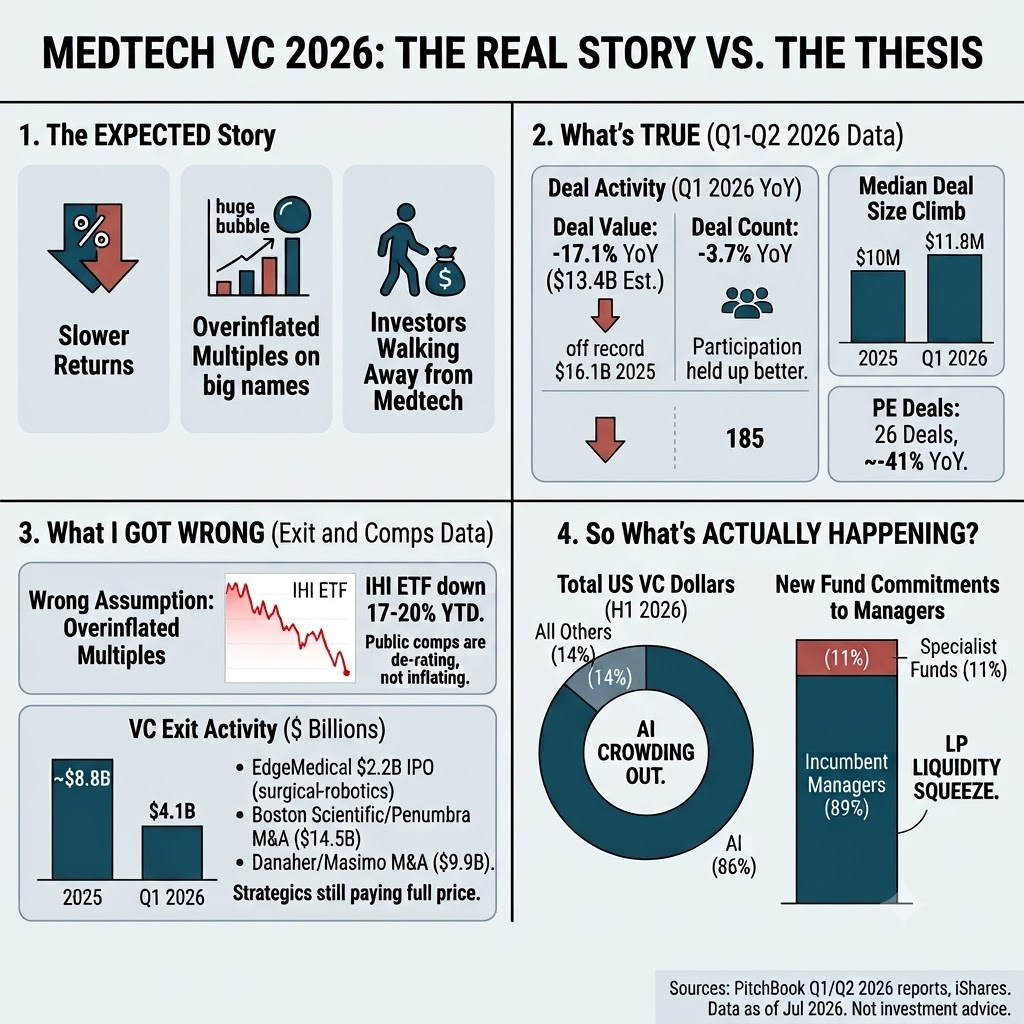
  • MedTech VC 2026: The Real Story vs. The Thesis

    MedTech VC 2026: The Real Story vs. The Thesis

    One thing I love about investing is that the best research often disproves your own assumptions.

    I kept hearing “medtech VC is in decline,” so I decided to dig into the data myself. I expected shrinking investor interest, inflated valuations, and a weak exit environment.

    Instead, I found a more nuanced story.

    What’s true:

    → Medtech VC deal value fell 17.1% YoY in Q1 2026, but off a record $16.1B in 2025.

    → Deal count fell only 3.7% YoY. Participation held up far better than dollars.

    → Median deal size climbed to $11.8M (from 2025’s already-record $10M). The money isn’t leaving, rather concentrating into fewer, larger checks.

    → Medtech PE deal count dropped ~41% YoY to 26 deals in Q1.

    What I got wrong:

    I assumed overinflated multiples were scaring VCs off. The opposite is true. IHI (iShares US Medical Devices ETF) is down 17–20% YTD, trading at a compressed multiple vs. its 2021 peak. Public medtech comps are de-rating, not inflating. If rich multiples were the brake, we wouldn’t be seeing this.

    I also missed the exit data. Medtech VC exits hit $4.1B in Q1 2026 alone, and nearly half of all of 2025, anchored by EdgeMedical’s $2.2B surgical-robotics IPO. Strategics are still paying full price for differentiated assets: Boston Scientific/Penumbra ($14.5B), Danaher/Masimo ($9.9B). Not a sector investors have given up on.

    So what’s actually happening?

    Medtech isn’t necessarily being rejected, but instead, being crowded out. AI absorbed 86% of all US VC dollars in H1 2026. And with LPs still starved for distributions, 89% of new fund commitments this year went to seasoned, incumbent managers. A tough backdrop for the smaller, specialist funds that anchor early-stage medtech.

    I’m living a version of this firsthand. My own company is raising a pre-seed round right now, and the pattern shows up everywhere in conversations with investors: the ones still writing early-stage medtech checks are stretched thin, and a lot of the specialist funds that used to anchor rounds like ours simply aren’t raising new funds of their own. A medtech-focused fund manager put it well at a recent industry conference: with early-stage medtech funds in short supply, it’s become a buyer’s market for the VCs still active at seed and Series A. That tracks with what I’m seeing. The investors still in the game aren’t necessarily writing bigger checks because they love the sector more, they’re writing bigger checks because there are fewer of them left standing, and they can afford to be more selective about who they back.

    There’s a second piece to this I initially missed too: strategics aren’t sitting on the sidelines waiting for VCs to de-risk deals for them anymore. Corporate venture arms like Medtronic Ventures, J&J’s JJDC, and Philips Ventures have all stepped up their early-stage activity, effectively filling part of the gap left by pulled-back generalist and specialist funds. That’s a meaningfully different capital structure than five years ago: less spray-and-pray from generalist funds chasing the next big multiple, more concentrated conviction from investors, traditional and corporate alike, who actually understand the regulatory and clinical path a device has to walk.

    The real picture coming out of the clouds isn’t “medtech VC is dying.” It’s capital discipline colliding with an AI supercycle and an LP liquidity squeeze, while the exit window is quietly reopening underneath the headlines.

    For founders building in this space right now, the takeaway is less “the money is gone” and more “the money got pickier.” Clinical validation, a clear regulatory pathway, and evidence of real hospital demand aren’t optional anymore. They’re the price of entry to get in front of the smaller pool of investors who are still writing checks.

    I’m pretty curious how others read this: is medtech’s Q1 pullback a temporary AI crowding-out effect, or the start of a more structural re-rating?

    Photo: drogatnev, Getty Images

    Jordan Lisnow

    Jordan Lisnow is COO and co-founder of CuffWay, a medtech startup building the first automated, adaptive cuff pressure controller for intubated patients. He is a three-time founder with two prior exits, and previously worked in venture capital at Traverse Ventures evaluating early-stage teams across AI, fintech, SaaS, and frontier tech.

    This post appears through the MedCity Influencers program. Anyone can publish their perspective on business and innovation in healthcare on MedCity News through MedCity Influencers. Click here to find out how.

  • Hidden Risks and Costs of Maternal/Infant Health that Health Plans Miss

    Hidden Risks and Costs of Maternal/Infant Health that Health Plans Miss

    baby fertility pregnancy

    Pregnancy and neonatal care are complex healthcare journeys requiring specialized insight to address and navigate the unique challenges involved. From clinical risks to social and non-clinical drivers of health, member engagement to the potential for overbilling, the need to control costs and improve outcomes has never been greater.

    Access to reliable transportation can be an overlooked but critical barrier to maternal care. A missed prenatal visit can lead to complications that send the mother into labor well ahead of the due date, leading to a prolonged NICU stay. A long NICU stay can generate high medical costs, not to mention the stress on families potentially facing substantial medical expenses, the future health of the mother and child, and billing complexities. ProgenyHealth sees the bigger picture and understands how to work with health plans to manage these risks.

    A new report from ProgenyHealth offers a window into how the business works with commercial and Medicaid health plans to close gaps in maternity and NICU care management that traditional programs overlook. Health plans benefit from the company’s experience and insight to address these challenges. 

    The process involves turning information gathered from extensive claims and clinical data, as well as case management interactions, into timely interventions that enhance the member experience, improve outcomes and manage costs. To download the white paper Beneath the Surface: The Hidden Risks and Costs Commercial and Medicaid plans Are Missing, fill in the form below:

    Photo: Morten Falch Sortland, Getty Images

  • Before Saying Yes to the Medical Test, Know the Risks and Benefits

    Before Saying Yes to the Medical Test, Know the Risks and Benefits

    (Maria Fabrizio for WPLN and KFF Health News)

    When Lori Baute first learned about precautionary full-body MRI scans, she dismissed the idea.

    “ I heard Kim Kardashian got one, and some other wealthy people,” Baute said. But at 59, she was worried about her long-term health. She has a family history of cancer, and she’s a critical caregiver for her aging mom and her adult brother with special needs.

    After a close friend was diagnosed with bladder cancer, Baute decided to make an appointment with a clinic that offers full-body scans near where she lives in Ocala, Florida. Her results came back a week later. One major finding: She has lesions on her pancreas. “When I got that, I was really petrified,” she said.

    Worried about pancreatic cancer, Baute shared the results with her gastroenterologist, who ordered a targeted MRI scan as a follow-up. That test showed the lesions were benign cysts.

    Baute’s experience is becoming more common as companies pitch body scans directly to consumers as a way to detect cancer and other diseases early. But no major medical association — including the American Cancer Society and the American College of Radiology — recommends these scans for people without a very high risk of certain cancers.

    And even medical screenings that doctors do recommend can carry some of the same reasons for caution.

    The QTip:

    Before saying yes to the test, ask about the risks and benefits — even if your doctor recommends it.

    Here’s what to know:

    Every Test Comes With Costs and Risks

    At a minimum, a medical test will cost you time — and could mean a hefty medical bill. Many tests marketed directly to consumers, like full-body scans and at-home blood screening kits, are not covered by insurance, and some tests can cost several thousand dollars.

    Some laboratory tests might involve only the discomfort of a blood draw or the awkwardness of collecting a urine or stool sample, but others carry the possibility of physical harm. For example, a small percentage of people who get CT scans each year will develop cancer because of the radiation exposure from the tests, according to estimates from the National Institutes of Health. Relatively simple procedures like a biopsy or an endoscopy come with the risks of pain, infections, tearing, a reaction to anesthesia, or further serious complications.

    Plus, testing can cause anxiety and stress — as patients wait for results and if the results are inconclusive. “I see patients every week in my office who are tortured by the results of tests that they really didn’t need to ever have,” said Rita Redberg, a University of California-San Francisco professor and cardiologist and an advocate for less medical testing. For example, if you discover a cyst, then “you’re living for the next year, two years, three years getting repeated tests to figure out whether it’s benign or a cancer,” Redberg said. She cautions patients against testing unless they have specific symptoms.

    Testing Often Leads to More Testing — And More Risk

    A reality of getting a medical test is that the results often lead to additional, and potentially more invasive, testing. Doctors call this “diagnostic cascade.”

    Baute, for example, plans to continue monitoring her pancreas with annual scans. To her, she said, the financial cost and anxiety are worth it if she can feel “like I’m in control of my health and I have knowledge.”

    But Redberg points to a worst-case scenario, documented by JAMA Internal Medicine in 2011: After starting an exercise program, a 52-year-old woman experienced chest pain and went to see her doctor. Her exam suggested that her pain was muscular and she had a low risk for heart disease. Still, her doctor ordered a scan of her heart to reassure her. The results led her doctor to order another test, during which her artery was ripped. She had emergency bypass surgery, experienced complications, and ultimately, Redberg said, “she ended up with a heart transplant — all from this unnecessary scan just to reassure her.”

    A Few Simple Questions Can Help You Decide

    Before saying yes to the test, it’s important to know about the risks and benefits — even if your doctor recommends it, Redberg said. She suggests asking a medical provider and yourself questions like:

    • What am I going to learn from this test?
    • How is this test going to help in my care?
    • Could I improve my health without doing this test?

    She said many test results, especially in her field of cardiology, end up pointing patients back to the basics of a healthy lifestyle, like eating well, exercising, and not smoking. And those, she said, could be advised without a test.

    People and Policy

    If your health insurance covers a medical test, that means the test has most likely met vetted, scientific standards that demonstrate benefits to patients. Insurers must cover evidence-based services that have a rating of A or B from the U.S. Preventive Services Task Force. Private insurers, as well as Medicaid and Medicare plans, must cover the full cost of recommended preventive screenings. Many medical tests marketed directly to consumers are not covered by insurance.


    Emily Siner at Nashville Public Radio contributed to this report.


    HealthQ is a health series from reporters Cara Anthony and Blake Farmer, approachable guides to an unapproachable healthcare system. It’s a collaboration between Nashville Public Radio and KFF Health News.

  • Witnessing the Failed Execution of Christa Pike: ‘We Could All Hear Her Breathing’

    Witnessing the Failed Execution of Christa Pike: ‘We Could All Hear Her Breathing’

    On Sept. 30, I was one of the seven media witnesses who observed Tennessee fail to execute convicted murderer Christa Pike, the first woman to face the death penalty in the state in almost 200 years.

    From our previous reporting, each of us had an inkling that the lethal injection process might not go according to plan. Pike’s attorneys had asked the Tennessee Supreme Court to allow her to be hanged instead, citing concerns that a platelet disorder and small veins would make the actual injection not only painful but ineffective.

    And Tennessee had already botched an execution attempt in May, when healthcare workers failed to establish complete IV access into Tony Carruthers, who was sentenced to death after being convicted for his involvement in the kidnapping and murders of three people in 1994.

    Tennessee Gov. Bill Lee said after the failed execution of Carruthers, who has maintained he is innocent, that the state wouldn’t try again to kill him for at least a year. After Pike left the execution chamber in an ambulance on Sept. 30, Lee announced he would suspend lethal injections for the rest of the year.

    The morning of Pike’s scheduled execution, I and the other media witnesses arrived at the Riverbend Maximum Security Institution in Nashville by 8:30 a.m. and waited to be ushered into the prison with nothing but our driver’s licenses in hand. The plan was to wait inside until Pike began her journey to the death chamber at 10 a.m.

    But we didn’t make it that far.

    Before the Department of Correction’s staffers began moving us away from the outdoor media tent and our belongings, the reporters’ phones all went off. A federal circuit court had stayed the execution. This was my fifth stint as a media witness to an execution, and I’d never seen a stay issued. We didn’t know what that would mean.

    It turned out to mean waiting for nine hours at the prison, barred from leaving the grounds. We spent most of it in the boardroom where parole hearings take place.

    Hours of Waiting. Then, ‘It’s a Go.’

    Throughout the wait, the victim’s family often came up in conversation. In 1995, Pike, then 18 years old, killed Colleen Slemmer, who was 19. Slemmer’s family in Florida traveled to Tennessee for the execution with money raised through crowdfunding. It’s unclear where they waited while the last-minute legal wrangling played out.

    Sometime around 6 p.m., the prison system’s communications director, Dorinda Carter, told us: “It’s a go.”

    Tennessee had asked the U.S. Supreme Court to lift the stay, and it did. Carter read the ruling aloud to us.

    For unknown reasons, it took another hour or so for the security team to usher us into the witness bay, an all-white cinder block room with black pleather chairs in two rows and a big window overlooking the death chamber. A loudspeaker pipes sound into the room from the chamber when the microphones are on.

    A black curtain hangs in front of the window inside the death chamber. Department of Correction workers open it once IV lines are inserted into the condemned prisoner.

    The curtain is there to obscure the workers who place the IVs, in order to shield their identities as required by state law. That process is enshrined in the “Lethal Injection Execution Protocol,” which is the guidebook the Department of Correction writes for itself. There is no other regulation over executions in the state.

    My employer, the Nashville public radio station WPLN, is a party in a lawsuit challenging the state’s concealment of the IV insertion. When executions are botched, it’s often due to something going wrong while IVs are placed — or with the subsequent step if IVs fail, placing a central line in a deeper vein through the chest, neck, or groin.

    A lower court ruled in favor of WPLN and other media plaintiffs in January, but the state appealed the order, and it has been halted while higher courts consider the case.

    The Death Chamber

    The American Medical Association officially bars doctors from participating in executions, and many other health professionals also consider assisting an execution to be unethical.

    Outside of prison staffers and the execution team, only the prisoner’s spiritual adviser and attorney are allowed in the room with the prisoner while the IVs are inserted. So generally, attorneys’ descriptions are the only account of the procedure.

    Under normal circumstances, witnesses sit in the bay for 10 or 15 minutes with the curtain closed. That’s how long it tends to take for the IV team to place a line and start running saline, to prepare for the 5 grams of the sedative pentobarbital that will be pumped in to kill the prisoner.

    Once the lines are set, the execution team enters an adjacent, concealed room. The IV lines run through the wall into that hidden chamber, from which the drugs are administered.

    But at Pike’s execution, we sat in the bay for 45 minutes with the curtain closed and the microphone turned off.

    Until Carruthers’ failed execution, the Department of Correction kept the lights off in the witness bay during the wait. Witnesses at his execution said they sat in a dark room for an hour and a half as the execution team tried and failed to place an IV line. This time, the prison kept the lights on.

    The clock we use to give a minute-by-minute account is in the death chamber, so we can’t see it with the curtain closed. John North, a reporter with the television station WBIR in Knoxville, was the only witness wearing a watch. The rest of us asked him over and over what time it was.

    After half an hour, it was clear the IV team must have been struggling.

    We wondered whether Pike’s execution would unfold similarly to Carruthers’. That time, the governor called and ordered the execution halted before the curtain ever opened.

    But at 7:27 p.m., we heard the curtain being drawn away.

    We saw Pike in profile, lying on the gurney, facing the window for the other bay, where the victim’s family and prosecutors sit.

    We saw Pike’s spiritual adviser, Mikey Noechel, who wore a wine-red sash over his suit. Together, they sang and talked about Buddhist teachings. 

    Under the state’s protocol, the spiritual adviser is allowed in the death chamber as the pentobarbital flow begins, though the attorneys are not.

    There is no signal when the lethal drugs start flowing, but it’s assumed to begin after the prisoner delivers her final words. It’s typical for the spiritual adviser to offer prayers and other support, and for there to be a back-and-forth between the two.

    Pike spoke.

    “I just want to say that I’m going to leave this world the way I’ve spent most of my life, and that is with love,” she said.

    She said that she had love for those who hate her, and that she was at peace with her death.

    Moments later, Pike told Noechel her arm was burning. She said it was in one specific spot and asked corrections staff in the room whether that was normal.

    Pentobarbital is alkaline, so it burns like drain cleaner if it touches skin. If the IV is administered correctly, that is unlikely to happen.

    But Pike and Noechel chatted for what seemed a shocking amount of time. Prisoners tend to show signs of being sedated a few minutes in. Pike didn’t.

    Something Is Wrong

    The Tennessee Department of Correction uses an odd practice to announce the drugs have been fully administered. There’s a small, hinged door built into the wall between the concealed drug management room and the death chamber, with a platform beneath it. Once the drugs have completely flowed through the IV, the door is opened and a rock is placed on the platform. That initiates a five-minute waiting period, after which the curtain closes again to obscure a doctor, who enters the death chamber, checks the prisoner’s pulse, and certifies the death.

    In each of the executions I’ve witnessed, the prisoners look unconscious long before the rock comes out, and in the minutes following they’re presumed dead.

    The rock came out at 7:41 p.m. At 7:44 p.m., Pike was still speaking quietly to Noechel.

    My jaw dropped. It was clear to me then that something was very wrong.

    Once the five minutes are up and the curtain closes to conceal the doctor, who confirms the time of death, the spiritual adviser moves into the witness bay and stays there until everyone leaves the facility.

    But after Noechel entered the witness bay, staff came in and ordered him back into the death chamber. There was only one reason to do so: They were trying again.

    The curtain reopened.

    The state’s protocol dictates that, as a backup plan, prison staff can run a second round of pentobarbital. According to a statement from the Death Penalty Information Center, which tracks execution attempts and their outcomes, Pike is “the first person to survive after being injected with lethal doses of execution drugs.”

    Eventually, Pike stopped talking. She started snoring.

    She continued to snore after the rock was put out the second time and the curtain closed again. We continued to hear her snore over the loudspeaker.

    The state’s protocol does not contemplate a second round of drugs failing to kill the prisoner, so there are essentially no rules for the situation the Department of Correction found itself in with Pike.

    It’s unclear what was happening behind the curtain. Her lawyers later said they weren’t allowed in the death chamber.

    The curtain closed at 8:16 p.m., and we listened to Pike’s snoring for nearly 40 minutes.

    Tensions rose between the media witnesses and Carter, the Department of Correction’s communications director. I asked her: “Do they do a third round? Are you going to resuscitate her?” Carter didn’t have an answer. Another witness, Steven Hale of the Nashville Banner, asked why the curtain was closed. The doctor wasn’t certifying Pike’s death. We could all hear her breathing.

    At 8:53 p.m., the prison warden, Kenneth Nelsen, came over the loudspeaker and said, “Media witnesses, please exit the area.”

    ‘Intubated, on a Ventilator’

    We went out to the news conference, which the Department of Correction usually requires media witnesses to participate in. While one of us was speaking, several emergency vehicles arrived. We saw the caravan leave with its sirens on. That was our only insight into whether Pike was alive.

    Pike’s attorneys later confirmed she was hospitalized. As of Oct. 1 she remained in critical condition at an undisclosed Nashville hospital, according to her attorneys.

    Her lawyers, in an emergency filing with the Davidson County Chancery Court on Oct. 2, alleged that the execution team apparently didn’t “realize that the IV lines were not correctly placed or that the veins had blown” and that pentobarbital had “in whole or in part” entered her body instead of her veins.

    Pike arrived at the hospital with both of her arms “swollen, burned, and blistered,” they wrote. “She is intubated, on a ventilator, and remains unconscious.”

    Pike’s future, as well as that of lethal injection in Tennessee, is uncertain.

    Lee, the Republican governor who has paused executions for the rest of the year, leaves office in January. The front-runner in the Nov. 3 election to replace him, U.S. Sen. Marsha Blackburn, has been a vocal supporter of the death penalty. After Pike’s failed execution, the Republican candidate posted her solution to X.

    “Bring back the electric chair and deliver justice for these victims swiftly,” she wrote. “As your governor, I will do just that.”

    The electric chair was last used in the U.S. in Nashville when Tennessee executed Nicholas Sutton in 2020. He was one of five prisoners who chose the electric chair over lethal injection in the state from 2018 to 2020.

    This article is from a partnership that includes WPLN, NPR, and KFF Health News.

  • Opinion: I’m a doctor. Here’s what I want the public to know about AI tools and health care costs

    Opinion: I’m a doctor. Here’s what I want the public to know about AI tools and health care costs

    When Blue Cross Blue Shield recently published research suggesting that hospitals use artificial intelligence tools to extract more money from insurers without providing additional care, people were mad. Amid growing concerns about AI, one glimmer of hope has been its potential to improve health — and yet, here it was: inflating health care costs without yielding any benefits.

    As a doctor who has used the kinds of tools being criticized, I’m frustrated, too: We can document honestly and still wind up inflating hospital bills. This is because comorbidities function as an on-off switch with respect to billing, even though they affect patient care in nuanced ways.

    Although the problem warrants a systemic fix, the best short-term solution is for hospitals to create more nuanced documentation tools, and for clinicians to exercise judgment when using them.

    What did the research show?

    BCBS suggested hospitals are using automated tools to document secondary diagnoses — like anemia, malnutrition, and low sodium — which allow them to charge more for caring for these patients.

    For instance, a patient might be admitted for diverticulitis (primary diagnosis), but found on post-op labs to have acute blood-loss anemia (secondary diagnosis). Hospitals can use these secondary diagnoses to label a patient as having a comorbidity or a complication, allowing them to bill more for the hospitalization, whether or not they treated the patient’s anemia. These “bump codes” have cost BCBS hundreds of millions of dollars over the past two years, and these costs are presumably passed along to patients in the form of higher premiums.

    BCBS claims that bump coding has become more widespread because hospitals are using AI tools to identify secondary diagnoses. Automated tools can skim a patient’s chart and prompt physicians to document that the patient is, for instance, anemic, and what they are doing about it.

    Are doctors to blame?

    A few weeks after I started medical residency, I began getting emails from hospital administrators I had never met, whose signatures said they were risk adjustment specialists. The emails were generic and polite, advising me to review clinical documentation integrity (CDI) queries on inpatients I was caring for. If I didn’t respond quickly, the request would be forwarded to the attending physician supervising me. A typical CDI query would point out that my note hadn’t commented on, say, a patient’s low sodium level, and would ask me to document that they had low sodium and what (if anything) we were doing about it.

    Like most residents, I was already spending far more time on my computer than I was with my patients. Soon, CDI queries streamed into my inbox with such regularity that I turned to a more senior doctor to ask how I might stave them off. That doctor showed me an automated tool that I could include in my notes. This tool would assess a patient’s lab results, automatically detect any additional diagnoses a patient had (like anemia, malnutrition, or low sodium), and prompt me to specify whether we were monitoring, evaluating, or treating.

    I assumed it was lucrative to the hospital for me to document these diagnoses (why else would they be paying risk adjustment specialists to email me about them?), but we almost always were at least monitoring the secondary diagnosis in question, and I accurately documented as much.

    Including this tool’s outputs in my notes kept the risk adjustment specialists from hounding me and won me back several minutes of each day — enough time to poke my head into a patient’s room before I went home, or call a patient’s family member to give a quick update. I always answered the questions included in my tool honestly, but in the back of my mind, I wondered whether I was doing my patients a disservice: Was I inflating the cost of their hospitalizations without actually improving their care?

    Where bump codes come from

    In general, hospitals are reimbursed for hospitalizing patients on the basis of diagnosis-related groups, or DRGs. DRG payments are set by the Centers for Medicare and Medicaid Services by analyzing claims data. (Medicare uses DRGs to set payments, while many commercial insurers, including BCBS, use the DRG system to negotiate reimbursement rates with hospitals.) Let’s say a patient is admitted with diverticulitis requiring surgery (typically billed as DRG 331 if there are no complications). CMS has estimated how much it usually costs to care for one of these patients and insurers prospectively pay hospitals on that basis; a hospital generally won’t get reimbursed more for keeping the patient longer, administering more drugs, placing more IVs, and so on.

    However, some hospitals care for sicker patients than others. The typical diverticulitis patient at a tertiary medical center in a poor area will require more support than a diverticulitis patient at a community hospital in an affluent area. The government does not want to penalize hospitals that see more complex patients, and so it allows hospitals to seek additional reimbursement forcomorbidities or complications that increase the cost of their care.

    This is where bump codes come from: Hospitals can bill more complex diverticulitis admissions as DRG 330, which is reimbursed at a higher rate. Not all comorbidities or complications count: In 2007, the last time DRGs were substantially changed, CMS analyzed claims data and used this analysis to decide which conditions qualify and set reimbursement rates. CMS pays hospitals more for patients with conditions like low sodium because it has found that it costs hospitals more to care for these patients (perhaps because they tend to be hospitalized longer and more often require ICU admissions).

    However, although CMS adjusts DRG payments from year to year, the list of bump codes hasn’t been overhauled in nearly two decades.

    Bump codes can help identify complex patients and ensure hospitals are paid more for caring for them. These are good things, in part because they reduce hospitals’ incentive to seek out healthier, more advantaged patients. While BCBS claims that hospitals are increasingly using these codes to bill more without actually providing more care, hospitals would presumably counter that they were being insufficiently reimbursed before, and that their coding is accurate. After all, the BCBS study does not claim that hospitals are engaging in fraud; the question is just whether the lab abnormalities hospitals are billing for warrant higher reimbursements.

    So who’s right?

    This issue boils down to the following question: How much more does it cost to care for a patient with a secondary condition, and do current coding rules accurately reflect this?

    The answer is that it depends. For instance, not all low sodium levels are created equal. If a patient briefly has a sodium level that falls below the normal range, but their sodium immediately corrects once they’re able to eat again, they probably don’t require any additional resources, and hospitals shouldn’t be reimbursed more for caring for them.

    By contrast, a patient with dangerously low sodium levels requiring an ICU stay, frequent lab checks, and carefully titrated IV fluids undoubtedly does use more resources.

    This leaves doctors in a tough spot: Risk adjustment specialists ask us to document real diagnoses that we know could increase the cost of a patient’s bill, but we have no idea by how much. Moreover, there’s no medical school module on how much any of these comorbidities affects the true cost of the hospitalization. Against this backdrop, it makes sense that doctors try to just tell the truth: yes, this patient has low sodium, and we are monitoring it, even though this probably allows hospitals to code some patients as being more resource-intensive than they truly are.

    What we can agree on

    This entire enterprise — risk adjustment specialists spamming doctors, who are already nose-deep in documentation burden, to document diagnoses that often do not affect patient care, while insurers publish reports that fail to capture the nuance of the issue, leaving the public angry and confused — highlights a more general problem with respect to how the U.S. health care system works.

    By design, hospitals and insurers are meant to compete with each other, with hospitals trying to collect as much money as they can for providing care, and insurers trying to pay as little as possible. Hospitals bolster their side by hiring risk adjustment specialists and employing AI tools, while health insurers hire payment integrity specialists and employ different AI tools.

    Patients lose out because the administrative bloat inflates the cost of medical care, while making costs less transparent and harder to contest. Ultimately, the fix should be structural: At a minimum, we need to overhaul the list of secondary conditions that are eligible for bump coding. CMS attempted to do this in 2019, when it proposed downgrading or eliminating many bump codes based on new data showing they were not associated with increased costs. But hospitals pushed back, and the effort eventually stalled.

    What should we do in the meantime?

    Secondary diagnoses are supposed to be billed only when they are clinically significant — for instance, when they require further evaluation, treatment, diagnostic procedures, or monitoring. But in practice, the bar for clinical significance is probably lower than it should be. (Even rechecking a lab may qualify as monitoring.) Accordingly, I suspect the BCBS study is tracking a real problem, and that much of the documentation of secondary diagnoses isn’t linked to patient complexity.

    Early in residency, I was caring for an immunosuppressed patient who kept spiking fevers. My colleagues and I wondered whether he might have an indolent infection lurking somewhere and ordered an echocardiogram to rule out endocarditis. His heart valves showed no signs of bacterial growth, but trace backflow was detected across one of his valves, a finding present in most people.

    Soon, I received a CDI query inviting me to document his valve dysfunction in my note. I did not do this, because his incidental valve finding was irrelevant to his hospitalization. Instead, I typed out a response indicating as much. However, it would have been easier and quicker to click through the check boxes, and, despite answering them honestly, potentially inflate the patient’s bill.

    At least some CDI tools built into electronic medical records — including the one I have used — default to including secondary diagnoses in ways that are likely to lead to bump coding. One way to improve the status quo would be to ensure that such tools give physicians the option to document whether a secondary diagnosis is clinically significant or not, rather than simply asking them how they are addressing it (on the presumption that it is clinically significant).

    Hospitals should build such tools, and regulators should ensure they do. In the meantime, I’ll exercise clinical judgment when using my CDI tool — if the low sodium seems important, I’ll document it, and if it doesn’t, I’ll politely decline when a risk adjustment specialist invariably asks me to.

    Leah Pierson is a resident physician.

  • Equitable Care Depends on Intelligent Infrastructure: Actuarial AI and Value-Based Risk Contracts

    Equitable Care Depends on Intelligent Infrastructure: Actuarial AI and Value-Based Risk Contracts

    Najib Jai, MD, Chief Operating Officer, Arbital Health

    Equitable access to health care is more than just about geographical coverage. It depends on the healthcare system’s ability to identify risk early, intervene intelligently, and sustain those interventions across the most clinically and socially complex populations.

    This is why many value-based care (VBC) models struggle. Underserved Medicaid and Medicare populations frequently experience a disproportionate burden of chronic diseases, behavioral health challenges, transportation barriers, food insecurity, language gaps, and disconnected care journeys. Once patients present in the emergency department or experience an avoidable admission, the opportunity for lower-cost, lower-acuity care is often less possible. 

    The challenges are well understood – most organizations are still operating with lagging data, subsequent incomplete visibility into contract performance, and limited ability to connect contractual risk with clinical action in real time. As healthcare continues shifting toward value-oriented reimbursement models, equitable care delivery increasingly depends on infrastructure capable of turning population-level data into timely, actionable clinical and operational decisions.

    One Provider’s Experience

    A large provider organization that serves roughly 141,000 Medicaid and Medicare patients recently confronted this reality. Nearly 45% of its patients managing diabetes were also navigating multiple comorbidities, creating a population vulnerable to acute exacerbations, hospitalizations, and readmissions.

    The organization faced significant operational headwinds common to many serving underserved communities. Payer data often arrived months late, making it difficult to understand why contracts were under-performing or which patients were trending toward acute episodes before costs escalated. The organization was effectively trying to manage complex value-based risk arrangements while looking backward through incomplete data.

    Unfortunately, this dynamic is not unique; across healthcare, providers serving high-risk populations are frequently asked to manage increasingly sophisticated contracts without the same actuarial visibility historically available to payers. The result is reactive care management instead of proactive intervention, particularly for populations where earlier outreach can make the greatest difference. Actuarial AI and predictive intelligence can help alter VBC’s trajectory by offering a more comprehensive, forward-looking framework. 

    Traditional Predictive Models Aren’t Up to the Challenge

    Traditional predictive models often focus narrowly on utilization forecasting or retrospective reporting. The next generation of actuarial AI systems is beginning to amalgamate claims data, contract logic, demographics, utilization trends, and clinical workflows into a more operationally useful framework. Instead of simply identifying what happened, these systems can help organizations understand what is likely to happen next, and where intervention opportunities exist before costs spike.

    The Importance of Operationalizing Insight 

    Risk presents heterogeneously across communities, age groups, languages, comorbidity profiles, and care access patterns; a one-size-fits-all intervention strategy inevitably leaves gaps. Predictive intelligence that can stratify risk dynamically across diverse patient populations allows providers to target outreach more precisely and allocate finite care management resources where they can have the greatest impact. This reduces costs as well as the friction that prevents appropriate care from happening proactively.

    Much like with the technology that has preceded it, we’ve learned that AI adoption in healthcare only succeeds when it streamlines and is integrated into existing workflows rather than creating new administrative burdens. Physicians are not resistant to tools that help them, just to those that add unnecessary steps to already compressed processes and cluttered workdays. Organizations most likely to improve outcomes for vulnerable populations will not necessarily be the ones with the most sophisticated dashboards, but the ones capable of operationalizing insight directly into care delivery. If AI can surface which patients are at risk for avoidable admissions, identify the clinical and social drivers contributing to that risk, and simplify the pathway for intervention, then providers can act earlier and more impactfully.

    Actuarial AI in Action

    The experience of the provider organization mentioned earlier offers a practical example. After implementing actuarial AI tools, they were able to analyze utilization patterns and contract performance in real time, uncovering insights that traditional reporting had obscured. While initial payer data suggested pediatrics and OB were driving readmissions, deeper analysis identified hypertension as a leading root cause of avoidable hospital utilization. That insight materially changed their intervention strategy.

    The system launched a hypertension management initiative specifically targeting Medicaid and Medicare patients with complex comorbidities, embedding prompts into clinical workflows and expanding outreach to previously unengaged patients within its risk contracts. Multi-lingual engagement campaigns helped convert previously disconnected patients back into care.

    The organization moved from reacting to adverse events after they occurred to identifying risk trajectories earlier enough to intervene. That is the promise of combining actuarial AI with VBC infrastructure: strengthening the system’s ability to consistently deliver appropriate care at scale.

    Transparency and Trust Are Critical Ingredients

    There is a growing tension between regulated clinical AI and the informal use of ungoverned AI tools across healthcare environments. Across the industry, leaders agree that black-box outputs cannot become the foundation for clinical, operational, or financial decision-making.

    For AI-driven VBC models to meaningfully support underserved populations, providers must understand how risk is being calculated, how interventions are prioritized, and how recommendations align with real-world patient needs. Otherwise, the industry risks replicating existing inequities inside more sophisticated systems.

    The Future of Equitable Care

    The future of equitable care delivery will depend on whether healthcare organizations can unify clinical intelligence, actuarial rigor, and operational execution into a single framework that supports both outcomes and sustainability. Healthcare already possesses enormous volumes of claims, utilization, demographic, and clinical information. The problem has been the inability to synthesize and operationalize that information quickly enough to change patient trajectories while there is still time to act. Actuarial AI and predictive intelligence are beginning to close that gap.

    As VBC continues to evolve, the organizations best positioned to improve equity may be the ones that can transform data into earlier intervention, precise outreach, and more informed clinical decisions, not just for the easiest patients, but for the populations that healthcare has historically struggled to serve well.


    About Najib Jai, MD,

    Dr. Najib Jai, MD, is the Chief Operating Officer of Arbital Health. His career evolved from supporting value based care (VBC) models through private equity investing to joining Oak Street Health to lead specialty care strategy, improving outcomes for patients with complex, multimorbid conditions. He later co-founded Conduce Health, pioneering the first multi-specialty VBC platforms that match the right specialist with the right patient, considering their social drivers of health. Through predictive modeling and innovative contracting structures, his work improved care coordination and outcomes for high-risk populations. Now at Arbital Health, Dr. Jai continues to influence the industry by embedding clinical and operational insight into its Actuarial AI infrastructure, which enables payers and providers to identify the highest-risk members and their emergent needs to drive positive outcomes at scale.

  • Investing in Community Health: A New Model for Safety-Net Healthcare Innovation

    Investing in Community Health: A New Model for Safety-Net Healthcare Innovation

    Community health centers (CHCs) are one of healthcare’s most important yet overlooked care delivery establishments. Despite being a crucial link to healthcare for the communities they serve, CHCs are often asked to adopt new health technology after the fact, rather than being invited to help to shape it. 

    The launch of Facktor Ventures last week is an effort to change that dynamic.

    As a new early-stage venture fund focused on technology and services for CHCs and the broader healthcare safety net, Facktor Ventures is taking a new approach to healthcare investing: it’s structured so that the organizations delivering care on the ground collectively become majority owners of the fund as limited partners. 

    This makes them a different kind of an investment organization compared with traditional venture capital firms that have deep-pocketed entities as their limited partners.

    This distinct model gives participating organizations a mechanism to help influence investment decisions and then potentially earn returns that could be re-invested in their missions – something which can be difficult for CHCs to do given their financial constraints and competing demands on limited resources. 

    “We built Facktor Ventures so health centers and other safety-net organizations can collectively hold majority ownership as limited partners,” said Michael Ceballos, partner at Facktor Ventures, and senior director at Facktor in an interview. “That connects capital with the experience of the organizations closest to patients, giving them an opportunity to inform innovation and share in its financial success.”

    Facktor Ventures is the venture arm of Los Angeles-based Facktor, a healthcare consulting firm that works directly with more than 360 health centers to advance community-based care. Facktor Ventures plans to invest primarily at the Seed and Series A stages for companies that create healthcare software, digital health, and other healthcare services to support safety-net care. The fund’s areas of investment include patient access, revenue cycle performance, care management, workforce capacity, and cybersecurity. Ceballos declined to provide the size of the fund.

    Community health centers are nonprofit organizations that offer affordable, high-quality primary care to people living in areas where that care is difficult to access. CHCs serve 33 million Americans, and a total of 90% of their patients live at or below 200% of the federal poverty level, with many either uninsured or covered by Medicare or Medicaid. 

    These safety-net organizations face distinct needs and challenges, and more common investment strategies may overlook these realities, resulting in products and services that are poorly aligned with their needs or difficult to scale. CHCs bring firsthand knowledge of their patients’ needs and operational workflows, helping to clarify investment decisions. In this context, the investments made by the new fund could potentially have a significant impact.

    Ceballos explained in an interview why he believes this setup carries potential for CHCs to expand their missions.

    “What makes this idea so consequential is the combination of scale and ownership. Community health centers collectively form the nation’s largest primary care network, caring for millions of Americans, many with low incomes and limited options for care. When those organizations help shape innovation and have a stake in its success, the potential reaches far beyond any individual investment. We want the people closest to patients to help build the future of healthcare and the value created to help sustain their mission.”

    Rather than focusing on CHCs simply adopting technology built by others, the venture aims to drive innovation that prioritizes their most pressing needs, from reducing staff burden to improving patient access and addressing the realities of budget and insurance constraints.

    “We want safety-net patients and the organizations caring for them to influence innovation from the beginning,” Ceballos said. “The ambition is big: help the community health movement become an owner and architect of its future, with a voice in the innovation it helps make successful and an opportunity to share in the value created.”

    The idea is to change the role of community health centers in healthcare innovation. Instead of waiting for startups to build products and then deciding whether to adopt them, CHCs could help shape those products and services from the start. Facktor Ventures is putting safety-net organizations closer to the source of the capital, with hopes of producing technology that works better for the people and providers who need it most. 

  • Shionogi Adds to Its Rare Disease Strategy With $2B IntraBio Acquisition

    Shionogi Adds to Its Rare Disease Strategy With $2B IntraBio Acquisition

    The growth strategy of Shionogi & Co. is picking up a new piece through the $2 billion acquisition of IntraBio, a biotech company that brings a drug approved in two rare indications along with experience and expertise that complement the Japanese firm’s pipeline of drugs for rare neurological diseases.

    The main IntraBio asset in the deal announced Monday is levacetylleucine, brand name Aqneursa. The FDA initially approved this drug in 2024 as a treatment for the neurological manifestations of Niemann-Pick disease type C, a rare inherited enzyme deficiency. It’s one of just two FDA-approved therapies for this disorder. Last month, the FDA expanded Aqneursa’s label to include ataxia-telangiectasia (A-T), making it the first approved therapy for this rare neurodegenerative disorder.

    Osaka, Japan-based Shionogi established a commercial presence in rare disease through a business deal earlier this year, the $2.5 billion acquisition of global rights to Radicava, an amyotrophic lateral sclerosis drug developed by Tanabe Pharma. Shionogi’s other rare disease drug candidates are also from business deals.

    S-606001, currently in mid-stage clinical development for the rare enzyme deficiency Pompe disease, was licensed from Maze Therapeutics in 2024. Zatolmilast came from Shionogi’s 2020 Tetra Therapeutics acquisition. In May, Shionogi disclosed that this oral small molecule failed two Phase 3 tests in Fragile X syndrome, a genetic disorder that leads to intellectual disability and developmental delays. A separate mid-stage study is still evaluating the molecule in Jordan syndrome, a rare neurodevelopmental disorder.

    Privately held IntraBio was founded in 2015. Its scientific founders hailed from the University of Oxford and the University of Munich, where they discovered and developed small molecules that modulate lysosomal function and intracellular calcium signaling. Initially based in Oxford, U.K., IntraBio relocated to Austin, Texas, in 2024.

    Aqneursa is a modified form of L-leucine, an essential amino acid sourced from food that the body needs for building and repairing muscle and for enabling cells to produce energy. IntraBio’s version of the amino acid is modified in a way intended to help it cross membranes, including the blood-brain barrier. But Aqneursa’s label states that the drug’s mechanism of action for treating Niemann Pick and A-T is unknown. The company has said this drug has potential applications in a range of rare and common neurological disorders. According to Shionogi, Aqneursa generated $67.8 million in revenue in fiscal 2025.

    Shionogi’s largest source of revenue is royalties from HIV drugs marketed by ViiV Healthcare, a company majority owned by GSK. Earlier this year, Shionogi increased its minority ownership stake in ViiV from 10% to 21.7%. Those HIV medicines are part of a broader Shionogi business strategy with a 2030 target date for achieving growth goals. Another goal in this strategy is entering the rare disease business overseas.

    Beyond Aqneursa’s FDA approvals, the drug also received European Commission approval early this year for Niemann Pick disease type C. An additional European regulatory review is ongoing in A-T. In a prepared statement, Shionogi CEO Isao Teshirogi said the IntraBio acquisition shows his company’s commitment to building a global business in rare disease.

    “Bringing Aqneursa to Shionogi after our acquisition of Radicava will deepen our commitment to rare disease communities, expand our capabilities and strengthen our portfolio as we advance future innovation for patients with significant unmet needs,” he said.

    The IntraBio acquisition still needs to clear regulatory reviews. Shionogi said it expects the transaction will close by the end of this year.

    Photo: Soichiro Koriyama/Bloomberg, via Getty Images