Author: admin

  • These 100 Nursing Homes Face Perilous Flood Risk. Minnesota Shows What Can Happen.

    These 100 Nursing Homes Face Perilous Flood Risk. Minnesota Shows What Can Happen.

    NEW RICHLAND, Minn. — Floodwater seeped through the nursing home’s front door just before sunrise.

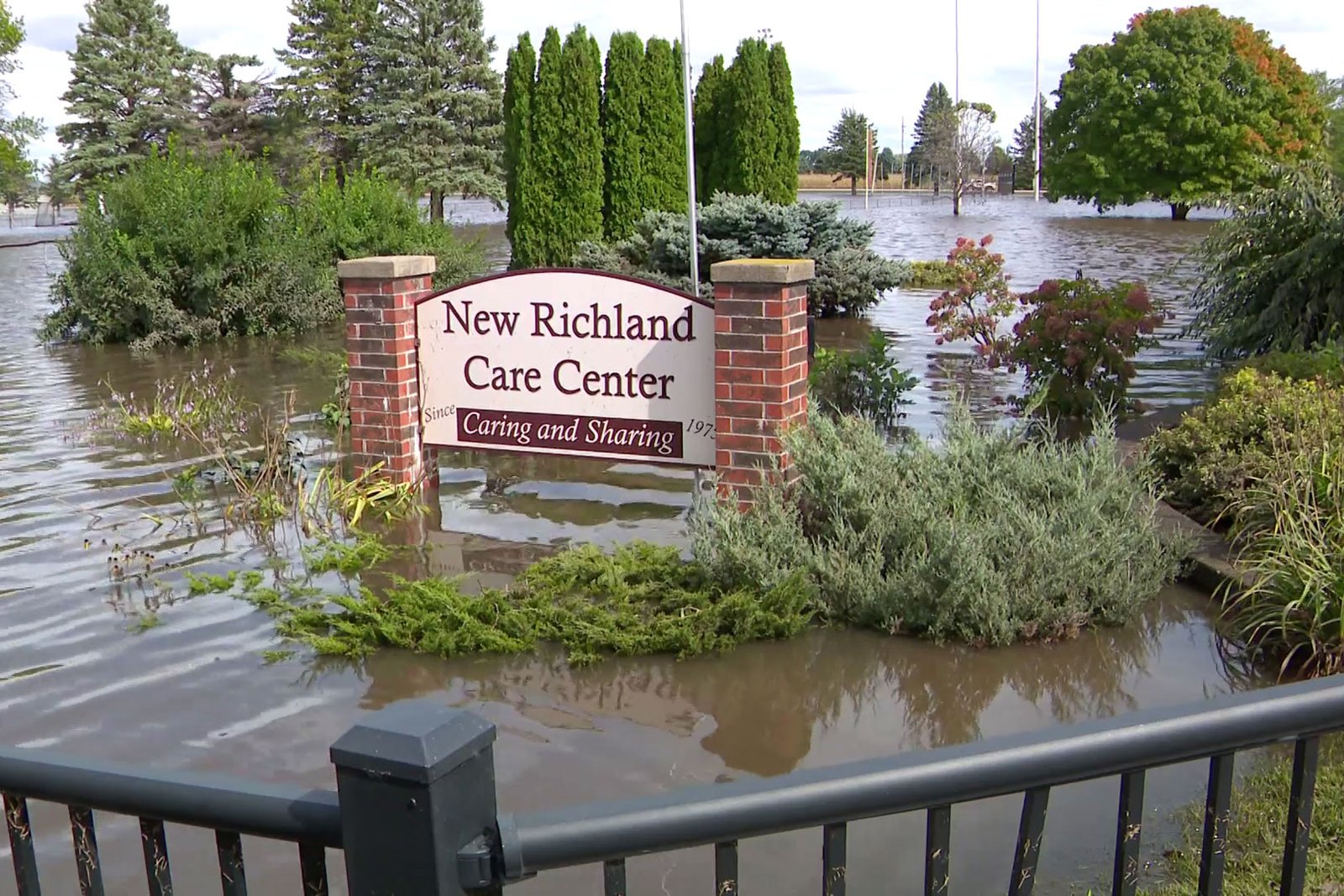
    Inside the New Richland Care Center, staff members rushed to move 36 residents out of the building on Sept. 19 while they still could. They pushed elderly residents in wheelchairs through 4-inch-deep water to buses waiting in the parking lot, said nursing home administrator Robert Johannsen.

    Inches turned to feet as the last three residents were wheeled out on hospital beds, lifted “as high as they can go” to escape the rising water, Johannsen said. Firefighters and volunteers from a high school football team pushed the beds to safety across the street, he said.

    “It’s pretty devastating,” Johannsen said of the now-shuttered nursing home. “There was at least 2½ feet of water flowing down the hallways.”

    The small-town, government-run nursing home is about 100 yards from a drainage ditch in southern Minnesota. It has flooded three times in 16 years, including during the September storm that was large but far from historic, according to the National Weather Service.

    New Richland is one of 100 U.S. nursing homes that face some of the nation’s worst flood risk — where at least 2 feet of water during a big storm could endanger residents — according to a KFF Health News analysis of peer-reviewed flood hazard mapping provided by Fathom, a United Kingdom-based company considered a leader in flood simulation.

    The KFF Health News analysis builds upon a 2025 investigation that used Fathom’s mapping to identify at least 170 U.S. hospitals at risk of significant flooding. Fathom’s estimates are generally seen as more modern than official flood maps released by the Federal Emergency Management Agency, which are often out of date and don’t account for the changing climate.

    “Every community across the United States carries some level of flood risk,” said Oliver Wing, the chief scientific officer at Fathom. “There is this idea that unless you can either see the ocean or the Mississippi from your front room, then you’re not at risk of flooding — when the reality is that anywhere rain can fall, it can flood.”

    The U.S. has nearly 15,000 nursing homes housing more than 1.2 million people. In floods and other disasters, the residents are especially vulnerable because many are medically frail, cognitively impaired, or immobile. Some require daily care that can’t be reliably provided during a disaster, yet they are also so fragile that relocation could send them to the emergency room.

    Additionally, many nursing homes were built near coastlines or waterways in the 1970s, before widespread concern about climate change, to keep residents cool and content, said David Dosa, the head of geriatrics at the UMass Chan Medical School.

    “It’s a lot more comfortable than being in an urban jungle,” Dosa said. “Obviously, now you’re in places that are a little more at risk.”

    Dosa has studied nursing home evacuations since Hurricane Katrina flooded the New Orleans area in 2005. Dozens of people were killed in facilities that tried to ride out the storm and flooded after the levees broke.

    After Katrina, the nursing home industry pivoted toward evacuations, although some of those decisions also led to deaths, Dosa said.

    In preparation for the next three Gulf hurricanes, more than 270 nursing home evacuations were recorded, according to a peer-reviewed study Dosa co-wrote in 2011. Within the 30 days that followed each storm, the regions hit saw a cumulative total of 277 more nursing home resident deaths than expected, suggesting a “significant increase in mortality and morbidity associated with evacuation,” according to the study.

    “It’s Russian roulette. You’re damned if you do. You are damned if you don’t,” Dosa said of evacuations. “Older adults and disasters don’t mix.”

    A similar study published in 2024 found a 16% greater chance of ER visits among residents of Florida assisted living facilities who were evacuated before Hurricane Irma in 2017. People in assisted living facilities generally need less care than those in nursing homes.

    “Assisted living residents are quite frail in their own right,” said Cassandra Hua, an assistant professor at UMass Lowell, who led that study. “But nursing home residents are usually at higher risk. So anything you see in assisted living might be multiplied in a nursing home setting.”

    Even a few inches of flooding can interrupt nursing home care and force an evacuation. For each of the 100 nursing homes identified by the KFF Health News analysis, Fathom’s data predicted a 100-year flood event could bring at least 2 feet of water to the buildings.
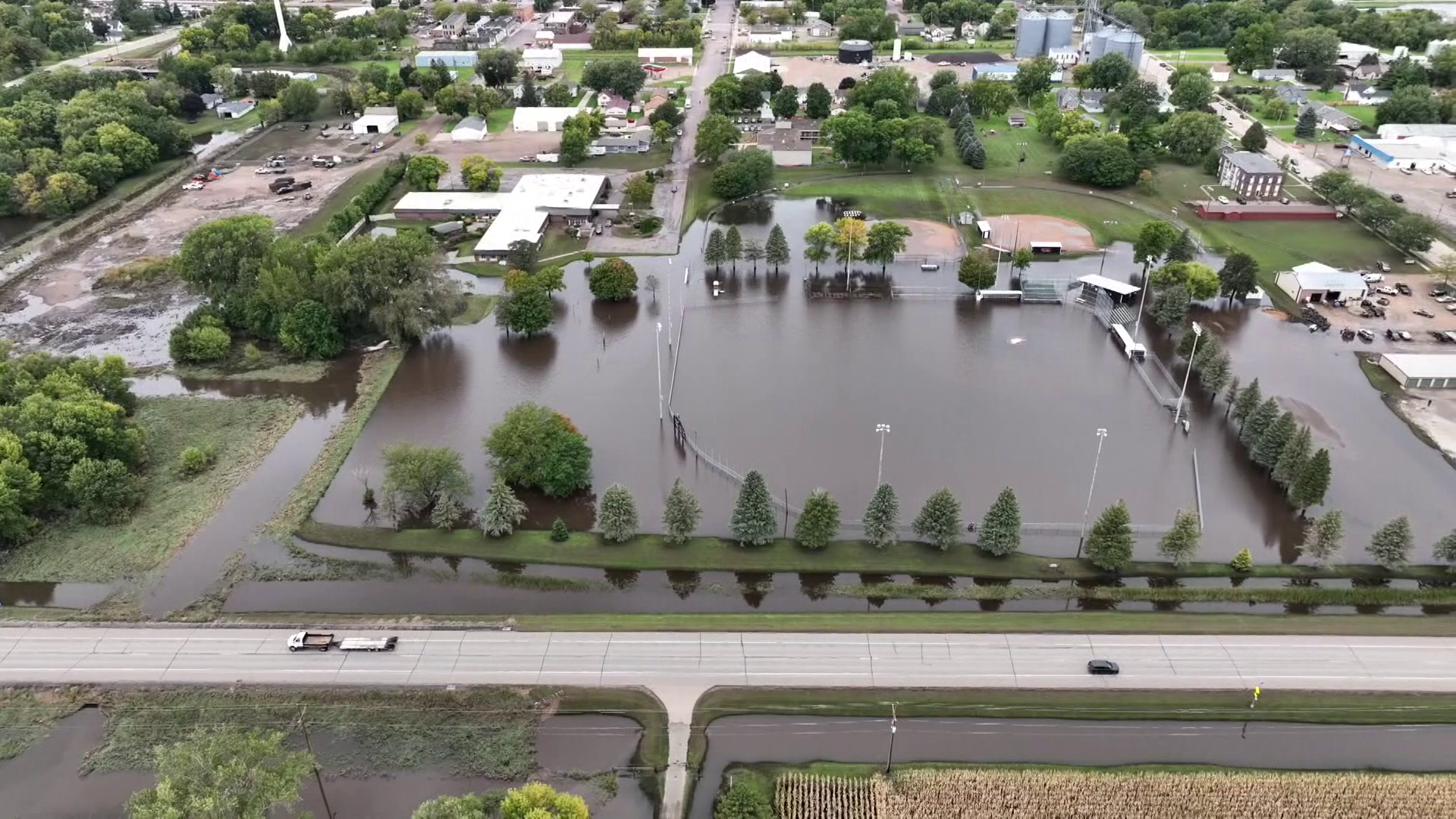
    In an aerial image, a baseball field beside a road is flooded with water. The road is dry.
    Aerial footage shows lingering floodwater in New Richland, Minnesota. The white-roofed New Richland Care Center can be seen along the upper-left edge of the ponding water. (WCCO/CBS Minnesota)

    A 100-year flood is an intense weather event with a 1% chance of occurring in any given year, but it can happen more often. Climate scientists largely agree that extreme weather is worsening as the planet warms, which allows the atmosphere to hold more moisture and causes sea levels to rise.

    And storms are drenching regions once considered at lower risk for flooding, where essential facilities and entire communities might be less prepared, said Drew Gronewold, a University of Michigan climate scientist. In other regions, storms are now less frequent but becoming “off-the-charts” powerful, he said.

    “Storm tracks are changing their trajectory,” Gronewold said. “These types of, in air quotes, ‘unanticipated events’ are going to be part of our future.”

    Some of the nursing homes KFF Health News has identified as at risk have flooded in the past five years, including facilities in Florida, Kentucky, Texas, and Washington.

    Five of the facilities flooded in 2012 as Superstorm Sandy clobbered New York, according to a report from the Natural Resources Defense Council, while a sixth, the elevated Seagate Rehabilitation and Nursing Center, narrowly rode out the storm. In Indiana, more than 150 people were evacuated from the five-story Munster Med Inn during Hurricane Ike in 2008. Members of the National Guard carried some residents down flights of stairs in the dark.
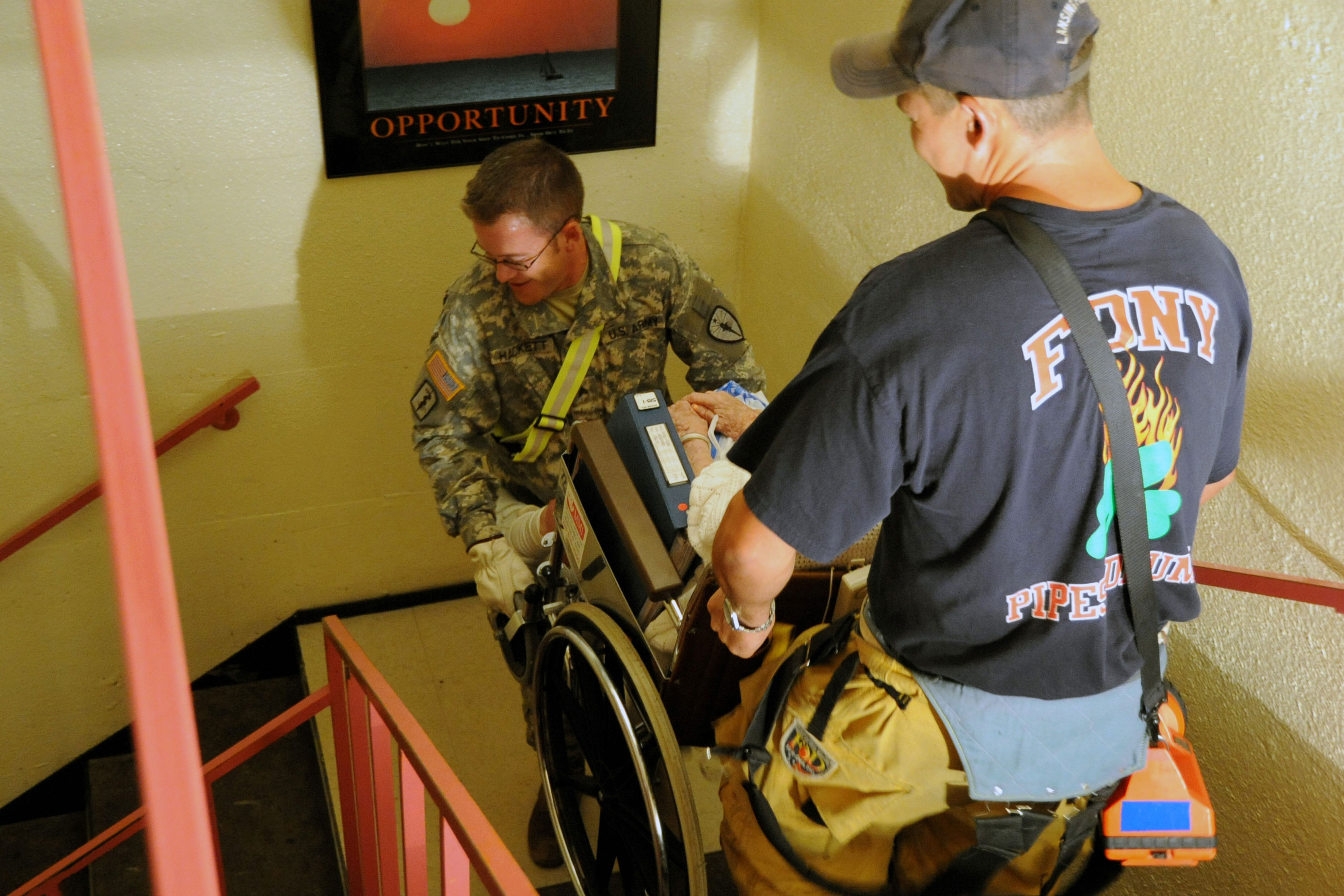
    A photograph from above of two men carrying a person in a wheelchair down a flight of stairs.
    Rescuers from the Indiana National Guard and the Munster Fire Department evacuate a resident of the Munster Med Inn in Indiana, in the wake of Hurricane Ike in 2008. More than 150 residents were evacuated, according to a U.S. Army news release. (Michael B. Krieg/Indiana National Guard)

    Then there is the New Richland Care Center. Local media reports show it was evacuated due to flooding in 2010 and 2016, then partially surrounded by floodwater in 2023, before the Sept. 19 evacuation.

    Storms dropped 4 to 8 inches of rain on much of southeastern Minnesota the day before, setting off widespread flooding, said National Weather Service meteorologist Brennan Dettmann. The rainfall was heavy for September but would not have been out of place in July, he said.

    It was too much for New Richland. Storm runoff from nearby farms pooled in a low-lying baseball diamond at the edge of town before swamping nearby streets. Johannsen, the nursing home administrator, said maintenance workers who were trying to fix sewer drains called him in the middle of the night to warn about flooding in the park across the street.

    “They said, ‘You need to come in. The water is rising,’” Johannsen said. “At that point, I think the water was a good 30 feet away from the building. I wasn’t really concerned.”
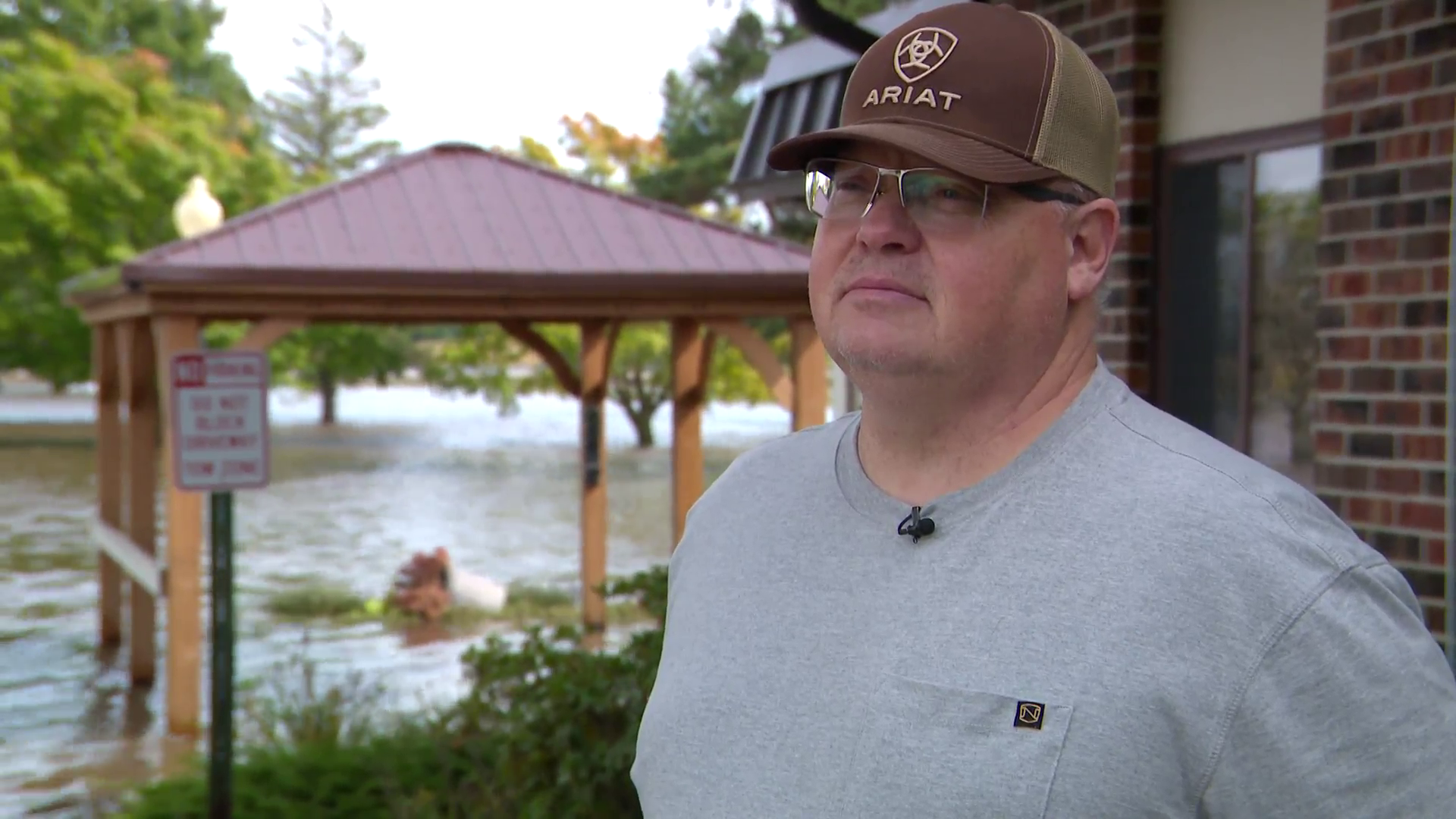
    A man stands in front of a building and the area next to the building behind him is flooded with water.
    The New Richland Care Center in southeastern Minnesota flooded on Sept. 19, forcing the evacuation of 36 residents. Some residents were pushed on hospital beds through feet of floodwater to escape the facility, administrator Robert Johannsen says. (WCCO/CBS Minnesota)

    Wing, the Fathom scientist, said the danger should have been obvious. Although Minnesota’s natural landscape once would have absorbed heavy rains, the farmland around New Richland funnels runoff into creeks and ditches that lead to a low-lying bowl near the nursing home. It’s almost as if the location is designed to flood, Wing said.

    “The choice has been made that we don’t want water in our crop fields. We want it in the nursing homes of vulnerable people,” Wing said. “That’s the choice that has been made, politically, in that part of Minnesota.”

    Inside the ruined nursing home, receding floodwaters left behind knee-high watermarks, mud-smeared floors, and a lingering smell that Johannsen said reminded him of growing up on a farm. Water destroyed treasured photo albums left behind in a low cabinet, he said.

    Johannsen said the nursing home — which, with 85 employees, is one of the largest employers in town — will be closed for five months to a year for repairs. He said all its residents were moved into a school gymnasium and have been resettled across about nine area nursing homes.

    “It was an awful experience that I hope nobody ever has to go through. Because these people lost homes,” Johannsen said. “My staff is losing their jobs. And I don’t know what to do.”
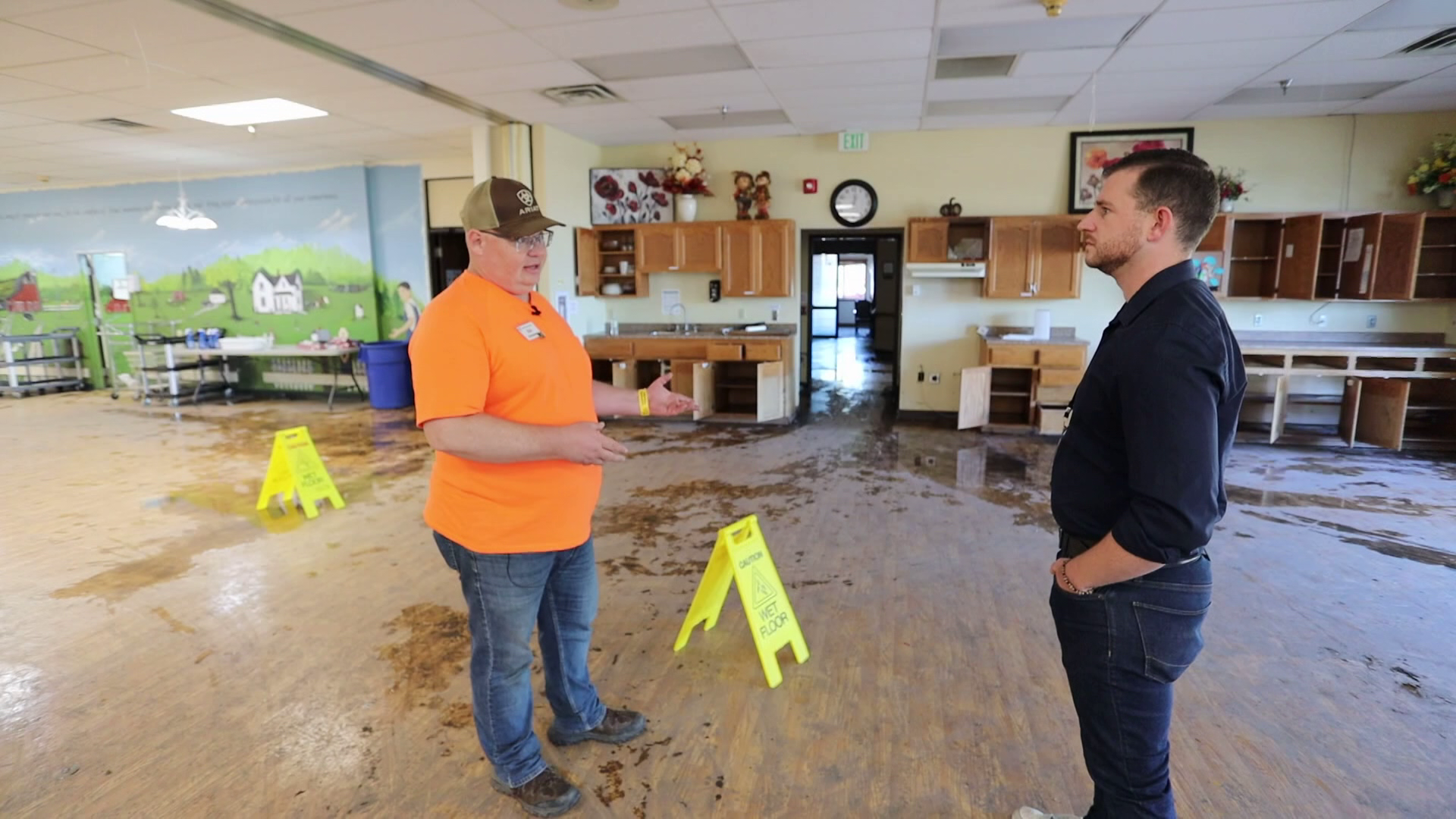
    Two people stand inside a large room and talk. Areas of the floor have standing water and two
    New Richland Care Center administrator Robert Johannsen (left) examines the damaged nursing home in the wake of a Sept. 19 flood that forced the evacuation of 36 residents. Johannsen says the facility will be closed for months for repairs. (WCCO/CBS Minnesota)

    Methodology

    For this analysis, we used data from Fathom, a United Kingdom-based company that specializes in flood-risk modeling worldwide. To assess the United States’ vulnerability, Fathom uses sophisticated computer simulations and detailed terrain data covering the country. It accounts for environmental factors such as climate change, soil conditions, and many rivers and creeks not mapped by other sources. Fathom’s modeling has been peer-reviewed and used by insurance companies, the World Bank Group, the Nature Conservancy, and government agencies in Florida, Texas, and elsewhere. The Iowa Flood Center has validated Fathom’s U.S. data.

    Through a data use agreement, Fathom shared U.S. mapping data that predicts areas with at least a 1% chance of flooding in any given year. Fathom’s data estimates the effects of coastal, fluvial, and pluvial flooding and accounts for dams, reservoirs, and other structures that defend against floods.

    To identify at-risk nursing homes, we used a Centers for Medicare & Medicaid Services database to map more than 14,000 nursing homes. With GPS coordinates as the center point, we created a circle with a 100-yard radius around each nursing home, which in most cases captured the building and nearby grounds. We then mapped Fathom’s flood-risk data to see where it overlapped with these circles. We started by looking for nursing homes where at least 20% of the circle’s area had a predicted flood depth of at least 1 foot. That gave us an initial list of more than 750 nursing homes.

    Then we visually inspected those facilities using mapping software and Google Maps to confirm that floodwaters were predicted to reach or surround the buildings. We trimmed our list to the 100 nursing homes where the most flooding was predicted, with additional weight given to deeper water.

    Our analysis does not account for how flooding beyond a nursing home’s footprint could still affect employees or patients. And it does not assess what steps facilities may have already taken to prepare for severe weather events.

    Fathom provided guidance and feedback as we developed our analysis.
  • STAT+: Anthropic joins ARPA-H clinical AI moonshot, will hold closed-door health care event

    STAT+: Anthropic joins ARPA-H clinical AI moonshot, will hold closed-door health care event

    You’re reading the web edition of STAT’s health tech newsletter

    Nicolas TUCAT / AFP via Getty Images

    Mario covers technology in health care, including FDA regulation of artificial intelligence; how Medicare pays for health tech; the use of AI in clinical care; mental health chatbots; and consumer wearables. He’s also the co-author of the free, twice weekly STAT Health Tech newsletter. You can reach Mario on Signal at mariojoze.13.

    You’re reading the web edition of STAT’s Health Tech newsletter, our guide to how technology is transforming the life sciences. Sign up to get it delivered in your inbox every Tuesday and Thursday.

    Good morning health tech readers!

    Anthropic has been loudly warning that AI might one day lead to catastrophe. And yet, the company is moving aggressively into health care, even as AI regulation is in a state of flux.

    STAT+ Exclusive Story

    Already have an account? Log in

    STAT+

    STAT+

    This article is exclusive to STAT+ subscribers

    Unlock this article — plus in-depth analysis, newsletters, premium events, and news alerts.

    Already have an account? Log in

    View All Plans

    To read the rest of this story subscribe to STAT+.

    Subscribe

    1. Health Tech Correspondent

      Mario covers technology in health care, including FDA regulation of artificial intelligence; how Medicare pays for health tech; the use of AI in clinical care; mental health chatbots; and consumer wearables. He’s also the co-author of the free, twice weekly STAT Health Tech newsletter. You can reach Mario on Signal at mariojoze.13.

  • PubMed Update: Data Updates Scheduled for 2027 Baseline

    PubMed Update: Data Updates Scheduled for 2027 Baseline

    There will be no change to the PubMed DTD for 2027. There are two upcoming changes to PubMed data that will take effect when the 2027 PubMed baseline is published:

    1. A new allowed value “NotIndexed” will be added for the IndexingMethod attribute of the element.
    2. PubMed FTP data will be generated using the new process announced in June 2025.

    New Allowed IndexingMethod Value

    Introduced with the 2017 DTD, IndexingMethod specifies the method used to assign Medical Subject Headings (MeSH) to the citation. The current allowed values include:

    • Curated – MeSH indexing is provided algorithmically and a human reviewed (and possibly modified) the algorithm results
    • Automated – MeSH indexing is provided algorithmically
    • Manual – MeSH indexing is provided by humans

    A fourth allowed value, “NotIndexed” will identify citations that are in scope for MEDLINE but do not have abstract text in PubMed and therefore are not indexed with MeSH terms. During Year-End Processing in December 2026, NLM will move these citations from In Process status to MEDLINE status and assign the NotIndexed value. If abstract text is later provided to PubMed, the citation will be indexed, and the status will be updated to the appropriate IndexingMethod allowed value.

    PubMed data consumers parsing the IndexingMethod attribute should prepare for this new value.

    Updated FTP Data

    Starting with the annual baseline release in December 2026, the content of PubMed data distributed via FTP will be generated using the same technology as the PubMed website and E-utilities API; this update means the FTP data will match the PubMed website and API.

    Test FTP data generated with the new process is available to help prepare for this transition. Users are encouraged to view the test data and check their workflows. Please share any questions or feedback via the NLM Help Desk. Please note, the test files may differ from the current FTP files due to the data differences described in the June 2025 FTP announcement.

    For more information about accessing PubMed data via FTP, please see: Download PubMed Data.

    Contact the NLM Help Desk

    Please reach out to us if you have questions about these PubMed updates.

  • Why MAHA wants to make health data much more accessible

    Why MAHA wants to make health data much more accessible

    WASHINGTON — The Make America Healthy Again movement wants your health data.

    The MAHA Institute, a think tank formed by allies of Robert F. Kennedy Jr. after his appointment as health secretary, held an event on Monday that emphasized the benefits of opening up health data sharing in the United States. In particular, the event highlighted how sharing patients’ health records with federal researchers could benefit the study of the origins of chronic diseases.

    In a speech at the event, Kennedy said that user agreements restrict access to data, giving “institutions that control important health data the power to decide who can study it and what questions they’re allowed to ask, and that creates protectionism in science and it leads to the politicization of science.”

    “A qualified researcher with legitimate hypotheses should not need permission from a gatekeeper to test it, particularly from an industry gatekeeper,” he said in his remarks, which began and ended with a standing ovation.

    The idea of using data from health information exchanges for research is controversial because of privacy concerns.

    Speakers throughout the day brought up the state of Nebraska’s partnership with the federal government. As reported earlier this year by KFF Health News, Nebraska’s health information exchange network, called CyncHealth, is sharing patient data with the federal government to enable studies on vaccines and autism. 

    Kennedy said Monday he wants to aggregate “immunization records, clinical data, laboratory results, pharmacy information, and claims to create a more complete picture of a patient’s health over a long period of time.” That data would come from state health information exchanges, EHRs, laboratories, Medicare, Medicaid, and commercial health data platforms like HealthVerity. 

    “We’re already using all these data to answer some of our most important questions. Too much remains fragmented, vulcanized, difficult to link, and inaccessible to researchers,” he said, citing a desire to aggregate the data and make it available to all researchers.

    While KFF reported Nebraska’s partnership was with the Centers for Disease Control and Prevention and focused on vaccines and autism, MAHA Institute President Mark Gorton said a partnership between Nebraska and the National Institutes of Health “has successfully produced data for the study of chronic disease and serves as a proof of concept for the state-federal hybrid model.” Neither partnership seems to have been publicly announced, though the NIH has already stood up an effort to build Medicare and Medicaid databases within the NIH in an effort to better understand autism.

    Nebraska’s CyncHealth was, until the end of last year, led by Jamie Bland, who became chief data strategist of the MAHA Institute in April.

    At the time of KFF’s reporting, leaders of other state health information exchanges decided not to share information with the government. Using such data for research could run into patient privacy, ethics, and legal issues.

    For example, Jonathan Ketcham, who was chief health care economist at the White House until earlier this year, when he moved back to his economics professorship at Arizona State University, said on Monday that Arizona’s health information exchange data “cannot be used, even de-identified, for researcher grants without individual consent” from providers.

    “The issue is not a technical limitation,” Andrew Kress, CEO and founder of data company HealthVerity, told STAT last year. “It’s really been more around data governance, data ownership, data privacy. Those are the reasons that these things have not worked, more so than you can’t find the right data to do it.” Hospitals, for example, sometimes sell their patients’ de-identified data, or carefully grant access under data use agreements that spell out what purpose the data can be used for. Patients also normally have to consent to their information being used for research.

    Gorton said that the partnership with Nebraska has only worked “because of the investments that Nebraska has made in data governance.” “If this model is going to expand, we will need to see other states make similar investments in the mundane yet crucial function of data governance,” he said.

    The administration has sought to give patients more control over their own data through initiatives like the CMS Health Tech Ecosystem. “Liberate patient records,” said top HHS official Chris Klomp at a STAT event in March. “Let us be very clear on CMS’ official position on this: The record belongs to the patient. It goes everywhere the patient needs to go. We’re serious about this.” 

    But the improved health data infrastructure from these and other Trump administration efforts would help standardize health data, making it ripe for helping answer research questions.

    “We’ve had a lot of public controversy about vaccine safety,” said Donald Rucker, chief strategy officer at 1upHealth and national coordinator for health IT during the first Trump administration. “Many of the [health information exchanges] could answer these questions right now if the immunization registries weren’t actually unlinked to the HIEs,” he said.

    Gorton said at the event that the partnership with Nebraska is a model for state-federal cooperation on health data, and that all 50 states will try different approaches to “growing America’s health data infrastructure.”

    “With these successes, residents will experience health data record portability and a better healthcare experience. Once citizens experience what is possible in one state, other states will rush to follow,” said Gorton. “This pilot is just one small step on a long journey, and we are excited to be part of this adventure.”

  • STAT+: The last ‘breakthrough’ devices to get special treatment from Medicare

    STAT+: The last ‘breakthrough’ devices to get special treatment from Medicare

    Katie covers the impact of health technology on patients, clinicians, and businesses. Her stories explore the price tag of clinical AI, digital health at the FDA, and the boom in direct-to-consumer telehealth. Confidential tips can be sent on Signal at palmer.01.

    In the last month, manufacturers have announced “breakthrough” status from the Food and Drug Administration for a menagerie of devices: triage algorithms for abdominal CT scans, diagnostic panels for urinary tract infections, and thrombectomy robots, to name a few.

    They’re coming in just under the wire: As of October, new breakthrough-designated devices will no longer be eligible for special treatment when it comes to qualifying for extra Medicare payments. These devices, and more than a dozen others, are included in the latest update of STAT’s Breakthrough Device Tracker, which since 2022 has captured nearly 800 devices reported to have FDA breakthrough status. 

    In August, the Centers for Medicare and Medicaid Services finalized the removal of pathways that have made it easier for breakthrough devices to qualify for supplementary Medicare payments for both inpatient and outpatient use. Since 2020, devices that received the designation from the FDA have been able to qualify for new technology add-on payments and transitional pass-through payments without proving they provide a substantial clinical improvement over alternatives, or that they are new. 

    STAT+ Exclusive Story

    Already have an account? Log in

    STAT+

    STAT+

    This article is exclusive to STAT+ subscribers

    Unlock this article — and get additional analysis of the technologies disrupting health care — by subscribing to STAT+.

    Already have an account? Log in

    View All Plans

    To read the rest of this story subscribe to STAT+.

    Subscribe

  • Risk from toxic metals can persist months after wildfires, Maui study finds

    Risk from toxic metals can persist months after wildfires, Maui study finds

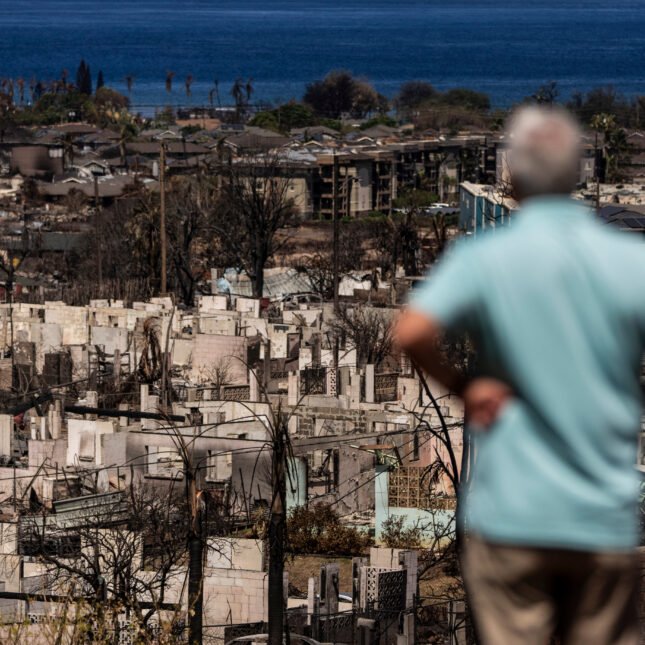
    Metal mixtures found in the leftover smoke, ash and debris from the deadly 2023 Maui wildfires were harmful to the lung health of people living nearby long after the burning ended, a new study says.

    The work shows that major wildfires, which are worsening with the planet’s warming, could have lasting effects beyond immediate exposure.

    Post-wildfire air quality needs to be monitored longer term, the research suggests, and recovery efforts need to consider what might remain in contaminated soot, residue and dirt well after burning stops.

    The wildfires, caused by wind spreading a brushfire spurred by downed power lines, burned on the Hawaiian island of Maui in August 2023, destroyed the town of Lāhainā and killed more than 100 people. They were among the deadliest in U.S. history.

    New research published in the journal Proceedings of the National Academy of Sciences on Monday found higher metal levels, associated with respiratory harm, in nearby residents up to a year and a half after the fires.

    As part of the Maui Wildfire Exposure Study, one of the largest postfire investigations in the country, University of Hawai‘i researchers studied the urine of 1,400 adults. They found substantially elevated concentrations of metals such as arsenic, cadmium, copper and antimony.

    Chemicals from burned buildings and electronics

    These metals could be the result of burned buildings, vehicles, electronics and other materials lost in the wildfires, the researchers say. They can cause a different human impact than simply the burned vegetation that is typically studied after fires of this magnitude.

    “What we’re dealing with, especially in the aftermath of what we experienced in Lāhainā, is a much more complicated mixture of these chemical exposures,” said Alika Maunakea, co-principal investigator of MauiWES and an anatomy, biochemistry, and physiology professor at the University of Hawai‘i, Mānoa.

    Alika Maunakea: Consequences of fire “can unfold over many years.”
    Crystal Milner/STAT

    The researchers found antimony nearly 40 times higher in the Maui participants than U.S. biomonitoring data. They found manganese 3.8 times higher, barium 2.3 times and arsenic 2.2 times.

    Having more metals in the body was more likely to result in abnormal lung function, such as having less breathing capacity and difficulty moving air in and out of one’s lungs, during standard breathing tests, the study found.

    Those lung effects aligned with the geographic distribution of smoke and ash; those nearest to Lāhainā, and Wailuku and Kahului, experienced a different impact than in those near Kula.

    “It’s really important to identify potential sources of these exposures and to mitigate and reduce potential risks for re-exposures that might be contributing to these effects,” Maunakea said. “What happens to the land and environment can shape what people breathe, take into their bodies, and develop over time. The consequences of that can unfold over many years.”

    Warming planet can worsen wildfires

    Wildfires are getting larger, more intense, faster-moving and more frequent in certain parts of the globe, experts say, in part due to the warming and drier weather associated with climate change. Human-caused climate change has upped the likelihood of many major fires around the world in recent years and led to fires in regions that typically do not see them as often.

    The researchers did note a limitation of the study in that it cannot assess exactly how much of the impact came directly from the wildfires versus chronic or other exposures — such as Hawai‘i’s geology, diet, historic agricultural and industrial activity and environmental sources — given there is no comparable data from before August 2023.

    However, previous studies have also found significant long-term human impacts from wildfires and other environmental crises. The impacts have included lung issues and mental health issues such as depression.

    “This is bigger than wildfires. These climate-related disasters can change the environment in ways that continue after the immediate emergency is over,” said Ruben Juarez, co-principal investigator of MauiWES and professor of health economics at the university. “Floods, hurricanes, fires, and other disasters definitely can disturb soil, debris, buildings, and legacy contaminants that we have in Hawai‘i, creating these pathways for exposure. … Disaster response should not stop when visible danger is gone.”

    Kekoa Taparra, a physician and assistant professor who studies chronic diseases at the University of California, Los Angeles, said the research expands our understanding of the health burden of the fires, particularly over an extended period.

    “This type of work echoes that climate-related disasters affect human health well beyond the immediate injuries and deaths we see during the event itself,” said Taparra, who was not involved in the study released Monday but has studied the health impacts of disasters. “Historic wildfires in Lāhainā  and even Los Angeles have highlighted how these disasters can produce longer-lasting consequences through displacement, disruption of healthcare and social networks, environmental exposures, and potentially increased mortality.

    “As these events become more frequent and severe, understanding and measuring their full health impact will be essential to building more resilient communities and health systems.” — Alexa St. John

  • Introducing Linked Discoveries!

    Introducing Linked Discoveries!

    Linked Discoveries™ is an experimental pilot resource developed by the National Library of Medicine (NLM) that helps users explore how articles with PubMed® abstracts connect to the surrounding literature. Linked Discoveries creates neighborhoods of related articles, highlights shared conditions, genes, and chemicals across the neighborhood, and surfaces context like NIH funding, citation relationships, retractions, and reviews.

    The information displayed and available in Linked Discoveries comes from PubMed, including abstracts and reference data, along with related condition, gene, and chemical data linked from other NLM databases like Gene, MedGen, and PubChem®.

    How does Linked Discoveries relate to PubMed’s Similar Articles?

    Both Linked Discoveries and PubMed Similar Articles identify neighborhoods of related articles, but each is built for a different kind of task and does this in different ways.

    PubMed Similar Articles generates a ranked list of related articles that can be combined with other PubMed searches for further refinement. For more information, refer to the Similar Articles section of the PubMed User Guide.

    Linked Discoveries is a dynamic, interactive tool that lets users explore the research neighborhood itself to surface shared topics such as conditions, genes, and chemicals, along with contextual signals like citation relationships, retractions, and reviews. It uses an AI-informed approach to build neighborhoods of related articles. For more information, refer to the Linked Discoveries User Guide.

    How can I access Linked Discoveries?

    When looking at an abstract page in PubMed, you may see a “Linked Discoveries” button along the right-hand column on larger screens or below the title on smaller screens. Please note that this button is only available on abstract pages for articles that represent original research, reviews, and related evidence.

    To explore a “neighborhood” of related articles for the PubMed record of interest (the “seed” article), click the Linked Discoveries button. A new browser tab will open and in Linked Discoveries, you will be able to:

    • View your article of interest (the “seed”). Your seed article appears as the light blue node labeled “Seed” in the top left corner of the visualization. In the timeline view, a dotted blue line marks the publication year of the seed article.
    • View related articles (the “neighborhood”). Each article in the neighborhood is represented by a node labeled with the first author and year of publication. The node color indicates the article type. See the key at the bottom of the visualization to identify article types.
    • Filter the neighborhood by shared topics. Filter by condition, gene, or chemical to narrow the neighborhood to articles sharing those topics. You can select one or more topics to filter on and choose whether the neighborhood is narrowed to records tagged with any of the selected topics, or all the selected topics.
    • View details for a selected node. By default, details for the seed article are shown in the article information card to the right of the graph or timeline. Click a different node to view its details instead. Filter the graph or timeline by clicking on the name of a specific condition, gene, or chemical on the information card. Click “View in table” to view the neighborhood in a structured table format.
    • Build a new neighborhood from one of the nodes. Click “Set as seed article” to generate a new neighborhood from any of the nodes in the current visualization.

    Your feedback will help guide our next steps!

    Linked Discoveries is an experimental pilot resource still under active refinement, with ongoing exploration of new features and capabilities planned for future releases. We invite you to try Linked Discoveries, explore a topic of interest to you, and share your thoughts using the Feedback button on any Linked Discovery page. Your feedback will help us shape where this pilot goes next!

    How can I learn more?

    Consult the Linked Discoveries User Guide which provides helpful information as well as some tips on using the resource.

    [Editor’s note: NCBI Insights published a more detailed blog post.]

  • STAT+: The rise of the AI-native radiology practice

    STAT+: The rise of the AI-native radiology practice

    Mario covers technology in health care, including FDA regulation of artificial intelligence; how Medicare pays for health tech; the use of AI in clinical care; mental health chatbots; and consumer wearables. He’s also the co-author of the free, twice weekly STAT Health Tech newsletter. You can reach Mario on Signal at mariojoze.13.

    Good morning health tech readers!

    It’s gonna be a great day. 

    Reach me: [email protected]

    The Medicare RPM backlash

    Medicare’s plan to rein in spending on remote patient monitoring has prompted surprising pushback from insurers. Under these billing codes, Medicare pays health care providers to track and manage the health of their patients using connected devices like blood pressure cuffs.

    As I report in a new story, UnitedHealth Group, CVS Health, and Kaiser Permanente all wrote letters opposing a medicare proposal that such remote-monitoring services be rendered directly by employees of the provider billing for it. Currently much of RPM is delivered by vendors working under the supervision of the billing providers.

    STAT+ Exclusive Story

    Already have an account? Log in

    STAT+

    STAT+

    This article is exclusive to STAT+ subscribers

    Unlock this article — plus in-depth analysis, newsletters, premium events, and news alerts.

    Already have an account? Log in

    View All Plans

    To read the rest of this story subscribe to STAT+.

    Subscribe

  • How we’re using Proxygen to transform API development

    Jonathan Eagle explains how the NHS England API Management team tackled some of the biggest pain points in API development in the NHS – and how a new tool called Proxygen is cutting integration time with the NHS API Platform from weeks to days.

  • STAT+: In radiology, AI is blurring the line between technology development and clinical practice

    STAT+: In radiology, AI is blurring the line between technology development and clinical practice

    Katie covers the impact of health technology on patients, clinicians, and businesses. Her stories explore the price tag of clinical AI, digital health at the FDA, and the boom in direct-to-consumer telehealth. Confidential tips can be sent on Signal at palmer.01.

    A decade ago, machine learning scientist and Nobel laureate Geoffrey Hinton made a proclamation that still puts radiologists on edge.

    “If you work as a radiologist,” the so-called godfather of artificial intelligence said at a conference, “you’re like a coyote that’s already over the edge of the cliff, but hasn’t yet looked down.” Deep learning was getting so good, so fast, said Hinton, that “people should stop training radiologists now.” In five years — ten, max — AI would do better than radiologists, he predicted. 

    The clock has run out on that prediction. But the field of radiology isn’t just staring at its shoes, waiting to see how technology upends the profession. Instead, a growing number of radiology practices, in particular outpatient and teleradiology groups, are aggressively embracing AI: developing and acquiring their own tech, deploying it in-house, and marketing their “AI-native” capabilities to radiologist employees and hospital customers alike. 

    STAT+ Exclusive Story

    Already have an account? Log in

    STAT+

    STAT+

    This article is exclusive to STAT+ subscribers

    Unlock this article — and get additional analysis of the technologies disrupting health care — by subscribing to STAT+.

    Already have an account? Log in

    View All Plans

    To read the rest of this story subscribe to STAT+.

    Subscribe