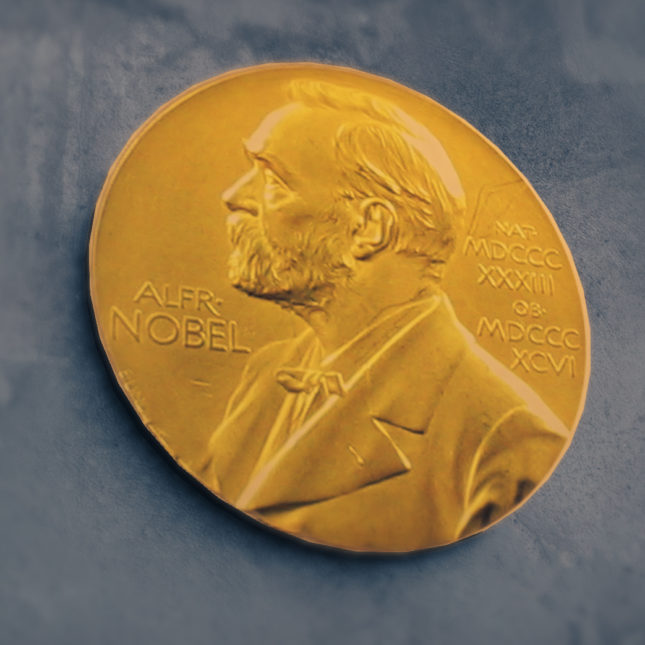
Henri B. Kagan and Kenso Soai were awarded the 2026 Nobel Prize in chemistry on Wednesday for discovering how to manipulate “mirror image” molecules, paving the way for manufacturing more precise and safer drugs.
Kagan, 95, of the Université Paris-Sud in France, and Soai, 76, of Tokyo University of Science in Japan, solved a chemical mystery: Some molecules exist in the world that are mirror images of one another. This is a phenomenon known as chirality, from the Greek word for hand (as hands are mirror images of one another). Amino acids, the building blocks of proteins, are among chiral molecules, and a living organism can only contain one of the versions. The other mirror molecule is found rarely elsewhere in nature. More than half of clinically employed drugs are chiral, so understanding how this imbalance of two mirrored molecules occurs had crucial relevance for pharmacology.
As the Nobel Committee puts it, imagine needing to make copies of a set of keys, but when you try to make them, you get both the key that correctly fits the lock, and a mirror image of it. It’s very hard to distinguish which is which, so you risk trying the wrong key into the lock.
The stakes are much higher if that key is a drug: when chemists develop new drugs, they often end up with some of their chiral versions, too. Sometimes, the mirror molecule does something completely different from what it was originally intended to — take novrad, a cough medicine, and darvon, a painkiller, which are chiral molecules (hence their mirror names, too). Other times the mirror molecule can cause serious side effects.
Still, drugs are typically sold as so-called “racemates” containing an equal mixture of both molecules, and prior to Kagan and Soai ,it was pretty much the only option, as chemists had not found a way to produce a molecule without its chiral version in equal parts.
That changed with the scientists’ “discovery of non-linear effects and autocatalysis in asymmetric organic synthesis,” as the Nobel Committee described it. In 1986, Kagan found a way to manipulate chemical reactions so that they produced more of one type of mirror images. Seventeen years later, Soai was finally able to develop an experiment that created only one of the two variants, creating a chiral molecule out of a non-chiral combination of molecules for the first time “since the dawn of life.”
“This is probably the coolest experiment in organic chemistry,” said Peter Somfai, a member of the Nobel Committee for Chemistry, referencing the Soai reaction.
From a pharmaceutical point of view, this opened the door to the creation of chiral drugs containing only the necessary version of the molecule, achieving greater precision and lower side effects.
“I’m very excited to receive this very nice news about the Nobel Prize,” said Soai, calling into the award ceremony at the Karolinska Institutet in Stockholm, Sweden, from his native Hiroshima, Japan. “Of course this is one of the most exciting days of my life. I am very glad to share the award with professor Kagan.”
There have been 202 award winners since the first chemistry prize was awarded in 1901, of which 8 have been women. However, only 200 individuals won the award, as both Frederick Sanger and Barry Sharpless have been awarded twice. The youngest recipient was 35, the oldest 97.
The award has been given 118 times: 63 times to a single individual, and has been shared among two winners 26 times, and among three (the maximum allowed by the Nobel statute) 29 times.
The winners will receive 12 million Swedish Kronor (SEK), or roughly $1.2 million.
The medicine and physics prizes were awarded earlier this week.