Tag: Health Tech

  • The fall of Roe dramatically changed abortion access. This researcher used Reddit to capture how

    The fall of Roe dramatically changed abortion access. This researcher used Reddit to capture how

    Betsy Pleasants was studying one historic disruption to abortion access when a more seismic one emerged.

    In spring 2022, as a graduate student at UC Berkeley School of Public Health, Pleasants was researching the effects of the Covid-19 pandemic on abortion services when a leaked draft opinion indicated that the U.S. Supreme Court would overturn Roe v. Wade. The court finalized its decision that June, ending the nearly 50-year-old constitutional right to abortion and ushering in an era of rapid change and increased state restrictions.

    Working with her thesis committee, Pleasants, who is interested in expanding access to abortion and other reproductive health care, adapted her dissertation to study conversations on the social network Reddit. Her new focus was tracking emerging barriers to abortion access in real time and examining the role of online resources in connecting people with evidence-based health information and services.

    “When it became clear that Roe v. Wade was going to be overturned, we all agreed that we had to shift the project,” said Pleasants, now a postdoctoral research associate at the Center for Women’s Health Research at the University of North Carolina. The Supreme Court decision “is something that required a response, and this project was positioned to offer timely insights into what this policy change means in people’s lives.”

    Pleasants and her colleagues plumbed thousands of posts from the Reddit forum r/abortion using natural language processing (NLP) — a type of computational analysis used to identify patterns in human language — alongside a qualitative close reading of a subset of posts. Through this dual approach, grounded in safeguards for user privacy, Pleasants is defining a framework for using artificial intelligence tools without losing sight of the context, complexity, and people behind the data.

    “We are in a complex policy moment for reproductive health,” said Pleasants, who was recently named a STAT Wunderkind. This type of research “is an act of documenting in an effort to work towards evidence-based policy change over time, and to advocate for the change that’s needed to promote access to reproductive health care.”

    Findings by Pleasants and her colleagues reaffirmed well-established barriers to access, including high costs and limited appointment availability, while also revealing lesser-known challenges, such as delays in receiving abortion medications by mail, low credibility of online ordering platforms, and concerns about the legal risks of seeking abortion or related medical care.

    “Embracing this opportunity and new methods was visionary,” said Ushma Upadhyay, professor in the Department of Obstetrics, Gynecology, & Reproductive Sciences at the University of California San Francisco, who mentored Pleasants during her doctoral research. “At the time, I didn’t know of any other studies using NLP to study online discourse on abortion. Most researchers will just take a random sample of a manageable number that they can analyze, and so this approach was really great because Betsy was able to get a more complete picture.”

    For scientists like Pleasants, the value of NLP goes beyond making large-scale research more efficient. It offers a broader view of how people communicate and behave at a scale that would otherwise be difficult to capture.

    “Computational research is like a stepping stool over a tall fence that lets you look at the other side and see everything that’s around you,” said Danny Valdez, associate professor of public health at the Indiana School of Public Health-Bloomington, who has employed NLP to study vaccine misinformation, addiction and recovery, and cancer care. “NLP, machine learning, and, increasingly, AI methods give you a 1,000-foot overview of how people communicate when they need help. You can learn a lot about the pulse of the nation, which helps us understand and inform where future policy could be headed.”

    A new model for studying online discourse

    Growing up in North Carolina, Pleasants got her first window into how people access health information, sparking an interest that would eventually shape her career. Even in Durham, a liberal core city of North Carolina’s Research Triangle, she recalled receiving abstinence-only sex education from a gym teacher. The contrast between the information she received at school and at home made her aware of how unevenly health knowledge and resources could be distributed.

    “I saw peers and other people in the community navigating not having good sex education, not having access to desired health services, and stigma,” said Pleasants. “All of these things really shaped the capacity they had to make decisions for themselves about their reproductive health.”

    Those early observations would become a throughline in Pleasants’ career, from earning her undergraduate degree at the University of North Carolina to completing her master’s and doctorate at UC Berkeley, and ultimately returning to UNC for her postdoctoral research.

    Pleasants entered college with an eye on becoming a physician, but was instead drawn to medical anthropology and broader discussions of how history, politics, and culture have shaped, and continue to shape, the U.S. health care system.

    “A big question that came up for me was: ‘Do I want to work within that system or do I want to critically engage with it?’” said Pleasants. “So, I ended up on this trajectory of research with an interest in asking questions of how we offer health services, particularly for women, and seeking to understand how we can make that better for all people as much as possible.”

    Analyzing r/abortion while at Berkeley allowed Pleasants to capture perspectives often overlooked by conventional research methods. The platform’s relative anonymity gave people space to speak candidly about personal experiences they might hesitate to share elsewhere. And because most community members had not interacted with the health care system, their experiences would often be missed by practice-based analysis.

    “Following the reversal of Roe v. Wade, a lot of people were turning to Reddit for support,” said Upadhyay.

    Pleasants and her collaborators used NLP to analyze more than 7,000 posts from the months before, during, and after the leak of the Supreme Court’s draft decision, identifying 55 distinct topics. Human oversight was integral throughout, both to validate the computational approach and to guide deeper qualitative analysis. The team closely examined posts within the identified topics to understand not only what people were discussing, but how they were navigating their experiences.

    The research revealed a wide range of barriers to abortion care, from state bans, high costs, and long travel distances to stigma and lack of social support. It also surfaced emerging challenges, including delays receiving abortion medications by mail, uncertainty about the legitimacy of online services, and concerns about potential legal risks. The qualitative analysis provided further insight into the impacts of these barriers, including anxiety and isolation and, in some cases, the need to self-manage abortions.

    The emphasis on human supervision also extended to protecting the privacy of Reddit users. As NLP and AI tools become more widely integrated into public health research, their use has fueled broader discussion, both within the research community and among the public, about the ethical use of online data. Pleasants said the stakes are particularly high in reproductive health research.

    “We are studying issues that are, at minimum, sensitive and stigmatized, and in some cases even pose risks for prosecution,” she said. “This becomes even more complex when you’re working with publicly available data where people may not be aware that their posts could be used for research.”

    To protect Reddit users, the team employed a “heavy disguise” process, replacing potentially identifiable posts with composite quotations that combined and rephrased similar experiences. The researchers then tested these composites using online searches and plagiarism-detection tools to help ensure they could not be traced back to their original sources.

    Together, these practices have established a model for studying sensitive online discourse at scale.

    “As this technology keeps getting faster and faster and faster, you do have very talented and forward-thinking researchers like Betsy, who are slowing things down and looking at how to make this as rigorous and concrete as possible through a very firm qualitative lens,” said Valdez, who was not involved in Pleasants’ research, though both have received funding from the Society of Family Planning. “We need work like Betsy’s that’s already acknowledged the difficulties of social media mining … and to show very high regard for the content that people are leaving on social media.”

    Today, Pleasants said her research, which has now expanded to include contraception and misinformation online, has taken on greater urgency as shifting policies increasingly constrain access to reproductive health care. She noted that researchers, advocates, and clinicians in the field have long worked amid scrutiny and uncertainty.

    “The importance of the research doesn’t lessen just because policies make the work harder. Rather, the opposite seems true right now,” she said.


  • Vitalize Secures $31M To Help Hospitals Manage Labor, Capacity

    Vitalize Secures $31M To Help Hospitals Manage Labor, Capacity

    money growth fundraise

    Vitalize, an AI platform that helps hospitals manage labor and capacity, announced Tuesday that it raised $31 million in Series A funding.

    The platform functions like an “air-traffic control” system for the healthcare workforce, according to Veeraj Shah, co-founder and CEO of Vitalize. It coordinates scheduling, staffing and patient capacity. It supports processes across inpatient, ancillary and ambulatory care settings.

    “Labor accounts for 50-60% of hospital operating costs, yet many health systems still manage staffing and capacity through manual, disconnected processes,” Shah told MedCity News. “Vitalize is helping move these operations from manual and reactive to automated and predictive, reducing administrative burden and unnecessary labor costs while improving patient flow.”

    The Series A round was led by Oak HC/FT, with participation from Norwest, .406 Ventures, Constellation Ventures, Y Combinator, Rock Health Capital and MemorialCare Innovation Fund.  Vitalize declined to share its total funding to date.

    “Labor is a nearly trillion-dollar line item for U.S. health systems, making it one of the largest and most underpenetrated software markets in healthcare,” said Vig Chandramouli, partner at Oak HC/FT, in a statement. “What sets Vitalize apart is that it doesn’t just surface insight – it drives action, and the ROI shows up fast. We’re thrilled to back co-founders Veeraj Shah and Sanketh Andhavarapu, and a founding team with the clinical, operational, and technical depth to capture a market this size.”

    The financing will be used to build Vitalize’s growth and deployment teams, as well as to invest in their AI models, Shah said.

    The company’s platform is achieving results, according to some clients. St. Luke’s Chief Information Officer David Pereles said the company saw a 54% reduction in premium labor spend across overtime and agency costs in just 12 weeks. Rochester Regional Health Chief Nurse Executive Dan Ireland said its clinical leaders are spending 50% less time on manual staffing and scheduling.

    Shah said the company’s ultimate goal is to “unlock healthcare’s full capacity.”

    “Our thesis is that the workforce is the key to unlocking the hardest operational challenges in healthcare delivery and enabling our system to see more patients,” he said. “After labor operations, Vitalize will move to capacity management and supply chain optimization to serve as an intelligence layer for healthcare operations.”

    Photo: Richard Drury, Getty Images

  • STAT+: AI for breast cancer risk prediction goes DTC, regulatory cloud over Utah sandbox, and AI psychosis

    STAT+: AI for breast cancer risk prediction goes DTC, regulatory cloud over Utah sandbox, and AI psychosis

    You’re reading the web edition of STAT’s Health Tech newsletter

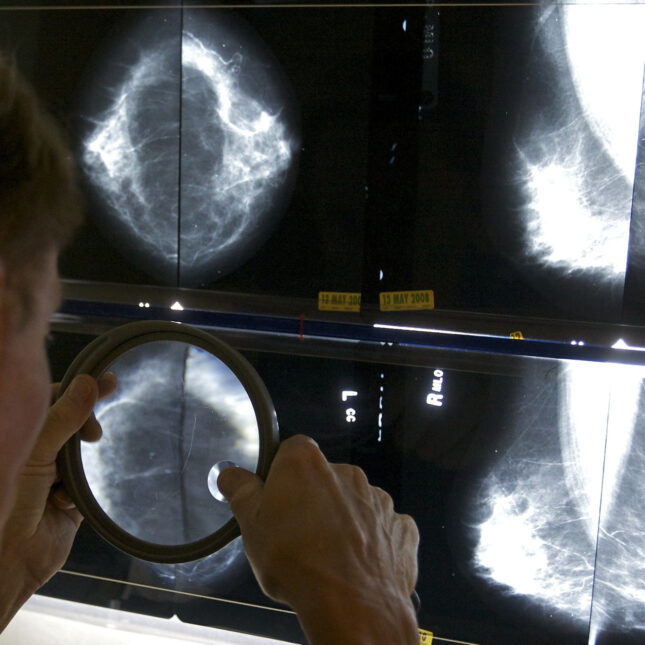
    Damian Dovarganes/AP

    Mario covers technology in health care, including FDA regulation of artificial intelligence; how Medicare pays for health tech; the use of AI in clinical care; mental health chatbots; and consumer wearables. He’s also the co-author of the free, twice weekly STAT Health Tech newsletter. You can reach Mario on Signal at mariojoze.13.

    You’re reading the web edition of STAT’s Health Tech newsletter, our guide to how technology is transforming the life sciences. Sign up to get it delivered in your inbox every Tuesday and Thursday.

    Good morning health tech readers!

    I had the pleasure of profiling Yasha Ektefaie, a fellow at the Broad Institute, who is newly announced STAT Wunderkind. Check out our annual list of promising young researchers here.

    STAT+ Exclusive Story

    Already have an account? Log in

    STAT+

    STAT+

    This article is exclusive to STAT+ subscribers

    Unlock this article — plus in-depth analysis, newsletters, premium events, and news alerts.

    Already have an account? Log in

    View All Plans

    To read the rest of this story subscribe to STAT+.

    Subscribe

    1. Health Tech Correspondent

      Mario covers technology in health care, including FDA regulation of artificial intelligence; how Medicare pays for health tech; the use of AI in clinical care; mental health chatbots; and consumer wearables. He’s also the co-author of the free, twice weekly STAT Health Tech newsletter. You can reach Mario on Signal at mariojoze.13.

  • STAT+: Why this startup is taking its AI to predict breast cancer risk directly to patients

    STAT+: Why this startup is taking its AI to predict breast cancer risk directly to patients

    Waiting on doctors and insurers to get on board would have taken too long, Clairity says

    Adobe

    Katie covers the impact of health technology on patients, clinicians, and businesses. Her stories explore the price tag of clinical AI, digital health at the FDA, and the boom in direct-to-consumer telehealth. Confidential tips can be sent on Signal at palmer.01.

    You’re reading Part 5 of Paying for AI, a series examining how new clinical artificial intelligence tools influence the affordability of health care and patients’ long-term health. Here’s Part 1, Part 2, Part 3, and Part 4.

    “Don’t wait. Choose to be informed.” 

    That’s the call to action that patients will find on the site for digital health company Everlywell, which has offered at-home lab tests directly to consumers for a decade. But last week, it wasn’t marketing a prick to measure blood glucose or screen for celiac disease: It was launching one of a new generation of AI-based risk prediction algorithms for medical images. 

    STAT+ Exclusive Story

    Already have an account? Log in

    STAT+

    STAT+

    This article is exclusive to STAT+ subscribers

    Unlock this article — and get additional analysis of the technologies disrupting health care — by subscribing to STAT+.

    Already have an account? Log in

    View All Plans

    To read the rest of this story subscribe to STAT+.

    Subscribe

    1. Health Tech Correspondent

      Katie covers the impact of health technology on patients, clinicians, and businesses. Her stories explore the price tag of clinical AI, digital health at the FDA, and the boom in direct-to-consumer telehealth. Confidential tips can be sent on Signal at palmer.01.

  • Trilliant Health: Misaligned Incentives Are Undermining US Healthcare

    Trilliant Health: Misaligned Incentives Are Undermining US Healthcare

    The U.S. healthcare system is facing a tragedy of the commons, in which each stakeholder is incentivized to act in their own self-interest. That is the focus of Trilliant Health’s report released on Tuesday.

    Trilliant Health is a healthcare analytics and market research firm. The report examines six trends drawn from Trilliant’s claims database, price transparency data and government and industry sources.

    “The six different trends that we cover all really tie into the tragedy of the commons, which ultimately is this idea that incentives reward individual actors for their behavior that the collective cannot sustain, and this is just something that we see throughout our healthcare system,” said Trilliant Health’s Chief Research Officer Allison Oakes. “Unfortunately, everyone in the healthcare system is really incentivized to be managing and sort of optimizing for their own revenue and profits, and no one is entirely responsible for actually improving health.”

    The six trends include:

    1. The healthcare system isn’t functioning as a system: About 70% of Americans believe the healthcare system has major problems or is in a state of crisis, and healthcare costs are continuing to rise. Employee deductibles and premiums are increasing faster than wages and inflation.

    “Americans are more concerned about affording healthcare than they are about gas, housing, utilities, and groceries. … I think this affordability issue is really starting to hit a breaking point,” Oakes said.

    2. Population unwellness is a systemic failure: The U.S. population is increasingly becoming unwell due to poor diet, physical inactivity and social isolation. However, healthcare incentives continue to prioritize sick care over prevention.

    Pediatric behavioral health visits for pervasive developmental and anxiety disorders increased substantially from 2019 to 2025. In 2025, 6.4% of children were taking five or more medications, and more than 10% of patients in 11 states received opioid prescriptions from three or more providers. 

    3. Disconnect between demand and supply: Behavioral health and primary care physician supply is lacking. By 2038, the overall physician supply is projected to meet just 87.7% of demand, with adult psychiatrists and primary care physicians facing the largest shortages at 49.8% and 80.4% adequacy, respectively.

    In addition, advanced imaging and behavioral health visits grew faster than primary care from 2019 to 2025, while consumers increasingly turned to self-testing and other nontraditional approaches to meet their health needs.

    4. Value is not incentivized, nor measured or managed: CMS uses more than 800 active quality measures, but only 27% are tied to outcomes. In addition, hospital negotiated rates show little correlation with quality, with higher prices not necessarily associated with lower 30-day mortality rates, the report found.

    5. Fraud, waste and abuse: Misaligned incentives are contributing to fraud, waste and abuse, the report shows. From 2019 to 2024, the number of for-profit hospices rose 11.2%, and nonprofit hospices fell 2%. In addition, for-profit hospices saw a 13.7% Medicare margin in 2023, versus -1.3% for nonprofits.

    6. Negative-sum game: New medications are challenging the U.S. healthcare system’s traditional reliance on higher patient and procedure volumes to drive revenue. 

    The growing use of drugs such as GLP-1s and SGLT2 inhibitors has coincided with declines in certain procedures, suggesting that medications could increasingly replace or reduce demand for costly interventions.

    Photo: champc, Getty Images

  • Teladoc Health Adds Contactless Vitals and Ambient AI Scribe to Virtual Visit Platform

    Teladoc Health Adds Contactless Vitals and Ambient AI Scribe to Virtual Visit Platform

    telehealth telemedicine

    Teladoc Health announced Wednesday that it is launching two new AI-powered capabilities built into its Solo smart care platform for hospitals and health systems to be used during virtual visits. 

    SoloVitals, which captures patients’ heart rate and respiratory rate using only the camera on their device, will be available for private preview with select customers, with wider availability expected in December. The New York-based telemedicine company did not identify those customers. SoloScribe, an ambient, EHR-integrated documentation tool, is now generally available.

    Both tools integrate with the already-established Solo virtual care platform, so that the more than 15,000 global customers can smoothly integrate the new capabilities without the need to add new technology, according to the company’s news release. SoloVitals and SoloScribe aim to support patient care operations and reduce technology fragmentation across health systems so that providers can keep their focus where it’s truly needed – on the patient.

    “SoloVitals addresses a common gap many hospital virtual care teams experience, where they cannot collect real-time physiologic data from patients during a virtual visit,” said Joby McKenzie, general manager of North American health systems at Teladoc Health. 

    Danny Sanchez, vice president of technology and innovation at Teladoc Health, explained how SoloVitals collects patient vital signs contactlessly. 

    “During intake for a virtual visit, the patient uses the camera on their own device to capture supported vital signs of heart rate and respiration rate,” Sanchez said. “It uses remote photoplethysmography (“rPPG”) to detect very small changes in the color of the skin caused by blood flow. This data is combined with a computer vision assessment of patients’ fine movements and is then evaluated by sophisticated algorithms to return multiple physiologic measurements.”

    Results are then available for the provider before or during the virtual visit, offering real-time physiologic data which can help to inform care decisions. Sanchez noted that patients do not need to download a separate app, and that the process is guided by on-screen prompts to facilitate a smooth user experience. 

    SoloScribe offers ambient AI documentation – that alone is not unique, but what makes SoloScribe stand out is simple: it doesn’t require hospital systems to apply new technology. It works within the Solo platform that’s already integrated into the EHR – be it Epic or Oracle Health.

    “Most ambient scribe tools on the market ask hospitals to buy, install and manage one more piece of technology,” said Sanchez. “Our clients keep telling us they want the opposite: new capabilities built into the products and workflows they already know and use.”

    This goes to the heart of one of the biggest challenges health systems face today, that McKenzie identified as “technology fragmentation.” 

    She added that “each new capability comes with another vendor, another login, another device, or another workflow. The larger opportunity of integration is to help health systems move from a collection of disconnected tools to a more unified care environment.”

    Photo credit: Sorbetto, Getty Images

  • STAT+: Why health AI pilots in Utah may be on a collision course with the FDA

    STAT+: Why health AI pilots in Utah may be on a collision course with the FDA

    You’re reading the web edition of STAT’s AI Prognosis newsletter

    STAT/Adobe

    Brittany Trang, Ph.D., covers AI in health and medicine: Does it actually work? Who benefits, or might be harmed? She writes the weekly AI Prognosis newsletter. Follow her on Threads, Mastodon, and Bluesky. You can reach Brittany on Signal at btrang.01.

    Mario covers technology in health care, including FDA regulation of artificial intelligence; how Medicare pays for health tech; the use of AI in clinical care; mental health chatbots; and consumer wearables. He’s also the co-author of the free, twice weekly STAT Health Tech newsletter. You can reach Mario on Signal at mariojoze.13.

    This is the web edition of STAT’s AI Prognosis newsletter, our guide to artificial intelligence in health care and medicine. Sign up to get it delivered in your inbox every Wednesday. 

    I have refused to read or watch “The Love Hypothesis” — I referred to it as the “Title IX movie” the other day when I forgot its name. But the clips are inescapable on my Instagram feed, and the science gaffes seem … real bad. Absolute butchering of how academia works? The impossible chemistry on the poster? Wearing miniskirts in the lab? Vortexing a test tube? *shudders*

    Once again: I firmly believe STAT would allow me to consult on science-related elements on film sets. Offers for Hollywood gigs, health tech story tips, comments: [email protected]

    STAT+ Exclusive Story

    Already have an account? Log in

    STAT+

    STAT+

    This article is exclusive to STAT+ subscribers

    Unlock this article — plus in-depth analysis, newsletters, premium events, and news alerts.

    Already have an account? Log in

    View All Plans

    To read the rest of this story subscribe to STAT+.

    Subscribe

    1. Brittany Trang, Ph.D., covers AI in health and medicine: Does it actually work? Who benefits, or might be harmed? She writes the weekly AI Prognosis newsletter. Follow her on Threads, Mastodon, and Bluesky. You can reach Brittany on Signal at btrang.01.

    2. Health Tech Correspondent

      Mario covers technology in health care, including FDA regulation of artificial intelligence; how Medicare pays for health tech; the use of AI in clinical care; mental health chatbots; and consumer wearables. He’s also the co-author of the free, twice weekly STAT Health Tech newsletter. You can reach Mario on Signal at mariojoze.13.

  • Cybersecurity Experts to Hospital Leaders: Think Beyond Traditional Disaster-Recovery Planning

    Cybersecurity Experts to Hospital Leaders: Think Beyond Traditional Disaster-Recovery Planning


    As healthcare organizations increasingly lean on connected technology, hospital leaders need to think beyond traditional disaster-recovery planning and prepare for prolonged technology outages. That was the message of cybersecurity experts who met last week to discuss today’s most pressing threats to healthcare data and infrastructure at a healthcare summit hosted by Rubrik.

    Rubrik is a cybersecurity and data management company based in Palo Alto, California.

    The timing of this conversation is notable. Last month, senators reintroduced the Health Infrastructure Security and Accountability Act, which applies baseline minimum cybersecurity requirements for healthcare organizations, along with $1.3 billion to help hospitals bolster their defenses. In August, a cyberattack on Boston Scientific disrupted manufacturing and supply chains, highlighting how attacks can have far-reaching impacts on healthcare operations. 

    Throughout the summit, experts echoed the same concern: AI-driven cybersecurity attacks pose a new level of risk for hospitals and health systems. These supercharged attacks could disrupt clinical operations for weeks, potentially leaving patients waiting for care. 

    Nicole Perlroth, bestselling author and host of the To Catch a Thief podcast, expounded on her concerns regarding AI cyberattacks. 

    “What we can really expect is that any vulnerability or any misconfiguration or any human error that you have in managing your security estate will be discovered at machine speed and exploited at machine speed,” she said.

    John Riggi, national adviser for cybersecurity and risk at the American Hospital Association, added to the gloomy picture, calling cyberattacks on healthcare organizations a “threat to life”. He called out how these attacks can disrupt operations in every step of the healthcare delivery workflow, to the point that patient care is badly delayed – which could be life-threatening.

    When technology fails due to some design failure because it wasn’t designed securely, “but which the bad guys have exploited or found today at machine speed — when those systems go down, there is an immediate disruption and delay to healthcare delivery,” Riggi warned.

    Cybersecurity threats are also manifold in that they can come from a variety of sources: they could emanate from foreign actors in Russia, China, North Korea, and Iran who want to target healthcare entities, particularly now that AI tools offer less-sophisticated attackers the opportunity to launch significant operations. 

    Speakers suggested interventions to bolster cybersecurity within healthcare systems. They emphasized that hospitals must be prepared to operate without IT for prolonged periods of 30 days or more, and encouraged regular testing of downtime and continuity plans, as well as strengthening backup systems. 

    However, this heightened era of threats could also have a positive outcome in the future of healthcare cybersecurity.

    “Long term, I hope that we basically get to a place we’ve never been before,” Perlroth said. “That this forces us to do the things we have talked about to death over the past few years in terms of secure-by-design, formal methods, patching, backups, real time backups, backup intelligence, et cetera.”

    Photo: Traitov, Getty Images

  • STAT+: FDA spells out 2027 AI guidance plans

    STAT+: FDA spells out 2027 AI guidance plans

    You’re reading the web edition of STAT’s Health Tech newsletter

    Stock photo of The FDA logo displayed on the screen of a smartphone with blue and black background
    Adobe

    Mario covers technology in health care, including FDA regulation of artificial intelligence; how Medicare pays for health tech; the use of AI in clinical care; mental health chatbots; and consumer wearables. He’s also the co-author of the free, twice weekly STAT Health Tech newsletter. You can reach Mario on Signal at mariojoze.13.

    You’re reading the web edition of STAT’s Health Tech newsletter, our guide to how technology is transforming the life sciences. Sign up to get it delivered in your inbox every Tuesday and Thursday.

    Good morning health tech readers!

    Just one week until the STAT Summit in Boston. I’ll be on stage. If you are interested in coming but are on the fence, give me a shout.

    STAT+ Exclusive Story

    Already have an account? Log in

    STAT+

    STAT+

    This article is exclusive to STAT+ subscribers

    Unlock this article — plus in-depth analysis, newsletters, premium events, and news alerts.

    Already have an account? Log in

    View All Plans

    To read the rest of this story subscribe to STAT+.

    Subscribe

    1. Health Tech Correspondent

      Mario covers technology in health care, including FDA regulation of artificial intelligence; how Medicare pays for health tech; the use of AI in clinical care; mental health chatbots; and consumer wearables. He’s also the co-author of the free, twice weekly STAT Health Tech newsletter. You can reach Mario on Signal at mariojoze.13.

  • MedTech VC 2026: The Real Story vs. The Thesis

    MedTech VC 2026: The Real Story vs. The Thesis

    One thing I love about investing is that the best research often disproves your own assumptions.

    I kept hearing “medtech VC is in decline,” so I decided to dig into the data myself. I expected shrinking investor interest, inflated valuations, and a weak exit environment.

    Instead, I found a more nuanced story.

    What’s true:

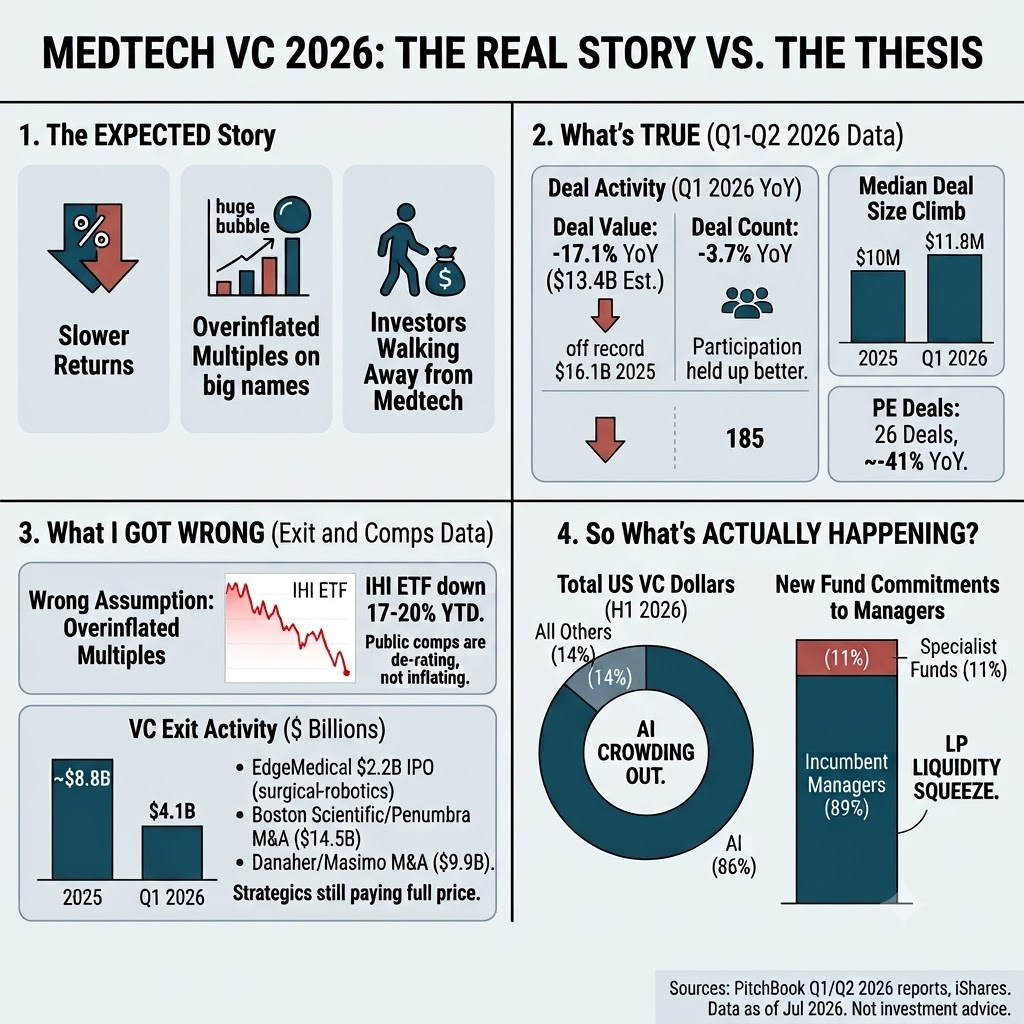
    → Medtech VC deal value fell 17.1% YoY in Q1 2026, but off a record $16.1B in 2025.

    → Deal count fell only 3.7% YoY. Participation held up far better than dollars.

    → Median deal size climbed to $11.8M (from 2025’s already-record $10M). The money isn’t leaving, rather concentrating into fewer, larger checks.

    → Medtech PE deal count dropped ~41% YoY to 26 deals in Q1.

    What I got wrong:

    I assumed overinflated multiples were scaring VCs off. The opposite is true. IHI (iShares US Medical Devices ETF) is down 17–20% YTD, trading at a compressed multiple vs. its 2021 peak. Public medtech comps are de-rating, not inflating. If rich multiples were the brake, we wouldn’t be seeing this.

    I also missed the exit data. Medtech VC exits hit $4.1B in Q1 2026 alone, and nearly half of all of 2025, anchored by EdgeMedical’s $2.2B surgical-robotics IPO. Strategics are still paying full price for differentiated assets: Boston Scientific/Penumbra ($14.5B), Danaher/Masimo ($9.9B). Not a sector investors have given up on.

    So what’s actually happening?

    Medtech isn’t necessarily being rejected, but instead, being crowded out. AI absorbed 86% of all US VC dollars in H1 2026. And with LPs still starved for distributions, 89% of new fund commitments this year went to seasoned, incumbent managers. A tough backdrop for the smaller, specialist funds that anchor early-stage medtech.

    I’m living a version of this firsthand. My own company is raising a pre-seed round right now, and the pattern shows up everywhere in conversations with investors: the ones still writing early-stage medtech checks are stretched thin, and a lot of the specialist funds that used to anchor rounds like ours simply aren’t raising new funds of their own. A medtech-focused fund manager put it well at a recent industry conference: with early-stage medtech funds in short supply, it’s become a buyer’s market for the VCs still active at seed and Series A. That tracks with what I’m seeing. The investors still in the game aren’t necessarily writing bigger checks because they love the sector more, they’re writing bigger checks because there are fewer of them left standing, and they can afford to be more selective about who they back.

    There’s a second piece to this I initially missed too: strategics aren’t sitting on the sidelines waiting for VCs to de-risk deals for them anymore. Corporate venture arms like Medtronic Ventures, J&J’s JJDC, and Philips Ventures have all stepped up their early-stage activity, effectively filling part of the gap left by pulled-back generalist and specialist funds. That’s a meaningfully different capital structure than five years ago: less spray-and-pray from generalist funds chasing the next big multiple, more concentrated conviction from investors, traditional and corporate alike, who actually understand the regulatory and clinical path a device has to walk.

    The real picture coming out of the clouds isn’t “medtech VC is dying.” It’s capital discipline colliding with an AI supercycle and an LP liquidity squeeze, while the exit window is quietly reopening underneath the headlines.

    For founders building in this space right now, the takeaway is less “the money is gone” and more “the money got pickier.” Clinical validation, a clear regulatory pathway, and evidence of real hospital demand aren’t optional anymore. They’re the price of entry to get in front of the smaller pool of investors who are still writing checks.

    I’m pretty curious how others read this: is medtech’s Q1 pullback a temporary AI crowding-out effect, or the start of a more structural re-rating?

    Photo: drogatnev, Getty Images

    Jordan Lisnow

    Jordan Lisnow is COO and co-founder of CuffWay, a medtech startup building the first automated, adaptive cuff pressure controller for intubated patients. He is a three-time founder with two prior exits, and previously worked in venture capital at Traverse Ventures evaluating early-stage teams across AI, fintech, SaaS, and frontier tech.

    This post appears through the MedCity Influencers program. Anyone can publish their perspective on business and innovation in healthcare on MedCity News through MedCity Influencers. Click here to find out how.