Author: admin

  • Wildfires Linked to Surge in Mental Health-related Emergency Department Visits, Study Shows

    Wildfires Linked to Surge in Mental Health-related Emergency Department Visits, Study Shows

    An Emory University study published Feb. 15 in Nature Mental Health shows wildfires lead to an increase of anxiety-related emergency department visits in the western United States, amplifying the concerning parallel trajectory of two escalating public health crises — mental health and climate change.

    The National Institutes of Health-funded study — conducted by researchers at Emory’s Rollins School of Public Health — is among the largest and most comprehensive research ever undertaken on the association between wildfire-related exposures and anxiety disorders.

    Analyzing satellite-driven data and nearly 1.9 million emergency department visits across five states (California, Arizona, Nevada, Oregon and Utah) from 2007-18, the researchers showed wildfire smoke events — which is when wildfires become the main source of ambient pollution within a ZIP code — were associated with a 6.3% increase in mental health-related emergency department visits.

    In addition to this startling data, the study shows:

    • Women, girls and older adults are more susceptible to severe anxiety disorders associated with wildfire exposures.
    • Men and boys also experienced an increase in anxiety disorders but only when linked to major smoke events.
    • Evidence for enhanced disaster risk reduction and climate risk management strategies, including climate awareness and risk communication tailored for vulnerable populations.

    What the researchers say:

    “The scary thing about climate change is it doesn’t have a clear boundary; you fear a lot about the unknown. Now we can use the knowledge we’ve gained to tell people there is no need to panic. When you receive a wildfire smoke alert, close your windows, limit your outdoor activities and don’t panic. Those sorts of preventative measures can potentially benefit the entire population,” says study co-author Yang Liu, PhD, chair and Gangarosa Distinguished Professor in the Gangarosa Department of Environmental Health at Rollins.

    “Mental health is one of the most prevalent health conditions in the U.S. and our study found multiple pathways between wildfires and an association with severe anxiety disorders. Many people are already dealing with some mild or moderate mental health symptoms. Now imagine they wake up and see the sky covered in smoke, they’re likely going to feel even more anxious,” says the study’s lead author Qingyang Zhu, PhD, a postdoctoral fellow in the Gangarosa Department of Environmental Health.

    Why it matters:

    • Rising temperatures and shifting drying patterns substantially escalated the potential for wildfires globally over the past 20 years, resulting in expanded burned areas and prolonged fire seasons.
    • The western United States is notoriously a major fire-prone region, due to the recurrent presence of fire weather conditions, increasing droughts and the abundance of fuel resources.
    • Climate change has been linked to a variety of psychological disorders such as anxiety, depression, post-traumatic stress disorder and eating disorders.
    • Mental health disorders, including anxiety disorders, have been an increasing threat to global public health in the past three decades. According to the most recent Global Burden of Disease study released in 2020, anxiety disorder was the 24th leading contributor — out of 369 diseases — to the global burden of disease.

    This research was supported by the National Institute of Environmental Health Sciences of the NIH (ES034175 and ES027892). The NIH has established an NIH Climate Change and Health Initiative to reduce health threats from climate change, including mental health.

  • Usability improvement: Links now underlined on mouseover

    Usability improvement: Links now underlined on mouseover

    U.S. flag

    An official website of the United States government

    Dot gov

    The .gov means it’s official.
    Federal government websites often end in .gov or .mil. Before sharing sensitive information, make sure you’re on a federal government site.

    Https

    The site is secure.
    The https:// ensures that you are connecting to the official website and that any information you provide is encrypted and transmitted securely.

    Home Page

    PubMed® comprises more than 40 million citations for biomedical literature from MEDLINE, life science journals, and online books. Citations may include links to full text content from PubMed Central and publisher web sites.

    Learn

    Find

    Download

    Explore

    PubMed Updates

    Feature updates and other PubMed highlights

    • Data Updates Scheduled for 2027 Baseline

      September 29, 2026

      There will be no change to the PubMed DTD for 2027. There are two upcoming changes to PubMed data that will take effect when the 2027 PubMed baseline is published.

    • Introducing Linked Discoveries™!

      September 24, 2026

      Linked Discoveries™ is an experimental pilot resource developed by the National Library of Medicine (NLM) that helps users explore how articles with PubMed® abstracts connect to the surrounding literature.

    • New & Noteworthy RSS Feed Has a New URL

      April 16, 2026

      PubMed’s New & Noteworthy RSS feed provides another way to stay up to date with the latest news published in the NLM Technical Bulletin for PubMed.

    • Article Type Filters Updated to Reflect MeSH Changes to Publication Types

      March 31, 2026

      The article type filters in PubMed have been updated to reflect Annual MeSH Processing (AMP) updates to Publication Types, including discontinued publication types from the past several years.

  • Radon-associated Cardiovascular Risks Highlight Need for Household Testing

    The University of North Carolina at Chapel Hill utilizes numerous security controls. One of these security controls has flagged your request as malicious activity.

    If you believe this is an error or would like additional information, contact the ITS Service Desk by reporting the issue on the Help Portal or calling them at 919-962-HELP. Provide the information below and ask that your request be directed to the ITS Digital Services group.

    • 2026-10-12T23:04:00
    • 2a02:4780:2b:1785:0:2e67:aca:1
    • https://sph.unc.edu/sph-news/radon-associated-cardiovascular-risks-highlight-need-for-household-testing/
    • Reference this support identifier: 9e8322664c8de12b5cc3928e6e403610873333cc296503c22c26bc35eff6b394
  • Reduced Blood Lead Levels Linked to Lower Blood Pressure in American Indians

    Reduced Blood Lead Levels Linked to Lower Blood Pressure in American Indians

    Researchers have linked a decade-long decline in the blood lead levels of American Indian adults to long-term cardiovascular health benefits, including reduced blood pressure levels and a reduction in a marker associated with hypertrophic cardiomyopathy and heart failure. The research team, supported by the National Institutes of Health, found that adults who had the greatest reductions in blood lead levels saw their systolic blood pressure fall by about 7 mm Hg, an amount comparable to the effects of blood pressure-lowering medication. Lead exposure is known to harm the health of children by damaging the brain and nervous system and slowing growth and development. It has also been associated with increased risks for heart disease in adults. The findings published in the Journal of the American Heart Association.

    “This is a huge win for public health, especially since many American Indians can face higher risks for elevated lead levels,” said Anne E. Nigra, Ph.D., the senior study author and an assistant professor of environmental health sciences at Columbia University Mailman School of Public Health, New York City. “Compared to the general U.S. population, American Indian communities experience both a higher burden of cardiovascular disease and elevated metal exposure. We saw that even small decreases in a person’s blood lead levels can have meaningful health outcomes.”

    Investigators partnered with 285 American Indian adults in the Strong Heart Family Study, an extension of the Strong Heart Study, the largest and longest study of cardiovascular health outcomes and risk factors among American Indian adults. Participants lived in one of four tribal communities in Arizona, Oklahoma, North Dakota, or South Dakota. The authors explained that features of the built environment can lead to elevated lead exposure in tribal communities. This includes being exposed to lead through well water, local waterways, foods, including canned goods, herbs, and spices, as well as paint and dust.

    For this retrospective review, the researchers looked at blood lead levels and blood pressure readings over time. Lead was first measured in blood collected during a 1997-1999 study visit and again in blood collected during a follow-up visit between 2006-2009. During these visits, participants had their blood pressure taken and participated in medical exams that included echocardiographs, a test to assess the heart’s structure and function. To support equal comparisons among participants, researchers controlled for multiple factors, including social variables, including education and income, cardiovascular disease risks, and medical history.

    At the start of the study, the average blood lead level was 2.04 µg/dL. Throughout the study, the average blood lead level fell by 0.67 µg/dL, or 33%. The most significant changes occurred in participants with average starting blood lead levels of 3.21 µg/dL and who experienced reductions of about 1.78 µg/dL, or 55%. This drop was linked to a 7 mm Hg reduction in systolic blood pressure.

    Nigra and the study authors credit these improvements in large part to public health policies and efforts implemented in recent decades to reduced lead exposure through paint, gasoline, water, plumbing, and canned items. The decline in blood lead levels observed in the study are similar to those seen in the general U.S. population in recent years, but exposure to elevated levels of lead and other metals have been disproportionately higher among American Indians.

    “This is a sign that policies and awareness and education campaigns in these communities to reduce blood lead levels are working,” said Mona Puggal, M.P.H., an epidemiologist in the Division of Cardiovascular Sciences at the National Heart, Lung, and Blood Institute (NHLBI). “The reductions in blood pressure are comparable to improvements one sees with lifestyle changes, such as getting 30 minutes of daily exercise, reducing salt intake, or losing weight.”

    The investigators noted the importance of also conducting this research in other communities, especially for populations with elevated risks for lead exposure and cardiovascular disease.

    “More research needs to be done to determine how environmental agents exacerbate cardiovascular and other diseases, and more needs to be done to improve the environmental health of American Indians,” said Lindsey A. Martin, Ph.D., a health science administrator at the National Institute of Environmental Health Sciences (NIEHS), also part of NIH.

    This research was funded by NIEHS and NHLBI.

    Study: Lieberman-Cribbin W, Li Z, Lewin M, Ruiz P, Jarrett JM, Cole SA, Kupsco A, O’Leary M, Pichler G, Shimbo D, Devereux RB, Umans JG, Navas-Acien A, Nigra AE. 2024. The contribution of declines in blood lead levels to reductions in blood pressure levels: longitudinal evidence in the Strong Heart Family Study. J Am Heart Assoc. doi: 10.1161/JAHA.123.031256. [Full Text]


    About the National Heart, Lung, and Blood Institute (NHLBI): NHLBI is the global leader in conducting and supporting research in heart, lung, and blood diseases and sleep disorders that advances scientific knowledge, improves public health, and saves lives. For more information, visit www.nhlbi.nih.gov.

  • Largest Study of Its Kind Suggests Physical Activity Reduces a Woman’s Risk of Developing Breast Cancer Before Menopause

    Regular leisure time physical activity may reduce the risk of breast cancer for women before menopause, according to new research funded by Breast Cancer Now.

  • Study Clearly Identifies Nutrients as a Driver of the Great Atlantic Sargassum Belt

    Study Clearly Identifies Nutrients as a Driver of the Great Atlantic Sargassum Belt

    Woods Hole, Mass. — Under normal conditions, the floating macroalgae Sargassum spp. provide habitat for hundreds of types of organisms. However, the Great Atlantic Sargassum Belt (GASB) that emerged in 2011 has since then caused unprecedented inundations of this brown seaweed on Caribbean coastlines, with harmful effects on ecosystems while posing challenges to regional economies and tourism, and concerns for respiratory and other human health issues.

    Researchers looking into the question of what is the nutrient supply for the GASB say that they have now clearly identified that the nutrient content of Sargassum tissue could help determine the enrichment sources and potentially improve predictions and Sargassum management efforts.

    “We show clearly for the first time that Sargassum in the GASB is enhanced in both nitrogen and phosphorus, indicative of a healthy and thriving population,” according to the journal article “Nutrient and arsenic biogeochemistry of Sargassum in the western Atlantic,” published in Nature Communications.

    “Stable nitrogen isotope values point to riverine sources in some circumstances and are more equivocal in others. Distinguishing the various nutrient sources sustaining the GASB will require systematic snapshots of nutrient content and isotopic composition across its entire breadth,” according to the paper. “Presumably, the closer one gets to the source, the higher the nitrogen and / or phosphorus content of Sargassum should be. In that sense, basin-wide patterns in nitrogen and phosphorus elemental composition could provide the fingerprinting necessary to unequivocally determine the sources.”

    The paper notes that a variety of nutrient sources for the GASB blooms have been suggested, including upwelling, vertical mixing, discharge from the Amazon and Congo rivers, and atmospheric deposition. Though, the paper states that the causes of the GASB and the mechanisms controlling its variability remain unknown.

    The paper also indicates that the nutritional status of Sargassum in the GASB is enriched, with higher nitrogen and phosphorus content than are populations of Sargassum that reside in its Sargasso Sea habitat.

    “In its traditional environment, Sargassum is a great ecological benefit. However, the proliferation of biomass in the tropical Atlantic has proven the old adage that too much of a good thing can be bad,” said journal article lead author Dennis McGillicuddy, Jr., senior scientist in the Applied Ocean Physics and Engineering Department at the Woods Hole Oceanographic Institution (WHOI).

    The finding that nitrogen and phosphorus are higher in the GASB than in the Sargasso Sea “is a smoking gun that the GASB inundations are nutrient-driven,” said McGillicuddy. “A consequence of this finding is that it presents us potentially with the opportunity to use those nitrogen and phosphorus markers in Sargassum tissue to fingerprint the ultimate sources of these nutrients that are sustaining these seaweed blooms.”

    In addition, the paper notes that the presence of arsenic in Sargassum tissue – which reflects phosphorus limitation – significantly constrains the utilization of the seaweed biomass that washes ashore.
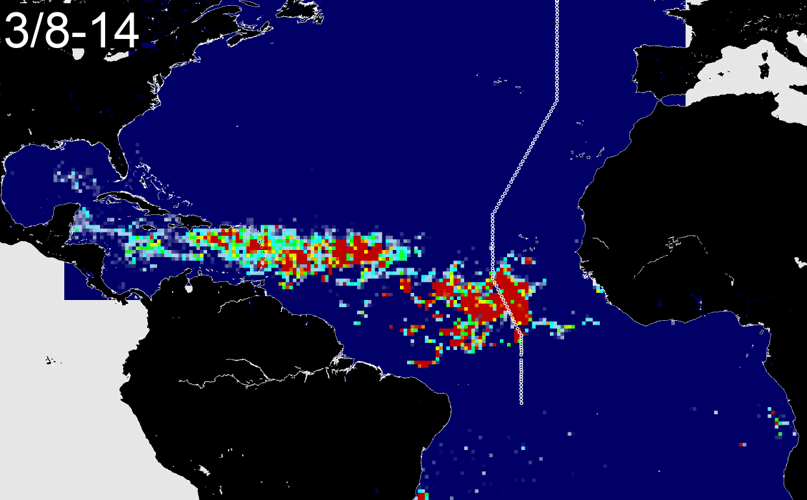
    Sargassum Belt

    Sargassum coverage based on satellite data. The white circles indicate sampling locations on GO-SHIP line A16 .(Image courtesy of C. Hu and B. Barnes)

    “As the Great Atlantic Sargassum Belt has grown over the last decade, the public has become increasingly aware of this phenomenon and its impact on coastal communities,” said co-author Peter Morton, associate research scientist in the Department of Oceanography at Texas A&M University, College Station. “Our research shows that Sargassum could become enriched in arsenic, depending on the conditions in which it grows. Plans to remove or exploit this material when it washes ashore should consider the potential for Sargassum to contain high concentrations of arsenic, so we encourage affected communities to proceed with caution when exploring options to deal with seasonal inundations of Sargassum.”

    Due to the threats that the Sargassum inundations pose to the environment, economy, and human health, the paper recommends the need for expanded observational and modeling studies to understand the GASB’s physical, biological, and chemical drivers. The paper notes that “the societal need for scientific understanding is urgent: improved seasonal to interannual predictions would offer tremendous value for proactive planning and response, while quantification of the underlying causes could inform potential management actions to mitigate the problem.”

    McGillicuddy first saw Sargassum when he was a child growing up in Florida and his grandfather took him fishing near the seaweed because that was the best place to fish. “It was an oasis in the oceanic desert,” McGillicuddy said.

    “Now, the system has changed in a fundamental way. We’ve got an oceanographic process out there that is creating this. As a scientist, and as a fisherman, I feel an urgent need to try to understand this situation, not only to help answer the interesting scientific questions around this problem, but do so in a way that we are able to understand the situation and eventually mitigate it in a way that would be of value to society,” he said.

    McGillicuddy and co-author Brian Lapointe also stressed the importance of the interdisciplinary and collaborative nature of this research, which encompasses a number of disciplines including biology, chemistry, and physics.

    “This collaborative study illustrates the value of interdisciplinary research teams to understanding complex oceanographic phenomena in an era of rapid global change, in this case, the Great Atlantic Sargassum Belt that formed in 2011,” said co-author Brian Lapointe, a research professor at Florida Atlantic University’s Harbor Branch Oceanographic Institute, and one of the world’s foremost authorities on Sargassum.

    Funding for this research was provided by the National Science Foundation, the National Institute of Environmental Health Sciences through the Woods Hole Center for Oceans and Human Health, WHOI, the Isham Family Charitable Fund, the State of Florida, and NASA.

    Sargassum samples of opportunity were collected on U.S. GO-SHIP lines A20 (Ryan Woosley, chief scientist; marine physical chemist at the Massachusetts Institute of Technology’s Center for Global Change Science), and A22 (Viviane Menezes, chief scientist; physical oceanographer at WHOI), carried out on the R/V Thomas G. Thompson (voyages TN389 and TN390) with the support of the U.S. National Science Foundation and the National Oceanic and Atmospheric Administration. U.S. GO-SHIP (Global Ocean Ship-based Hydrographic Investigations Program) is a component of International GO-SHIP.

    ###

    Authors: Dennis J. McGillicuddy, Jr.1*, Peter L. Morton2, Rachel A. Brewton3, Chuanmin Hu4, Thomas B. Kelly5, Andrew R. Solow1, and Brian E. Lapointe3

    Affiliations:

    1Department of Applied Ocean Physics and Engineering, Woods Hole Oceanographic Institution, Woods Hole, MA, USA

    2Department of Oceanography, Texas A&M University, College Station, TX, USA

    3Harbor Branch Oceanographic Institute, Florida Atlantic University, Fort Pierce, FL, USA

    4College of Marine Science, University of South Florida, St. Petersburg, FL, USA

    5College of Fisheries and Ocean Science, University of Alaska Fairbanks, Fairbanks, AK, USA.

    *Corresponding author

    About Woods Hole Oceanographic Institution

    The Woods Hole Oceanographic Institution (WHOI) is a private, non-profit organization on Cape Cod, Massachusetts, dedicated to marine research, engineering, and higher education. Established in 1930, its primary mission is to understand the ocean and its interaction with the Earth as a whole, and to communicate an understanding of the ocean’s role in the changing global environment. WHOI’s pioneering discoveries stem from an ideal combination of science and engineering—one that has made it one of the most trusted and technically advanced leaders in basic and applied ocean research and exploration anywhere. WHOI is known for its multidisciplinary approach, superior ship operations, and unparalleled deep-sea robotics capabilities. We play a leading role in ocean observation and operate the most extensive suite of data-gathering platforms in the world. Top scientists, engineers, and students collaborate on more than 800 concurrent projects worldwide—both above and below the waves—pushing the boundaries of knowledge and possibility. For more information, please visit www.whoi.edu

  • Sister Study Turns 20

    Sister Study Turns 20

    What: This October marks the 20th anniversary of the Sister Study, the nation’s largest and longest ongoing study of women with a close family history of breast cancer. This landmark study seeks to identify the environmental and genetic factors that affect a women’s chance of developing breast cancer. The study is led by the National Institute of Environmental Health Sciences (NIEHS), part of NIH.

    The Sister Study was initiated in response to community concerns about rising rates of breast cancer in the United States during the 1980s and 1990s. NIEHS researchers proposed a novel research approach – to study the sisters of women who have had breast cancer. Sisters share many things including genes and early-life environments. These common features make women whose sisters had breast cancer twice as likely to develop breast cancer themselves. By studying these sisters, researchers have increased ability to detect disease risks that are related to both environment and genes.

    NIEHS launched the study and enrolled its first participant in the fall of 2003. By the spring of 2009 the study surpassed its goal of 50,000 participants. The researchers collected biological and environmental samples – blood, urine, toenail clippings and household dust – from participants at the beginning of the study. They used questionnaires to gather a multitude of data about health histories, environmental exposures, and lifestyles.

    The Sister Study is still going strong. The women continue to participate in a variety of ways, including annually updating contact information and reporting any major changes to their health.

    “We are extremely grateful for all the women who’ve participated in the study. There would be no Sister Study without them,” said Dale Sandler, Ph.D., chief of the Epidemiology Branch at NIEHS and principal investigator of the Sister Study. “Over the past 20 years, more than 50,000 women have devoted their time and shared very personal information about their family histories, their lifestyles, and their health – all to help us understand how we might change our environment to reduce our risk for breast cancer.”

    The study has discovered many of the factors that may contribute to a woman developing breast cancer, including air pollution, trauma and psychosocial stress, dietary factors, permanent hair dye and chemical hair straighteners, some ingredients in personal care products, and obesity. The study has also discovered how exposure-related changes to DNA may influence biological aging and breast cancer risk. A full listing of the research publications from the Sister Study.

    Who: Dale Sandler, Ph.D., lead researcher for the Sister Study, and chief of the NIEHS Epidemiology Branch, is available for comment.

    When: During the first week of October, Dr. Sandler and other members of the NIEHS Sister Study research team will be available for media interviews.


  • Global Call to Action on Sleep Health Published in The Lancet Public Health

    Global Call to Action on Sleep Health Published in The Lancet Public Health

    > News > News > Global Call to Action on Sleep Health Published in The Lancet Public Health

    ROCHESTER, Minn., September 29, 2023 — A global call to action was published in The Lancet Public Health on September 28 that urges decisionmakers to recognize sleep health as a foundation of human health. Decades of research across disciplines make this fact abundantly clear. Now is the time to begin leveraging sleep health to improve human health and wellbeing worldwide.

    Authored by an international group of experts on behalf of World Sleep Society (WSS), this viewpoint, titled “The Urgent Need for All Countries to Promote Sleep Health,” specifies three actions for governments at all levels, researchers and other stakeholders:

    • Educate: promote sleep and circadian health education and awareness
    • Research: collect and centralize standard sleep and circadian data in every country
    • Implement public health policies: include sleep health initiatives to advance public health agendas

    Read the complete text in The Lancet Public Health:  https://www.thelancet.com/journals/lanpub/article/PIIS2468-2667(23)00182-2/fulltext

    Improve Sleep to Improve Overall Health

    Like nutrition and physical activity, sleep health is a uniquely powerful target for interventions that improve overall health, yet most countries do not include sleep health in their public health agendas.

    “There is strong evidence that sleep is essential for physical and mental health, as well as well-being, across the entire lifespan. Disruption of sleep and circadian rhythms significantly increases the risk for dementia, obesity, diabetes and cardiovascular disease. Now is the time to integrate sleep and circadian health programs to promote the health span worldwide. No public health agenda is sufficient without the inclusion of sleep,” says Phyllis C. Zee, MD, PhD, chair of the WSS Global Sleep Health Task Force and president of World Sleep Society.

    The Costs of Inaction

    The costs of inaction are clear: avoidable burdens on health systems and continued exacerbation of global health inequities. “Our viewpoint describes in brief the wide-ranging consequences of poor sleep health for individuals, communities and governments worldwide. We are already bearing these burdens. We need action in these three areas – awareness, research and public policy – to lighten those burdens and improve lives,” says Diane C. Lim, MD, and Arezu Najafi, MD, lead co-authors of the article.

    Standardize Data Collection

    For its own part, the international research community must standardize data collection on global sleep health. “Researchers across many disciplines such as occupational health and urban planning who are interested in leveraging the science of sleep and circadian health to ultimately improve population health both locally and internationally must work together to collect – in a standardized fashion – the multi-dimensional sleep and circadian data that decision-makers need,” says Chandra Jackson, Ph.D., Senior Investigator at the National Institute of Environmental Health Sciences (NIEHS), part of the National Institutes of Health, and co-senior author of the viewpoint with Dr. Zee.

    Further information is available at worldsleepsociety.org/global-sleep-health. Follow World Sleep Society for updates and opportunities for organized collaboration.

  • AI and Machine Learning Can Successfully Diagnose Polycystic Ovary Syndrome, New Study Confirms

    AI and Machine Learning Can Successfully Diagnose Polycystic Ovary Syndrome, New Study Confirms

    Artificial intelligence (AI) and machine learning (ML) can effectively detect and diagnose Polycystic Ovary Syndrome (PCOS), which is the most common hormone disorder among women, typically between ages 15 and 45, according to a new study by the National Institutes of Health. Researchers systematically reviewed published scientific studies that used AI/ML to analyze data to diagnose and classify PCOS and found that AI/ML based programs were able to successfully detect PCOS.

    “Given the large burden of under- and mis-diagnosed PCOS in the community and its potentially serious outcomes, we wanted to identify the utility of AI/ML in the identification of patients that may be at risk for PCOS,” said Janet Hall, M.D., senior investigator and endocrinologist at the National Institute of Environmental Health Sciences (NIEHS), part of NIH, and a study co-author. “The effectiveness of AI and machine learning in detecting PCOS was even more impressive than we had thought.”

    PCOS occurs when the ovaries do not work properly, and in many cases, is accompanied by elevated levels of testosterone. The disorder can cause irregular periods, acne, extra facial hair, or hair loss from the head. Women with PCOS are often at an increased risk for developing type 2 diabetes, as well as sleep, psychological, cardiovascular, and other reproductive disorders such as uterine cancer and infertility.

    “PCOS can be challenging to diagnose given its overlap with other conditions,” said Skand Shekhar, M.D., senior author of the study and assistant research physician and endocrinologist at the NIEHS.

    “These data reflect the untapped potential of incorporating AI/ML in electronic health records and other clinical settings to improve the diagnosis and care of women with PCOS,” said Shekhar.

    Study authors suggested integrating large population-based studies with electronic health datasets and analyzing common laboratory tests to identify sensitive diagnostic biomarkers that can facilitate the diagnosis of PCOS.

    Diagnosis is based on widely accepted standardized criteria that have evolved over the years, but typically includes clinical features (e.g., acne, excess hair growth, and irregular periods) accompanied by laboratory (e.g., high blood testosterone) and radiological findings (e.g., multiple small cysts and increased ovarian volume on ovarian ultrasound). However, because some of the features of PCOS can co-occur with other disorders such as obesity, diabetes, and cardiometabolic disorders, it frequently goes unrecognized.

    AI refers to the use of computer-based systems or tools to mimic human intelligence and to help make decisions or predictions. ML is a subdivision of AI focused on learning from previous events and applying this knowledge to future decision-making. AI can process massive amounts of distinct data, such as that derived from electronic health records, making it an ideal aid in the diagnosis of difficult to diagnose disorders like PCOS.

    The researchers conducted a systematic review of all peer-reviewed studies published on this topic for the past 25 years (1997-2022) that used AI/ML to detect PCOS. With the help of an experienced NIH librarian, the researchers identified potentially eligible studies. In total, they screened 135 studies and included 31 in this paper. All studies were observational and assessed the use of AI/ML technologies on patient diagnosis. Ultrasound images were included in about half the studies. The average age of the participants in the studies was 29.

    Among the 10 studies that used standardized diagnostic criteria to diagnose PCOS, the accuracy of detection ranged from 80-90%.

    “Across a range of diagnostic and classification modalities, there was an extremely high performance of AI/ML in detecting PCOS, which is the most important takeaway of our study,” said Shekhar.

    The authors note that AI/ML based programs have the potential to significantly enhance our capability to identify women with PCOS early, with associated cost savings and a reduced burden of PCOS on patients and on the health system.

    Follow-up studies with robust validation and testing practices will allow for the smooth integration of AI/ML for chronic health conditions.

    Several NIEHS clinical studies focus on understanding and detecting PCOS. Learn more at Join an NIEHS Study.

    Grants: This work was supported by the Intramural Research Program of the NIH/National Institute of Environmental Health Sciences (ZIDES102465 and ZIDES103323).


    Reference: Barrera FJ, Brown EDL, Rojo A, Obeso J, Plata H, Lincango EP, Terry N, Rodríguez-Gutiérrez R, Hall JE, Shekhar S, 2023. Application of machine learning and artificial intelligence in the diagnosis and classification of polycystic ovarian syndrome: a systematic review. Frontiers in Endocrinology. [Full Text Barrera FJ, Brown EDL, Rojo A, Obeso J, Plata H, Lincango EP, Terry N, Rodríguez-Gutiérrez R, Hall JE, Shekhar S, 2023. Application of machine learning and artificial intelligence in the diagnosis and classification of polycystic ovarian syndrome: a systematic review. Frontiers in Endocrinology.] 


  • NIH Awards $50.3 Million for “Multi-Omics” Research on Human Health and Disease

    NIH Awards $50.3 Million for “Multi-Omics” Research on Human Health and Disease

    Tuesday, September 12, 2023

    NIH awards $50.3 million for “multi-omics” research on human health and disease

    The National Institutes of Health is establishing the Multi-Omics for Health and Disease Consortium, with approximately $11 million awarded in the consortium’s first year of funding. The new consortium aims to advance the generation and analysis of “multi-omic” data for human health research.

    Multi-omics refers to a research approach that incorporates several “omics” data types derived from different research areas — such as genomics, epigenomics, transcriptomics, proteomics and metabolomics. Each of these data types reveals distinct information about different aspects of a biological system, and leveraging all these data types at once is becoming increasingly possible with advances in high-throughput technologies and data science. 

    The integration of multiple types of data from an individual participant’s biological sample can provide a more holistic view of the molecular factors and cellular processes involved in human health and disease, including untangling genetic and non-genetic factors in health and disease. Such an approach offers great promise in areas such as defining disease subtypes, identifying biomarkers and discovering drug targets.

    “Beyond gaining insights into individual diseases, the primary goal of this consortium is to develop scalable and generalizable multi-omics research strategies as well as methods to analyze these large and complex datasets,” said Joannella Morales, Ph.D., a National Human Genome Research Institute (NHGRI) program director involved in leading the consortium. “We expect these strategies will ultimately be adopted by other research groups, ensuring the consortium’s work will have broad and long-lasting impacts for clinical research.”

    Approximately half of the awarded funds will support the work of six disease study sites, which will examine conditions such as fatty liver diseases, hepatocellular carcinoma, asthma, chronic kidney disease and preeclampsia, among others. The sites will enroll research participants, at least 75% of whom will be from ancestral backgrounds underrepresented in genomics research. The sites will also collect data on participants’ environments and social determinants of health to be used in conjunction with the multi-omics data. Combining the multi-omic and environmental data can offer an even more comprehensive view of the factors that contribute to disease risk and outcomes.

    Specimens provided by participants will be processed at the omics production center, which will use high-throughput molecular assays to generate genomic, epigenomic, transcriptomic, proteomic and metabolomic data that will be analyzed to generate molecular profiles of disease and non-disease states. The data analysis and coordination center will then incorporate all of these data into large, organized datasets that will be made available to the scientific community for further studies.

    “Multi-omics studies are at the forefront of biomedical research and promise to advance our understanding of disease onset and progression,” said Erin Ramos, Ph.D., M.P.H., deputy director of NHGRI’s Division of Genomic Medicine. “All while potentially providing important clues for treatment design and drug-discovery efforts. This new consortium is an important step in making those advances a reality.”

    Approximately $50.3 million will be awarded to the consortium over five years, pending the availability of funds. The award is funded jointly by NHGRI, the National Cancer Institute (NCI) and the National Institute of Environmental Health Sciences (NIEHS).

    Multi-Omics for Health and Disease Consortium

    Disease study sites and principal investigators

    • Louise Laurent, M.D., Ph.D., University of California, San Diego
    • Krzysztof Kiryluk, M.D., Columbia University — New York City
    • Stephanie Christenson, M.D., University of California, San Francisco — co-funded with NIEHS
    • Vaia Lida Chatzi, M.D., Ph.D., University of Southern California Keck School of Medicine — Los Angeles — co-funded with NIEHS
    • Tanika N. Kelly, M.D., M.P.H., Tulane University — New Orleans — co-funded with NIEHS
    • Joseph McCormick, M.D., University of Texas Health Science Center — Houston — funded by NCI

    Omics production center and principal investigator

    • Gary J. Patti, Ph.D., Washington University — St. Louis

    Data analysis and coordinating center and principal investigator

    • Zhiping Weng, Ph.D., University of Massachusetts Chan Medical School — Worcester — co-funded with NCI

    The National Human Genome Research Institute (NHGRI) is one of the 27 institutes and centers at the NIH, an agency of the Department of Health and Human Services. The NHGRI Division of Intramural Research develops and implements technology to understand, diagnose and treat genomic and genetic diseases. Additional information about NHGRI can be found at: https://www.genome.gov/.

    About the National Institutes of Health (NIH): NIH, the nation’s medical research agency, includes 27 Institutes and Centers and is a component of the U.S. Department of Health and Human Services. NIH is the primary federal agency conducting and supporting basic, clinical, and translational medical research, and is investigating the causes, treatments, and cures for both common and rare diseases. For more information about NIH and its programs, visit www.nih.gov.

    NIH…Turning Discovery Into Health®

    Institute/Center

    Contact