Tag: Insurance

  • Aging Life Care Managers Can Be a ‘Godsend’ for Families

    Aging Life Care Managers Can Be a ‘Godsend’ for Families

    Kristin Martinelli began her workday at 7:30 a.m. on a recent Monday, completing an online Medicaid recertification form for a client in a nursing home in Austin, Texas.

    Next, she drove to meet an 85-year-old and her daughter, who had come in from out of town. The older woman had “pretty advanced dementia” and was scheduled to move into the secure memory care unit of a senior living facility that day, said Martinelli, who works as an aging life care manager with Mir Care Consultants in Central Texas. The three of them had a 9 a.m. meeting with the primary care doctor who would complete the paperwork for the move.

    At the meeting, Martinelli explained the situation, and the doctor said he’d fill in the patient’s forms that afternoon. But later in the day, she got a call from a colleague saying that the doctor wouldn’t be able to complete the forms that day after all. That created a scramble because the woman wasn’t safe alone in her house. Martinelli ended up calling a home care agency she trusted. “I begged them to provide me with a caregiver in the next four hours,” she said.

    If a combination of appointments, bureaucracy, vigilance, and worry about a vulnerable older person — often interspersed with medical emergencies — sounds familiar, it might help to know about a service its providers ruefully call the best-kept secret in eldercare.

    Independent certified professionals like Martinelli used to be known as geriatric care managers. That’s what I called the people who helped my 88-year-old father make the 125-mile move from his apartment to a continuing care community near me, and later helped my disabled sister transition from her home to an assisted living facility.

    I also used words like “godsend” and “indispensable.” After the moves, the care managers kept tabs on both my father and sister monthly and eased my fears that something urgent might strike the moment I left on a vacation or a work trip.

    About a decade ago, these experts rebranded themselves as aging life care managers. It usually takes a couple of years to become one. Most enter the profession as nurses or social workers; some are physical or occupational therapists or gerontologists. They must attain a required combination of advanced education and supervised experience before they can take the certification exam.

    The Aging Life Care Association, the nonprofit that represents these professionals, was founded in the 1980s and has grown to more than 2,000 members, but care managers still have a persistent public awareness problem.

    “When we talk to someone, they say, ‘I wish I could have called you six months ago, but I didn’t know you existed,’” said Susy Elder Murphy, who owns Aging Well Eldercare, a large practice serving Washington, D.C., and its Maryland suburbs.

    The caller is typically an adult child, the Aging Life Care Association has reported. Martinelli described a common scenario: “Mom is in the hospital, or the children went to visit and hadn’t realized she was so sick. They’re in a crisis.”

    Enter the aging life care manager. What distinguishes her (it is usually a woman) from people with confusingly similar names — senior care advisers, patient advocates, care navigators — is her independence.

    Aging life care managers work for the client and the family paying them, not for hospitals or insurance companies. Moreover, the association’s extensive code of ethics specifically prohibits “accepting or giving referral fees, fee splitting, kickbacks or other similar arrangements in exchange for client referrals.”

    Contrast that with companies that promise free advice on senior living, like A Place for Mom. Care facilities pay A Place for Mom fees for steering new residents their way, as the organization discloses on its website. Advisers for companies that receive fees may be unlikely to recommend places that don’t pay, or to recommend home care, unless the company also contracts with local agencies.

    “They’re really marketers, salespeople,” Julie Wagner, chief executive of the Aging Life Care Association, said about the referral companies. Some companies are more transparent than others about these financial incentives.

    “If you want to buy a car and you go to the Ford dealer, they will not say, ‘I really see you in a Subaru,’” Murphy said. “You should be talking to someone who’s objective, neutral, and experienced.”

    Care managers don’t come cheap. Wagner said association members’ hourly rates range from $150 to $350, with big geographic variations. In Texas, Mir’s standard rate is $185 an hour, billed in 15-minute increments. In Washington, Murphy’s practice charges $210 an hour. Sometimes families share the cost, as my sister and I did. And in some cities, social service agencies provide these specialists on a sliding scale.

    Aging life care managers serve as coordinators, not hands-on caregivers, and the range of services they provide is quite broad.

    They can, for example: Arrange and oversee a move to or within a senior living facility. Deal with insurers, including Medicare and Medicaid. Drive a client to the dentist. Recommend not only local residential communities and home care agencies but elder law lawyers, medical specialists, therapists, senior move managers, and hospice organizations. Visit weekly or monthly to see that everything is going smoothly. Alert family members if it isn’t.

    “A part of our job is mediating between family members, acting as a sounding board,” Martinelli said.

    In fact, care managers like Murphy find their clients often seem more willing to listen to them than to their adult children — even if the advice is the same. “Your mom didn’t change our diapers or teach us to talk,” she said. “It’s a different relationship.”

    In a 2025 survey of clients and families commissioned by the Aging Life Care Association, “the responses were overwhelmingly positive,” said Jullie Gray, a co-author of the study who teaches at the University of Washington School of Social Work.

    The nearly 200 respondents did not constitute a representative national sample, Gray said. But 93% said the benefits of hiring an aging life care manager outweighed the costs, and 99% said they would recommend such a manager to someone else. The survey’s findings were presented at the 2025 meeting of the Gerontological Society of America.

    Jeffrey Bernstein, an engineer in Middleton, Massachusetts, has for years relied on Aging Well Eldercare for help with his parents, two older siblings, and an aunt, all in Maryland. Like many people who eventually learn about care managers, “I had no idea such a person existed,” he said, until his wife read about them in a magazine.

    Bernstein, 65, was unable to relocate to care for his family directly. But with care managers, “when something came up, they were there, they stepped up,” he said. “More importantly, they knew what to do when I wouldn’t have. It was tremendously helpful for my peace of mind.”

    The same was true with Martinelli’s 85-year-old client in Austin. She spent the night with temporary caregivers and moved into her new home in the memory care unit that Tuesday, after her doctor finally produced the necessary documentation. “She went in just before noon,” Martinelli reported. “She had lunch.”

    How was the new resident adjusting? “It’s been OK,” Martinelli said, sounding relieved. “So far, so good.”

    The New Old Age is produced through a partnership with The New York Times.

  • California’s Billionaire Tax Promises Healthcare Relief. The Fine Print Is Murkier.

    California’s Billionaire Tax Promises Healthcare Relief. The Fine Print Is Murkier.

    The pitch behind California’s billionaire tax proposal is simple: Tax the richest residents in the nation’s wealthiest state to offset steep federal cuts to healthcare, food assistance, and education.

    But if approved by voters in November, it’s unclear how much money the ballot initiative would raise, how quickly the funding would become available, and how lawmakers would spend it.

    The measure would steer proceeds from a first-in-the-nation wealth tax to a state healthcare fund, giving the governor and lawmakers the power to decide how to spend what California’s nonpartisan legislative analyst estimated would be “tens of billions of dollars.” Backers say it could raise up to $100 billion over five years to keep hospitals and emergency rooms open and preserve insurance coverage for millions of Californians. Yet, community health centers, doctors, and other healthcare entities that might benefit from such a cash infusion argue that the union spearheading the measure has readied a blank check for politicians.

    “I’m not sure that you can say, with full security, that this will stop clinics from being closed or healthcare workers from being laid off, or people from losing their healthcare,” said Chris Hoene, executive director of the California Budget & Policy Center, a left-leaning nonprofit.

    Taxing the Ultrarich

    Put on the ballot by one of California’s largest healthcare unions, Proposition 40 would impose a one-time 5% tax on roughly 200 Californians with a net worth of at least $1 billion, including most of their stock holdings, yachts, and artwork. It would apply to those who were residents of California on Jan. 1, 2026. Real estate, pensions, and retirement accounts would generally be exempt.

    The revenue raised is intended to offset the roughly $30 billion a year in anticipated losses to the Golden State from congressional Republicans’ One Big Beautiful Bill Act. Over the next four years, state and federal funding cuts are projected to nearly double California’s uninsured population, which stands at about 2.4 million people, according to the University of California-Berkeley Labor Center.

    Securing additional tax revenue is essential because state lawmakers have yet to come up with a way to pay for healthcare services that will be affected by the cuts, said Dave Regan, president of Service Employees International Union-United Healthcare Workers West, which represents hospital workers and got the wealth tax on the ballot. It would earmark 90% of the tax revenue for healthcare, while the remaining 10% would be split between food assistance and education at lawmakers’ discretion. Regan said such broad categories would give politicians flexibility to be more responsive to the looming cuts.

    “Figuring out or predicting exactly what the fallout will be, of where reductions and cuts get made, in a complicated healthcare system, it’s just too difficult to predict,” Regan said.

    Among the choices the next governor and lawmakers will face are whether to provide healthcare to people cut off by the new federal Medicaid work requirements, reverse state rollbacks limiting coverage for immigrants with legal status, or raise the low physician reimbursement rates that make some providers reluctant to accept patients enrolled in Medi-Cal, the state’s version of Medicaid.

    Lawmakers could also shore up subsidies on Covered California, the state’s health insurance marketplace, whose enrollees have seen their premiums skyrocket after losing millions in federal assistance after Congress last year let enhanced subsides expire.

    Most of the money must be spent on health, but healthcare experts said the measure’s ambiguous language could allow lawmakers to use the new billionaire health fund to replace existing state dollars, contrary to the text of the proposition.

    “A lot of times these propositions are written in a way to get attention and get support,” said Glenn Melnick, a healthcare economist at the University of Southern California. “But in fact, they can be used for other things later.”

    Instead, the healthcare industry is pushing for a long-term funding plan. René Bravo, a pediatrician in San Luis Obispo County and the president of the California Medical Association, worries that a one-time infusion of tax dollars “is going to run out.”

    “We need to work on a more sustainable, durable funding mechanism for the Medi-Cal system,” he said.

    At the same time, doctors are asking him what will happen when the biggest Medi-Cal eligibility cuts begin to take effect next year. Even if voters approve the ballot measure, the money wouldn’t be available for at least a few months while the state collects the tax. And billionaires could spread their payments over five years.

    Californians Divided

    Pasadena resident Lynne Wines, a 72-year-old retired banker, knows the state needs the money. But she worries that wealthy investors will see the measure as a precedent and flee the state. Even though the ballot measure is clear that it’s a one-time tax, Wines said it’s a slippery slope.

    “Taxes have a way of being needed over and over, and politicians have a way of finding those needs,” Wines said. “So, I don’t really feel secure that this is just a one-time thing.”

    She noted that Google co-founder and billionaire Sergey Brin bought a home in Nevada and moved some of his businesses to the Silver State late last year. He is backing ad campaigns opposing the measure. Brin has given more than $100 million to a nonprofit promoting two competing measures, Propositions 41 and 42, designed to blunt or block it, according to contributions filed with the secretary of state’s office. One would count some new state taxes toward California’s overall spending limit and require the state auditor to review new state tax proposals before voters weigh in. The other would prohibit new state taxes on personal property, intellectual property, retirement accounts, and other assets.

    GOP gubernatorial candidate Steve Hilton, who has been endorsed by President Donald Trump, warned on CNN in June that just the threat of the tax “has sent trillions of dollars, by some estimates, of wealth leaving the state.” A March study by the conservative Hoover Institution at Stanford University projected that the billionaire tax would cost California $25 billion, citing, in part, the lost revenue from billionaires who have already left the state.

    California voters appear torn over departing billionaires. Two independent September polls suggested voter support for Proposition 40 varied from a low of 45% to a high of 52%.

    Pasadena resident Steve Erler, 74, works full-time as a building manager because he can’t afford to retire. He worries that federal cuts will hurt children and seniors.

    A middle-aged man kneels on lush green grass with his medium-sized dog on a leash beside him.
    Steve Erler of Pasadena, California, works full-time as a building manager because he can’t afford to retire. He worries that federal cuts will hurt children and seniors, and he supports a California ballot measure that would tax billionaires. (Jackie Fortiér/KFF Health News)

    “These people who are making all this money, they can never spend it all. What are they going to do, buy another house in the Hamptons, buy another jet? They don’t need that,” Erler said while out walking his dog in August. “They need to be able to say when they go to bed at night, ‘I helped a child with healthcare. I helped a senior get fed.’ That’s what’s important,” he said.

    Democrats are divided — one of many ideological fights playing out nationwide this election cycle as progressives take on more centrist candidates. U.S. Sen. Bernie Sanders (I-Vt.) and the California Democratic Party have endorsed Proposition 40, while Gov. Gavin Newsom, who is exploring a presidential bid, and Democratic gubernatorial nominee Xavier Becerra oppose it while saying that ultrawealthy or high-earning people should pay more. “It’s time for an economic reset, a true minimum tax on billionaires that, well, ensures the people at the very top pay at least the tax rate their own workers pay,” said Newsom, who supports a federal wealth tax, although legislation for a federal wealth tax in Congress has stalled.

    If voters approve the ballot measure, political analysts said, it could show other states that taxing the wealthy may help close budget gaps and pay for essential services. Already several Democratic states, including Hawai‘i, Maine, Massachusetts, and Rhode Island, have approved millionaire taxes, but those have been limited to income, not overall wealth. Voters in Washington state will decide this fall whether to keep their millionaire tax.

    “I do think this is just the beginning of these proposals nationwide,” said Melnick, the USC healthcare economist.

  • Medical Debt Is Crushing Hospital Patients in Los Angeles. Health Officials May Have a Fix.

    Medical Debt Is Crushing Hospital Patients in Los Angeles. Health Officials May Have a Fix.

    LOS ANGELES — Every Tuesday, Naman Shah sees tuberculosis patients at a small public clinic in Los Angeles’ San Fernando Valley. Shah, a physician and epidemiologist at the Los Angeles County Department of Public Health, pores over images of battered lungs, listens to labored breathing, and checks medications.

    It’s part of an initiative dating to the early 20th century to control infections so tuberculosis doesn’t spread. “We like doing things upstream,” Shah said, “meaning before they happen, not after the damage is done.”

    Today, Shah and his colleagues are applying the same principle to medical debt. A key part of that effort is a new system to allow every hospital in Los Angeles County to easily screen patients for financial aid. The goal: to stop low-income families from getting a bill that buries them in debt.

    Shah estimates this system could prevent several hundred million dollars of medical debt every year.

    Vicious Cycle

    Nationwide, an estimated 100 million adults have some form of healthcare debt. In Los Angeles County, the nation’s most populous, public health officials calculate that about 800,000 residents have medical bills they can’t pay.

    “The impacts of medical debt were staggering,” said Shah, who used to staff a rural health clinic in India and, since 2023, has led a county initiative in Los Angeles to tackle the debt problem.

    “People end up with credit card debt and then a vicious cycle of high interest rates and poverty,” he said. “People forgo their prescriptions. People forgo appointments. And then you get into worse health.”

    Hospitals typically offer financial aid to patients with low incomes. But information about assistance is often hard for patients to get. Applying can be cumbersome. And many eligible patients never seek aid, research shows.

    “Most people walk into the hospital and walk out without any knowledge of financial assistance,” said Jared Walker, founder of Dollar For, a nonprofit that helps patients nationwide apply for aid, often called charity care.

    That’s fueling debt. It’s also driving costly collection efforts that even hospital officials acknowledge pointlessly target low-income patients who are unlikely to be able to pay.

    “They’re turning their wheels trying to collect on debt that isn’t collectable,” said Adena Tessler, regional vice president for the Hospital Association of Southern California.

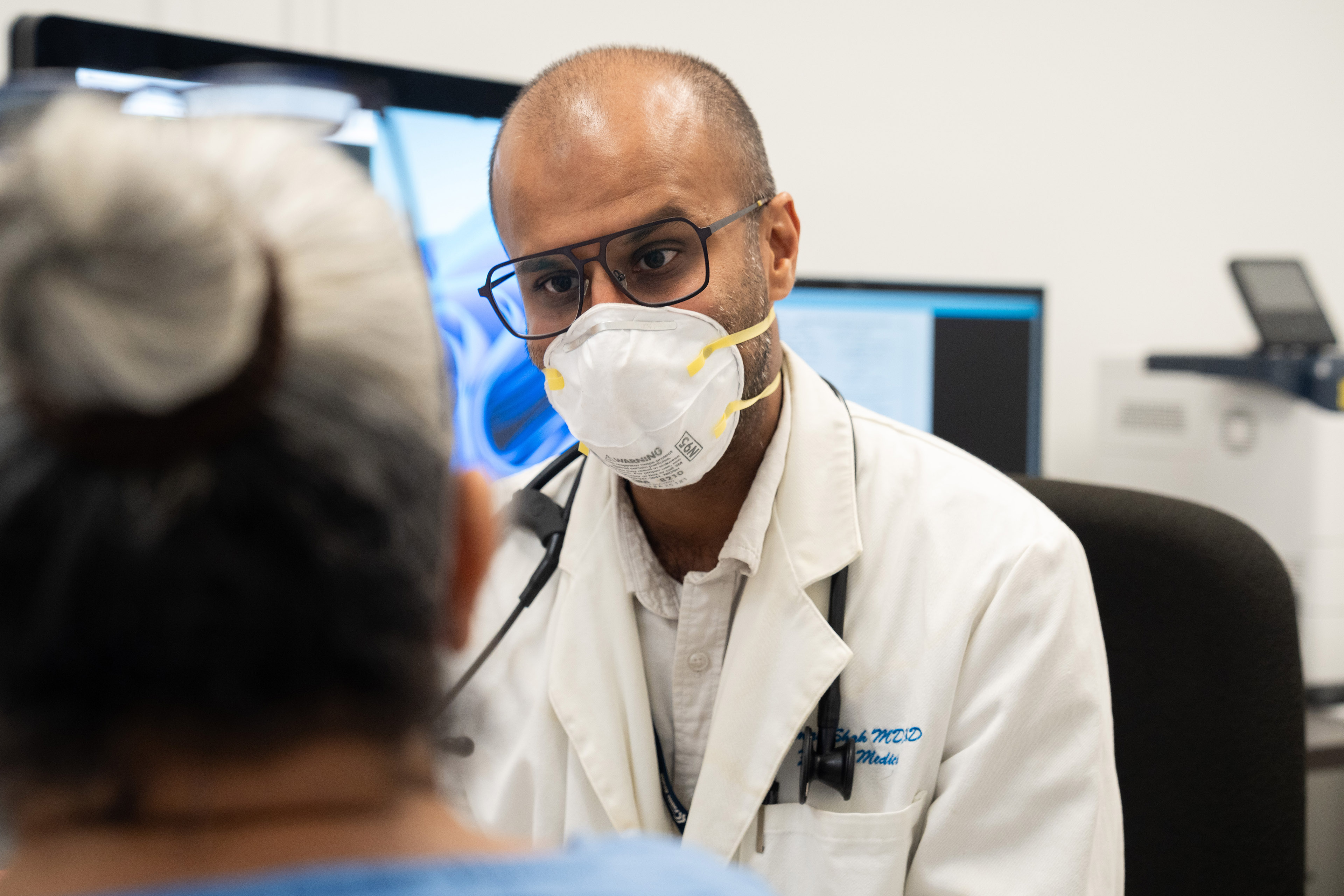
    A doctor wearing glasses and a facemask talks with a patient
    Naman Shah examines a patient at Monrovia Health Center, a Los Angeles County public health clinic in Monrovia, California. Shah says reducing medical debt in the community will depend on effective prevention strategies, just as stopping the spread of infectious disease does. (Lauren Justice for KFF Health News and Tradeoffs)

    Presumptive Eligibility

    One potential solution is a system that automatically screens and qualifies low-income patients for financial aid without requiring an application. This is called presumptive eligibility.

    Some hospitals already use such systems, which rely on software that checks patient eligibility based on publicly available information such as credit history.

    The strategy can be very effective. Shah said hospitals that have deployed presumptive eligibility systems have reported as much as a 50% increase in the amount of financial aid they give patients.

    Under a state law passed last year, all California hospitals will have to start doing presumptive eligibility screening by next July.

    But the systems can be expensive and difficult for smaller hospitals to implement. Only about 1 in 5 hospitals in Los Angeles County currently use them, Shah said.

    Public health officials wondered if they could help more hospitals set them up.

    The county, which, like many local governments, faces major fiscal challenges, couldn’t pay for this, Shah said. But the public health department could bring together healthcare and hospital officials in the county to figure out another solution.

    “The beauty of government is not when it always has to do the work,” Shah said. “We have the ability to make sure that people cooperate.”

    The Hospital Association of Southern California, initially wary of the county initiative, came to see improving hospital financial aid programs as beneficial to hospitals, many of which were wasting money on collections. “The billing process is cumbersome and costly,” said Paul Young, a senior vice president with the association.

    The association agreed to procure a presumptive eligibility system and make it available to its members. This bulk-purchasing approach, which Young compared to “a Costco model,” would lower the cost for individual hospitals, he said.

    At the same time, L.A. Care, a nonprofit health plan that administers Medicaid coverage for more than 2.5 million low-income county residents, committed $2 million to set up the system.

    The investment reflected the safety net insurer’s mission to make medical care accessible to more people, said Melanie Fontes Rainer, who leads strategic planning for L.A. Care. “It’s going to make Los Angeles County better,” she said.

    Making It Work

    Getting the new system up and running by January, as the partners hope, faces challenges.

    Hospital officials are figuring out how the system will be funded in the long term. And it’s unclear how many of the county’s 88 acute care hospitals will ultimately use it, even if it’s cheaper and easier to access.

    The partners are also working to improve data that the system relies on to screen patients. One goal is to link the system to tax records maintained by the state of California. This would provide hospitals with more accurate information on patients’ income than current systems, which often rely on estimated income.

    Walker, the patient advocate at Dollar For, said he’s heartened by the county’s effort. “I’m optimistic that we can make a better charity care system,” he said. “And the fact that hospitals in Los Angeles County are willing to be innovative and creative about ways we can do that is super encouraging.”

    For his part, Shah said county public health officials recognize that a better screening system at hospitals won’t by itself eliminate medical debt. But he said the public health department couldn’t ignore a problem that affects more county residents than asthma or tobacco use.

    “Prevention is our bread and butter,” he said.

    A doctor wearing a white coat and glasses, with a stethoscope around his neck, stands in a medical clinic hallway
    “The impacts of medical debt were staggering,” says Naman Shah, who since 2023 has led a Los Angeles County initiative to tackle the debt problem. (Lauren Justice for KFF Health News and Tradeoffs)

    This article is part of “Hidden Help,” an investigative series from Tradeoffs and KFF Health News about how hospitals can protect their patients from the life-altering harms of medical debt.

  • STAT+: Are stem cell treatments about to have their day?

    STAT+: Are stem cell treatments about to have their day?

    You’re reading STAT’s D.C. Diagnosis newsletter

    Adobe

    John writes about the politics of health care, and he is the author of the twice-weekly D.C. Diagnosis newsletter. You can reach John on Signal at John_Wilkerson.07.

    You’re reading the web edition of D.C. Diagnosis, STAT’s twice-weekly newsletter about the politics and policy of health and medicine. Sign up here to receive it in your inbox on Tuesdays and Thursdays.

    Celebrity doctor Mike Varshavski has been contacted by The Bachelor for its 30th season. Send news tips and hot physicians to [email protected] or John_Wilkerson.07 on Signal.

    A lame lame-duck

    On Friday, President Trump said he will give $90 to more than 20 million seniors to help pay for Medicare premiums.

    STAT+ Exclusive Story

    Already have an account? Log in

    STAT+

    STAT+

    This article is exclusive to STAT+ subscribers

    Unlock this article — plus in-depth analysis, newsletters, premium events, and news alerts.

    Already have an account? Log in

    View All Plans

    To read the rest of this story subscribe to STAT+.

    Subscribe

    1. John writes about the politics of health care, and he is the author of the twice-weekly D.C. Diagnosis newsletter. You can reach John on Signal at John_Wilkerson.07.

  • Before Saying Yes to the Medical Test, Know the Risks and Benefits

    Before Saying Yes to the Medical Test, Know the Risks and Benefits

    (Maria Fabrizio for WPLN and KFF Health News)

    When Lori Baute first learned about precautionary full-body MRI scans, she dismissed the idea.

    “ I heard Kim Kardashian got one, and some other wealthy people,” Baute said. But at 59, she was worried about her long-term health. She has a family history of cancer, and she’s a critical caregiver for her aging mom and her adult brother with special needs.

    After a close friend was diagnosed with bladder cancer, Baute decided to make an appointment with a clinic that offers full-body scans near where she lives in Ocala, Florida. Her results came back a week later. One major finding: She has lesions on her pancreas. “When I got that, I was really petrified,” she said.

    Worried about pancreatic cancer, Baute shared the results with her gastroenterologist, who ordered a targeted MRI scan as a follow-up. That test showed the lesions were benign cysts.

    Baute’s experience is becoming more common as companies pitch body scans directly to consumers as a way to detect cancer and other diseases early. But no major medical association — including the American Cancer Society and the American College of Radiology — recommends these scans for people without a very high risk of certain cancers.

    And even medical screenings that doctors do recommend can carry some of the same reasons for caution.

    The QTip:

    Before saying yes to the test, ask about the risks and benefits — even if your doctor recommends it.

    Here’s what to know:

    Every Test Comes With Costs and Risks

    At a minimum, a medical test will cost you time — and could mean a hefty medical bill. Many tests marketed directly to consumers, like full-body scans and at-home blood screening kits, are not covered by insurance, and some tests can cost several thousand dollars.

    Some laboratory tests might involve only the discomfort of a blood draw or the awkwardness of collecting a urine or stool sample, but others carry the possibility of physical harm. For example, a small percentage of people who get CT scans each year will develop cancer because of the radiation exposure from the tests, according to estimates from the National Institutes of Health. Relatively simple procedures like a biopsy or an endoscopy come with the risks of pain, infections, tearing, a reaction to anesthesia, or further serious complications.

    Plus, testing can cause anxiety and stress — as patients wait for results and if the results are inconclusive. “I see patients every week in my office who are tortured by the results of tests that they really didn’t need to ever have,” said Rita Redberg, a University of California-San Francisco professor and cardiologist and an advocate for less medical testing. For example, if you discover a cyst, then “you’re living for the next year, two years, three years getting repeated tests to figure out whether it’s benign or a cancer,” Redberg said. She cautions patients against testing unless they have specific symptoms.

    Testing Often Leads to More Testing — And More Risk

    A reality of getting a medical test is that the results often lead to additional, and potentially more invasive, testing. Doctors call this “diagnostic cascade.”

    Baute, for example, plans to continue monitoring her pancreas with annual scans. To her, she said, the financial cost and anxiety are worth it if she can feel “like I’m in control of my health and I have knowledge.”

    But Redberg points to a worst-case scenario, documented by JAMA Internal Medicine in 2011: After starting an exercise program, a 52-year-old woman experienced chest pain and went to see her doctor. Her exam suggested that her pain was muscular and she had a low risk for heart disease. Still, her doctor ordered a scan of her heart to reassure her. The results led her doctor to order another test, during which her artery was ripped. She had emergency bypass surgery, experienced complications, and ultimately, Redberg said, “she ended up with a heart transplant — all from this unnecessary scan just to reassure her.”

    A Few Simple Questions Can Help You Decide

    Before saying yes to the test, it’s important to know about the risks and benefits — even if your doctor recommends it, Redberg said. She suggests asking a medical provider and yourself questions like:

    • What am I going to learn from this test?
    • How is this test going to help in my care?
    • Could I improve my health without doing this test?

    She said many test results, especially in her field of cardiology, end up pointing patients back to the basics of a healthy lifestyle, like eating well, exercising, and not smoking. And those, she said, could be advised without a test.

    People and Policy

    If your health insurance covers a medical test, that means the test has most likely met vetted, scientific standards that demonstrate benefits to patients. Insurers must cover evidence-based services that have a rating of A or B from the U.S. Preventive Services Task Force. Private insurers, as well as Medicaid and Medicare plans, must cover the full cost of recommended preventive screenings. Many medical tests marketed directly to consumers are not covered by insurance.


    Emily Siner at Nashville Public Radio contributed to this report.


    HealthQ is a health series from reporters Cara Anthony and Blake Farmer, approachable guides to an unapproachable healthcare system. It’s a collaboration between Nashville Public Radio and KFF Health News.

  • Opinion: I’m a doctor. Here’s what I want the public to know about AI tools and health care costs

    Opinion: I’m a doctor. Here’s what I want the public to know about AI tools and health care costs

    When Blue Cross Blue Shield recently published research suggesting that hospitals use artificial intelligence tools to extract more money from insurers without providing additional care, people were mad. Amid growing concerns about AI, one glimmer of hope has been its potential to improve health — and yet, here it was: inflating health care costs without yielding any benefits.

    As a doctor who has used the kinds of tools being criticized, I’m frustrated, too: We can document honestly and still wind up inflating hospital bills. This is because comorbidities function as an on-off switch with respect to billing, even though they affect patient care in nuanced ways.

    Although the problem warrants a systemic fix, the best short-term solution is for hospitals to create more nuanced documentation tools, and for clinicians to exercise judgment when using them.

    What did the research show?

    BCBS suggested hospitals are using automated tools to document secondary diagnoses — like anemia, malnutrition, and low sodium — which allow them to charge more for caring for these patients.

    For instance, a patient might be admitted for diverticulitis (primary diagnosis), but found on post-op labs to have acute blood-loss anemia (secondary diagnosis). Hospitals can use these secondary diagnoses to label a patient as having a comorbidity or a complication, allowing them to bill more for the hospitalization, whether or not they treated the patient’s anemia. These “bump codes” have cost BCBS hundreds of millions of dollars over the past two years, and these costs are presumably passed along to patients in the form of higher premiums.

    BCBS claims that bump coding has become more widespread because hospitals are using AI tools to identify secondary diagnoses. Automated tools can skim a patient’s chart and prompt physicians to document that the patient is, for instance, anemic, and what they are doing about it.

    Are doctors to blame?

    A few weeks after I started medical residency, I began getting emails from hospital administrators I had never met, whose signatures said they were risk adjustment specialists. The emails were generic and polite, advising me to review clinical documentation integrity (CDI) queries on inpatients I was caring for. If I didn’t respond quickly, the request would be forwarded to the attending physician supervising me. A typical CDI query would point out that my note hadn’t commented on, say, a patient’s low sodium level, and would ask me to document that they had low sodium and what (if anything) we were doing about it.

    Like most residents, I was already spending far more time on my computer than I was with my patients. Soon, CDI queries streamed into my inbox with such regularity that I turned to a more senior doctor to ask how I might stave them off. That doctor showed me an automated tool that I could include in my notes. This tool would assess a patient’s lab results, automatically detect any additional diagnoses a patient had (like anemia, malnutrition, or low sodium), and prompt me to specify whether we were monitoring, evaluating, or treating.

    I assumed it was lucrative to the hospital for me to document these diagnoses (why else would they be paying risk adjustment specialists to email me about them?), but we almost always were at least monitoring the secondary diagnosis in question, and I accurately documented as much.

    Including this tool’s outputs in my notes kept the risk adjustment specialists from hounding me and won me back several minutes of each day — enough time to poke my head into a patient’s room before I went home, or call a patient’s family member to give a quick update. I always answered the questions included in my tool honestly, but in the back of my mind, I wondered whether I was doing my patients a disservice: Was I inflating the cost of their hospitalizations without actually improving their care?

    Where bump codes come from

    In general, hospitals are reimbursed for hospitalizing patients on the basis of diagnosis-related groups, or DRGs. DRG payments are set by the Centers for Medicare and Medicaid Services by analyzing claims data. (Medicare uses DRGs to set payments, while many commercial insurers, including BCBS, use the DRG system to negotiate reimbursement rates with hospitals.) Let’s say a patient is admitted with diverticulitis requiring surgery (typically billed as DRG 331 if there are no complications). CMS has estimated how much it usually costs to care for one of these patients and insurers prospectively pay hospitals on that basis; a hospital generally won’t get reimbursed more for keeping the patient longer, administering more drugs, placing more IVs, and so on.

    However, some hospitals care for sicker patients than others. The typical diverticulitis patient at a tertiary medical center in a poor area will require more support than a diverticulitis patient at a community hospital in an affluent area. The government does not want to penalize hospitals that see more complex patients, and so it allows hospitals to seek additional reimbursement forcomorbidities or complications that increase the cost of their care.

    This is where bump codes come from: Hospitals can bill more complex diverticulitis admissions as DRG 330, which is reimbursed at a higher rate. Not all comorbidities or complications count: In 2007, the last time DRGs were substantially changed, CMS analyzed claims data and used this analysis to decide which conditions qualify and set reimbursement rates. CMS pays hospitals more for patients with conditions like low sodium because it has found that it costs hospitals more to care for these patients (perhaps because they tend to be hospitalized longer and more often require ICU admissions).

    However, although CMS adjusts DRG payments from year to year, the list of bump codes hasn’t been overhauled in nearly two decades.

    Bump codes can help identify complex patients and ensure hospitals are paid more for caring for them. These are good things, in part because they reduce hospitals’ incentive to seek out healthier, more advantaged patients. While BCBS claims that hospitals are increasingly using these codes to bill more without actually providing more care, hospitals would presumably counter that they were being insufficiently reimbursed before, and that their coding is accurate. After all, the BCBS study does not claim that hospitals are engaging in fraud; the question is just whether the lab abnormalities hospitals are billing for warrant higher reimbursements.

    So who’s right?

    This issue boils down to the following question: How much more does it cost to care for a patient with a secondary condition, and do current coding rules accurately reflect this?

    The answer is that it depends. For instance, not all low sodium levels are created equal. If a patient briefly has a sodium level that falls below the normal range, but their sodium immediately corrects once they’re able to eat again, they probably don’t require any additional resources, and hospitals shouldn’t be reimbursed more for caring for them.

    By contrast, a patient with dangerously low sodium levels requiring an ICU stay, frequent lab checks, and carefully titrated IV fluids undoubtedly does use more resources.

    This leaves doctors in a tough spot: Risk adjustment specialists ask us to document real diagnoses that we know could increase the cost of a patient’s bill, but we have no idea by how much. Moreover, there’s no medical school module on how much any of these comorbidities affects the true cost of the hospitalization. Against this backdrop, it makes sense that doctors try to just tell the truth: yes, this patient has low sodium, and we are monitoring it, even though this probably allows hospitals to code some patients as being more resource-intensive than they truly are.

    What we can agree on

    This entire enterprise — risk adjustment specialists spamming doctors, who are already nose-deep in documentation burden, to document diagnoses that often do not affect patient care, while insurers publish reports that fail to capture the nuance of the issue, leaving the public angry and confused — highlights a more general problem with respect to how the U.S. health care system works.

    By design, hospitals and insurers are meant to compete with each other, with hospitals trying to collect as much money as they can for providing care, and insurers trying to pay as little as possible. Hospitals bolster their side by hiring risk adjustment specialists and employing AI tools, while health insurers hire payment integrity specialists and employ different AI tools.

    Patients lose out because the administrative bloat inflates the cost of medical care, while making costs less transparent and harder to contest. Ultimately, the fix should be structural: At a minimum, we need to overhaul the list of secondary conditions that are eligible for bump coding. CMS attempted to do this in 2019, when it proposed downgrading or eliminating many bump codes based on new data showing they were not associated with increased costs. But hospitals pushed back, and the effort eventually stalled.

    What should we do in the meantime?

    Secondary diagnoses are supposed to be billed only when they are clinically significant — for instance, when they require further evaluation, treatment, diagnostic procedures, or monitoring. But in practice, the bar for clinical significance is probably lower than it should be. (Even rechecking a lab may qualify as monitoring.) Accordingly, I suspect the BCBS study is tracking a real problem, and that much of the documentation of secondary diagnoses isn’t linked to patient complexity.

    Early in residency, I was caring for an immunosuppressed patient who kept spiking fevers. My colleagues and I wondered whether he might have an indolent infection lurking somewhere and ordered an echocardiogram to rule out endocarditis. His heart valves showed no signs of bacterial growth, but trace backflow was detected across one of his valves, a finding present in most people.

    Soon, I received a CDI query inviting me to document his valve dysfunction in my note. I did not do this, because his incidental valve finding was irrelevant to his hospitalization. Instead, I typed out a response indicating as much. However, it would have been easier and quicker to click through the check boxes, and, despite answering them honestly, potentially inflate the patient’s bill.

    At least some CDI tools built into electronic medical records — including the one I have used — default to including secondary diagnoses in ways that are likely to lead to bump coding. One way to improve the status quo would be to ensure that such tools give physicians the option to document whether a secondary diagnosis is clinically significant or not, rather than simply asking them how they are addressing it (on the presumption that it is clinically significant).

    Hospitals should build such tools, and regulators should ensure they do. In the meantime, I’ll exercise clinical judgment when using my CDI tool — if the low sodium seems important, I’ll document it, and if it doesn’t, I’ll politely decline when a risk adjustment specialist invariably asks me to.

    Leah Pierson is a resident physician.

  • STAT+: New Trump regulations would clean up health care pricing disclosures

    STAT+: New Trump regulations would clean up health care pricing disclosures

    Public drug price information is now coming next year, Trump officials say

    Mehmet Oz at a federal event on Monday in Washington announcing new health care price transparency rules.Finn Gomez/Getty Images

    By Bob Herman

    Oct. 5, 2026

    Bob Herman is the author of Health Care Inc., an award-winning weekly newsletter about the business of health and medicine.

    Bob covers the money in health care, focusing on health insurance and hospitals. His stories delve into Medicare Advantage, opaque prescription drug benefits, and how much executives actually make. He is also the author of the Health Care Inc. newsletter. You can reach Bob on Signal at bobjherman.09.

    The Trump administration released new regulations Monday that will force health insurance companies to publish cleaned-up spreadsheets of the prices that they pay hospitals and doctors, while stripping out meaningless data that clogged up the files.

    Trump officials also said they will start developing the system for disclosing prescription drug prices next month. A “hopeful” final plan for drug pricing data will come out by next May, said Mehmet Oz, the head of Medicare and Medicaid, at an event Monday. The government will enforce those requirements by the end of 2027. 

    Last year, the Trump administration punted on finalizing drug price disclosure rules, in a victory for drug companies and pharmacy benefit managers that have fiercely guarded their prices. 

    STAT+ Exclusive Story

    Already have an account? Log in

    STAT+

    STAT+

    This article is exclusive to STAT+ subscribers

    Unlock this article — plus daily intelligence on Capitol Hill and the life sciences industry — by subscribing to STAT+.

    Already have an account? Log in

    View All Plans

    To read the rest of this story subscribe to STAT+.

    Subscribe

    1. Business of Health Care Reporter

      Bob covers the money in health care, focusing on health insurance and hospitals. His stories delve into Medicare Advantage, opaque prescription drug benefits, and how much executives actually make. He is also the author of the Health Care Inc. newsletter. You can reach Bob on Signal at bobjherman.09.

  • Medicare Is More Broken Than We Thought

    Medicare Is More Broken Than We Thought

    Note: “An Arm and a Leg” uses speech-recognition software to generate transcripts, which may contain errors. Please use the transcript as a tool but check the corresponding audio before quoting the podcast.

    Please note that this transcript may include errors.

    Dan: Hey there. In the first week of October last year, 2025 — a whole bunch of senior citizens in Minnesota got a letter with some bad news. 

    Amy Hockert: A lot of changes coming in 2026. We know that at minimum 160,000 of you, absolutely have to pay attention to this,

    Dan: Their health insurance through Medicare Advantage was going away. 

    Erin: I was so mad. I was like, “No. Now what do I do?” And I look at my husband and said, “Now what?” “

    Dan: Folks like Erin– who lives in small-town Cambridge,Minnesota–  were going to have to find a new plan by the end of Medicare’s annual open enrollment period, which would start in a couple weeks.

    Up until now, Erin had been on a plan from a local nonprofit insurance outfit called U Care.

    UCare offered some of the most generous and affordable plans in Medicare Advantage — the version of Medicare operated by private health insurance companies. 

    But U Care was going belly up.

    FOX 9: The collapse of UCare after 40 years in Minnesota has been swift and stunning.

    Dan: Callers jammed the phonelines at Minnesota’s Aging Pathways hotline — thats the state agency that helps people with Medicare. Kelli Jo Greiner runs it.

    Kelli Jo Greiner: I don’t know any other way to describe it other than total chaos. Our phones were ringing off the hook.

    Dan: Meanwhile, in the Twin Cities suburb of Maple Grove, an insurance broker named Alison Ebert had been getting ready for her busy season, making appointments with her usual clients.

    Alison Ebert: October 1st through October 14th, I always set my appointments with my clients. I always joke I get paid in cookies and coffee because I go to their homes, we sit down. I know their families, I know their kids, their grandkids

    Dan: The day open enrollment started, she got 47 calls — from people she’d never met. People whose coffee and cookies she’d never tasted.  That was new. 

    And more would call. Because more letters were starting to go out.

    Not just from U Care. Other health insurance carriers were dropping out of the area. UnitedHealthcare, BlueCross, Aetna, Humana — all canceled Medicare Advantage plans in counties all over the state. Three counties were left with no Medicare Advantage plans at all. 

    And… this wasn’t just something that was just happening in Minnesota. Almost 3 million seniors across the country had plans in 2025 that would stop being offered to them in 2026.

    And that’s because at their headquarters, insurance companies had done their calculations, assessed their risks, and decided that offering plans to those people would no longer be profitable enough. So, seniors from Maine to California saw the number of available Medicare Advantage plans shrink by the dozen — leaving a lot of them confused, and with fewer, often worse and more costly health insurance options. 

    It’s part of a big new trend — these disappearing acts  have been increasing in recent years, and insurance companies have already signaled that more are coming. Major insurers have already announced intentions to dump plans that currently cover more than two million seniors. 

    We’ve spoken with folks in a dozen states — in rural places like Vermont and North Dakota, and in states with rural and urban centers like Maryland and Minnesota — about how it all went down last year — and what we can take away for this year.

    My colleague Emily Pisacreta and our awesome summer intern Lynn Barbera made those calls. And Emily, you called that experience “eye opening.” 

    Emily: Uh, yeah. We already knew from previous reporting that people had problems with Medicare Advantage. At first this story sort of seemed like one more thing people on Medicare Advantage had to worry about. But it turns out to be more than that. What happened last year — and is about to happen again this fall — showed us big problems, problems that affect everyone who’s on Medicare — or hopes to be one day. There are layers to this. 

    Dan: And we’re gonna peel them back. Get ready for a big dose of Medicare.

    This is An Arm and a Leg, a show about why health care costs so freaking much and what we can maybe do about it. I’m Dan Weissmann, I’m a reporter and I like a challenge. So our job on this show is to take one of the most enraging, terrifying, depressing parts of American life and to bring you a show that’s entertaining, empowering and useful.

    Emily, a while back, we looked at problems with Medicare Advantage. How about we do a little recap?

    Emily: Yeah. 

    Dan: We were taking our first deep look at Medicare itself, and as we said then, it kind of blew our minds. 

    Emily: Before we did that story, I was under the impression that you wake up on your 65th birthday and never have to pay a medical bill again, never have to deal with health insurance companies again. In fact, that’s the dream of Medicare For All. 

    Dan: But it’s not the reality of Medicare as it exists. For one thing, signing up means making a dizzying number of choices. 

    And you basically never escape private insurance companies. No way. Turns out, they run a lot of Medicare — so you could see dozens of different plans offered by different companies. 

    But here’s the most important part: You have to choose between what’s now called Traditional Medicare — run by the U.S. Government — and Medicare Advantage plans, run by private insurance companies. 

    And they both have downsides. 

    Traditional medicare doesn’t cover everything. For outpatient medical care — for doctor visits, outpatient procedures, infusions, physical therapy, X-rays and MRIs, you name it — Medicare only pays 80 percent of the bill.  

    And those other things can get so expensive — the remaining 20 percent can run to thousands of dollars that most seniors don’t have. 

    If you want that covered — and, I mean, you do — you actually have to buy a “supplemental” policy — people call them “Medigap” plans. They’re offered by private insurance companies. And you pay a premium. 

    Oh, and did I mention that you’re already paying a premium to the feds for your Medicare? Yep. Exactly how much depends on your financial situation, but most people pay just over 200 bucks a month.

    Medigap premiums – to the private companies – are on top of that. They vary a lot — by what plan you pick, and by where you live — but the average is another two-hundred and some every month. And that number goes up every year. 

    So you’re paying all that but then you’ve still got another gap. Vision, dental, and hearing. Traditional Medicare doesn’t cover them at all. So Medigap plans generally don’t cover them either. 

    The dark joke is that eyes, ears and teeth are “luxury organs”

    Because who needs to see or hear or chew? 

    So those are some BIG gaps.

    A lot of Medicare Advantage plans offer to fill those gaps:

    MA Ad 2: This card I’m holding in my hand, it’s an example of an all-in-one Medicare Advantage membership card.

    Dan: Lots of them include what’s missing  

    Woman in Ad2: That card helps me with my vision costs, my dental costs.

    Dan: Some of them even subsidize the premium you’d be paying to the feds, even bringing it down to zero. You can see how appealing that is.

    … and insurance companies hammer that appeal home with floods of TV ads

    Plus direct mail, phone calls, and facebook ads out the wazoo. None of which mention the downsides to Medicare Advantage… 

     which are basically: All the downsides we’re all familiar with from dealing with insurance companies. 

    Their network might not include your doctors and providers. It might not include very many providers near you at all. 

    And once you find an in-network provider, the insurance company can make you jump through hoops like pre-authorization. Or deny a claim. And then you get to fight through an appeals process. 

    I talked with a guy in Texas, Robert Wolpa. He’s got HIV, a pacemaker, other stuff. He said he felt like he was spending half his days on hold, waiting to talk with badly-paid, badly-trained people.

    Robert Wolpa: I’m 71. I just turned 71 in November and I’ve got, I’ve got a little of the HIV cognizant crap. Like, my short term memory is gone. And I think to myself, what have I gotten myself into?

    Dan: This is the thing: You can be 65 years old, in totally decent shape, playing pickleball or whatever, never seeing a doctor. 

    But when you pick Medicare Advantage, most of the time you’re also choosing for an older, sicker version of yourself. Who may need to see specialists, and who may not have as much capacity to fight with insurance companies. 

    I mean, most relatively young and healthy people have a hard enough time. 

    This is where Traditional Medicare starts to look much more appealing. Practically every provider takes it, and denials are almost unheard of.

    But for most people, if you’ve chosen Medicare Advantage, it’s a no-backsies situation. 

    You can still sign up for Traditional Medicare, but you may not be able to get a Medigap policy. 

    For one thing, it may not be in your budget. Robert Wolpa got a quote: Almost 500 bucks a month. Like a third of his social security check.

    Robert Wolpa: And I said, okay. Next option.

    Dan: And lots of people don’t have the option at all. In most states, if you don’t sign up at age 65, Medigap plans are allowed to reject you if you have… pre-existing conditions. 

    Sarah Jane Tribble: It’s sort of shocking, actually, right? Like, the Affordable Care Act passes and makes it so that everybody with pre existing conditions can get insurance no matter what, but it leaves out the people who might need that the most, who are 65 and older. 

    Dan: That’s the person who had introduced us to Robert Wolpa, and helped us understand this whole issue. Sarah Jane Tribble,a reporter with our pals at KFF Health News had just published her own story about the pitfalls of Medicare Advantage.

    This comes as a big surprise to a LOT of folks — as Sarah Jane found out while she was reporting her story, and talking about it with friends.

    With all of these… advantage — all the marketing, and all the gaps it fills– Medicare Advantage has grown by leaps and bounds in its 20-some years. 

    At this point, the majority of seniors are on Medicare Advantage.

    So, OK: Long recap, but. That’s what we KNEW a couple of years ago. 

    And it turns out — based on what happened last fall, and what’s about to happen this year — the problems are way worse than we knew. 

    Which brings us back to our friends in Minnesota. In early October 2025.

    News anchor 1: In 90 days, thousands of Minnesotans will lose their Medicare Advantage coverage.

    News anchor 2: Many major health care providers are dropping their Medicare Advantage plans in 2026. 

    Dan: So, Emily. What the heck happened?

    Emily: So that local nonprofit insurance company – UCare– they went broke, and all their Medicare Advantage plans got pulled from the market. Pretty quickly after that, UnitedHealthcare, Aetna, and others sent break up letters of their own to thousands of their beneficiaries.

    Lots of people turned to insurance brokers for help. 

    But many brokers weren’t calling them back. Because things had started going haywire for them too. Insurance broker Alison Ebert told us she was used to getting paid in cookies and coffee – and this time around, she would mean that literally — because in the days leading up to open enrollment she got an unusual call from her contact at UnitedHealthcare.

    Alison Ebert: She said, “I just wanna let you know before you get the email, we’re not paying commissions this year.”

    Emily No commissions. No payment from the insurance company for anyone she would enroll in their Medicare Advantage plans. Which is for health insurance brokers — the whole business model. 

    Alison Ebert: And my heart just sunk. That was the first phone call, and one by one thereafter, all the major carriers except for Allina Health Aetna, followed suit.

    Emily: Other brokers in Minnesota told me the same thing. I asked Alison: why do you think they cut commissions? She says a rep for one of the big companies told her the ugly truth. 

    Alison Ebert: With UCare exiting the market,” she said, “Let’s face it, we don’t want everybody that sunk UCare on our plan. And so this is how we’re gonna c- curb enrollments.” 

    Emily:  Alison got the message: These insurance companies wanted to curb enrollments. They specifically didn’t want to insure people who they tho  ught “sunk UCare” — meaning, people who used health care. Who filed claims. Who cost money.If brokers didn’t get commissions for selling plans to these folks, a lot fewer of them would sign up.  

    Alison Ebert: Because they’ve always told us about 80% of the sales comes through brokers like us.

    Emily: Now, a few weeks later, it was October 15, open enrollment was starting, and her phone was ringing off the hook. 47 people on day one. And more every day after that. Plus all her regular clients — the ones whose grandkids she knew by name.

     Alison had to decide what to do  — could she afford to help all those people for free? 

    Alison Ebert: I have kids. I mean, I deserve to get paid. I need to put gas in my tank to go to these people’s homes.  

    Emily: But Alison didn’t think it was right to leave people hanging.

    Alison Ebert: I left a message on my answering machine saying, “You know, due to the fact that we’re not getting paid this season, a lot of brokers left the market and I’m just returning calls as they come. But just be aware that it might take me a couple weeks to get back to you.”

    Emily: Instead of going to everyone’s house, she set up office hours at a coffee shop to be able to see as many people as possible.

    Meanwhile… Kelli Jo Greiner and her colleagues at the state’s Medicare hotline were scrambling too.

    Kelli Jo Greiner: We had wait times of two hours. Nobody wants to wait for even 10 minutes, let alone two hours

    Emily: She and her team had to improvise.

    Kelli Jo Greiner: We have staff that don’t usually do Medicare counseling. They help with, like, long-term care and other areas, and we even put those folks on the phones to help

    Emily: And she wrangled a weekly spot on FOX 9 in the Twin Cities to answer big questions.

    Amy Hockert: Medicare Monday is what we’re calling it. A lot of changes coming in 2026. Kelli Jo, thanks for joining us.

    Kelli Jo Greiner: Well, thank you. I’m glad to be here again. 

    Amy Hockert: All right. Well, let’s roll through it here.

    Emily: Kelli Jo told viewers: The most important thing is to be proactive. If you don’t do anything, the system will put you into traditional Medicare — but without a Medigap plan. Oh, and by the way, she told them: Your drug plan will probably disappear too, unless you sign up for a new one.

    So — she said, the good news, as far as it goes is: Right now you have a choice. And it’s just like the one you had when you were 65. You get to basically start over if you want, and get a Medigap plan even if you have a pre-existing condition. This is a special situation, they can’t reject you. 

    And once you’re on they can’t tell you which doctors to see. Almost every doctor in the country takes traditional Medicare.   

    Kelli Jo Greiner: And for many people that is a huge advantage,’cause we have a lot of snowbirds here that go south for the winter.

    Emily: But she says most people she talked with decided they just couldn’t afford those Medigap premiums. They were stuck with Medicare Advantage. Only now they had fewer and crummier Medicare Advantage plans to choose from. 

    Also, they were more expensive than these folks were used to. 

    Kelli Jo says a lot of people had been on plans with no monthly premium — but now all those plans were gone.  

    Kelli Jo Greiner: and so they ended up having to switch to a plan with a premium

    Emily: And in a lot of cases, without some extra benefits that Kelli Jo says are a big draw. Like discounts on groceries — or free gym memberships, a feature called Silver Sneakers.

    Kelli Jo Greiner: and I cannot even tell you how many people called us about Silver Sneakers. They were so upset about that change.

    Emily: So people ended up paying more than they were used to —  and getting less. 

    Dan: OK. So to recap: some Medicare Advantage plans disappeared.

    Emily: Yes.

    Dan: The remaining plans weren’t great.

    Emily: Right.

    Dan: And most people chose them anyway, because they couldn’t afford Medigap.

    Emily: Correct. And we can expect more of the same this year– and for who knows how many years ahead.

    Dan: So Medicare Advantage is getting shakier– even while it keeps growing. 

    Coming right up: how the dynamics behind all of this add up to trouble for all of Medicare. And what we can maybe do about it.   .

    This season of An Arm and a Leg is a co-production of Public Road Productions and KFF Health News — that’s a non-profit newsroom covering health issues in America. Their reporters are amazing — you’re about to hear from another of them. We’re honored to be their colleagues.

    Dan: Kelli Jo Greiner told us many folks who lost their Medicare Advantage plans  just couldn’t afford Medigap supplements. 

    Which, as we’ve been learning, has been one of the big dynamics behind the growth of Medicare Advantage in the first place. 

    Emily: Our colleague Julie Appleby found recently, that dynamic is getting starker.

    Julie’s a senior correspondent with our pals at KFF Health News.  

    Julie Appleby: I cover all things health insurance pretty much, uh, from the Affordable Care Act to Medicare, other kinds of health insurance programs, uh, that kind of thing. 

    Emily: Earlier this year, Julie got a call from a broker in Illinois.

    Julie Appleby: And he was telling me that more than, like, 80 of his customers were enrolled in a Medicare supplement,

    Emily: A specific plan. One that usually had low premiums. 

    Julie Appleby: But they suddenly raised their rates by 45%. And he said, “In my 49 years of doing business as a broker, I’ve never seen a premium increase be effective immediately on everyone. So I thought, “Hey, I’m gonna start looking into this.”

    Emily:  She found some good data from a company called Telos Actuarial — which showed: this price hike was part of a trend.

    Julie Appleby: There were increases going on kind of throughout the industry.

    Emily:. On average, the data showed premiums on Medigap went up almost 17% from the previous year.

    Not as high as that one plan with 45 percent increase, but still nothing to sneeze at. Brokers and other experts told her: That kind of increase used to be almost unheard of. But for the last bunch of years, it’s become a new normal. 

    Julie sees a connection with the growth of Medicare Advantage. 

    To understand it — and why everything about Medicare could be getting shakier and shakier — Julie’s gonna introduce us to a key term: Risk Pool. It’s a big part of how insurance prices get set.

    Julie Appleby: Insurance is a giant pool, right? We all are in the pool, and everybody kinda shares the cost. The insurance company has to sit down and try to figure out, “Well, gee, I’ve got this pool of people. How sick are they? How, how often are they gonna go to the doctor? How often are they gonna be hospitalized?” And then calculate out, “Okay, so what might that cost me?”

    Emily: So a lot depends on: Who’s in the risk pool for any given plan? If Medigap plans are more expensive than Medicare Advantage — but provide better coverage — then, who’s gonna choose the Medigap? People who think they’re gonna *need* that better coverage. Sicker people.

    And with millions of people getting the chance at do-overs — because their Medicare Advantage plans got nuked — these Medigap insurers have a bunch of new customers, who — it seems reasonable to think — may be sicker.  

    Julie Appleby: So these carriers are, then having to think, “Wow, I’m taking all these people on in this region, so I’m gonna have to raise my premiums to cover what might be those expected costs.” 

    Emily : And as premiums grow and grow, what we could see is a kind of vicious cycle. Because as new people turn 65, they’re looking at Medigap premiums that are harder and harder to afford.

    So more and more people are attracted to Medicare Advantage. I spoke with a researcher named Laura Skopec – she studies Medicare at the Urban Institute, an economic and social policy think tank. Here’s how she put it: If this trend continues — with Medigap prices driving more people to Medicare Advantage

    Laura Skopec: We’re gonna see a traditional Medicare that is sicker and wealthier, which is sort of a weird combination, but it’s gonna be sort of the sickest people that really need good access to specialists, wanna be able to go to the cancer center, you know, any sort of doctor they wanna go to, and the people that can afford Medigap

    Emily: Like, the sicker you are, the more you need this, and the more people who need it, the more expensive the supplements will be.

    Laura Skopec: The risk pool just keeps on worsening.

    Emily: So, expect Medicare Advantage to keep growing. And — as Laura points out — getting more expensive.

    Laura Skopec: The Medicare Payment Advisory Commission says we spend about fourteen percent more for everyone who chooses Medicare Advantage over traditional Medicare, and that was really not the point of the Medicare Advantage program, right? It was supposed to use sort of private sector processes to lower costs in Medicare, and it has not done that. 

    Emily: In fact, insurance companies are under increasing scrutiny for overcharging the government for Medicare Advantage. 

    The feds have been trying to impose some rules to cut down on those extra profits – all very technical stuff which we could devote a whole episode to.     

    Dan: Maybe we should

    Emily: Yeah and crackdown may have played a role in insurance companies pulling some of these plans off the market. And they say they’re gonna keep yanking more plans off the market unless they get MORE federal dollars. 

    Laura: They’re saying that their costs are going up for paying claims, which is probably true, and they point to market exits and other issues as, like, we need a pay bump here to stay in the market.

    Emily: All of this — pulling plans off the market, reducing benefits, trying to control who enrolls in their plans — all of this stuff is likely to keep happening. 

    So we should talk about what that looks like on the ground, and how seniors can navigate all these changes. 

    Remember Erin in Cambridge, Minnesota? 

    What happened to her really exemplifies how this kind of thing can play out. And how we can support each other.

    So Erin had gotten kicked off her plan when the whole enterprise behind it, UCare, collapsed.

    Erin had been really happy with UCare for the four years she was on one of their Advantage plans.

    Erin: You call their customer service and they are very helpful. I loved it.

    Emily:  she had access to specialists. 

    Erin: A thoracic, a neurologist, a urologist, a nephrology. An ENT specialist. 

    Emily: Erin had suffered four heart attacks in her late fifties. Because she couldn’t work, she started getting social security and Medicare early — when she was 58. She doesn’t really remember how she ended up picking Medicare Advantage over traditional Medicare.

    But it was working for her. Until they pulled the rug out from underneath her.

    Erin: I did not want them to go anywhere. I heard that, I was just in tears.

    I was so mad. I was like, “No. Now what do I do?” And I look at my husband and said, “Now what?” “

    Emily: And she says her husband had the answer immediately.

    Erin:Well, we’ll just call Desi.”

    Emily: We’ll just call Desi.

    Dan: Wait a minute–  Who is Desi?

    Emily: You gotta meet Desi. 

    Desi Panek: I’m Desi Panek, and I work at the Seven County Senior Federation here in Mora, Minnesota.

    Emily: That’s a member-led organization of seniors in eastern and central Minnesota who came together to advocate for themselves, and to help each other with transportation and other stuff seniors need. Including: signing up for — and dealing with — Medicare. 

    I met Desi and her boss Lisa Krahn, the Federation’s director, as they were gearing up for this year’s annual enrollment period. 

    Lisa: It can’t be as bad as it was last year 

    Emily: Yeah yeah. 

    Desi: We’ll find out soon. 

    Lisa: Oh, God 

    Emily: Yep, hold onto your hat. 

    Emily: Yep, they’re still dealing with the fallout from last year. This is Lisa:

    Lisa Krahn: Still quite a few people who show up, who are calling now, who don’t realize that they haven’t had a plan all year saying, “I just don’t have anything because my old plan left. Well, I wasn’t really paying attention to the mail they were sending me,” kind of a thing.

    Emily: Some of those people only found out when they got a bill in the mail. Or when they tried to pick up a prescription, and had to pay out of pocket cuz they didn’t have a drug plan anymore. 

    Luckily, Erin got the news before it was too late. She and her husband called Desi, and Desi helped them enroll in a new Medicare Advantage plan. Which Erin says, isn’t as good. 

    Erin: Right now I’ve got $1,700 out of pocket going to a pair of hearing aids

    Emily: She’s not a fan of the customer service. And she says she had to stop taking one of her preventative medications because her drug plan changed.

    Desi and Lisa are operating very much at ground level helping people like Erin, but they definitely have thoughts about the big picture –especially the stark choice between Medicare Advantage and traditional Medicare.

    Lisa Krahn: original Medicare is that thing you’ve been waiting your whole life to get. It’s good everywhere. And once you’re in, you’re in. 

    Emily: But it’s become too expensive for most people. Meanwhile, Medicare Advantage can really limit people’s access to care.

    Lisa Krahn: So, looking for a middle ground between those, it’s, it’s… There, there should be better choices, frankly, instead of such extreme ones.

    Desi Panek: Extreme is a really good word for that. I agree. 

    Emily: Extreme meaning there’s a big hole in one and there’s too many…

    Lisa Krahn: Restrictions on the other. But all the millions we’re dumping into advertising and these private companies, that could have filled the holes on original Medicare a long time ago. And that’s just antithetical to the function and the existence of the insurance industry, which, like the monarchy, maybe we can stop believing in. I’m revealing myself as a single-payer Medicare for All advocate, but we need better Medicare, frankly, you know? It always been shortchanged.

    Emily: Dan, speaking of Medicare For All.

    Dan: Yeah we really shouldn’t do an episode like this without mentioning it. Especially because it’s been coming up so much in this year’s election season. In Michigan, Abdul El-Sayed won the Democratic Senate primary, and Medicare for All was his number-one pitch.

    Abdul El Sayed: Yes, we really can guarantee healthcare in this country. Yes, we really can do it while spending a lot less and getting a lot more if our healthcare doesn’t still fund tens of millions of dollars in healthcare CEO, uh, salaries on top of it.

    Emily: People like Lisa — and Abdul El-Sayed — think of Medicare for All as a way to also plug the holes in existing Medicare. 

    Dan: Well, huh. OK, I mean, one thing I’m really tuning into is that all these big gaps in Medicare are all driven by the fact that ALL of Medicare — our big public benefit — is actually set up so it requires insurance companies to make a profit in order for it to function. Whether they’re selling Medicare Advantage plans, or Medigap policies.

    But then, how do Medicare for All advocates say that spreading Medicare to everybody makes the math actually work better?

    Emily: It’s all about that term Julie Appleby introduced us to:  Risk pool. How “risky” the people you’re insuring — the pool — are as a whole. Meaning, how much health care they need on average. The calculations change a lot when the pool is everyone, including people who are 25 as well as 65 and 95 — and when tax money funds health care directly instead of filtering it through private health insurance companies to administer and also take a profit.

    In fact, a recent study out of Yale estimates that Medicare For All — that is a Medicare that is completely void of private insurance companies — would reduce annual health expenditures by 1 trillion dollars every year.

    Dan: But that’s not just taking insurance companies out of Medicare — it’s taking them out of the whole U.S. health care system.

    Emily: Right. In the meantime, some politicians in Washington are talking about tweaks — big and small — to just Medicare itself. 

    Vermont Senator Bernie Sanders–

    Dan: the original Mr. Medicare For All 

    Emily: Yeah – in the meantime, he says we should extend traditional Medicare to cover vision, hearing, and dental. He’s introduced a bill in the Senate to do just that. 

    And Oregon Senator Ron Wyden recently introduced a bill that would put an out-of-pocket max on traditional Medicare. That way, people wouldn’t need supplements as much, and Medicare Advantage wouldn’t look as tempting.

    Both of those ideas would mean putting more federal money toward traditional Medicare.

    Dan: Which doesn’t SEEM like something Congress is likely to do. But what this whole story shows is: it seems like it’s gonna cost us either way. Either we put more public dollars into traditional Medicare, or we keep paying higher prices, collectively and individually,

    As for the here and now. If you have Medicare Advantage, but you don’t have a Desi or a Lisa to call, Emily, they gave you a breakdown of what you need to know.

    Emily:Yep. Their first piece of advice: open every piece of mail from your insurance company. That’s where you’re going to find out whether your plan is being cancelled. Or where you might find out they’re trying to auto-enroll you into a new plan, which might not be the best one for you.

    Desi Panek: The past couple of years we’ve had plans that end a specific plan, but will auto-enroll the e- the enrollee into another plan in the same company.

    Lisa Krahn: Crosswalking

    Desi Panek: Yes, so that’s a big deal. Pay attention to your mail. Um, you’re gonna get stuck with huge premiums if you just let it roll.

    Emily: And find someone to talk to.

    Remember Kelli Jo who runs the Medicare hotline for Minnesota? Every single state has one of those agencies. They’re called SHIP — S H I P — state health insurance assistance program. Google your state, SHIP, and Medicare

    If you can’t get through, there’s always insurance brokers. Desi has some advice on measuring up whether a broker is trustworthy.

    Desi Panek: Ask them if they sell every product available to you in your area. That’s one of the biggest things. I think that a lot of people just assume they’re gonna go to a broker or an agent and they’re gonna get the full scope, and that’s not necessarily true.

    Emily: You might want someone who sells Medigap supplements as well as Advantage plans. Someone who does that may be less inclined to push you into whatever’s paying them the highest commissions.

    Desi Panek: Word of mouth is a big deal for a lot of people, so asking your friends, your neighbors, uh, “Who did you work with? Are you happy? Are you unhappy? What was the experience like?”

    Dan: Talking to your friends and neighbors. It’s like, we gotta rely on each other.

    Emily: Which is why I’m kind of obsessed with this Senior Federation thing. People banding together to share information and resources to navigate this ongoing mess.

    Desi and Lisa’s group has been operating since 1975. There used to be a robust network of similar groups across the state. Theirs is the last one, but Desi says they’re going strong.

    Desi Panek: We’ve got our beautiful community and our thrift stores that keep our doors open and allow us to give that good information out, um, whether it’s what people wanna hear or not.

    Dan: And it went by kinda fast but I think I heard her say thrift stores?

    Emily: Yep! They have a side hustle. 

    Lisa Krahn: We run two thrift stores, the One More Time stores, which give us financial independence. So we’re not dependent on just memberships and just counseling fees or service fees. 

    Emily: That’s awesome, yeah, I’m dying to go to those thrift stores. I saw it on the website and I was like…

    Desi Panek: Did you see that we won Minnesota’s best thrift store?

    Emily: Stop it.

    Desi Panek: I mean it.  

    Emily: That’s so cool. Oh my God. 

    Lisa Krahn: By the Minnesota Star Tribune, yes. It was a popularity contest.

    Emily: Amazing. Wow.

    Dan: Wow for sure. Emily, thank you so much for all of this reporting.

    So here’s where we landed: Medicare is way more broken than we knew!  And we already knew it was kind of a confusing mess with a lot of holes. 

    Fixing it will require a huge lift.  The kind of thing that hasn’t seemed like a political possibility. And everybody will have BIG differences of opinion about how a fix should work. There are people who think the government shouldn’t be involved in health care at all. 

    Meanwhile, we’ve got what we’ve got.  We’ve got each other. 

    And… you just never know what might be possible.

    Next time on An Arm and a Leg, we’ll hear about what might be the most radical health care experiment since Medicare itself. 

    And the two guys — a Democrat and a Republican — who made it happen.

    Till then, take care of yourself. 

    This episode of An Arm and a Leg was produced by Emily Pisacreta, with help from our summer intern Lynn Barbera and me, Dan Weissmann— and edited by Ellen Weiss. Izabella Kulkarni provided additional production help.

    Reporting for this story was supported in part by Arnold Ventures. Listeners like you are our biggest source of support, and we need you more than ever. If you like what you’re hearing and want it to continue, head to arm and a leg show dot com, slash, support.  

    Adam Raymonda is our audio wizard.

    Our music is by Dave Weiner and Blue Dot Sessions. 

    Amanda Boyd is our Operations Manager. Bea Bosco is our consulting director of operations. 

    An Arm and a Leg is produced in partnership with KFF Health News. That’s a national newsroom producing in-depth journalism about health issues in America and a core program at KFF, an independent source of health policy research, polling, and journalism.

    Zach Dyer is senior audio producer at KFF Health News. He’s editorial liaison to this show.

    An Arm and a Leg is distributed by KUOW, Seattle’s NPR news station.

    And thanks to the Institute for Nonprofit News for serving as our fiscal sponsor.

    They allow us to accept tax-exempt donations. You can learn more about INN at INN.org.

    Finally, thank you to everybody who supports this show financially. Listeners like you are our biggest source of funding.

    You can join in any time at arm and a leg show, dot com, slash: support.

    Thanks! And thanks for listening

  • Patient Dies by Suicide After ‘Insurance Issue’ Delayed Medicine for Lung Disease Flare-Ups

    Patient Dies by Suicide After ‘Insurance Issue’ Delayed Medicine for Lung Disease Flare-Ups

    If you or someone you know may be experiencing a mental health crisis, contact the 988 Suicide & Crisis Lifeline by dialing or texting “988.”

    KYLE, Texas — Kenney Blewett was diagnosed with lung disease more than a decade ago but started experiencing flare-ups this year that made him feel like he couldn’t breathe.

    Blewett described those flare-ups as “the scariest thing in the world,” said his wife, Cindy, adding that while the episodes typically lasted no more than a few minutes, they had become more frequent.

    On top of that, simple tasks, like taking out the trash, left Blewett winded. He rarely left the house and had recently lost 45 pounds. “That sounds like cancer,” Cindy remembered one of his doctors said. It was clear, she said, that her husband’s poor health, tied to decades of smoking, was getting worse.

    That’s why, on June 2, Blewett’s pulmonologist wrote him a prescription for a new medication to improve the terrifying breathing issues caused by chronic obstructive pulmonary disease, or COPD. But the prescription wasn’t immediately filled. Two days after that doctor appointment, Blewett received an email from Walgreens explaining that, “due to an insurance issue that we’re working to resolve,” the medication was delayed.

    “He was hopeful that it would work,” Cindy said of the drug, two months after her husband’s death. “I wish we had the chance to find out.”

    Insurance delays and denials have become an infamous feature of the American healthcare system, with nearly 7 in 10 adults calling them “a major problem,” in a January KFF Health Tracking Poll.

    In June 2025, six months after UnitedHealthcare’s CEO was shot in New York, the Trump administration announced a highly publicized industry pledge, signed by dozens of major health insurers, to remove some of the barriers that block or delay patients from accessing doctor-recommended care. And yet that pledge was voluntary, and it carries no penalties if companies fail to comply. Indeed, a report published by KFF Health News in July found that some insurers that signed the pledge would not implement all the promised initiatives as originally outlined.

    Insurers Hedge on Trump-Backed Pledge To Improve Denials Process

    Last year, the Trump administration announced a voluntary pledge by dozens of insurers to improve prior authorization, which often requires patients to seek approval before treatments. But prior authorization remains commonplace, and there’s no evidence the government is trying to hold insurers to account.

    In recent years, lawmakers in most states, including Texas, have attempted to address delays and denials by regulating the insurance industry in the absence of substantial federal reform. But most health insurance plans, including traditional Medicare policies and employer-sponsored offerings, which together cover more than half of all Americans, typically aren’t under state jurisdiction.

    Even some medical office staff and pharmacy employees find the patchwork of state and federal insurance rules and regulations confusing, a problem that is poised to become more complicated as artificial intelligence plays a larger role in approving and processing claims.

    “It’s just gotten completely out of hand,” said Matt Toresco, CEO of Archō, a patient advocacy and consulting company. He argued that patients need more assistance facing insurance hurdles.

    The Blewetts’ story illustrates how navigating these complexities remains a herculean task for patients and their caregivers.

    Cindy has sought answers from Medicare; Kenney’s private Part D drug plan; his pulmonologist’s office; and Walgreens. She still has questions about who was responsible for the medication delay and how the holdup could have been prevented.

    If the COPD flare-up Blewett experienced on the afternoon of Sunday, June 7, could have been avoided, she wondered, would he still have chosen to die by suicide that night?

    A photo of a man standing in the woods seen on a laptop.
    Kenney Blewett, who was diagnosed with lung disease more than a decade ago, died by suicide in June. The Blewetts celebrated their 60th wedding anniversary earlier this year. (Callie Richmond for KFF Health News)

    ‘Complex and Convoluted’

    During that first week of June, Cindy said her husband repeatedly asked if his prescription — a liquid medication meant to be inhaled through the nebulizer machine Kenney owned — was ready to be picked up from Walgreens.

    Cindy said she wasn’t initially surprised or worried by the delay. Since its acquisition by a private equity firm last year, Walgreens has cut thousands of jobs across the country, according to the Private Equity Stakeholder Project. Cindy said in August that their Walgreens pharmacy in Kyle seemed to her to have been understaffed for months, and that prescriptions were being filled more slowly.

    When Cindy called the pharmacy a few days after Kenney’s appointment to find out more about the insurance delay, she said, a Walgreens employee told her the prescription required prior authorization. Also called preapproval or precertification, prior authorization is a practice widely used by health insurers that requires medical providers to seek permission before their patients may receive covered treatment.

    But Cindy didn’t know which of Kenney’s insurers required prior authorization for this medication.

    For years, she had helped manage multiple policies on behalf of her husband. Kenney was insured by Medicare parts A and B, the federal health insurance program for people 65 and older or with disabilities. But he also had a private Part D plan to cover drug costs through Wellcare Value Script, as well as a Medicare supplement plan through Blue Cross and Blue Shield of Texas — also called a “Medigap” plan — that paid for other out-of-pocket costs.

    Initially, Cindy assumed that Kenney’s Part D plan had invoked prior authorization for his new medication. But because it was a liquid that is inhaled through a nebulizer machine, this drug was one of relatively few covered by Medicare Part B’s durable medical equipment benefit, not Part D.

    The federal government had no record showing that this prescription had been billed to Kenney’s Part B policy, the Medicare agency told Cindy over the phone, she said.

    Sarah Tanner and Myriea Amaya, spokespeople for Centene, Wellcare Value Script’s parent company, would not answer questions for this article.

    After Kenney’s death, when Blewett sought clarification at the Walgreens pharmacy, she said the employee “kept saying different things.” She recalled his explaining that the prescription was submitted to Medicare Part B but without a necessary diagnostic code that the doctor should have included.

    Carmen Lopez, a spokesperson for Walgreens, told KFF Health News in late September that the company “cannot comment on matters involving specific individuals.”

    Subsequently, Cindy said, a district pharmacy supervisor for Walgreens reached out by phone, and told her the pharmacy tried to process the prescription through Part B on June 2, the same day as the pulmonologist appointment, but that the prescription was missing a diagnostic code from the physician. The supervisor said Walgreens sent a request for that code to the pulmonologist’s office later that day, Cindy recalled.

    Kenney’s pulmonologist — Rajesh Shetty of LungDocs — did not respond to phone or email messages from KFF Health News. But Cindy said an employee at the practice told her they did not see a fax from Walgreens asking for a diagnostic code for the prescription.

    Meanwhile, it couldn’t have been an issue with Kenney’s Medigap plan, since those policies don’t require prior authorization.

    “Short of getting attorneys involved,” Cindy said, “I’m not sure how to find out what really happened.”

    Cindy Blewett stands on her porch in front of her home. Foliage and plants from her garden on seen to the left.
    Cindy Blewett tried to figure out which of her husband’s insurers required prior authorization for his medication. (Callie Richmond for KFF Health News)

    More Red Tape Ahead

    Confusion surrounding these Part B and Part D distinctions is common, said Mike Hess, senior director of advocacy and regulatory affairs at the nonprofit COPD Foundation. “Medicare has gotten to be so complex and convoluted over the years,” he said, that even medical office staff and pharmacy employees often misunderstand the nuances.

    And with the introduction of AI to the preapproval process, navigating insurance hurdles will likely get more complex for Medicare beneficiaries, doctors say.

    Historically, traditional Medicare, unlike Medicare Advantage, used prior authorization sparingly. But in January, Medicare launched a pilot program in six states — Arizona, New Jersey, Ohio, Oklahoma, Texas, and Washington — testing the use of AI to preapprove some healthcare services.

    It is intended to “root out waste in Original Medicare,” CMS Administrator Mehmet Oz has said, but physicians and patients say the program is creating more red tape for Medicare beneficiaries and leading to inappropriate denials. The pilot program does not currently impose prior authorization requirements on COPD medications, but industry experts expect the scope of the initiative will grow to include more services and states.

    On the night of June 7, hours after her husband’s last COPD flare-up, Cindy Blewett was sitting on their back porch when she heard a loud noise. She assumed a picture had fallen off the wall in the living room. In fact, it was a gunshot. She discovered Kenney’s body in their bedroom.

    “I can’t tell you how horrible it was,” Cindy said.

    She said her husband had struggled with his mental health for a long time and had attempted suicide once before, years ago. His deteriorating health only made things worse, she said.

    Kenney confirmed that much in a note he left. He told Cindy that she was a wonderful wife, mother, and grandmother but that his health was too poor to continue living.

    A photo of a dark blue urn on a black table. A glass goblet is seen behind the urn.
    Cindy Blewett keeps an urn of her husband’s ashes. (Callie Richmond for KFF Health News)

    A second COPD medication, which his pulmonologist ordered directly from the drug manufacturer during the June 2 appointment, arrived several weeks after Kenney’s suicide, she said.

    “Perhaps, just perhaps,” Cindy said, “if he had received both medications in a timely manner, he would be here today, and we would have had many more years together.”

    Do you have an experience with prior authorization you’d like to share? Click here to tell KFF Health News your story.

    [Correction: This article was revised at 11 a.m. ET on Oct. 2, 2026, to correct the description of Mike Hess’ role at the COPD Foundation.]