Tag: Healthcare Costs

  • California’s Billionaire Tax Promises Healthcare Relief. The Fine Print Is Murkier.

    California’s Billionaire Tax Promises Healthcare Relief. The Fine Print Is Murkier.

    The pitch behind California’s billionaire tax proposal is simple: Tax the richest residents in the nation’s wealthiest state to offset steep federal cuts to healthcare, food assistance, and education.

    But if approved by voters in November, it’s unclear how much money the ballot initiative would raise, how quickly the funding would become available, and how lawmakers would spend it.

    The measure would steer proceeds from a first-in-the-nation wealth tax to a state healthcare fund, giving the governor and lawmakers the power to decide how to spend what California’s nonpartisan legislative analyst estimated would be “tens of billions of dollars.” Backers say it could raise up to $100 billion over five years to keep hospitals and emergency rooms open and preserve insurance coverage for millions of Californians. Yet, community health centers, doctors, and other healthcare entities that might benefit from such a cash infusion argue that the union spearheading the measure has readied a blank check for politicians.

    “I’m not sure that you can say, with full security, that this will stop clinics from being closed or healthcare workers from being laid off, or people from losing their healthcare,” said Chris Hoene, executive director of the California Budget & Policy Center, a left-leaning nonprofit.

    Taxing the Ultrarich

    Put on the ballot by one of California’s largest healthcare unions, Proposition 40 would impose a one-time 5% tax on roughly 200 Californians with a net worth of at least $1 billion, including most of their stock holdings, yachts, and artwork. It would apply to those who were residents of California on Jan. 1, 2026. Real estate, pensions, and retirement accounts would generally be exempt.

    The revenue raised is intended to offset the roughly $30 billion a year in anticipated losses to the Golden State from congressional Republicans’ One Big Beautiful Bill Act. Over the next four years, state and federal funding cuts are projected to nearly double California’s uninsured population, which stands at about 2.4 million people, according to the University of California-Berkeley Labor Center.

    Securing additional tax revenue is essential because state lawmakers have yet to come up with a way to pay for healthcare services that will be affected by the cuts, said Dave Regan, president of Service Employees International Union-United Healthcare Workers West, which represents hospital workers and got the wealth tax on the ballot. It would earmark 90% of the tax revenue for healthcare, while the remaining 10% would be split between food assistance and education at lawmakers’ discretion. Regan said such broad categories would give politicians flexibility to be more responsive to the looming cuts.

    “Figuring out or predicting exactly what the fallout will be, of where reductions and cuts get made, in a complicated healthcare system, it’s just too difficult to predict,” Regan said.

    Among the choices the next governor and lawmakers will face are whether to provide healthcare to people cut off by the new federal Medicaid work requirements, reverse state rollbacks limiting coverage for immigrants with legal status, or raise the low physician reimbursement rates that make some providers reluctant to accept patients enrolled in Medi-Cal, the state’s version of Medicaid.

    Lawmakers could also shore up subsidies on Covered California, the state’s health insurance marketplace, whose enrollees have seen their premiums skyrocket after losing millions in federal assistance after Congress last year let enhanced subsides expire.

    Most of the money must be spent on health, but healthcare experts said the measure’s ambiguous language could allow lawmakers to use the new billionaire health fund to replace existing state dollars, contrary to the text of the proposition.

    “A lot of times these propositions are written in a way to get attention and get support,” said Glenn Melnick, a healthcare economist at the University of Southern California. “But in fact, they can be used for other things later.”

    Instead, the healthcare industry is pushing for a long-term funding plan. René Bravo, a pediatrician in San Luis Obispo County and the president of the California Medical Association, worries that a one-time infusion of tax dollars “is going to run out.”

    “We need to work on a more sustainable, durable funding mechanism for the Medi-Cal system,” he said.

    At the same time, doctors are asking him what will happen when the biggest Medi-Cal eligibility cuts begin to take effect next year. Even if voters approve the ballot measure, the money wouldn’t be available for at least a few months while the state collects the tax. And billionaires could spread their payments over five years.

    Californians Divided

    Pasadena resident Lynne Wines, a 72-year-old retired banker, knows the state needs the money. But she worries that wealthy investors will see the measure as a precedent and flee the state. Even though the ballot measure is clear that it’s a one-time tax, Wines said it’s a slippery slope.

    “Taxes have a way of being needed over and over, and politicians have a way of finding those needs,” Wines said. “So, I don’t really feel secure that this is just a one-time thing.”

    She noted that Google co-founder and billionaire Sergey Brin bought a home in Nevada and moved some of his businesses to the Silver State late last year. He is backing ad campaigns opposing the measure. Brin has given more than $100 million to a nonprofit promoting two competing measures, Propositions 41 and 42, designed to blunt or block it, according to contributions filed with the secretary of state’s office. One would count some new state taxes toward California’s overall spending limit and require the state auditor to review new state tax proposals before voters weigh in. The other would prohibit new state taxes on personal property, intellectual property, retirement accounts, and other assets.

    GOP gubernatorial candidate Steve Hilton, who has been endorsed by President Donald Trump, warned on CNN in June that just the threat of the tax “has sent trillions of dollars, by some estimates, of wealth leaving the state.” A March study by the conservative Hoover Institution at Stanford University projected that the billionaire tax would cost California $25 billion, citing, in part, the lost revenue from billionaires who have already left the state.

    California voters appear torn over departing billionaires. Two independent September polls suggested voter support for Proposition 40 varied from a low of 45% to a high of 52%.

    Pasadena resident Steve Erler, 74, works full-time as a building manager because he can’t afford to retire. He worries that federal cuts will hurt children and seniors.

    A middle-aged man kneels on lush green grass with his medium-sized dog on a leash beside him.
    Steve Erler of Pasadena, California, works full-time as a building manager because he can’t afford to retire. He worries that federal cuts will hurt children and seniors, and he supports a California ballot measure that would tax billionaires. (Jackie Fortiér/KFF Health News)

    “These people who are making all this money, they can never spend it all. What are they going to do, buy another house in the Hamptons, buy another jet? They don’t need that,” Erler said while out walking his dog in August. “They need to be able to say when they go to bed at night, ‘I helped a child with healthcare. I helped a senior get fed.’ That’s what’s important,” he said.

    Democrats are divided — one of many ideological fights playing out nationwide this election cycle as progressives take on more centrist candidates. U.S. Sen. Bernie Sanders (I-Vt.) and the California Democratic Party have endorsed Proposition 40, while Gov. Gavin Newsom, who is exploring a presidential bid, and Democratic gubernatorial nominee Xavier Becerra oppose it while saying that ultrawealthy or high-earning people should pay more. “It’s time for an economic reset, a true minimum tax on billionaires that, well, ensures the people at the very top pay at least the tax rate their own workers pay,” said Newsom, who supports a federal wealth tax, although legislation for a federal wealth tax in Congress has stalled.

    If voters approve the ballot measure, political analysts said, it could show other states that taxing the wealthy may help close budget gaps and pay for essential services. Already several Democratic states, including Hawai‘i, Maine, Massachusetts, and Rhode Island, have approved millionaire taxes, but those have been limited to income, not overall wealth. Voters in Washington state will decide this fall whether to keep their millionaire tax.

    “I do think this is just the beginning of these proposals nationwide,” said Melnick, the USC healthcare economist.

  • Medical Debt Is Crushing Hospital Patients in Los Angeles. Health Officials May Have a Fix.

    Medical Debt Is Crushing Hospital Patients in Los Angeles. Health Officials May Have a Fix.

    LOS ANGELES — Every Tuesday, Naman Shah sees tuberculosis patients at a small public clinic in Los Angeles’ San Fernando Valley. Shah, a physician and epidemiologist at the Los Angeles County Department of Public Health, pores over images of battered lungs, listens to labored breathing, and checks medications.

    It’s part of an initiative dating to the early 20th century to control infections so tuberculosis doesn’t spread. “We like doing things upstream,” Shah said, “meaning before they happen, not after the damage is done.”

    Today, Shah and his colleagues are applying the same principle to medical debt. A key part of that effort is a new system to allow every hospital in Los Angeles County to easily screen patients for financial aid. The goal: to stop low-income families from getting a bill that buries them in debt.

    Shah estimates this system could prevent several hundred million dollars of medical debt every year.

    Vicious Cycle

    Nationwide, an estimated 100 million adults have some form of healthcare debt. In Los Angeles County, the nation’s most populous, public health officials calculate that about 800,000 residents have medical bills they can’t pay.

    “The impacts of medical debt were staggering,” said Shah, who used to staff a rural health clinic in India and, since 2023, has led a county initiative in Los Angeles to tackle the debt problem.

    “People end up with credit card debt and then a vicious cycle of high interest rates and poverty,” he said. “People forgo their prescriptions. People forgo appointments. And then you get into worse health.”

    Hospitals typically offer financial aid to patients with low incomes. But information about assistance is often hard for patients to get. Applying can be cumbersome. And many eligible patients never seek aid, research shows.

    “Most people walk into the hospital and walk out without any knowledge of financial assistance,” said Jared Walker, founder of Dollar For, a nonprofit that helps patients nationwide apply for aid, often called charity care.

    That’s fueling debt. It’s also driving costly collection efforts that even hospital officials acknowledge pointlessly target low-income patients who are unlikely to be able to pay.

    “They’re turning their wheels trying to collect on debt that isn’t collectable,” said Adena Tessler, regional vice president for the Hospital Association of Southern California.

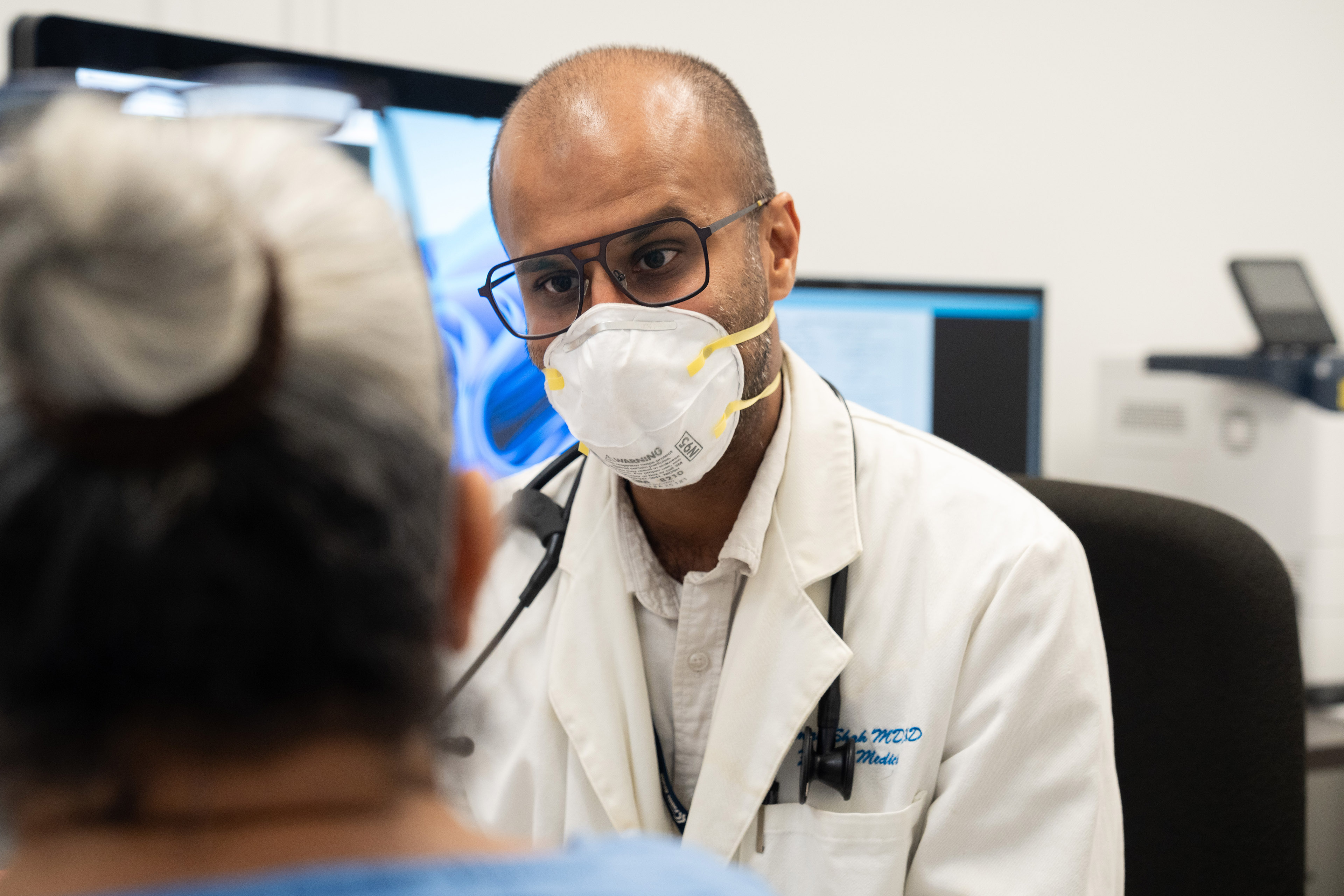
    A doctor wearing glasses and a facemask talks with a patient
    Naman Shah examines a patient at Monrovia Health Center, a Los Angeles County public health clinic in Monrovia, California. Shah says reducing medical debt in the community will depend on effective prevention strategies, just as stopping the spread of infectious disease does. (Lauren Justice for KFF Health News and Tradeoffs)

    Presumptive Eligibility

    One potential solution is a system that automatically screens and qualifies low-income patients for financial aid without requiring an application. This is called presumptive eligibility.

    Some hospitals already use such systems, which rely on software that checks patient eligibility based on publicly available information such as credit history.

    The strategy can be very effective. Shah said hospitals that have deployed presumptive eligibility systems have reported as much as a 50% increase in the amount of financial aid they give patients.

    Under a state law passed last year, all California hospitals will have to start doing presumptive eligibility screening by next July.

    But the systems can be expensive and difficult for smaller hospitals to implement. Only about 1 in 5 hospitals in Los Angeles County currently use them, Shah said.

    Public health officials wondered if they could help more hospitals set them up.

    The county, which, like many local governments, faces major fiscal challenges, couldn’t pay for this, Shah said. But the public health department could bring together healthcare and hospital officials in the county to figure out another solution.

    “The beauty of government is not when it always has to do the work,” Shah said. “We have the ability to make sure that people cooperate.”

    The Hospital Association of Southern California, initially wary of the county initiative, came to see improving hospital financial aid programs as beneficial to hospitals, many of which were wasting money on collections. “The billing process is cumbersome and costly,” said Paul Young, a senior vice president with the association.

    The association agreed to procure a presumptive eligibility system and make it available to its members. This bulk-purchasing approach, which Young compared to “a Costco model,” would lower the cost for individual hospitals, he said.

    At the same time, L.A. Care, a nonprofit health plan that administers Medicaid coverage for more than 2.5 million low-income county residents, committed $2 million to set up the system.

    The investment reflected the safety net insurer’s mission to make medical care accessible to more people, said Melanie Fontes Rainer, who leads strategic planning for L.A. Care. “It’s going to make Los Angeles County better,” she said.

    Making It Work

    Getting the new system up and running by January, as the partners hope, faces challenges.

    Hospital officials are figuring out how the system will be funded in the long term. And it’s unclear how many of the county’s 88 acute care hospitals will ultimately use it, even if it’s cheaper and easier to access.

    The partners are also working to improve data that the system relies on to screen patients. One goal is to link the system to tax records maintained by the state of California. This would provide hospitals with more accurate information on patients’ income than current systems, which often rely on estimated income.

    Walker, the patient advocate at Dollar For, said he’s heartened by the county’s effort. “I’m optimistic that we can make a better charity care system,” he said. “And the fact that hospitals in Los Angeles County are willing to be innovative and creative about ways we can do that is super encouraging.”

    For his part, Shah said county public health officials recognize that a better screening system at hospitals won’t by itself eliminate medical debt. But he said the public health department couldn’t ignore a problem that affects more county residents than asthma or tobacco use.

    “Prevention is our bread and butter,” he said.

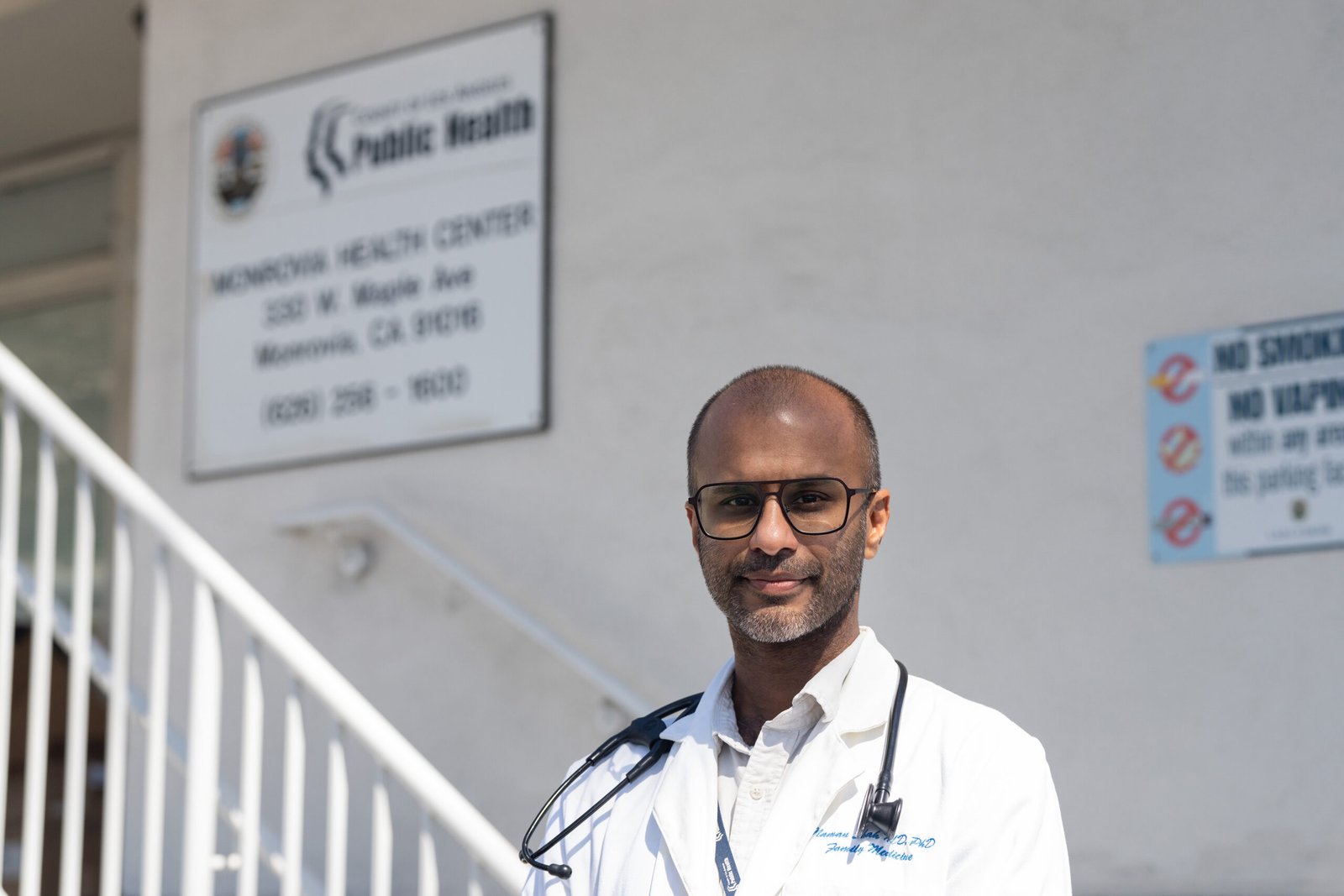
    A doctor wearing a white coat and glasses, with a stethoscope around his neck, stands in a medical clinic hallway
    “The impacts of medical debt were staggering,” says Naman Shah, who since 2023 has led a Los Angeles County initiative to tackle the debt problem. (Lauren Justice for KFF Health News and Tradeoffs)

    This article is part of “Hidden Help,” an investigative series from Tradeoffs and KFF Health News about how hospitals can protect their patients from the life-altering harms of medical debt.

  • Medicare Is More Broken Than We Thought

    Medicare Is More Broken Than We Thought

    Note: “An Arm and a Leg” uses speech-recognition software to generate transcripts, which may contain errors. Please use the transcript as a tool but check the corresponding audio before quoting the podcast.

    Please note that this transcript may include errors.

    Dan: Hey there. In the first week of October last year, 2025 — a whole bunch of senior citizens in Minnesota got a letter with some bad news. 

    Amy Hockert: A lot of changes coming in 2026. We know that at minimum 160,000 of you, absolutely have to pay attention to this,

    Dan: Their health insurance through Medicare Advantage was going away. 

    Erin: I was so mad. I was like, “No. Now what do I do?” And I look at my husband and said, “Now what?” “

    Dan: Folks like Erin– who lives in small-town Cambridge,Minnesota–  were going to have to find a new plan by the end of Medicare’s annual open enrollment period, which would start in a couple weeks.

    Up until now, Erin had been on a plan from a local nonprofit insurance outfit called U Care.

    UCare offered some of the most generous and affordable plans in Medicare Advantage — the version of Medicare operated by private health insurance companies. 

    But U Care was going belly up.

    FOX 9: The collapse of UCare after 40 years in Minnesota has been swift and stunning.

    Dan: Callers jammed the phonelines at Minnesota’s Aging Pathways hotline — thats the state agency that helps people with Medicare. Kelli Jo Greiner runs it.

    Kelli Jo Greiner: I don’t know any other way to describe it other than total chaos. Our phones were ringing off the hook.

    Dan: Meanwhile, in the Twin Cities suburb of Maple Grove, an insurance broker named Alison Ebert had been getting ready for her busy season, making appointments with her usual clients.

    Alison Ebert: October 1st through October 14th, I always set my appointments with my clients. I always joke I get paid in cookies and coffee because I go to their homes, we sit down. I know their families, I know their kids, their grandkids

    Dan: The day open enrollment started, she got 47 calls — from people she’d never met. People whose coffee and cookies she’d never tasted.  That was new. 

    And more would call. Because more letters were starting to go out.

    Not just from U Care. Other health insurance carriers were dropping out of the area. UnitedHealthcare, BlueCross, Aetna, Humana — all canceled Medicare Advantage plans in counties all over the state. Three counties were left with no Medicare Advantage plans at all. 

    And… this wasn’t just something that was just happening in Minnesota. Almost 3 million seniors across the country had plans in 2025 that would stop being offered to them in 2026.

    And that’s because at their headquarters, insurance companies had done their calculations, assessed their risks, and decided that offering plans to those people would no longer be profitable enough. So, seniors from Maine to California saw the number of available Medicare Advantage plans shrink by the dozen — leaving a lot of them confused, and with fewer, often worse and more costly health insurance options. 

    It’s part of a big new trend — these disappearing acts  have been increasing in recent years, and insurance companies have already signaled that more are coming. Major insurers have already announced intentions to dump plans that currently cover more than two million seniors. 

    We’ve spoken with folks in a dozen states — in rural places like Vermont and North Dakota, and in states with rural and urban centers like Maryland and Minnesota — about how it all went down last year — and what we can take away for this year.

    My colleague Emily Pisacreta and our awesome summer intern Lynn Barbera made those calls. And Emily, you called that experience “eye opening.” 

    Emily: Uh, yeah. We already knew from previous reporting that people had problems with Medicare Advantage. At first this story sort of seemed like one more thing people on Medicare Advantage had to worry about. But it turns out to be more than that. What happened last year — and is about to happen again this fall — showed us big problems, problems that affect everyone who’s on Medicare — or hopes to be one day. There are layers to this. 

    Dan: And we’re gonna peel them back. Get ready for a big dose of Medicare.

    This is An Arm and a Leg, a show about why health care costs so freaking much and what we can maybe do about it. I’m Dan Weissmann, I’m a reporter and I like a challenge. So our job on this show is to take one of the most enraging, terrifying, depressing parts of American life and to bring you a show that’s entertaining, empowering and useful.

    Emily, a while back, we looked at problems with Medicare Advantage. How about we do a little recap?

    Emily: Yeah. 

    Dan: We were taking our first deep look at Medicare itself, and as we said then, it kind of blew our minds. 

    Emily: Before we did that story, I was under the impression that you wake up on your 65th birthday and never have to pay a medical bill again, never have to deal with health insurance companies again. In fact, that’s the dream of Medicare For All. 

    Dan: But it’s not the reality of Medicare as it exists. For one thing, signing up means making a dizzying number of choices. 

    And you basically never escape private insurance companies. No way. Turns out, they run a lot of Medicare — so you could see dozens of different plans offered by different companies. 

    But here’s the most important part: You have to choose between what’s now called Traditional Medicare — run by the U.S. Government — and Medicare Advantage plans, run by private insurance companies. 

    And they both have downsides. 

    Traditional medicare doesn’t cover everything. For outpatient medical care — for doctor visits, outpatient procedures, infusions, physical therapy, X-rays and MRIs, you name it — Medicare only pays 80 percent of the bill.  

    And those other things can get so expensive — the remaining 20 percent can run to thousands of dollars that most seniors don’t have. 

    If you want that covered — and, I mean, you do — you actually have to buy a “supplemental” policy — people call them “Medigap” plans. They’re offered by private insurance companies. And you pay a premium. 

    Oh, and did I mention that you’re already paying a premium to the feds for your Medicare? Yep. Exactly how much depends on your financial situation, but most people pay just over 200 bucks a month.

    Medigap premiums – to the private companies – are on top of that. They vary a lot — by what plan you pick, and by where you live — but the average is another two-hundred and some every month. And that number goes up every year. 

    So you’re paying all that but then you’ve still got another gap. Vision, dental, and hearing. Traditional Medicare doesn’t cover them at all. So Medigap plans generally don’t cover them either. 

    The dark joke is that eyes, ears and teeth are “luxury organs”

    Because who needs to see or hear or chew? 

    So those are some BIG gaps.

    A lot of Medicare Advantage plans offer to fill those gaps:

    MA Ad 2: This card I’m holding in my hand, it’s an example of an all-in-one Medicare Advantage membership card.

    Dan: Lots of them include what’s missing  

    Woman in Ad2: That card helps me with my vision costs, my dental costs.

    Dan: Some of them even subsidize the premium you’d be paying to the feds, even bringing it down to zero. You can see how appealing that is.

    … and insurance companies hammer that appeal home with floods of TV ads

    Plus direct mail, phone calls, and facebook ads out the wazoo. None of which mention the downsides to Medicare Advantage… 

     which are basically: All the downsides we’re all familiar with from dealing with insurance companies. 

    Their network might not include your doctors and providers. It might not include very many providers near you at all. 

    And once you find an in-network provider, the insurance company can make you jump through hoops like pre-authorization. Or deny a claim. And then you get to fight through an appeals process. 

    I talked with a guy in Texas, Robert Wolpa. He’s got HIV, a pacemaker, other stuff. He said he felt like he was spending half his days on hold, waiting to talk with badly-paid, badly-trained people.

    Robert Wolpa: I’m 71. I just turned 71 in November and I’ve got, I’ve got a little of the HIV cognizant crap. Like, my short term memory is gone. And I think to myself, what have I gotten myself into?

    Dan: This is the thing: You can be 65 years old, in totally decent shape, playing pickleball or whatever, never seeing a doctor. 

    But when you pick Medicare Advantage, most of the time you’re also choosing for an older, sicker version of yourself. Who may need to see specialists, and who may not have as much capacity to fight with insurance companies. 

    I mean, most relatively young and healthy people have a hard enough time. 

    This is where Traditional Medicare starts to look much more appealing. Practically every provider takes it, and denials are almost unheard of.

    But for most people, if you’ve chosen Medicare Advantage, it’s a no-backsies situation. 

    You can still sign up for Traditional Medicare, but you may not be able to get a Medigap policy. 

    For one thing, it may not be in your budget. Robert Wolpa got a quote: Almost 500 bucks a month. Like a third of his social security check.

    Robert Wolpa: And I said, okay. Next option.

    Dan: And lots of people don’t have the option at all. In most states, if you don’t sign up at age 65, Medigap plans are allowed to reject you if you have… pre-existing conditions. 

    Sarah Jane Tribble: It’s sort of shocking, actually, right? Like, the Affordable Care Act passes and makes it so that everybody with pre existing conditions can get insurance no matter what, but it leaves out the people who might need that the most, who are 65 and older. 

    Dan: That’s the person who had introduced us to Robert Wolpa, and helped us understand this whole issue. Sarah Jane Tribble,a reporter with our pals at KFF Health News had just published her own story about the pitfalls of Medicare Advantage.

    This comes as a big surprise to a LOT of folks — as Sarah Jane found out while she was reporting her story, and talking about it with friends.

    With all of these… advantage — all the marketing, and all the gaps it fills– Medicare Advantage has grown by leaps and bounds in its 20-some years. 

    At this point, the majority of seniors are on Medicare Advantage.

    So, OK: Long recap, but. That’s what we KNEW a couple of years ago. 

    And it turns out — based on what happened last fall, and what’s about to happen this year — the problems are way worse than we knew. 

    Which brings us back to our friends in Minnesota. In early October 2025.

    News anchor 1: In 90 days, thousands of Minnesotans will lose their Medicare Advantage coverage.

    News anchor 2: Many major health care providers are dropping their Medicare Advantage plans in 2026. 

    Dan: So, Emily. What the heck happened?

    Emily: So that local nonprofit insurance company – UCare– they went broke, and all their Medicare Advantage plans got pulled from the market. Pretty quickly after that, UnitedHealthcare, Aetna, and others sent break up letters of their own to thousands of their beneficiaries.

    Lots of people turned to insurance brokers for help. 

    But many brokers weren’t calling them back. Because things had started going haywire for them too. Insurance broker Alison Ebert told us she was used to getting paid in cookies and coffee – and this time around, she would mean that literally — because in the days leading up to open enrollment she got an unusual call from her contact at UnitedHealthcare.

    Alison Ebert: She said, “I just wanna let you know before you get the email, we’re not paying commissions this year.”

    Emily No commissions. No payment from the insurance company for anyone she would enroll in their Medicare Advantage plans. Which is for health insurance brokers — the whole business model. 

    Alison Ebert: And my heart just sunk. That was the first phone call, and one by one thereafter, all the major carriers except for Allina Health Aetna, followed suit.

    Emily: Other brokers in Minnesota told me the same thing. I asked Alison: why do you think they cut commissions? She says a rep for one of the big companies told her the ugly truth. 

    Alison Ebert: With UCare exiting the market,” she said, “Let’s face it, we don’t want everybody that sunk UCare on our plan. And so this is how we’re gonna c- curb enrollments.” 

    Emily:  Alison got the message: These insurance companies wanted to curb enrollments. They specifically didn’t want to insure people who they tho  ught “sunk UCare” — meaning, people who used health care. Who filed claims. Who cost money.If brokers didn’t get commissions for selling plans to these folks, a lot fewer of them would sign up.  

    Alison Ebert: Because they’ve always told us about 80% of the sales comes through brokers like us.

    Emily: Now, a few weeks later, it was October 15, open enrollment was starting, and her phone was ringing off the hook. 47 people on day one. And more every day after that. Plus all her regular clients — the ones whose grandkids she knew by name.

     Alison had to decide what to do  — could she afford to help all those people for free? 

    Alison Ebert: I have kids. I mean, I deserve to get paid. I need to put gas in my tank to go to these people’s homes.  

    Emily: But Alison didn’t think it was right to leave people hanging.

    Alison Ebert: I left a message on my answering machine saying, “You know, due to the fact that we’re not getting paid this season, a lot of brokers left the market and I’m just returning calls as they come. But just be aware that it might take me a couple weeks to get back to you.”

    Emily: Instead of going to everyone’s house, she set up office hours at a coffee shop to be able to see as many people as possible.

    Meanwhile… Kelli Jo Greiner and her colleagues at the state’s Medicare hotline were scrambling too.

    Kelli Jo Greiner: We had wait times of two hours. Nobody wants to wait for even 10 minutes, let alone two hours

    Emily: She and her team had to improvise.

    Kelli Jo Greiner: We have staff that don’t usually do Medicare counseling. They help with, like, long-term care and other areas, and we even put those folks on the phones to help

    Emily: And she wrangled a weekly spot on FOX 9 in the Twin Cities to answer big questions.

    Amy Hockert: Medicare Monday is what we’re calling it. A lot of changes coming in 2026. Kelli Jo, thanks for joining us.

    Kelli Jo Greiner: Well, thank you. I’m glad to be here again. 

    Amy Hockert: All right. Well, let’s roll through it here.

    Emily: Kelli Jo told viewers: The most important thing is to be proactive. If you don’t do anything, the system will put you into traditional Medicare — but without a Medigap plan. Oh, and by the way, she told them: Your drug plan will probably disappear too, unless you sign up for a new one.

    So — she said, the good news, as far as it goes is: Right now you have a choice. And it’s just like the one you had when you were 65. You get to basically start over if you want, and get a Medigap plan even if you have a pre-existing condition. This is a special situation, they can’t reject you. 

    And once you’re on they can’t tell you which doctors to see. Almost every doctor in the country takes traditional Medicare.   

    Kelli Jo Greiner: And for many people that is a huge advantage,’cause we have a lot of snowbirds here that go south for the winter.

    Emily: But she says most people she talked with decided they just couldn’t afford those Medigap premiums. They were stuck with Medicare Advantage. Only now they had fewer and crummier Medicare Advantage plans to choose from. 

    Also, they were more expensive than these folks were used to. 

    Kelli Jo says a lot of people had been on plans with no monthly premium — but now all those plans were gone.  

    Kelli Jo Greiner: and so they ended up having to switch to a plan with a premium

    Emily: And in a lot of cases, without some extra benefits that Kelli Jo says are a big draw. Like discounts on groceries — or free gym memberships, a feature called Silver Sneakers.

    Kelli Jo Greiner: and I cannot even tell you how many people called us about Silver Sneakers. They were so upset about that change.

    Emily: So people ended up paying more than they were used to —  and getting less. 

    Dan: OK. So to recap: some Medicare Advantage plans disappeared.

    Emily: Yes.

    Dan: The remaining plans weren’t great.

    Emily: Right.

    Dan: And most people chose them anyway, because they couldn’t afford Medigap.

    Emily: Correct. And we can expect more of the same this year– and for who knows how many years ahead.

    Dan: So Medicare Advantage is getting shakier– even while it keeps growing. 

    Coming right up: how the dynamics behind all of this add up to trouble for all of Medicare. And what we can maybe do about it.   .

    This season of An Arm and a Leg is a co-production of Public Road Productions and KFF Health News — that’s a non-profit newsroom covering health issues in America. Their reporters are amazing — you’re about to hear from another of them. We’re honored to be their colleagues.

    Dan: Kelli Jo Greiner told us many folks who lost their Medicare Advantage plans  just couldn’t afford Medigap supplements. 

    Which, as we’ve been learning, has been one of the big dynamics behind the growth of Medicare Advantage in the first place. 

    Emily: Our colleague Julie Appleby found recently, that dynamic is getting starker.

    Julie’s a senior correspondent with our pals at KFF Health News.  

    Julie Appleby: I cover all things health insurance pretty much, uh, from the Affordable Care Act to Medicare, other kinds of health insurance programs, uh, that kind of thing. 

    Emily: Earlier this year, Julie got a call from a broker in Illinois.

    Julie Appleby: And he was telling me that more than, like, 80 of his customers were enrolled in a Medicare supplement,

    Emily: A specific plan. One that usually had low premiums. 

    Julie Appleby: But they suddenly raised their rates by 45%. And he said, “In my 49 years of doing business as a broker, I’ve never seen a premium increase be effective immediately on everyone. So I thought, “Hey, I’m gonna start looking into this.”

    Emily:  She found some good data from a company called Telos Actuarial — which showed: this price hike was part of a trend.

    Julie Appleby: There were increases going on kind of throughout the industry.

    Emily:. On average, the data showed premiums on Medigap went up almost 17% from the previous year.

    Not as high as that one plan with 45 percent increase, but still nothing to sneeze at. Brokers and other experts told her: That kind of increase used to be almost unheard of. But for the last bunch of years, it’s become a new normal. 

    Julie sees a connection with the growth of Medicare Advantage. 

    To understand it — and why everything about Medicare could be getting shakier and shakier — Julie’s gonna introduce us to a key term: Risk Pool. It’s a big part of how insurance prices get set.

    Julie Appleby: Insurance is a giant pool, right? We all are in the pool, and everybody kinda shares the cost. The insurance company has to sit down and try to figure out, “Well, gee, I’ve got this pool of people. How sick are they? How, how often are they gonna go to the doctor? How often are they gonna be hospitalized?” And then calculate out, “Okay, so what might that cost me?”

    Emily: So a lot depends on: Who’s in the risk pool for any given plan? If Medigap plans are more expensive than Medicare Advantage — but provide better coverage — then, who’s gonna choose the Medigap? People who think they’re gonna *need* that better coverage. Sicker people.

    And with millions of people getting the chance at do-overs — because their Medicare Advantage plans got nuked — these Medigap insurers have a bunch of new customers, who — it seems reasonable to think — may be sicker.  

    Julie Appleby: So these carriers are, then having to think, “Wow, I’m taking all these people on in this region, so I’m gonna have to raise my premiums to cover what might be those expected costs.” 

    Emily : And as premiums grow and grow, what we could see is a kind of vicious cycle. Because as new people turn 65, they’re looking at Medigap premiums that are harder and harder to afford.

    So more and more people are attracted to Medicare Advantage. I spoke with a researcher named Laura Skopec – she studies Medicare at the Urban Institute, an economic and social policy think tank. Here’s how she put it: If this trend continues — with Medigap prices driving more people to Medicare Advantage

    Laura Skopec: We’re gonna see a traditional Medicare that is sicker and wealthier, which is sort of a weird combination, but it’s gonna be sort of the sickest people that really need good access to specialists, wanna be able to go to the cancer center, you know, any sort of doctor they wanna go to, and the people that can afford Medigap

    Emily: Like, the sicker you are, the more you need this, and the more people who need it, the more expensive the supplements will be.

    Laura Skopec: The risk pool just keeps on worsening.

    Emily: So, expect Medicare Advantage to keep growing. And — as Laura points out — getting more expensive.

    Laura Skopec: The Medicare Payment Advisory Commission says we spend about fourteen percent more for everyone who chooses Medicare Advantage over traditional Medicare, and that was really not the point of the Medicare Advantage program, right? It was supposed to use sort of private sector processes to lower costs in Medicare, and it has not done that. 

    Emily: In fact, insurance companies are under increasing scrutiny for overcharging the government for Medicare Advantage. 

    The feds have been trying to impose some rules to cut down on those extra profits – all very technical stuff which we could devote a whole episode to.     

    Dan: Maybe we should

    Emily: Yeah and crackdown may have played a role in insurance companies pulling some of these plans off the market. And they say they’re gonna keep yanking more plans off the market unless they get MORE federal dollars. 

    Laura: They’re saying that their costs are going up for paying claims, which is probably true, and they point to market exits and other issues as, like, we need a pay bump here to stay in the market.

    Emily: All of this — pulling plans off the market, reducing benefits, trying to control who enrolls in their plans — all of this stuff is likely to keep happening. 

    So we should talk about what that looks like on the ground, and how seniors can navigate all these changes. 

    Remember Erin in Cambridge, Minnesota? 

    What happened to her really exemplifies how this kind of thing can play out. And how we can support each other.

    So Erin had gotten kicked off her plan when the whole enterprise behind it, UCare, collapsed.

    Erin had been really happy with UCare for the four years she was on one of their Advantage plans.

    Erin: You call their customer service and they are very helpful. I loved it.

    Emily:  she had access to specialists. 

    Erin: A thoracic, a neurologist, a urologist, a nephrology. An ENT specialist. 

    Emily: Erin had suffered four heart attacks in her late fifties. Because she couldn’t work, she started getting social security and Medicare early — when she was 58. She doesn’t really remember how she ended up picking Medicare Advantage over traditional Medicare.

    But it was working for her. Until they pulled the rug out from underneath her.

    Erin: I did not want them to go anywhere. I heard that, I was just in tears.

    I was so mad. I was like, “No. Now what do I do?” And I look at my husband and said, “Now what?” “

    Emily: And she says her husband had the answer immediately.

    Erin:Well, we’ll just call Desi.”

    Emily: We’ll just call Desi.

    Dan: Wait a minute–  Who is Desi?

    Emily: You gotta meet Desi. 

    Desi Panek: I’m Desi Panek, and I work at the Seven County Senior Federation here in Mora, Minnesota.

    Emily: That’s a member-led organization of seniors in eastern and central Minnesota who came together to advocate for themselves, and to help each other with transportation and other stuff seniors need. Including: signing up for — and dealing with — Medicare. 

    I met Desi and her boss Lisa Krahn, the Federation’s director, as they were gearing up for this year’s annual enrollment period. 

    Lisa: It can’t be as bad as it was last year 

    Emily: Yeah yeah. 

    Desi: We’ll find out soon. 

    Lisa: Oh, God 

    Emily: Yep, hold onto your hat. 

    Emily: Yep, they’re still dealing with the fallout from last year. This is Lisa:

    Lisa Krahn: Still quite a few people who show up, who are calling now, who don’t realize that they haven’t had a plan all year saying, “I just don’t have anything because my old plan left. Well, I wasn’t really paying attention to the mail they were sending me,” kind of a thing.

    Emily: Some of those people only found out when they got a bill in the mail. Or when they tried to pick up a prescription, and had to pay out of pocket cuz they didn’t have a drug plan anymore. 

    Luckily, Erin got the news before it was too late. She and her husband called Desi, and Desi helped them enroll in a new Medicare Advantage plan. Which Erin says, isn’t as good. 

    Erin: Right now I’ve got $1,700 out of pocket going to a pair of hearing aids

    Emily: She’s not a fan of the customer service. And she says she had to stop taking one of her preventative medications because her drug plan changed.

    Desi and Lisa are operating very much at ground level helping people like Erin, but they definitely have thoughts about the big picture –especially the stark choice between Medicare Advantage and traditional Medicare.

    Lisa Krahn: original Medicare is that thing you’ve been waiting your whole life to get. It’s good everywhere. And once you’re in, you’re in. 

    Emily: But it’s become too expensive for most people. Meanwhile, Medicare Advantage can really limit people’s access to care.

    Lisa Krahn: So, looking for a middle ground between those, it’s, it’s… There, there should be better choices, frankly, instead of such extreme ones.

    Desi Panek: Extreme is a really good word for that. I agree. 

    Emily: Extreme meaning there’s a big hole in one and there’s too many…

    Lisa Krahn: Restrictions on the other. But all the millions we’re dumping into advertising and these private companies, that could have filled the holes on original Medicare a long time ago. And that’s just antithetical to the function and the existence of the insurance industry, which, like the monarchy, maybe we can stop believing in. I’m revealing myself as a single-payer Medicare for All advocate, but we need better Medicare, frankly, you know? It always been shortchanged.

    Emily: Dan, speaking of Medicare For All.

    Dan: Yeah we really shouldn’t do an episode like this without mentioning it. Especially because it’s been coming up so much in this year’s election season. In Michigan, Abdul El-Sayed won the Democratic Senate primary, and Medicare for All was his number-one pitch.

    Abdul El Sayed: Yes, we really can guarantee healthcare in this country. Yes, we really can do it while spending a lot less and getting a lot more if our healthcare doesn’t still fund tens of millions of dollars in healthcare CEO, uh, salaries on top of it.

    Emily: People like Lisa — and Abdul El-Sayed — think of Medicare for All as a way to also plug the holes in existing Medicare. 

    Dan: Well, huh. OK, I mean, one thing I’m really tuning into is that all these big gaps in Medicare are all driven by the fact that ALL of Medicare — our big public benefit — is actually set up so it requires insurance companies to make a profit in order for it to function. Whether they’re selling Medicare Advantage plans, or Medigap policies.

    But then, how do Medicare for All advocates say that spreading Medicare to everybody makes the math actually work better?

    Emily: It’s all about that term Julie Appleby introduced us to:  Risk pool. How “risky” the people you’re insuring — the pool — are as a whole. Meaning, how much health care they need on average. The calculations change a lot when the pool is everyone, including people who are 25 as well as 65 and 95 — and when tax money funds health care directly instead of filtering it through private health insurance companies to administer and also take a profit.

    In fact, a recent study out of Yale estimates that Medicare For All — that is a Medicare that is completely void of private insurance companies — would reduce annual health expenditures by 1 trillion dollars every year.

    Dan: But that’s not just taking insurance companies out of Medicare — it’s taking them out of the whole U.S. health care system.

    Emily: Right. In the meantime, some politicians in Washington are talking about tweaks — big and small — to just Medicare itself. 

    Vermont Senator Bernie Sanders–

    Dan: the original Mr. Medicare For All 

    Emily: Yeah – in the meantime, he says we should extend traditional Medicare to cover vision, hearing, and dental. He’s introduced a bill in the Senate to do just that. 

    And Oregon Senator Ron Wyden recently introduced a bill that would put an out-of-pocket max on traditional Medicare. That way, people wouldn’t need supplements as much, and Medicare Advantage wouldn’t look as tempting.

    Both of those ideas would mean putting more federal money toward traditional Medicare.

    Dan: Which doesn’t SEEM like something Congress is likely to do. But what this whole story shows is: it seems like it’s gonna cost us either way. Either we put more public dollars into traditional Medicare, or we keep paying higher prices, collectively and individually,

    As for the here and now. If you have Medicare Advantage, but you don’t have a Desi or a Lisa to call, Emily, they gave you a breakdown of what you need to know.

    Emily:Yep. Their first piece of advice: open every piece of mail from your insurance company. That’s where you’re going to find out whether your plan is being cancelled. Or where you might find out they’re trying to auto-enroll you into a new plan, which might not be the best one for you.

    Desi Panek: The past couple of years we’ve had plans that end a specific plan, but will auto-enroll the e- the enrollee into another plan in the same company.

    Lisa Krahn: Crosswalking

    Desi Panek: Yes, so that’s a big deal. Pay attention to your mail. Um, you’re gonna get stuck with huge premiums if you just let it roll.

    Emily: And find someone to talk to.

    Remember Kelli Jo who runs the Medicare hotline for Minnesota? Every single state has one of those agencies. They’re called SHIP — S H I P — state health insurance assistance program. Google your state, SHIP, and Medicare

    If you can’t get through, there’s always insurance brokers. Desi has some advice on measuring up whether a broker is trustworthy.

    Desi Panek: Ask them if they sell every product available to you in your area. That’s one of the biggest things. I think that a lot of people just assume they’re gonna go to a broker or an agent and they’re gonna get the full scope, and that’s not necessarily true.

    Emily: You might want someone who sells Medigap supplements as well as Advantage plans. Someone who does that may be less inclined to push you into whatever’s paying them the highest commissions.

    Desi Panek: Word of mouth is a big deal for a lot of people, so asking your friends, your neighbors, uh, “Who did you work with? Are you happy? Are you unhappy? What was the experience like?”

    Dan: Talking to your friends and neighbors. It’s like, we gotta rely on each other.

    Emily: Which is why I’m kind of obsessed with this Senior Federation thing. People banding together to share information and resources to navigate this ongoing mess.

    Desi and Lisa’s group has been operating since 1975. There used to be a robust network of similar groups across the state. Theirs is the last one, but Desi says they’re going strong.

    Desi Panek: We’ve got our beautiful community and our thrift stores that keep our doors open and allow us to give that good information out, um, whether it’s what people wanna hear or not.

    Dan: And it went by kinda fast but I think I heard her say thrift stores?

    Emily: Yep! They have a side hustle. 

    Lisa Krahn: We run two thrift stores, the One More Time stores, which give us financial independence. So we’re not dependent on just memberships and just counseling fees or service fees. 

    Emily: That’s awesome, yeah, I’m dying to go to those thrift stores. I saw it on the website and I was like…

    Desi Panek: Did you see that we won Minnesota’s best thrift store?

    Emily: Stop it.

    Desi Panek: I mean it.  

    Emily: That’s so cool. Oh my God. 

    Lisa Krahn: By the Minnesota Star Tribune, yes. It was a popularity contest.

    Emily: Amazing. Wow.

    Dan: Wow for sure. Emily, thank you so much for all of this reporting.

    So here’s where we landed: Medicare is way more broken than we knew!  And we already knew it was kind of a confusing mess with a lot of holes. 

    Fixing it will require a huge lift.  The kind of thing that hasn’t seemed like a political possibility. And everybody will have BIG differences of opinion about how a fix should work. There are people who think the government shouldn’t be involved in health care at all. 

    Meanwhile, we’ve got what we’ve got.  We’ve got each other. 

    And… you just never know what might be possible.

    Next time on An Arm and a Leg, we’ll hear about what might be the most radical health care experiment since Medicare itself. 

    And the two guys — a Democrat and a Republican — who made it happen.

    Till then, take care of yourself. 

    This episode of An Arm and a Leg was produced by Emily Pisacreta, with help from our summer intern Lynn Barbera and me, Dan Weissmann— and edited by Ellen Weiss. Izabella Kulkarni provided additional production help.

    Reporting for this story was supported in part by Arnold Ventures. Listeners like you are our biggest source of support, and we need you more than ever. If you like what you’re hearing and want it to continue, head to arm and a leg show dot com, slash, support.  

    Adam Raymonda is our audio wizard.

    Our music is by Dave Weiner and Blue Dot Sessions. 

    Amanda Boyd is our Operations Manager. Bea Bosco is our consulting director of operations. 

    An Arm and a Leg is produced in partnership with KFF Health News. That’s a national newsroom producing in-depth journalism about health issues in America and a core program at KFF, an independent source of health policy research, polling, and journalism.

    Zach Dyer is senior audio producer at KFF Health News. He’s editorial liaison to this show.

    An Arm and a Leg is distributed by KUOW, Seattle’s NPR news station.

    And thanks to the Institute for Nonprofit News for serving as our fiscal sponsor.

    They allow us to accept tax-exempt donations. You can learn more about INN at INN.org.

    Finally, thank you to everybody who supports this show financially. Listeners like you are our biggest source of funding.

    You can join in any time at arm and a leg show, dot com, slash: support.

    Thanks! And thanks for listening

  • The MAHA Metamorphosis

    The MAHA Metamorphosis

    [Editor’s note: This transcript was generated using transcription software. It has been edited for style and clarity.] 

    Julie Rovner: Hello, from KFF Health News and WAMU Public Radio in Washington, D.C. Welcome to What the Health? I’m Julie Rovner, chief Washington correspondent for KFF Health News. And, as always, I’m joined by some of the best and smartest health reporters covering Washington. We’re taping this week on Thursday, Oct. 1, at 10 a.m. As always, news happens fast, and things might have changed by the time you hear this. So, here we go. 

    Today we are joined via videoconference by Rachel Roubein of The Washington Post. 

    Rachel Roubein: Hey, everybody. 

    Rovner: Shefali Luthra of The 19th. 

    Shefali Luthra: Hello. 

    Rovner: And my KFF Health News colleague Rachana Pradhan. 

    Rachana Pradhan: Hi, Julie. 

    Rovner: Later in this episode, we’ll have my interview with Dr. Aaron Carroll of AcademyHealth about the undoing of the federal Agency for Healthcare Research and Quality, AHRQ, where most of the staff has been laid off or retired, and hundreds of grants have been canceled midcycle. But first, this week’s news. 

    So we haven’t talked about the Make America Healthy Again movement in a while. It was a big week for MAHA here in Washington, D.C., with a gigantic summit at what used to be the Trump [International] Hotel, down the street from the White House. But it was hardly the event you’d expect if you still think of MAHA as moms who want their kids to have access to healthier food grown with fewer pesticides. Rather, this event featured representatives from health companies with business before the federal government, paying sponsorships of up to $300,000 each to sit on panels with officials from said government to talk about everything from the use of psychedelic drugs to fraud-fighting to wearables and AI [artificial intelligence]. The panel featuring Medicare and Medicaid chief Dr. [Mehmet] Oz was somewhat bizarrely moderated by comedian Russell Brand, who’s awaiting trial on sexual misconduct charges back in England. What was this event supposed to accomplish? 

    Roubein: I think you kind of hit the nail on the head in terms of just thinking about the MAHA movement and sort of where it’s going next, because you had some people, more sort of MAHA activists, who were upset that it didn’t talk about some of the core issues of the MAHA base, like vaccines, like pesticides. There have been some influential MAHA activists who’ve been upset at the administration and disillusioned that it hasn’t done more to crack down on pesticide use, etc., have been upset at the Trump administration, and have been saying just weeks before the midterm elections that Republicans may lose some of these votes, and some so-called MAHA moms might sit out the elections. And I don’t think this summit did anything to persuade them to go and vote Republican in the midterms. 

    Rovner: Yeah, it did seem, it seemed a great get-together if you wanted to sort of commune with the people who regulate your products, on a public stage. But both the president and Health and Human Services Secretary Robert F. Kennedy Jr. have felt free of late to talk about vaccines, although obviously not at this summit. But it seems that the issue that had united most of MAHA that we were just talking about, pesticides and ultraprocessed food, have been back-burnered by the White House. Rachel, you wrote a story about this. What happened to the food agenda? 

    Roubein: Pretty notably, one of the big potential parts of the food agenda is this petition that was filed by David Kessler. He’s the former head of the FDA [Food and Drug Administration] under both Republican and Democratic administrations. And his petition, essentially — I talked to food safety experts about it — could have launched a process that could have forced the industry to reformulate some ultraprocessed foods eventually. So that could have been a big deal. The status of it: It was filed August 2025, and Kennedy earlier this year had done a response to it, where he wanted to have food companies produce any detailed safety studies showing that certain ingredients common in ultraprocessed foods are generally safe. And what I had heard from talking to people is that that potential push had been slow-walked at the White House. I obtained a March draft of the letter that Kennedy sent to the White House for review. Now, HHS pushed back on the assertion that it was slow-walked, but this isn’t the first time that administration officials had wanted to and planned to announce something. They had been working on a definition of ultraprocessed foods that they wanted to release back in August, and that was delayed at the last minute, them just putting out more information about this draft definition. 

    Rovner: I feel like there’s this tension between the MAHA movement, which started as a grassroots movement to crack down on corporate power, and the White House is sort of wanting to deregulate everything. Those two things seem to be kind of at loggerheads, and it looks for now like the corporations are winning. We saw this with the pesticides earlier in the year, with glyphosate, that the agricultural community fought back and said, You can’t make us stop using it, because we need it to produce food. And now it seems that the food producers are saying: You have a deregulatory agenda. Why are you talking about regulating us more? Is that, am I reading this right that the corporate power is winning, at least so far? 

    Pradhan: It’s still a Republican administration, right? Regardless of Secretary Kennedy’s sort of mandate and passions, he’s still working with and for people who do not like to use government to restrict or regulate or ban things. Even, if you think about, we’ve come a long way since this point. But when former first lady Michelle Obama tried to put healthier foods in schools, she was roundly criticized for embodying a nanny state and all these things. And now, the political winds have shifted. But I still think to go up against the party’s kind of traditional views on regulating business and corporate interests, it’s a swamp. What are you going to do? They’re not going to want to regulate a lot. And like you said, Julie, there are ample actions to date that show that there isn’t necessarily a desire to impose more regulations. It’s also an election year. They may not want to antagonize corporate interests when you’re trying to not see huge losses, especially in potentially the House and maybe even the Senate. 

    Rovner: Yeah, they have enough people who are mad at them. They don’t want to add to it. 

    Pradhan: Exactly. 

    Rovner: Well, of course, with every political split comes a new political opportunity. In Michigan, Democratic Senate nominee Abdul El-Sayed, who’s a prominent supporter of “Medicare for All,” is now trying to grab back some of those Democrats who gravitated to MAHA by unveiling something he’s calling the “Building a Healthier America” agenda, focusing on fewer pesticides, cleaner water, and healthier food. Rachel, you wrote about this. Might it work? Might Democrats be able to sort of reclaim some of these people who drifted to the Republicans along with RFK Jr.? 

    Roubein: I think it’s something that particularly some progressive Democrats are looking to, and they might look to do if they win back the House. In the Farm Bill, you saw Republicans and — some Republicans — and Democrats push back against giving pesticide makers immunity liability shields. But I think it remains an open question. And I think it also depends on the different groups, in terms of MAHA. Tony Lyons at MAHA Action has said that they want there to be an alliance with Republicans. But you also see this with Rep. Alexandria Ocasio-Cortez trying to court some MAHA activists her way. So I think it’s an open question in terms of how this movement unfolds and whether there are any deviations towards the left. But it is a hard sell in some ways. Vaccines are a big part of a lot of people in the MAHA base. And when I asked El-Sayed about this, he said they’re, like, We’re going to agree to disagree on vaccines. 

    Rovner: Yeah, he’s trained as a doctor and he does believe in vaccines. And he was the head of public health at the city of Detroit. He’s definitely not with the anti-vaccine types. But it’s important to remember that the original anti-vax movement was a combination of people from the far right and from the far left. So there have always been a lot of Democrats in the anti-vax movement, and this has been a group that’s been kind of up for grabs. And we will, I guess we’ll see how it will all shake out. 

    Roubein: And some of the things on food Sen. Bernie Sanders has said for a long time, too. So there has always sort of been some of that intersection on certain issues. 

    Rovner: Yeah. Well, originally RFK Jr. was running as a Democrat before he took up with the Trump team. All right. Moving on. Today is Oct. 1, the start of the fiscal year. Happy FY 2027, everyone. The Trump administration marked the day a little early, informing Congress last Friday that it was declining to spend more than $800 billion, in what’s called a pocket rescission. That’s when an administration declines to spend money appropriated by Congress so close to the end of the fiscal year that it basically can’t be spent at all and Congress doesn’t have time to disapprove it. The majority of this funding is from HHS, largely for programs to help noncitizens and for what the administration calls, quote, “overfunded and unaligned” HHS research programs. That includes many related to minority health. Congressional spending leaders, including Senate Appropriations Chair Susan Collins of Maine, complained that pocket rescissions are illegal under a law called the Impoundment Control Act, and the Government Accountability Office issued an opinion this week backing that claim up. But, as we know, this administration likes to dare courts to stop it from doing things that just about everybody else acknowledges is illegal. And I guess that’s where we are here? 

    Luthra: No, I was just thinking, right? It’s October. Everything that happens now, we also think about in the context of an election, and I think a dynamic that we have talked about a lot is this effort by the administration to just sort of do what it would like to do with funding, even when many people might say that is not how the laws and separation of powers are supposed to work. And I think something really interesting for us to consider is whether those dynamics do, in fact, change in the new year. Given what Rachana mentioned earlier, there is a very good chance that Democrats control both chambers of Congress, not just one. And [does] that possibility of conflict with another branch in Washington change what behavior we see from the White House? I think that’s a really interesting question and something that we should be thinking about as the election gets closer, and then again depending on what the results end up being. 

    Rovner: Yeah, one of the really weedy issues here is who gets to sue the administration to say that, Hey, you’re not allowed to not spend money that we’ve appropriated. It was important that they came out and said that this was illegal, because the GAO, under the law, has standing to sue. But they don’t have a confirmed leader at this point, and Susan Collins was asked about this and said they may be a little bit wary to kind of get out in front of Congress. But I think it’s probably fair to say that if Democrats take back the House and Senate, that they would be more likely to want to either — I think that the Congress itself can sue the administration, can go to court and say, Hey, you can’t do this, which obviously the Republican Congress hasn’t wanted to do. But a Democratic Congress might. 

    Pradhan: What — has GAO ever been known to sue? 

    Rovner: That’s a good question. I can’t remember. We’ve had fights about rescissions before. 

    Pradhan: Yeah. 

    Rovner: But it’s — Russell Vought, the head of the White House Office of Management and Budget, says publicly that he thinks that the Impoundment Control Act is unconstitutional and therefore they don’t have to obey it. That’s clearly something for a court to determine. That’s clearly something for the Supreme Court to determine. We haven’t gotten there yet, but most of the time, I think, we’ve had lower courts that have warned the administration: Um, hey, there’s this law that says you can’t do that. You have to spend money the way Congress says you should spend money. The last time we had a pocket rescission, I looked it up, was last year when this administration did the same thing. That was the USAID [U.S. Agency for International Development] money. So before that, I’m not sure when. I may go back and have a look. Shefali, to your point, that was my next question anyway. It’s like, I would think that the one thing that is likely to change if the Democrats take Congress — obviously, we have two more years of the Trump administration — but I would think they would be a lot more zealous in guarding their spending power than this Congress has been. 

    Luthra: One would imagine. It seems hard to abdicate the power that one might want. That’s how separation of powers, in theory, is supposed to work. 

    Rovner: And it is kind of written into the Constitution. 

    Pradhan: I do wonder, though, if they think that, if they wouldn’t get a good, friendly decision from a court … 

    Rovner: The Supreme Court. Yeah. 

    Pradhan: Yeah. That could be far more damaging in the long term, right? 

    Rovner: Yes. There is the concern that the Supreme Court would agree with Russell Vought that the Impoundment Control Act … 

    Pradhan: Right. 

    Rovner: … is unconstitutional. That is a risk that they would run. 

    Pradhan: Right. 

    Rovner: Well, that will happen. We will see what happens with that. All right. So, obviously these latest cuts aren’t the only ones to HHS that have been made since [President Donald] Trump returned to office in 2025. We will talk more about what’s happened at the Agency for Healthcare Research and Quality in this week’s interview, but I want to talk a little bit right now about the Centers for Disease Control and Prevention, whose workforce we now know is down by almost a third, according to The New York Times. Quote: “The changes have hindered the C.D.C.’s ability to respond to outbreaks as measles spreads at home and Ebola abroad,” while, quote, “entire divisions have been shuttered, including teams that worked on smoking, sexual violence, child abuse and falls among older adults.” Separately, but not really separately, the CDC’s advisory committee on vaccine practices has ground to a halt after a judge struck down Kennedy’s replacement members as unqualified. Medical societies have stepped in with their own vaccine recommendations for this fall, but the official CDC guidance is already out of date because there’s no ACIP [Advisory Committee on Immunization Practices] to make recommendations. This is all going to come home to roost the next time we have a bad flu season, I imagine. 

    Pradhan: Yeah, I think that the Times, the New York Times, story, what I thought was really, kind of what they led with, was that even though last year you had these widespread firings across HHS and different agencies, including the CDC — the CDC at that time we know lost about 1 in 5 workers — but really the true scale of the losses is much higher. It’s about 30% fewer employees. But the CDC has really had a rough go of it. I think it probably was the — it was the poster child for everything that went wrong during the pandemic, in Republicans’ view. And so they’ve been very keen on dismantling a lot of that agency, more so than the FDA and more so than the NIH [National Institutes of Health], for example, even though they’ve also seen a lot of staff reductions. But CDC, I think, has been so crippled for so long, both because of the staff reductions and just the awful morale at the agency because of everything that the current political leadership has done since. Yeah. 

    Rovner: I would say, and the politicization of its leadership, things that were long run by career scientists in Democratic and Republican administrations that are now being run by political appointees, who are rather pointedly not scientists … 

    Pradhan: Yeah. 

    Rovner: … running this very scientifically driven agency. And of course we’ve had a fifth measles death in Pennsylvania now, that apparently the CDC is still not acknowledging the measles deaths in Pennsylvania. So there are still a lot of questions. The CDC does have, unlike several of the other HHS agencies, does have a Senate-confirmed leader. But so far, we haven’t heard very much from her. I guess we are all still sort of waiting to see what happens, but in the meantime, I can just imagine if we have a bad flu season or some other respiratory ailment that could have been prevented if CDC had been up to date with its vaccine recommendations, things could get rather loud and nasty later this winter. 

    Roubein: Some of the vaccine recommendations, some of this is very much tied into the lawsuit, just like the high-level ACIP not putting more vaccine recommendations out. And this part has had somewhat of a snowball effect, like the Vaccines for Children Program, giving out free vaccines to uninsured, underinsured kids, that was held up for about a month. That is now going through, but they had to kind of work through: What are the recommendations going to be? And they ended up going with prior recommendations because there is not an ACIP to meet. So some of this has been tied up in legal limbo. And yeah, on the measles deaths, CDC is now acknowledging two out of the five that Pennsylvania has reported. 

    Rovner: There we go. We’re finally hearing something. All right, we’re going to take a quick break. We will be right back. 

    Turning to reproductive health, the Hyde Amendment — that’s the annual appropriations rider that bars federal funding for abortion in most cases — turns 50 this week, which, as one abortion rights group pointed out, means that the ban itself has now been in effect longer than Roe v. Wade was in force. Shefali, what’s been the impact of the Hyde Amendment on the ground? What does it actually mean for people who are seeking reproductive care? 

    Luthra: It’s a bit more complicated than I think people might initially realize. The Hyde Amendment prohibits the use of federal funds to pay for abortion — functionally, Medicaid. And so Medicaid programs are jointly funded by state governments and federal governments. If you are in a state where the state government does not want to put money into paying for Medicaid coverage of abortion, your abortion will not be covered, especially if you are low-income. Most people who get abortions are people who cannot afford another child. They are parents already. They are largely people who are low-income and rely on something like Medicaid. However, there are states, the Californias, etc., of the world, that have made a point of putting state funds into their Medicaid programs. So in some states, you can get Medicaid to cover your abortion. That’s really helpful. It makes this procedure much more affordable. It can cost hundreds of dollars, sometimes a lot more, depending on where you are in your pregnancy, to get an abortion. But, of course, the fact that this has existed for so long has absolutely made it harder for people, often those who are most financially vulnerable, to get abortions. What you often hear from those patients, though, when I speak to them, is, like, This is something I really can’t afford right now, but I will pay for it anyway because I really can’t afford another child. I think the Hyde Amendment is really striking in that it makes this thing much harder to get. But for a lot of people, it doesn’t necessarily stop them from getting it, because it is just so important to them. 

    Rovner: It’s ironic that something that has to, literally Congress has to pass every year — it is a rider on a spending bill. Democrats have tried various ways to get rid of it, always failed. Even when we had a Congress that supported abortion rights, they could not get this out. It is just sort of part of the landscape now, isn’t it? 

    Luthra: And part of it is, I think, demonstrative of one of the more effective anti-abortion lines a lot of Republicans have. Abortion public opinion is very complicated. And people support abortion rights in the abstract, but when you get into more specifics, their views become more complicated. And one framing a lot of the GOP has really found success with is saying, We don’t support taxpayer funding of abortion. And that really works because people will hear that and they say: Oh, well, that sounds very extreme. I support this for other people, but, like, my tax dollars, they can’t fund that. And that is the line that has been used to keep Medicaid from paying for abortions, to keep the Hyde Amendment intact, and to keep other federal programs as well from making this more available. And I think it’s perhaps more politically complicated than first blush at abortion polling data might suggest to undo something like this, 

    Rovner: I absolutely agree. Well, still, anti-abortion forces remain intent on cutting off the main remaining source of access to abortion, the abortion pill mifepristone. This week, the attorneys general of Louisiana, Alabama, and Arkansas filed suit in federal district court — not at the Supreme Court, which the group’s press release says — to strike down the shield laws in New York, Massachusetts, and California. Those are the laws that enable doctors in those states to provide telehealth appointments to people in ban states seeking to terminate their pregnancies. Shefali, there’s already a lawsuit on mifepristone making its way through the courts, and it’s from Louisiana. How is this one different? 

    Luthra: This one is different because it specifically goes after shield laws and it challenges their constitutionality. That is a different argument. It is more sweeping. It could be the thing that finally gets the Supreme Court to weigh in on this issue. Right? It’s a very, very big legal question, something that constitutional scholars have believed, since the enactment of shield laws will ultimately be settled by the Supreme Court. However, I think it’s really important for us to take this suit with context. As you mentioned, there are so many cases making their way through the courts right now around how people get abortions, the provision of mifepristone, shield laws, etc., etc. We don’t know which one will end up at the Supreme Court. We don’t know how courts will rule. This is just one more quiver in the bow that abortion opponents are trying to use to stop this telehealth model that has found quite a bit of success. We will see which one lands. It very well could be this one, but, at this point, we just don’t know. 

    Rovner: Yeah, and I should point out that the other Louisiana case is about FDA and its approval of mifepristone to be prescribed via telehealth. So, and of course, we’re also waiting for the administration to do, to finish its FDA safety review, which we expect to see sometime after the election. Speaking of which, abortion is not quite the high-profile electoral issue this year that it was in 2024, but there’s still several abortion-related ballot initiatives to be voted on this year. Shefali, any that you’re watching particularly closely? Or any of the others of you? 

    Luthra: I am personally very interested in the Idaho measure and the Missouri one. I spent a bit of time in both of those states learning about what’s happening there over the past month. I think it’s really fascinating. In Missouri, it’s a very strange case. Two years ago, voters amended their constitution and said, We will protect abortion rights. Abortion is now legal in Missouri, a state run by very, very anti-abortion lawmakers. Those same lawmakers were horrified by this finding, and so they have put forth a new ballot measure that would overturn the 2024 result, and it would amend the state constitution to ban abortion. And if that passes, Missouri’s constitution would be the only state constitution to explicitly ban abortion. That’s a really big deal. If this passes, it could set an example to other states where voters have said, We support abortion rights and lawmakers have felt very frustrated by that. Polling right now is a very even split. There is a lot of money. We will see what happens. But I think this is a really interesting case for us to be following. 

    Rovner: And it’s super confusing because they just voted on this. 

    Luthra: It’s so confusing. And it’s called Amendment 3. If you look at two years ago, the abortion rights measure was also called Amendment 3, and so you might be like: Well, I just voted on Amendment 3. I voted for it. I should vote for it again. And in fact, that would be the opposite. And I’ve spoken to people … 

    Pradhan: That’s very confusing. That’s very confusing. How are people supposed to keep up with all this? I can barely keep up with it. 

    Luthra: How are they supposed to keep up with all of it? That’s such a good question. 

    Pradhan: It’s a lot. 

    Luthra: But no, and I’ve spoken to people who work in politics in the area, and they had no idea this was even on the ballot. And I was like, That’s also really striking that abortion has faded from a lot of the political consciousness. But actually there’s this measure that could have really sweeping consequences and really inspire similar action in other states. And the Idaho measure, I think, also very interesting. That would actually not amend the constitution. It would just pass a law that would overturn Idaho’s very, very strict abortion ban, which has sparked all these headlines — women being airlifted to Utah for medical emergencies, doctors leaving, labor and delivery wards shutting down because the law is so strict there. It’s really an open question, but there is some polling that suggests that this could pass. They have gotten a lot of support from Democrats, but also independents, also Republicans. A lot of people in Idaho who were never really politically engaged very deeply are, because this abortion ban has been so sweeping, affected so many of them so personally. If it passes, the legislature could vote to overturn it, and we’ve seen that happen in states around the country. But I think we don’t know, A) if it will pass and, B) if it did how lawmakers might react. There’s a real chance — right? — that they are just so surprised that this happens that maybe you do reconsider the politics of instituting an abortion ban when voters rejected one. But absolutely worth following and seeing what happens in this case, for political reasons but also because a lot of people’s lives could be really, really fundamentally changed as a result of it. 

    Roubein: Missouri sounds like such an interesting test case, because I remember back in 2022, after the Supreme Court decision, abortion rights groups were really grasping for a strategy, so they were throwing a bunch of different things at the wall, lawsuits, and then they tried the ballot measures, and it just seemed to work and take off steam. So that’s pretty interesting. 

    Rovner: Yeah, and of course, as you pointed out, Missouri has some of the most strident anti-abortion lawmakers in Congress. Josh Hawley, the senator whose wife is one of the lawyers for the anti-abortion, for the main anti-abortion legal group. So Missouri is one of those states that’s got all of the poles represented, and we will have to see how that all comes out. 

    Pradhan: Can I make one last addendum on the abortion thing, which is because I’m a Virginia resident? Actually, I was talking to my husband the other day. I said, “Oh, this is how you know that Democrats are in charge,” or we have a relatively new Democratic governor. So now there’s a proposed constitutional amendment on the ballot to amend the state constitution to codify abortion being legal until 28 weeks, so basically through the first two trimesters. Which, you know, Virginia is interesting. I’m biased because I live here, but it’s, of course, trended blue with many prior elections, like leading up to now. But parts of the state are very, very conservative. 

    Rovner: Yeah, Virginia is still the South in a lot of ways. 

    Pradhan: Yeah. Oh, yeah. And it doesn’t take you long to figure that out once you leave the D.C. area, and there’s a lot of religious-based opposition to abortion. So I’m not sure how it’ll do, whether people will support it or not. 

    Rovner: I’m curious whether — if we really are looking at a blue wave, and we certainly see a lot of Democrats in unlikely states who seem to have at least a chance of getting elected because of the frustration, mostly with the economy — whether that will bring along some of these other issues in a way that it might not have. Because, as we say all the time, midterms are about turnout, and it looks like the motivated voters this time are bluer than redder. But I guess that’s another thing that we will have to wait and see. 

    All right, that is this week’s news. Now we’ll play my interview with Aaron Carroll of AcademyHealth, and then we will come back and do our extra credits.  

    I am pleased to welcome back to the podcast Dr. Aaron Carroll, president and CEO of AcademyHealth, which supports the health services research community. Aaron Carroll, thank you so much for being here. 

    Aaron Carroll: Always a pleasure. 

    Rovner: So I’ve asked you here to talk about the Trump administration’s effective dismantling of the Agency for Healthcare Quality and Research, which even many of our very nerdy listeners might not have heard of. But first, tell us what health services research is and how it differs from the biomedical research that most people are more familiar with. 

    Carroll: I think everybody really gets what we might call discovery research, which is about learning new things at a cellular, molecular, you know, body level — the creation of drugs, the creation of new procedures. You know, everybody sort of understands why we need to do that. But that’s only part of the problem. The bigger problem is how do we actually get that to where people are? So health services research focuses on: How do we improve the access, the quality, and the cost of a healthcare system? Another way I like to think about it is that everything that people hate about healthcare is what health services research focuses on. It costs too much? Yeah, that’s health services research. You can’t get in to see the clinician you want? Wait times are too long? That’s health services research. You feel like you’re not getting the quality that you should, or you’re worried that you know chronic diseases on …? That’s health services research. We spend very little time and very little money, unfortunately, on that type of research. But it’s just as important as discovery research, and I think that one of the reasons why we continue to be so dissatisfied with the healthcare system is because we’re not committed to studying and improving those things in the same way we are discovery. 

    Rovner: So how does AHRQ facilitate that, or how has AHRQ facilitated that? 

    Carroll: Sure. So, I mean, some of it is by creating and maintaining some of the big databases that people use to study the healthcare system, things like MEPS or other related databases. 

    Rovner: MEPS is the Medical Expenditures … 

    Carroll: Medical Expenditure Panel Survey. Yes, but I think the bigger way is that they give out independent investigator grants the same way that the NIH does. It just focuses more on health services research, and sometimes they have, you know, different areas that they choose to focus on, depending on the administration, because every administration should get to set priorities or, you know, decide what they think are most important. But they usually give out lots of grants, and I’ve had some over my career, that allow you to do all kinds of research to try to examine how you might improve the way that people receive care or pay for care or get care. 

    Rovner: And some of that research has actually created improvements in the healthcare system, is that fair to say?  

    Carroll: Absolutely. Yeah, I mean, the reason that, like, we landed on, say, $35 for insulin is because of health services research. It’s because of research that was done that found that that was sort of the inflection point. That when out-of-pocket costs got above that amount, people stopped taking their insulin as they should. And I understand the need for some copays — and obviously, we have a healthcare system. … But it’s, like, finding that kind of stuff out is health services research. And, you know, even some of the grants that were canceled this year would make sense to any, everyday Americans. Like, how do we improve the way that hospitals use antibiotics so we get less resistance, or how do we improve care using telehealth so that kids can get better asthma care or autism diagnoses? These are not discoveries in the sense of new medications, but they are things that we need to learn how to do to make the healthcare system work for everyone. 

    Rovner: So I actually covered the creation of not just AHRQ, but of its predecessor agency, the Agency for Health Care Policy and Research, way back in 1989, when I was a baby healthcare reporter. It was not just a bipartisan agency. Its creation was spearheaded by Republicans who wanted to know, basically, which medical interventions worked and whether the U.S. was getting its money’s worth on medical procedures. The reinvention of the agency 10 years later was led by Sen. Bill Frist, a Republican former transplant surgeon who later served as the Senate’s majority leader. So, how did the Trump administration come to view this agency as so “woke” that it basically needed to be disassembled? 

    Carroll: I don’t know. And again, if you don’t like the research priorities, it is perfectly reasonable for an administration to say, Let’s change them. And if they decided they wanted to focus on cost, OK. If they decided they wanted to focus on access, OK. There’s so many different ways to do this, but what they’ve done instead is apparently cancel a ton of grants that were already ongoing — and I’d be happy to talk about more specifics about that — but also they just are not spending the money. In fiscal year 2025, there was a significant amount of money that wasn’t spent. Many believe that’s an illegal impoundment, and there’s a case working its way through the courts right now, led by the Society for General Internal Medicine and Public Citizen, and they actually folded in some of the cancellation grants. But in fiscal year 2026, almost no money has been given out for new grants. Today, as we’re taping this, it is the last day of the fiscal year. I have no idea how possibly they’re going to spend the $345 million that was appropriated in 2026. A lot of that is not going to go out the door. In answer to that, they have said that 97% is being on track to be spent. I don’t know how that’s possible. And it’s very, very likely, again, we’re going to see a ton of money unspent, and I imagine lawsuits and more yelling will follow. 

    Rovner: So, Congress appropriated this money. The president signed the appropriations bill. What can Congress do, and why isn’t Congress doing something? 

    Carroll: So I ask those same questions every day. I don’t understand how Congress is not out of its mind. I mean, this is not something, again, from the “woke” Biden administration. This is this Congress, this House, this Senate passed a budget in a bipartisan manner, that was then signed by the president of the United States — this president — into law. The money’s been appropriated. … In fact, there was specific language in the budget that required HHS to staff up to make sure that they could spend this money. They have not staffed up. They have not spent the money. I don’t know how Congress is not losing their minds. It is an absolute ignoring the law. It is absolutely ignoring Congress’ will. I know there’s a GAO investigation. I know questions have been asked, and I don’t think answers have been given. It makes no sense whatsoever. I don’t know, again, why Congress isn’t screaming and yelling and taking action. Now, what action should they take? Hearings, oversight, make sure that all of this happens. Haul people in to session and find out why are they not following the law, and force the executive branch, as the legislative branch should do, as an equal part of our government, to follow the law. 

    Rovner: And it’s not just the grants. I mean, most of the staff has now been basically terminated. 

    Carroll: Yeah. Well, that’s what I mean. And there are now minimum staffing requirements in the law, and those are not being followed. I mean, depending upon whose estimates you believe, somewhere between 75% and 90% of AHRQ staff have either been let go or have left the organization. We can’t get exact numbers because they won’t release them. But there aren’t enough people even to process or put the money out the door. Even if they decided today we’ve got to get all the money, it’s not possible. There just aren’t people there to fill out the forms, check the budgets, do all the due diligence, administer the grants, oversee it. There’s no one there, and it’s an absolute abdication of their responsibility to enact the budget and the law as Congress has appropriated and put forth. 

    Rovner: Last question: What would it mean — I mean, what would the loss, basically, of what AHRQ has been doing for these last 26 years mean — to the healthcare system and how it runs? 

    Carroll: I mean, we spend $40-some billion a year on the NIH — I think about $47 billion. AHRQ, again, is $345 million. So we have been massively underspending on sort of what I would call “delivery” research on how the healthcare system works. And it’s one of the reasons why Americans are getting angrier and angrier every year because they’re, like, Why won’t things get better? Well, we’re not funding it enough. We’re not doing enough. And then, what little we were doing, they canceled in July and refused to spend now. So, what’ll happen? We will remain just as angry, if not angrier, about how much we’re paying for healthcare. We will remain just as angry, if not angrier, about how we can’t get what we need, and we’ll remain just as angry, if not angrier, about the fact that we can spend all this money that we do, $5 trillion-plus, and still feel like we’re not getting the quality, and continue to complain about how unhealthy we all are. AHRQ is the solution to a lot of these problems, and, for some reason, we just won’t use it. 

    Rovner: Aaron Carroll, we will stay on top of this. We will revisit it. I promise. 

    Carroll: I’m glad to hear that. 

    Rovner: Thank you. 

    Carroll: Thank you. 

    Rovner: OK, we’re back. Now it’s time for our extra-credit segment. That’s where we each recognize a story we read this week we think you should read, too. Don’t worry if you miss it. We will post the links in our show notes on your phone or other mobile device. Rachel, why don’t you go first this week? 

    Roubein: My extra credit is headlined “Once Described as Obesity Medicines for ‘Patients,’ GLP-1s Are Increasingly Lifestyle Drugs for ‘Customers.’” It was in Stat by Elaine Chen. I thought it was a really fascinating story because we’ve all seen the cultural shift toward GLP-1s, and we’ve all heard the drugs praised as a way to address obesity as a medical issue. But Elaine reports that the drugs are now being increasingly marketed as a way to look and feel better. I thought there were some notable examples. The story explored how Novo Nordisk, which is one of the drugs’ makers, has particularly leaned into the shift. For instance, the company had advertisements this summer with slogans that include “live lighter” and “a summer glow-up.” And instead of labeling the drug as a drug for weight management, it sometimes is referring to it as a weight loss drug. And Elaine talked to some doctors and patient advocates that think the drug’s being talked about more as a retail product, run against the industry’s sort of initial goals of trying to convince the greater public that obesity is a disease and that the drug should be covered by insurance. For Novo Nordisk’s part, a spokeswoman told Elaine that how people expect to access and experience care has changed in recent years, and the company recognizes that healthcare needs to become more responsive, relevant, and easier to fit into everyday life. 

    Rovner: I would just note, and it’s a very good story, that if the drugmakers lowered the price of the drugs, it would be easier to get it covered by insurance. But that’s just an aside. Shefali. 

    Luthra: My story is from The Atlantic by Caitlin Dickerson. The headline is “The Babies Left Behind in America.” It’s a great story. It is about when parents are deported without their children, what happens to those children? This is the kind of reporting that is really hard to do because you have to spend time with children who have lost their parents. But I think it’s really important, especially as we see this uptick in detaining and deporting, in particular, people with children. I’ve spoken to a lot of mothers who have been deported when they had children here, and the consequences will last probably people’s whole lives. There are health consequences, especially when you have young children. There is PTSD, and I think Caitlin Dickerson has done some of the best reporting on immigration in the past decade, maybe longer. And this is absolutely an essential addition to that canon. 

    Rovner: It is indeed. Rachana. 

    Pradhan: My story is a trifecta from my colleagues Phil Galewitz, Andrew Jones, and Claudia Boyd-Barrett, who wrote a story about, as of today, hundreds of thousands likely of immigrants who are lawfully present in the United States but who have low incomes are now no longer eligible for Medicaid. This is part of President Trump’s signature One Big Beautiful Bill Act, which will enact greater coverage reductions next year, starting in 2027. But this group of people is now no longer eligible for Medicaid. It includes refugees, some people who have been granted asylum, and also, you know, victims of domestic violence and/or human trafficking. So the story gets into how we have our beloved Congressional Budget Office here in Washington that sort of estimates the impacts of tons of legislation. And they estimated previously that about 100,000 immigrants would be uninsured by 2034 because of this provision. But based on figures that my three colleagues got from state governments or state Medicaid agencies, the figure is likely to be higher of the numbers of immigrants with legal status who are going to now not be able to receive Medicaid. So yeah. So it’s a great read, and I know Julie will put the link in the podcast and in the comments. 

    Rovner: I will indeed. Yes, there’s the continuing, you know, “immigration is a health issue, too” theme that we have this week. All right, my extra credit is actually an update to an extra credit from last month. Like last month’s story, it’s from The New York Times, and it’s called “U. of Michigan Halts New Grading Plan After Backlash From Critics,” by Madaleine Rubin. And it seems that my alma mater — also, full disclosure, the alma mater of my editor and several of our panelists — has rethought the idea of letting incoming freshmen complete their first semester without letter grades to ease them into college life. According to a statement from interim university president Domenico Grasso, there was concern that students would be, quote, “unfairly portrayed as coddled or unprepared for the demands of a rigorous Michigan education.” Yeah, I would add that a lot of the backlash came from my fellow alums, and that even though I attended Michigan well back in the 20th century, even in the olden days, we had the option to take classes pass/fail if we wanted to. Although I would note that under the original proposal here, the students wouldn’t have failed, but they would either have gotten a pass or a “no credit.” Good job rethinking this, guys, and Go Blue. 

    OK, that is this week’s show. Thanks to our editor, Emmarie Huetteman, and our producer-engineer, Francis Ying. A reminder: What the Health? is now available on WAMU platforms, the NPR app, and wherever you get your podcasts — as well as, of course, kffhealthnews.org. Also, as always, you can email us your comments or questions. We’re at whatthehealth@kff.org. Or you can still find me on X @jrovner, or on Bluesky @julierovner. Where are you guys hanging about these days? Shefali. 

    Luthra: I guess I’m on Bluesky @shefali, but you can also email me. 

    Rovner: There you go. Rachana. 

    Pradhan: @rachanadpradhan, both on Bluesky and on X, and you can always email me at RachanaP@kff.org. 

    Rovner: Rachel. 

    Roubein: Yes. X: @rachel_roubein; Bluesky: @rachelroubein; and Signal is always good too: RachelRoubein.28. 

    Rovner: Great. Thank you all. We will be back in your feed next week. Until then, be healthy. 

  • Hospitals Have a Little-Known Tool To Prevent Medical Debt. Here’s How It Works.

    Hospitals Have a Little-Known Tool To Prevent Medical Debt. Here’s How It Works.

    If you have medical debt, there’s a good chance you owe money to a hospital.

    One way patients can avoid medical debt is through hospital financial assistance, also known as charity care. Most of the nation’s hospitals offer free or discounted medical care to patients with very high medical debt or low incomes.

    Getting financial assistance, however, can be challenging. Many patients don’t know that hospitals offer financial help, surveys show, and complex application forms leave others stymied.

    Hospitals often demand that applicants turn over bank statements, pay stubs, tax returns, divorce filings, or other materials, and submit their applications in person, by mail, or by fax.

    “They don’t make it easy,” said Neale Mahoney, a Stanford University economist who studies medical debt.

    Such hurdles leave many patients with unpaid bills they should never have had to pay in the first place. In a single year, hospitals and health systems billed patients for at least $2 billion that they likely didn’t owe, one analysis found.

    As healthcare costs climb and more people lose their coverage, states and hospitals are testing an emerging approach to fix this problem: automatically screening patients to see if they qualify for assistance and proactively wiping out debt when they do. This is known as “presumptive eligibility.”

    Under this approach, patients may have the cost of their care wiped out before they see any bills — but not always. Hospitals differ on when, how, and for whom they use auto-enrollment, potentially impinging on patients’ finances.

    Here’s what you need to know about how auto-enrollment works.

    What is hospital financial assistance?

    In many states, hospitals set their own criteria for whom they provide financial aid. Eligibility is typically based on income for the patient’s entire household. The closer patients are to poverty, the less they have to pay. Patients with middle incomes and insurance are sometimes eligible for discounts, especially if their bills would gobble up a big chunk of what they earn.

    At least 11 states require hospitals to wipe out bills for low-income patients, though income cutoffs vary. Georgia, for example, mandates free care for anyone with income slightly above the federal threshold for poverty. In several states — including Oregon, North Carolina, and Maryland — patients can earn double that amount and still get free care.

    But in most states, many patients must complete applications to receive assistance.

    Several states in recent years have launched investigations and passed legislation designed to make it easier for people to get help. Research into medical debt, however, suggests gaps persist.

    How many hospitals use auto-enrollment?

    Nearly all nonprofit hospitals say they screen and automatically reduce bills for certain patients.

    Under the Affordable Care Act, nonprofit hospitals must make reasonable efforts to find people who are eligible for help before they take patients to court, sell their debt to collection agencies, or ding their credit over bills. Presumptive eligibility is one way hospitals can comply with the regulation, which took effect in 2016.

    In the first year under the new rules, about 70% of tax-exempt hospitals nationwide said they screened patients and proactively reduced bills, according to an analysis of federal data for Tradeoffs by the independent research institute RTI International. As of 2022, that figure was nearly 90%.

    The federal law doesn’t apply to for-profit and public hospitals, which don’t have to report the actions they take before going after patients for unpaid bills.

    In six states, policymakers require hospitals to use presumptive eligibility and skip applications for certain patients. Those states are California, Delaware, Illinois, Maryland, North Carolina, and Oregon.

    Who is eligible to be automatically enrolled in financial assistance?

    In most states, hospitals decide which patients can skip the application.

    Common groups automatically screened include people who are homeless, deceased, or already enrolled in state or federal programs to help low-income households with housing, food, or prescriptions. Other hospitals have more unique criteria, like Christus Health, which will write off bills for anyone in a religious order who took a vow of poverty.

    Eligibility criteria are often buried in official policies and hard to find or decipher. Some hospitals share little to no public information about whom they will proactively screen. Thirteen hospitals owned by Ascension, one of the nation’s largest Catholic health systems, state only that they may screen patients “with a sufficient unpaid balance.”

    Across the half-dozen states with presumptive eligibility mandates, eligibility rules vary. Maryland, for example, requires hospitals to proactively wipe out bills only for patients who already get government help for food or utilities but are ineligible for Medicaid. In Illinois, lawmakers created less-stringent requirements for rural hospitals compared with urban facilities.

    In Oregon, starting in 2024, hospitals had to screen anyone who owed more than $500 and every patient on Medicaid or who is uninsured. In 2025, roughly 80% of Oregon patients who got financial help with bills never filled out an application, based on data shared publicly by the first 26 hospitals to do so. The state’s legislature this year raised the screening threshold to include patients who owe at least $1,500 for a single visit.

    Without an application, how do hospitals figure out who gets help?

    Hospitals have several ways to find patients eligible for financial assistance.

    Typically, hospitals turn to public records, any information patients have previously volunteered, or tools from consumer credit companies to estimate whether patients qualify to have bills reduced.

    For example, if a hospital sees that a patient lives in a high-poverty ZIP code or has no address listed, that could be enough to deem them eligible. Many pay companies to run employment and credit checks on patients to determine whether they qualify for free care.

    Hospitals may also consider how likely patients are to pay bills, regardless of how much they earn. This is called “propensity to pay.” California and Oregon prohibit its use, concerned that hospitals may try to collect more often from people who dutifully pay their bills even though their incomes qualify them for financial assistance.

    When do hospitals screen patients for financial aid?

    It depends.

    Illinois, North Carolina, and Oregon require hospitals to screen certain patients before they send any bills. California hospitals will have to do the same starting in 2027.

    Some hospitals voluntarily screen patients before sending bills; others try to collect money from patients first. As long as they screen patients before suing them for very overdue bills, hospitals can stay within the letter of the federal law that pushed many of them to embrace presumptive eligibility.

    For example, the policy of Christus Health is to screen patients only “after all other eligibility and payment sources have been exhausted.”

    Anna Stelter, vice president of policy for the Texas Hospital Association, said hospitals want to investigate other options for payment — like Medicaid or county safety net programs — before they give out financial assistance.

    “We do want to make sure that whoever is financially responsible for that care is identified and pays,” Stelter said. “Charity care is the relief of last resort.”

    Hospitals’ publicly posted policies may also be fuzzy about when they will screen for patients likely eligible for help. For example, Cook Children’s Health Care System in Fort Worth, Texas, says its goal is to determine a patient’s eligibility “as soon as sufficient information is available.”

    Who pays the bills when patients get free care?

    In one sense, we all do. Taxpayers cover some or all of the cost of financial assistance, though the amount varies by hospital.

    About half the nation’s hospitals are nonprofit and legally get a pass on paying most taxes. KFF estimates that nonprofit hospitals pocketed $24 billion in 2020 that they would otherwise have paid as income, sales, or property taxes.

    Government-owned and for-profit hospitals have their own sets of tax benefits to help offset costs for low-income patients. Government hospitals often get additional taxpayer support, and for-profit hospitals generally receive smaller government subsidies, like additional payments for caring for high numbers of uninsured and Medicaid patients.

    Whether taxpayer dollars fully cover hospitals’ costs for financial assistance depends on the amount of government support they receive — information often not publicly available. It also hinges on how many patients need help, how many meet hospitals’ criteria for assistance, and how many get through an application. Research shows hospitals spend widely different amounts on financial assistance, from less than 1% of yearly expenses to more than 7%.

    Philanthropy and hospitals’ income cover costs not absorbed by tax dollars.

    This article is part of “Hidden Help,” an investigative series from Tradeoffs and KFF Health News about how hospitals can protect their patients from the life-altering harms of medical debt.

    Melanie Evans is a reporter for Tradeoffs, a nonprofit newsroom reporting on healthcare’s toughest choices. Sign up for the weekly newsletter to get the latest stories every Thursday morning.

    Tradeoffs’ reporting for this series was supported, in part, by the California Health Care Foundation, the National Institute for Health Care Management Foundation, and the Solutions Journalism Network.

  • Rural MAHA Followers Say Trump Health Policies Haven’t Reached Their Communities

    Rural MAHA Followers Say Trump Health Policies Haven’t Reached Their Communities

    About half of rural voters identify with Make America Healthy Again, a sprawling political movement championed by the Trump administration, but most said President Donald Trump’s healthcare policies have not benefited their communities, according to a new poll from The Associated Press in partnership with KFF.

    About 8 in 10 rural voters — an important voting bloc for Trump and fellow Republicans in recent elections — said the Trump administration’s policies have had a negative effect or no impact on the health of people where they live. Most MAHA supporters, 68%, also feel this way, according to the national survey of more than 2,000 rural registered voters.

    The findings signal an apparent disconnect between the Trump administration’s MAHA-branded policy priorities and rural America’s perception of their reach and effectiveness.

    Iowa pastor Mike Jager, 58, is a registered Republican and considers himself part of the MAHA movement. The Trump administration’s health policies have had “minimal” impact on the health of his community, Jager said, but he added that Trump’s health secretary, Robert F. Kennedy Jr., is moving the needle “in the right direction.”

    “It’s a beginning,” Jager said. “It’s a big ship to try and turn around and course-correct.”

    Kennedy has used the MAHA label to support various agendas, including abandoning long-standing vaccine guidance, researching ultraprocessed foods, and investing in regenerative agriculture.

    Jager lives in Sumner, Iowa, “less than a quarter mile from where the corn ends and the city begins.” He’s seen family members and neighbors develop diseases that he believes resulted in part from exposure to agricultural chemicals and consumption of unhealthy, processed foods.

    In the June Republican primary for governor, Jager voted for Zach Lahn, a businessman and farmer, who ran on a MAHA platform and beat out Trump-backed U.S. Rep. Randy Feenstra. He plans to vote for him again in November.

    A photo of Mike Jager standing in front of an altar inside of a church.
    Jager said that President Donald Trump’s health secretary, Robert F. Kennedy Jr., is moving the needle “in the right direction.” (Miriam Alarcón Avila for KFF Health News)

    Many Rural Voters Are Prioritizing Health Issues

    About two-thirds of rural voters who support MAHA said it’s “extremely” or “very” important to them to vote for a candidate who does, too, while only 4 in 10 rural voters overall said the same.

    Trump sought to seize on MAHA support during his campaign for another term two years ago. Now, amid tight midterm races, Kennedy has campaigned to galvanize the movement’s support. In May, he attended a MAHA bill signing with Iowa Republican Gov. Kim Reynolds, and in August, he went fishing with Lahn, posting about it on social media.

    Yet the survey indicates voters are noticing “this weird split in the Trump administration” between what Kennedy messages and what Trump says and does, said David Peterson, a political science professor at Iowa State University.

    “It’s this mix of things coming out of D.C., out of different pieces of the administration, that’s confusing people,” Peterson said.

    In Iowa, concerns about what’s causing rising cancer rates are “a big deal,” he said. For many people who identify with MAHA, being healthy includes taking on corporate agriculture and pharmaceutical companies that they think cause cancer, he added.

    “The sort of populist messaging around that is appealing right now,” Peterson said.

    In the poll, views on healthcare access and costs largely diverged along party lines. Most Democratic and independent voters said the Trump administration’s healthcare policies have had a negative impact on their healthcare costs and the health and well-being of people in their communities. Republicans were likelier to say there hasn’t been an impact.

    Talking on the phone from her 200-acre farm in Carroll County, Iowa, 71-year-old Donna Klocke said that her husband had died from cancer and that she has neighbors who also have cancer.

    “It’s just very prevalent,” Klocke said. “We’re in a farming community. We use chemicals and pesticides and all kinds of things that aren’t necessarily good for us.”

    Klocke, a Democrat, said the MAHA movement is a good idea because she cares about being healthy, but she does not consider herself part of it and will not be voting for a candidate who represents the movement.

    Kennedy, who was an anti-vaccine activist before entering politics and has sent mixed messages to Americans about getting the measles vaccine, scares her.

    “Measles are coming back and polio,” Klocke said. “It’s the measles that really gets me. It’s like, do you not understand how dangerous it is?”

    A photo of Donna Klocke standing in front of a cornfield in Iowa.
    Donna Klocke cares about being healthy but does not consider herself part of the Make America Healthy Again movement. Her husband died from cancer after a life spent farming the family’s 200 acres in Carroll County, Iowa. (Kathyrn Gamble for KFF Health News)

    Survey Reflects Angst Over Healthcare

    About half of rural voters said their communities don’t have enough doctors or other healthcare providers, and even more said there aren’t enough mental health workers specifically. The share of rural voters who said their community does not have enough hospitals increased to 35% from 21% in a similar question asked in a KFF-Washington Post survey in 2017.

    And as with the general population, healthcare, gas, and grocery costs are top pain points. More than 6 in 10 rural voters said they were worried about healthcare costs.

    The level of worry varied based on coverage, with rural voters enrolled in employer plans or Medicare less likely to be worried. The survey found that 80% of working-age rural voters on Medicaid were very or somewhat worried about healthcare costs. Last year, Republicans passed a tax and spending bill that cut over $900 billion in projected Medicaid spending over a decade and mandated new eligibility requirements.

    Among rural voters who purchase their own insurance, such as the individual coverage plans available on Affordable Care Act marketplaces, 77% said they were worried.

    In the tiny community of Lipan, Texas, west of Dallas, Kim Solis and her husband have a handyman-and-home-remodel business and get their insurance on the marketplace. Since Trump was elected again, their premium payment jumped from zero to $166 a month. Their copays went up, and their deductibles each increased by $2,000.

    Solis, 62, said she worries what will happen if they get a big medical bill.

    “Certainly, we’d be in a world of hurt trying to take money out of savings or getting it out of our 401(k) just to be able to do something about it,” she said.

    Most MAHA Voters Are Also MAGA — But Not All

    Like the general population, rural voters said they trust their own doctors and healthcare providers for health information over government agencies or officials, according to the poll.

    Trust in Kennedy and Trump fell largely along partisan lines. About 10% of rural Democratic voters reported having a “great deal” or “fair amount” of trust in Kennedy, compared with 74% of rural Republican voters. About 5% of rural Democrats and 69% of rural Republicans said they trust Trump a “great deal” or “fair amount” for reliable health information.

    While Make America Great Again and MAHA identities are “linked in a lot of ways,” the rising costs of healthcare and groceries pose a challenge for those committed to the MAHA principles that Kennedy promotes, said Peterson, the Iowa State professor.

    Buying healthy food “becomes, ‘I can’t afford to do that because of Trump’s policies,’” he said.

    In Stamping Ground, Kentucky, Alma Johnson, 65, works as night security at a horse farm. Johnson said gas had gone up but her overall cost of living had decreased since Trump took office.

    Johnson voted for Trump in 2016, 2020, and 2024 and said she “pretty much” likes how Trump is running the country. But she said she is not a MAGA devotee, preferring to “think for myself.”

    MAHA, however, is an easy sell for Johnson because, she said, she doesn’t think people should be able to buy junk food through the Supplemental Nutrition Assistance Program, or SNAP.

    Still, she said she hasn’t seen much impact from the Trump administration’s healthcare policies, including the new food pyramid.

    “It takes a long time to change people, their habits, their thoughts, or the things they do,” Johnson said.

    About the Poll

    The KFF-AP Rural Voters Survey was conducted online and by telephone Aug. 12-24, 2026, among 2,241 registered voters living in rural areas, defined as census tracts that fall within codes 5-10 of the U.S. Department of Agriculture’s 2020 Rural-Urban Commuting Area codes. Voters were reached through a combination of the probability-based SSRS Opinion Panel and a registration-based sample from the L2 voter file. Overall results have a margin of sampling error of plus or minus 3 percentage points, including design effects due to weighting. Error margins are larger for subgroups. In collaboration with the AP, KFF researchers worked to design the survey sample and questionnaire and analyze and report findings.

    This report is from a collaboration between KFF Health News and The Associated Press.