Category: Politics

  • As White House shifts focus toward AI and tech, U.S. science leaders defend role of the American university

    As White House shifts focus toward AI and tech, U.S. science leaders defend role of the American university

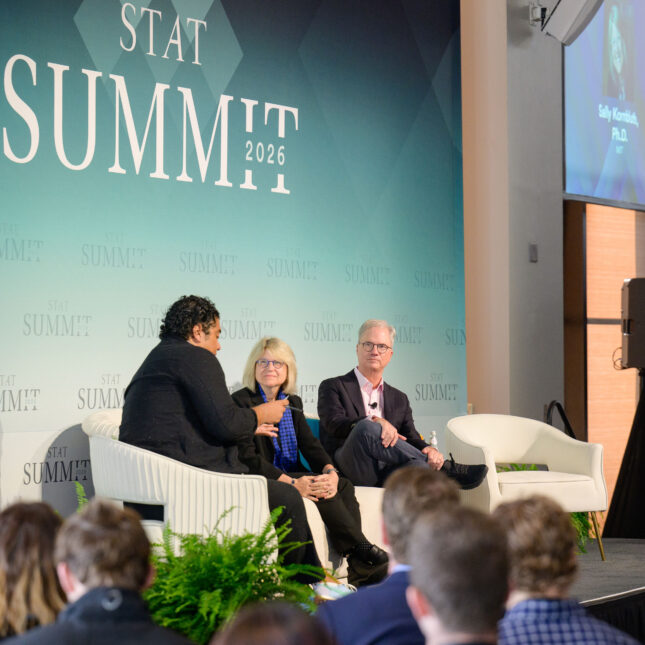
    BOSTON — This fall, the Massachusetts Institute of Technology, where 95% of students are STEM majors, enrolled nearly 500 fewer graduate students — a 20% drop compared to 2024. The reduction is a direct result of a $100 million cut in federal research awards to the institution in that same timespan, MIT President Sally Kornbluth said at the STAT Summit Wednesday in Boston. 

    Graduate students are largely supported with these grants, and “if we admit someone, we don’t want them to be partway through their Ph.D. and run out of funding, so we tend to be conservative on the front end,” Kornbluth said. “I wish I had a crystal ball and knew when things were going to turn around, but for now we’re just being cautious.”

    It’s not just MIT. Universities across the country have suspended or shrunk admissions to graduate programs in response to a tumultuous 18 months that have included unprecedented grant terminations, funding delays, and policy changes to how science is supported at the federal level. Even if the upcoming midterms usher in a power shift in Congress, it will do little to change the uncertainty faced by academic institutions regarding the reliability of the U.S. government as a science funding partner, particularly in light of a recently revealed plan for political appointees to gain more control over National Institutes of Health grantmaking decisions.

    “We will go toe-to-toe with the best of them based on merit. If there are other elements that lead to being funded or not, we don’t have control of that and that concerns me,” Kornbluth said. “I think we just have to do our very best science and feel like that in the end will win the day, and the country needs that.”

    Kornbluth was joined by Holden Thorp, editor-in-chief of the Science family of journals, to argue for the model of American research that for the last 80 years propelled the U.S. to global dominance in science, technology, and medicine. First articulated by Vannevar Bush in his 1945 report “The Endless Frontier,” it involved sustained public funding of science at research universities and federal laboratories and a commitment to open inquiry.

    While that model was showing signs of stagnation before the second Trump presidency, the last 18 months have shredded the social compact at its foundation. In its place, the administration has proposed a new blueprint for American innovation — one that is focused more narrowly on national priorities and a smaller role for the federal government in science funding. 

    At the White House’s Science: A New Golden Age summit last week, the Trump administration announced $6 billion in new national research investments, including support for the buildout of advanced computing facilities and autonomous laboratories, the development of nuclear powered spacecraft and next-generation quantum computers, and the creation of accelerated training programs in artificial intelligence and engineering. White House Office of Science and Technology Policy Director Michael Kratsios described the funding announcement as “the most transformative day for the American scientific enterprise since the reshaping of the federal research ecosystem following World War II.” 

    The investments mark the administration’s first steps to implement its vision for advancing U.S. innovation. Laid out in an OSTP report over the summer, it calls for a dramatic shift of hundreds of billions of research dollars from universities to industry — primarily AI and technology companies. 

    While there are roles for commercial entities as well as national labs to play in propelling science and innovation, Kornbluth said, what has very uniquely flourished at universities is the very basic end of the pipeline — the unpressured curiosity-driven research that has led to revolutionary discoveries including CRISPR gene editing, microRNA, and this year’s Nobel-winning work underlying the exploding field of optogenetics. “I worry that all of these moves, while they’ll have short term gains, are going to result in a serious drought in the pipeline … for us maybe five, 10 years down the line, but certainly for our children and their children’s children,” Kornbluth said. 

    It’s too soon to see the effects of these shifting priorities in research output indicators like top-tier journal publications, Thorp said. But he doubts the Trump administration’s push will do much to reverse the ongoing trend of the U.S. falling further behind its geopolitical rivals. 

    Even before the last 18 months of disruptions and delays to government investment, the U.S. was on its way to losing its place of prominence as the world’s largest public funder of science. Forecasts have put China on track to surpass the U.S. on research spending in the next two to three years. On the ground, that means buildings going up, more people going to graduate school, and a tangible sense of momentum. 

    “The atmosphere is just so much more pro-science there than it is here,” Thorp said, recounting a recent trip to China in which he sat down with presidents of several universities. 

    It’s getting results. Nine out of the top 10 academic research institutions are now in China, according to the latest data from the Nature Index, with Harvard University as the lone U.S. representative. A decade ago, American universities held half of the top 10 spots. 

    “Submissions from China continue to increase, not just in number but in quality,” Thorp said of the Science family of journals. To the point that, Science Advances, an open-access journal that is slightly less competitive than the flagship, is now publishing an equal number of papers from the U.S. and China. He expects the same to be true for Science within the next four to five years. “That’s the competitive effect that I don’t think the administration has very good answers for,” Thorp said. “At least when I write to them and ask them if they want to comment about it in my column, they never respond to me.”

    How these dueling visions of research in America play out will in some ways be shaped by the outcomes of the next few elections. But science happens on a longer time scale, and both Thorp and Kornbluth pointed to the need of scientists and academics everywhere, regardless of who holds power in Washington, to confront the underlying political reality of rising populism and cratering trust in institutions. 

    Kornbluth highlighted a new initiative launched this month — MIT for America — which sends students and alumni out across the country to help under-resourced high schools teach math, computer science, and other STEM classes often required for admission into the kinds of college programs required to move ahead in the increasingly AI-centric U.S. economy.  “We want to both meet people where they are, give their kids the opportunity, and also make them understand us as people who care about their communities,” she said.

    Thorp urged universities to follow MIT’s lead on getting rid of legacy admissions policies that give children of alumni an edge (which the university did decades ago). “It’s a huge part of why people are suspicious of higher education,” Thorp said. But he acknowledged that there’s only so much that institutions of all types can do to reverse the tide of populism, which has been growing for close to a century. 

    “My view is we have to accept the fact of what modernity has given us,” Thorp said. “Some people come to me as the editor of Science and think I have a big platform, and I’m sure they go to STAT and think STAT has a big platform, but compared to Mr. Beast, we’re off by three orders of magnitude. I can put all the cool videos and explainers and everything I want to on the Science social media accounts, which are the largest in academic publishing, and it’s not going to move the needle.”

  • Americans trust science more than peers around the world, survey shows

    Americans trust science more than peers around the world, survey shows

    Americans have more trust in science than most of the rest of the world, according to a new survey of people in 140 countries, a finding that may seem difficult to explain in a country deeply divided by issues such as the benefits and harms of vaccines. 

    According to the newest edition of the Wellcome Global Monitor, 52 percent of Americans report having “a lot” of trust in science. Across the globe, that number is a mere 26 percent. 

    Americans, in aggregate, are also more eager to get vaccines compared to peer nations; 45 percent of Americans say they would want to get vaccines recommended by a nurse or doctor “right away.” In Germany only 28 percent say the same. 

    And while the share of people globally who agree that science benefits most people in their society has dropped from 42 percent in 2018 to 37 percent in 2025, the share of Americans who agree with that statement has actually increased from 48 percent to 57 percent. 

    But the aggregate statistics don’t tell the whole story. STAT’s analysis of the Wellcome data demonstrates that while America may, in general, appreciate and trust science, it is also far more divided than peer nations. 

    Take the religious divide: According to STAT’s analysis there was, on average, a 5 percentage point gap between the percentage of religious  and non-religious people in high-income nations who said science benefits most people in their country. In the United States that gap was 24 percentage points.

    A similar divide — 19 percentage points — separates urban and rural Americans on the question of science’s benefits. The divide across other high-income nations is just three points. Education level divides Americans as well — just 47 percent of Americans without  four-year degrees reported believing  that science benefits most people, compared to 71 percent of college grads. 

    Wellcome, a British foundation focused on scientific research, funded the survey in 2018, 2020 and 2025. The most recent version was administered as part of the Gallup World Poll through a combination of in-person, telephone and online surveys of more than 140,000 adults. The global findings were weighted “to ensure that global estimates accurately reflect the relative populations of countries in the survey.” 

    The survey does not offer an explanation for why the United States appears to be outpacing its peers on trust. But at least some of Americans’ seeming polarization may be explained by Americans’ tendency toward extremes. 

    Americans are “more extreme responders to public opinion surveys,” said Matthew Motta, an associate professor at Boston University School of Public Health who is an expert on public opinion research. 

    For example, a smaller proportion of Germans than Americans said they would “not get vaccines at all.” Only 8 percent of Germans were completely anti-vaccine, compared to 13 percent of Americans. Instead, the vast majority of Germans said they would “prefer to think about it for some time.”  

    The survey also showed that Americans who historically have been less trusting are not necessarily souring on science and its benefits. STAT’s analysis finds that the proportion of Americans who identify as religious and who believe science benefits most people increased by four percentage points, from 46 percent in 2018 to 50 percent in 2025. Self-reported religious Americans are also more likely to report an eagerness to be vaccinated when compared to peer countries.

    A similar pattern plays out with Americans without  four-year degrees. The percentage of non-college grads who say science benefits most people increased by three percentage points over that seven-year period, and they too are more likely than residents of peer nations with similar education to want vaccines right away. 

    So  what is causing America’s growing divide over trust in science? The poll shows it is growing enthusiasm for science among highly educated, secular Americans. Both reported substantial increases in their appreciation of the benefits of science: 13 percentage points for college grads, and 15 percentage points for secular Americans over seven years, the Wellcome survey found. 

    In short, America is divided not because certain groups are souring on science, but because others are becoming more appreciative of its benefits. 

    That might seem like good news. But the divide nonetheless underscores that the benefits of science are not reaching a large swath of Americans in ways they can see and feel.

     “People are feeling left behind, they are not understanding how this benefits me,” said Brian Castrucci, president and CEO of the de Beaumont Foundation, which focuses on strengthening public health. 

    Some divisions facing Americans will be difficult to combat in a country as large and diverse as the United States. City dwellers with cancer who can access care at a top-rated university medical center will inevitably see science’s impact on their lives more than people in a rural area who might have to travel a great distance for even the most basic hospital care.  

    Wellcome found that trust in science is closely associated with confidence in a nation’s health care systems, which presents a problem for the United States as well. Just 40 percent of Americans reported a lot of confidence in U.S. hospitals and health clinics, the same proportion  as in Portugal and Uruguay. 

    Anti-science sentiment coming from America’s top political officials is likely playing a role too, several experts said. Diverging views on science among America’s political parties became apparent during the Tea Party movement of the 2010s and was amplified during Trump’s presidency, said Yotam Ophir, an associate professor of communication at the University at Buffalo. 

    But experts STAT spoke to underscored that this new data doesn’t just indicate the need for the sorts of systemic changes that can take decades to fulfill. Scientists need to hone their ability to discuss the benefits of science in people’s everyday lives, and to stop expecting the public to blindly trust them, several experts told STAT.  

    “What we need to do is be better communicators, not better debaters. We are not going to be able to lecture people into trusting us,” Castrucci said.

    Mark Henderson, Wellcome’s executive director of corporate affairs and engagement, said scientists who wish to take steps based on the report’s findings should “meet people where they are.”

    “Approach people on a level with understanding and engagement and respect, and you’re going to get a better outcome,” Henderson added. “It’s not rocket science, but it often surprises me how hard people in the scientific community find it to do that.”

  • STAT+: Biotech companies are struggling to navigate Trump’s new tariffs

    STAT+: Biotech companies are struggling to navigate Trump’s new tariffs

    WASHINGTON — A broad tariff on imported pharmaceuticals took effect at the end of September, and some biopharma companies and the industry group that represents them say many are being left in the dark on how to get exemptions. 

    The Trump administration announced a 100% section 232 tariff in April, impacting imports of patented drugs and their active ingredients. At the time, the White House offered a number of pathways for companies to reduce their tariff burden, including striking a most-favored nation deal to sell drugs in the U.S. at similar prices to other wealthy countries or agreeing to bring production to the U.S.

    Companies that made MFN agreements would have had start paying tariff costs in July, but now aren’t on the hook for payment until early 2029, per their agreements. That exempts many of the biggest U.S. drugmakers, while leaving smaller biotech firms to face the levies.

    STAT+ Exclusive Story

    Already have an account? Log in

    STAT+

    STAT+

    This article is exclusive to STAT+ subscribers

    Unlock this article — plus daily coverage and analysis of the biotech sector — by subscribing to STAT+.

    Already have an account? Log in

    View All Plans

    To read the rest of this story subscribe to STAT+.

    Subscribe

  • STAT+: PhRMA sues over Trump policy mandating lower drug prices in Medicare

    STAT+: PhRMA sues over Trump policy mandating lower drug prices in Medicare

    Pilot program known as GLOBE is intended to test ‘most-favored nation’ policy

    Close up stock news photo of medicare advantage membership cards
    Jenny Kane/AP

    By John Wilkerson

    Oct. 7, 2026

    John Wilkerson, a Washington correspondent, is the author of D.C. Diagnosis, a twice-weekly newsletter about the politics and policy of health and medicine.

    John writes about the politics of health care, and he is the author of the twice-weekly D.C. Diagnosis newsletter. You can reach John on Signal at John_Wilkerson.07.

    WASHINGTON — The brand drug industry’s main trade group is suing the Trump administration over a pilot program tying Medicare drug prices to those in peer countries.

    The Pharmaceutical Research and Manufacturers of America said Wednesday that it had filed a complaint in the U.S. District Court for the District of Columbia asserting that the “most-favored nation” pilot in Medicare Part B exceeds Medicare’s statutory authority. 

    The pilot, called GLOBE, is not expected to have much impact because the administration exempted all but a handful of companies in return for their agreement to voluntary deals to charge Medicaid MFN prices. 

    STAT+ Exclusive Story

    Already have an account? Log in

    STAT+

    STAT+

    This article is exclusive to STAT+ subscribers

    Unlock this article — plus daily coverage and analysis of the pharma industry — by subscribing to STAT+.

    Already have an account? Log in

    View All Plans

    To read the rest of this story subscribe to STAT+.

    Subscribe

    1. John writes about the politics of health care, and he is the author of the twice-weekly D.C. Diagnosis newsletter. You can reach John on Signal at John_Wilkerson.07.

  • STAT+: Are stem cell treatments about to have their day?

    STAT+: Are stem cell treatments about to have their day?

    You’re reading STAT’s D.C. Diagnosis newsletter

    Adobe

    John writes about the politics of health care, and he is the author of the twice-weekly D.C. Diagnosis newsletter. You can reach John on Signal at John_Wilkerson.07.

    You’re reading the web edition of D.C. Diagnosis, STAT’s twice-weekly newsletter about the politics and policy of health and medicine. Sign up here to receive it in your inbox on Tuesdays and Thursdays.

    Celebrity doctor Mike Varshavski has been contacted by The Bachelor for its 30th season. Send news tips and hot physicians to [email protected] or John_Wilkerson.07 on Signal.

    A lame lame-duck

    On Friday, President Trump said he will give $90 to more than 20 million seniors to help pay for Medicare premiums.

    STAT+ Exclusive Story

    Already have an account? Log in

    STAT+

    STAT+

    This article is exclusive to STAT+ subscribers

    Unlock this article — plus in-depth analysis, newsletters, premium events, and news alerts.

    Already have an account? Log in

    View All Plans

    To read the rest of this story subscribe to STAT+.

    Subscribe

    1. John writes about the politics of health care, and he is the author of the twice-weekly D.C. Diagnosis newsletter. You can reach John on Signal at John_Wilkerson.07.

  • STAT+: New Trump regulations would clean up health care pricing disclosures

    STAT+: New Trump regulations would clean up health care pricing disclosures

    Public drug price information is now coming next year, Trump officials say

    Mehmet Oz at a federal event on Monday in Washington announcing new health care price transparency rules.Finn Gomez/Getty Images

    By Bob Herman

    Oct. 5, 2026

    Bob Herman is the author of Health Care Inc., an award-winning weekly newsletter about the business of health and medicine.

    Bob covers the money in health care, focusing on health insurance and hospitals. His stories delve into Medicare Advantage, opaque prescription drug benefits, and how much executives actually make. He is also the author of the Health Care Inc. newsletter. You can reach Bob on Signal at bobjherman.09.

    The Trump administration released new regulations Monday that will force health insurance companies to publish cleaned-up spreadsheets of the prices that they pay hospitals and doctors, while stripping out meaningless data that clogged up the files.

    Trump officials also said they will start developing the system for disclosing prescription drug prices next month. A “hopeful” final plan for drug pricing data will come out by next May, said Mehmet Oz, the head of Medicare and Medicaid, at an event Monday. The government will enforce those requirements by the end of 2027. 

    Last year, the Trump administration punted on finalizing drug price disclosure rules, in a victory for drug companies and pharmacy benefit managers that have fiercely guarded their prices. 

    STAT+ Exclusive Story

    Already have an account? Log in

    STAT+

    STAT+

    This article is exclusive to STAT+ subscribers

    Unlock this article — plus daily intelligence on Capitol Hill and the life sciences industry — by subscribing to STAT+.

    Already have an account? Log in

    View All Plans

    To read the rest of this story subscribe to STAT+.

    Subscribe

    1. Business of Health Care Reporter

      Bob covers the money in health care, focusing on health insurance and hospitals. His stories delve into Medicare Advantage, opaque prescription drug benefits, and how much executives actually make. He is also the author of the Health Care Inc. newsletter. You can reach Bob on Signal at bobjherman.09.

  • STAT+: NIH awarded all its grant funding, but delayed and opaque decisions stymied researchers

    STAT+: NIH awarded all its grant funding, but delayed and opaque decisions stymied researchers

    A STAT analysis of National Institutes of Health spending shows that in the 2026 fiscal year, which ended Wednesday, the agency continued reducing grant awards involving health disparities, race, and ethnicity but made little progress toward other Trump administration priorities, including disbursing funds more evenly across the country and expanding support for early-career scientists.

    While the agency, like last year, spent its entire external grants budget of roughly $34 billion after a slow start, the manner in which it did so is sowing deep uncertainty among researchers. In a survey and interviews, they said delays in the grant review process are slowing down the pace of their work, and making it difficult for them to propose and conduct the sort of innovative, impactful science that the NIH exists to support.

    Overall, the agency funded around 58,000 projects, a slight drop from the 61,000 awarded during the 2025 fiscal year and well below the roughly 63,700 grants awarded annually in the years before the second Trump administration. Though this number may increase somewhat in the coming weeks because of reporting lags in the NIH grants database, the smaller number of grants potentially resulted from the White House’s push to fully fund more multiyear grants in advance, which meant that there was less funding on hand to issue new awards. 

    STAT+ Exclusive Story

    Already have an account? Log in

    STAT+

    STAT+

    This article is exclusive to STAT+ subscribers

    Unlock this article — plus in-depth analysis, newsletters, premium events, and news alerts.

    Already have an account? Log in

    View All Plans

    To read the rest of this story subscribe to STAT+.

    Subscribe

  • STAT+: HHS announces new efforts to speed up, expand clinical trials with AI

    STAT+: HHS announces new efforts to speed up, expand clinical trials with AI

    WASHINGTON — The Department of Health and Human Services announced a set of new initiatives aimed at speeding up clinical trials by incorporating more artificial intelligence and computational models and moving away from sharply delineated trial phases. 

    The centerpiece five-year program, dubbed SURPASS — “Simulation-augmented, Real-time Platform Adaptive Seamless Trials” — will kick off later this fall by accepting “ground-breaking ideas from cross-disciplinary teams in statistics, AI, and clinical trial design, operations, and regulation,” reads a website about the program. 

    HHS is launching the program through the Advanced Research Projects Agency for Health. The initial announcement did not note how much funding was designated for the new initiatives, nor did it provide details on whether participants would be offered more flexibility or resources.  

    STAT+ Exclusive Story

    Already have an account? Log in

    STAT+

    STAT+

    This article is exclusive to STAT+ subscribers

    Unlock this article — plus daily coverage and analysis of the biotech sector — by subscribing to STAT+.

    Already have an account? Log in

    View All Plans

    To read the rest of this story subscribe to STAT+.

    Subscribe

  • Why MAHA wants to make health data much more accessible

    Why MAHA wants to make health data much more accessible

    WASHINGTON — The Make America Healthy Again movement wants your health data.

    The MAHA Institute, a think tank formed by allies of Robert F. Kennedy Jr. after his appointment as health secretary, held an event on Monday that emphasized the benefits of opening up health data sharing in the United States. In particular, the event highlighted how sharing patients’ health records with federal researchers could benefit the study of the origins of chronic diseases.

    In a speech at the event, Kennedy said that user agreements restrict access to data, giving “institutions that control important health data the power to decide who can study it and what questions they’re allowed to ask, and that creates protectionism in science and it leads to the politicization of science.”

    “A qualified researcher with legitimate hypotheses should not need permission from a gatekeeper to test it, particularly from an industry gatekeeper,” he said in his remarks, which began and ended with a standing ovation.

    The idea of using data from health information exchanges for research is controversial because of privacy concerns.

    Speakers throughout the day brought up the state of Nebraska’s partnership with the federal government. As reported earlier this year by KFF Health News, Nebraska’s health information exchange network, called CyncHealth, is sharing patient data with the federal government to enable studies on vaccines and autism. 

    Kennedy said Monday he wants to aggregate “immunization records, clinical data, laboratory results, pharmacy information, and claims to create a more complete picture of a patient’s health over a long period of time.” That data would come from state health information exchanges, EHRs, laboratories, Medicare, Medicaid, and commercial health data platforms like HealthVerity. 

    “We’re already using all these data to answer some of our most important questions. Too much remains fragmented, vulcanized, difficult to link, and inaccessible to researchers,” he said, citing a desire to aggregate the data and make it available to all researchers.

    While KFF reported Nebraska’s partnership was with the Centers for Disease Control and Prevention and focused on vaccines and autism, MAHA Institute President Mark Gorton said a partnership between Nebraska and the National Institutes of Health “has successfully produced data for the study of chronic disease and serves as a proof of concept for the state-federal hybrid model.” Neither partnership seems to have been publicly announced, though the NIH has already stood up an effort to build Medicare and Medicaid databases within the NIH in an effort to better understand autism.

    Nebraska’s CyncHealth was, until the end of last year, led by Jamie Bland, who became chief data strategist of the MAHA Institute in April.

    At the time of KFF’s reporting, leaders of other state health information exchanges decided not to share information with the government. Using such data for research could run into patient privacy, ethics, and legal issues.

    For example, Jonathan Ketcham, who was chief health care economist at the White House until earlier this year, when he moved back to his economics professorship at Arizona State University, said on Monday that Arizona’s health information exchange data “cannot be used, even de-identified, for researcher grants without individual consent” from providers.

    “The issue is not a technical limitation,” Andrew Kress, CEO and founder of data company HealthVerity, told STAT last year. “It’s really been more around data governance, data ownership, data privacy. Those are the reasons that these things have not worked, more so than you can’t find the right data to do it.” Hospitals, for example, sometimes sell their patients’ de-identified data, or carefully grant access under data use agreements that spell out what purpose the data can be used for. Patients also normally have to consent to their information being used for research.

    Gorton said that the partnership with Nebraska has only worked “because of the investments that Nebraska has made in data governance.” “If this model is going to expand, we will need to see other states make similar investments in the mundane yet crucial function of data governance,” he said.

    The administration has sought to give patients more control over their own data through initiatives like the CMS Health Tech Ecosystem. “Liberate patient records,” said top HHS official Chris Klomp at a STAT event in March. “Let us be very clear on CMS’ official position on this: The record belongs to the patient. It goes everywhere the patient needs to go. We’re serious about this.” 

    But the improved health data infrastructure from these and other Trump administration efforts would help standardize health data, making it ripe for helping answer research questions.

    “We’ve had a lot of public controversy about vaccine safety,” said Donald Rucker, chief strategy officer at 1upHealth and national coordinator for health IT during the first Trump administration. “Many of the [health information exchanges] could answer these questions right now if the immunization registries weren’t actually unlinked to the HIEs,” he said.

    Gorton said at the event that the partnership with Nebraska is a model for state-federal cooperation on health data, and that all 50 states will try different approaches to “growing America’s health data infrastructure.”

    “With these successes, residents will experience health data record portability and a better healthcare experience. Once citizens experience what is possible in one state, other states will rush to follow,” said Gorton. “This pilot is just one small step on a long journey, and we are excited to be part of this adventure.”