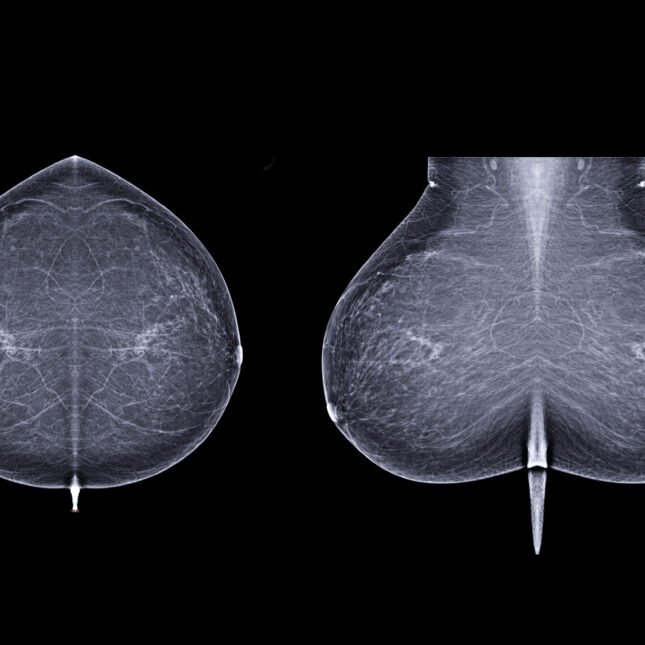
Of all the factors that can increase a person’s risk of breast cancer, age is among the most significant. Almost half of people diagnosed with breast cancer are at least 65, and about 20% are 75 or older. Despite these rates, older women are frequently excluded from clinical trials; one study of breast cancer trials found that only 9% of participants were 65 or older, leaving physicians with a poorer understanding of how drugs behave in older adults and fewer guidelines with which to treat them.
There’s increasing evidence that these patients could benefit from more tailored treatments. Neil Carleton, a cancer biologist and first-year resident physician at Brigham and Women’s Hospital, said that breast tumors can develop and grow differently in older patients than in younger ones because of hormone levels and inflammation.
“It can be a very heterogeneous disease,” Carleton said. But “historically, we’ve kind of treated all breast cancer the same,” he added — in a way that’s “age-agnostic.”
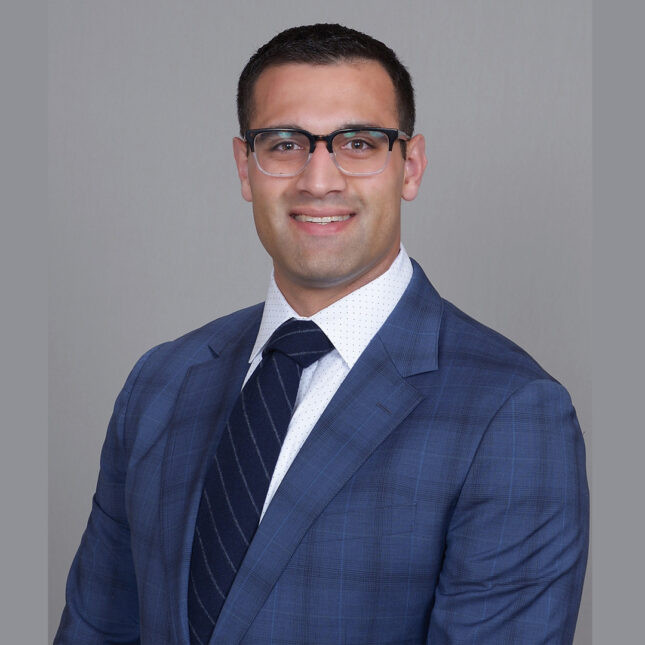
Carleton, who was recently named a STAT Wunderkind, wants to change that. After an M.D.-Ph.D. spent studying how clinicians can better treat tumors in older adults, he is now working to ensure that these patients receive care that is right for them, whether that means dialing back treatment or increasing it.
“We typically think an older adult may be a little bit more frail” or less able to tolerate standard surgeries and therapies, he said. “But I don’t even think it’s about that. I think it’s more about appropriately treating.”
Crafting the ‘nudge’
As an undergraduate at Carnegie Mellon University, Carleton spent two summers working in a Johns Hopkins prostate cancer lab and was surprised to see surgeons making a point to attend the department’s journal club. On Wednesday mornings, as the urology group — basic scientists and physicians alike, in all stages of their careers — filed into the conference room to discuss scientific papers in the field, Carleton began to see how medicine and research were intertwined.
He’d been thinking about medical school since high school in Pittsburgh, when a formative biology teacher veered his lessons away from photosynthesis and toward anatomy, physiology, and new biotechnology — the kind of science that explained how human health really worked. The idea of a physician-scientist was completely new, and it felt like the right fit.
“I knew you could be a doctor, and I knew you could do research. I had no idea that you could kind of do both,” Carleton said.
When he started his M.D.-Ph.D. at the University of Pittsburgh in 2018, Carleton began working in the lab of Adrian Lee and Steffi Oesterreich, a husband-and-wife team of breast cancer biologists who were enthusiastic about new ideas and had a robust track record of translational research. Lee remembers the intensity with which Carleton wanted to be involved in that kind of work. “We can go on doing basic research forever, but we would like to eventually impact patient care,” Lee said. “And you could tell that he wanted to do that.”
At the time, there were reports from surgeons and in the scientific literature that older women with breast cancer were being overtreated. The three started talking about the patients that would come to launch Carleton’s career and a body of work in Lee and Oesterreich’s lab. In 2020, under the guidance of Lee, Oesterreich, and surgeon Priscilla McAuliffe, Carleton set out to quantify how many patients were receiving a surgery called a sentinel lymph node biopsy.
When removing a tumor from a patient’s breast, surgeons sometimes make an incision in the armpit and take a small amount of lymph node tissue to see if the cancer has spread there. Though professional society guidelines recommended against performing this biopsy on women 70 or older with early-stage cancer, other groups had reported that it was still being done.
In data from the university medical center, Carleton found that about 65% of patients were still receiving biopsies. Rates actually continued to increase after the Society of Surgical Oncology adopted the guidelines in 2016, even though patients who received the biopsy were not more likely to survive or avoid recurrence. But “it can be very hard for surgeons to stop doing a surgery that’s kind of been ingrained in the paradigm for a while,” Carleton said.
How, then, could he and his colleagues convince surgeons to reconsider? They designed a “nudge” within the electronic health record — a pop-up that would appear in a provider’s schedule for a qualifying patient that would remind them to consider omitting the biopsy. They implemented the nudge in eight clinics across the community and, in a clinical trial, tracked biopsy rates. The year after the nudge, they decreased by almost half.
McAuliffe, now a breast cancer surgeon and clinical investigator at Emory University, said that surgeons encounter a lot of extraneous information in the electronic health record — but the nudge was simple. “I think that it reminded them without being a burden to them,” she said.
One surgeon, when surveyed, said that the nudge “did exactly what its job was,” urging physicians to think about biology rather than reflexively recommending the biopsy. “I had to keep in mind that complete care doesn’t always equate with better care,” they said.
The science behind a paradox
While in the clinic, Carleton began studying a years-old question in the lab. Most breast cancer cases in older women are estrogen-receptor positive (ER+), meaning that tumor cells have receptors that bind to estrogen and trigger cancer growth. By 85, 91% of women with breast cancer have ER+ disease, even though postmenopausal women have lower levels of circulating estrogen. Carleton wanted to know how those tumors managed, seemingly paradoxically, to thrive.
Looking at the gene expression in tissue from patients and healthy controls, Carleton and his colleagues found that the patients produced more of an enzyme involved in converting estrone — a form of estrogen that circulates in the bloodstream in postmenopausal women — to estradiol, its more potent version, within the tumor’s environment.
Scientists had known for 20 years that tumors made their own estrogen but didn’t know how it was done, Lee said. The enzyme Carleton identified was more than a mechanistic insight — it created a druggable target. In 3D models the lab made from patient cells, inhibiting the enzyme blocked estrogen conversion.
Currently, doctors often treat postmenopausal women with ER+ tumors with inhibitors of a different enzyme. The drugs cause side effects like fatigue and joint pain, which lead many patients to stop treatment prematurely. Though the work is still early, Carleton hopes that drugs targeting the process they identified, administered through a gel or patch, could treat or even prevent breast cancer with fewer side effects. “I think it opens up possible therapeutic interventions,” he said.
‘Refining what we do’
When looking through patient data early in his degree, Carleton noticed that some women ages 70 and older were forgoing surgery — not only the biopsy, but also a procedure to remove the main tumor in the breast. In this group, only 3% died of breast cancer after six years, and about 91% had their tumors controlled with primary endocrine therapy, which blocks estrogen receptors on ER+ breast cancer to prevent its growth.
If you could identify those patients for whom endocrine therapy might be enough treatment and monitor them, both the patient and their surgeon might be more comfortable with scaling back surgery, Lee said. “Precision medicine doesn’t mean doing more,” he said. “It means refining what we do, and sometimes refining what we mean we do means doing less.”
While others might have missed the dozens of patients that hadn’t had any surgery among the thousands that did, Lee said, Carleton has a knack for noticing small details. And in September 2021, he uncovered a way to potentially track disease in patients who might not need surgery.
Sitting in a talk at a local conference, Carleton learned about circulating tumor DNA (ctDNA), which cancer cells release into the bloodstream and can be measured to survey tumor growth. Natera, a molecular diagnostics company, had designed an assay that seemed perfect for older patients who’d declined surgery in favor of endocrine therapy: It required only a blood sample and could be done through a mobile blood-drawing service that came to their homes. Carleton and Lee approached Natera and, in the months afterward, designed a clinical trial to test whether they could use ctDNA to watch and identify patients at risk of progression.
“It’s not an easy trial to recruit to — to say to someone, ‘Hey, you have breast cancer, but we’re not going to cut it out,’” Lee said.
But Carleton “has an amazing ability to kind of get the message across and encourage people,” Lee said, and put in hours with patients and physicians to earn their trust. Carleton was surprised by how many older adults were thrilled to join a trial that would guide not only their care, but the treatment of others going forward. “I think it was kind of one of the first times they were even approached to join a study,” he said.
Over the next few years, the team studied patients who decided against surgery with Natera’s assay and ultrasound imaging. Patients with detectable ctDNA at six months were 30 times more likely to progress in their disease during the study, suggesting ctDNA was a marker of potential progression. And indeed, no patients with undetectable ctDNA before endocrine therapy progressed.
The ‘closer’
Today, as a first-year resident in Boston, Carleton spends most of his time treating patients. But he stays engaged with research: with the students in Lee and Oesterreich’s lab continuing to study the estrogen-converting enzyme, and with projects like designing a larger ctDNA trial. Lee and Oesterreich, with whom he still has regular check-ins, call him a “closer” — someone who takes on projects and sees them through to completion, synthesizing complex data from basic science and clinical practice into an understandable whole. “He has the complete package,” Lee said.
Ultimately, Carleton hopes this work can help patients receive care without frequent trips to the clinic — turning breast cancer “into more of a chronic disease,” he said, where a patient might just take a daily pill and have regular imaging or ctDNA tests.
Of course, Carleton said, not every patient will want that, and people with aggressive disease may need every intense treatment, test, and appointment. But better tools can help doctors identify: Who can be the patient they send home?