
Category: MedCity Influencers

  • Why Agentic AI Works in Hospitals When You Strip It Down

    Why Agentic AI Works in Hospitals When You Strip It Down

    A digitally generated image featuring an old-style computer monitor displaying the letters “AI” with neon business crowd. The scene blends retro computing with modern business aesthetics, symbolizing the journey of artificial intelligence from its early beginnings to its growing role in today’s corporate world. Ideal for illustrating themes of digital evolution, business transformation, AI adoption, and technology-driven innovation.

    Imagine an agentic AI solution that plans and executes multi-step tasks like triaging referrals, drafting notes, flagging deteriorating patients, and surfacing care recommendations. After the flawless demo, the committee approves what is supposed to be the answer to operational inefficiencies in healthcare. Fast forward six months: the system formally operates, but it no longer influences any real clinical decisions.

    Many hospitals are now trying to use AI to automate processes and free up staff time, running simultaneous pilots to perform as many tasks as possible. This quickly leads to pilot sprawl — a state where organizations can no longer even say which agents are still in active use.

    As one widely cited MIT analysis has shown, 95% of enterprise AI pilots fail to deliver measurable ROI, and I would add that they fail predictably. From my experience, I would distinguish the four most common scenarios:

    • The Big Bang: an attempt at a long, all-department transformation, so by the time anything goes live, the requirements have already changed, and the budget was spent before a single user has seen value.
    • Pilot Purgatory: a project that looks impressive in a controlled environment (demo) but cannot pass the reality check, working with human users, actual workflows, and unexpected interruptions.
    • Technology-First: the platform gets built before the problem it should solve is clearly defined, so the team ends up searching for at least some use case after the investment is already made.
    • Governance Paralysis: long months spent designing the perfect oversight model while the initiative quietly loses momentum, ownership, and executive support.

    In fact, all four scenarios share the same fundamental mistake: the system is designed to look intelligent, convincing, even flashy, but not as one you can trust in a real healthcare workflow.

    What especially shines in a demo often arrives as opaque in practice. Each new agent and each additional step creates another space where something can go wrong.

    An annoying glitch in a consumer app translates to delayed critical care or missed clinical alerts in a hospital. The human is never genuinely in the loop, so staff make the safest and most obvious decision and stop using the system they cannot fully rely on.

    Even if the model is robust, an agent operating outside the chart creates too much friction for daily use. Recently, Jonathan Bush argued in MedCity News that orchestration layers must be built above the EHR. While his diagnosis of EHR limitations is spot on, the proposed solution misses the reality of clinical workflows. An agent must live directly inside the patient chart via standard integrations. If it exists as a separate overlay, it will simply be abandoned.

    After a decade of working on EHR and HL7 FHIR integration projects, I see this exact friction more often than almost any model problem. For example, the clinician has to leave the record, open a second tool, and then come back just to act on the recommendation. A strong triage engine can be abandoned for exactly that reason.

    How do we handle all these issues? The fix is not a better model, but the right sequence. First comes assessment, then the pilot, then change management, and only then scaling. Between these phases there must be a real decision gate, and you should be ready to stop if there is no good reason to go further.

    • Assessment: The assessment should be brief — about four weeks. We need it to reduce risks before building anything. The potential use cases must be evaluated based on such criteria as value, feasibility, and personal relevance. Value shows the return you get. Feasibility shows whether it is achievable with the available data and infrastructure. And personal relevance is about whether the solution is useful to a particular person in their daily work. If the assessment is honest, the result is a readiness scorecard and a go/no-go call before the money is spent.
    • Pilot: It is not just a slideshow, but a real demonstrator that works with real users and real data in production, typically over twelve weeks. To pass the reality check and avoid getting lost in pilot purgatory, it must do one clearly defined and practical thing. If you cannot explain to a floor nurse in one sentence what exactly this AI agent does, you do not have one project but several. And this agent must surface in the chart clinicians already work in, not in a separate tool they have to open and use on its own. The system’s rationale must be clear — the specialist using it must understand why a particular case or patient surfaced. And of course, the human must be in the loop, not for show. The system can work and make sense only when the agent surfaces recommendations while a specialist makes the final clinical decision. On one documentation project built this way, follow-up documentation time fell by about a third and compliance with scheduled check-ins doubled. This aligns with broader industry validation; for instance, the AHA Market Scan noted a comparable 27% reduction in documentation time at Intermountain Health.
    • Change Management : Change management is probably the most underrated step that many teams skip. If no one wants to use the agent, it doesn’t matter how technically excellent it is. So, before you scale, you need not only to train the team how to use the solution, but also build it into daily processes and see whether it has actually caught on. You can see it in very simple signals — how often a nurse accepts or declines a suggestion and what share of recommendations she opens versus ignores. Those metrics are both proof of adoption and a map of what still needs improvement.
    • Scale: Finally, it makes sense to talk about scaling. And not because “everyone liked the pilot,” but because it met specific predefined criteria and showed real results, such as time saved per shift, error rate, and task compliance. If something is still missing in the pilot, you iterate or stop. If the demonstrator clears the bar, you earn a slightly broader next scope, one use case at a time. That’s how you can see value by week twelve, rather than postponing it for a year and a half. Evidence first, hype never. Federal transparency rules, such as the HTI-1 final rule, are already moving this way by demanding strict algorithm transparency in certified health IT.  

    In healthcare, the systems that scale are not the most ambitious ones, but the ones that are easiest to trust, govern, and use in real workflows. 

    The agents that succeed tend to do one narrow task clearly, visibly, and with a human still making the decision.

    And the hospitals that will pull ahead over the next couple of years are not the ones running the most impressive pilots. They are the ones running the fewest — and finishing them.

    Photo: akinbostanci, Getty Images

    Mykhailo Hentosh

    Mykhailo Hentosh is Head of Engineering and Solutions at Binariks, where he sets the technical direction for complex software programs in healthcare and AI. A software architect and solution designer with nearly two decades in the field, he is a core member of the company’s AI Center of Excellence. Much of his career has been spent on enterprise healthcare platforms, EHR and HL7 FHIR interoperability, and AI deployments that have to hold up in real clinical workflows. He is known for cutting through hype toward systems that make a measurable difference, and for challenging conventional thinking when the evidence does not support it.

    This post appears through the MedCity Influencers program. Anyone can publish their perspective on business and innovation in healthcare on MedCity News through MedCity Influencers. Click here to find out how.

  • What Corporate Venture Funds Get Wrong about Strategic Value

    What Corporate Venture Funds Get Wrong about Strategic Value

    A venture fund’s objective is to invest capital into early-stage companies to fuel growth, increasing the probability that they are acquired or reach public markets. That’s how an “exit” is achieved, with the invested capital returned at a risk-adjusted profit. Corporate venture capital (CVC) differs from orthodox venture capital because, alongside financial returns, a CVC’s goal is often to create strategic value for a core business.

    Delivering this strategic value is much easier said than done, and therefore not well addressed by most CVC funds. 

    Outlined below are four distinct practices that optimize strategic and financial value. 

    Define strategic value alongside financial return

    Strategic value comes in many forms. Pharma corporate venture should develop investments that might generate a valuable new target, drug, or vaccine candidate, improve the probability of pipeline success, reduce the cost of R&D, accelerate clinical trials — and more through the entire value chain. It is not necessary to acquire such businesses outright, but it is necessary to cultivate them into standardized, scaled solutions for scientists, regulators, clinicians, patients, and payors.

    Assessing the value of an asset — financial and/or strategic — is as much art as science. Financial value can be estimated using discounted cash flow analysis, which relies on pro forma projections and assumptions about future market pricing and multiples, or through comparable-company analysis. Quantifying strategic value is much more difficult. One derivative indicator of strategic value is whether the core CVC business engages with the portfolio company, through piloting, partnering, licensing, and/or purchasing products or services. A CVC that can’t generate this type of engagement is just delivering capital without a strategic return. 

    Lead internal collaborations that power sourcing and diligence

    Placing relevant strategic investments requires deep familiarity with the parent company’s objectives and priorities. This means dedicated internal workstreams with business leaders and subject matter experts who help refine and prioritize use cases and understand unmet needs. In-house CVC resources also help with pipeline building and technical, scientific, and clinical due diligence. Proper engagement is time-consuming and requires operational, process, and communication excellence — skills anathema to the normal concerns of most venture investors.

    Many benefits accrue from generating that upfront buy-in. Deep collaboration raises the CVC’s probability of succeeding in highly scientific and technical markets. It also instills early business awareness and engagement, so portfolio companies develop faster pilots and larger partnerships, executable in a shorter timeframe.

    Drive leverage through syndication

    Most CVC investors are equipped to lead negotiations and price rounds, but there’s a strong case for prioritizing syndicate creation. 

    Syndication provides leverage through agile, coordinated activity on negotiating terms, dividing or delegating board activities, and considering future mergers and acquisitions. It also extends financial leverage, allowing a fund to cover more of the market and back a broader range of strategic interest areas. Joining syndicated deals priced by expert financial investors tends to produce a fair market price. A CVC can always walk away when pricing runs ahead of what its internal modeling supports. 

    Even with reduced board involvement, a fund can stay engaged through shareholder and information rights — quarterly financials, board materials, regular check-ins — whether it holds a board or observer seat or is simply an shareholder. 

    Occasionally, a CVC will need to play a more significant company-building role, In such cases it can place a convertible note or lead a round outright — but always with an eye toward delegating responsibility over time. The correct level of involvement is a case-by-case decision, considering the strategic relevance of the platform, the stage of the company, and the experience of its board and management team.

    Deliver the payoff 

    None of this works as one single move, but as a pattern: sourcing shaped by internal collaboration, pricing and development sharpened by syndication, and continued engagement all the way to exit. Funds that operate this way tend to see their strategic and financial returns reinforce each other over time rather than trade off against one another.

    The key lies in recruiting and training leaders who roll up their sleeves and work seamlessly with internal partners. When portfolio investments help a business develop better therapies or reach patients faster, they deliver strategic value — and ultimately value to patients and providers.

    Photo: Hong Li, Getty Images

    David M. Rubin

    David M. Rubin, Ph.D., is a Managing Director in Merck GHIF, where he leads the drug discovery and precision medicine practice. Dr. Rubin ran and helped build life sciences companies in the USA, UK, Denmark, Hungary, and India. He was awarded National Institutes of Health and American Cancer Society Fellowships to support his research at Harvard Medical School on ubiquitin-dependent protein degradation. He received a B.A. in biology from SUNY Binghamton and a Ph.D. from Temple University. Junk Birds, his collection of previously published short stories, was published in 2025.

    This post appears through the MedCity Influencers program. Anyone can publish their perspective on business and innovation in healthcare on MedCity News through MedCity Influencers. Click here to find out how.

  • Pediatric Innovation Isn’t a Small-Market Problem, It’s an Incentive Problem

    Pediatric Innovation Isn’t a Small-Market Problem, It’s an Incentive Problem

    pediatric kids children

    The case for investing in children’s health should be self-evident. As a society we have a responsibility to invest in the next generation, and few investments carry greater long-term benefit than helping children reach their healthiest possible futures.

    When we diagnose and treat conditions early, we do more than improve a child’s health in the moment. We are altering the trajectory of their entire life: development of their personal confidence, resilience, mental wellbeing, learning capacity, and in many cases, also reducing decades of downstream public and private healthcare costs.

    Yet, pediatric innovation remains chronically and systemically undervalued in healthcare.

    That is not because the market for pediatric healthcare is small, it is because the incentives are misaligned. The cost of treating a child’s condition is incurred immediately. However, when early pediatric interventions are effective, their benefits often compound over decades.

    No single stakeholder is incentivized to properly and accurately consider the full return on early pediatric interventions and support their adoption. The average tenure of a person staying on the same health plan is two to three years. As a result, private insurers are focused on cost savings that will be realized within that time frame, which for pediatric treatments especially, may only represent a small proportion of the overall benefit.

    On the public insurance side, children are largely covered by Medicaid, and while pediatric health is a central tenet of Medicaid’s mission, the program is too often hamstrung by its structure. Unlike Medicare, which is entirely financed at the federal level, Medicaid is jointly financed between the federal government and each individual state. The program is often left underfunded, as its budget is subject to annual appropriations decisions by state legislators who have limited fiscal flexibility. Priorities are constantly changing, making long-term planning next to impossible for Medicaid decision makers.

    That misalignment has consequences well before a new technology ever reaches a payer’s desk. When long-term pediatric outcomes are undervalued, the ripple effect moves backward through the entire innovation pipeline, shaping what gets funded, what gets studied, and what ultimately reaches patients.

    Investors, wary of uncertain reimbursement and lower near-term returns, often direct capital toward adult indications with clearer paths to market. Drug and device developers may follow the same logic, deprioritize pediatric programs or skip pediatric studies. The result is a self-reinforcing cycle: limited investment leads to fewer pediatric success stories, which then reinforces the false perception that pediatric markets are too small or too risky to justify meaningful investment.

    This is why pediatric innovation in healthcare must be evaluated differently.

    Payers should require robust clinical evidence to make responsible coverage decisions. But the decision making framework for pediatric products should reflect the unique realities of childhood conditions: the value of early intervention, the long-term costs and consequences of undertreatment, and the potential for a therapy to alter a child’s life path before preventable challenges become permanent ones.

    Policy leaders should also examine whether existing pediatric coverage pathways are actually keeping pace with modern innovation. In theory, we already have a powerful mechanism for this: the Early and Periodic Screening, Diagnostic, and Treatment (EPSDT) benefit. Under federal law, EPSDT mandates that Medicaid-enrolled children receive all medically necessary services to correct or ameliorate important pediatric conditions, regardless of whether those services are explicitly covered in a state’s standard plan. It is a visionary policy designed to ensure that no child is left behind by the structural limitations of our healthcare system. In practice, awareness of the EPSDT benefit among Medicaid beneficiaries is low, and Medicaid plans need to do more to streamline the approval process for EPSDT-covered technologies.

    Investing in pediatric care is not simply a moral imperative. It is one of the most practical long-term investments the healthcare system can make.

    The question is not whether children’s health is worth the investment, that answer is self-evident. The real question is whether our healthcare ecosystem has the foresight to correct these incentive structures before another generation of children bear the cost of our delay.

    Photo: Suriyapong Thongsawang, Getty Images

    Scott Xiao

    Scott Xiao is the co-founder and CEO of Luminopia, a therapeutics company developing software-based interventions at the intersection of ophthalmology and neuroscience. Luminopia’s lead product is a novel FDA-cleared prescription digital therapeutic for amblyopia, the leading cause of vision loss in children, affecting approximately 1 in every 30 children. Scott founded Luminopia after leaving Harvard University at age 17, inspired by a classmate’s experience with amblyopia and the limitations of traditional treatment. He has led the company from early development through clinical validation, regulatory clearance and national commercialization, with the therapy now prescribed to more than 12,000 patients by 1,300+ providers at 600+ top eye institutes, children’s hospitals and private practices. Under his leadership, Luminopia became the first FDA-cleared virtual reality–based treatment for any medical condition. Scott has also spearheaded Luminopia’s real-world evidence strategy, including the development of the PUPiL Registry, which has been instrumental in securing both FDA label expansion and major payer coverage decisions. Scott has been recognized on Forbes 30 Under 30 list in Healthcare, MIT Technology Review Innovators Under 35, and Modern Healthcare’s 40 Under 40. Luminopia was also named one of TIME’s Best Inventions of 2023. Scott is a strong advocate for the role of technology in improving patient engagement and outcomes and is focused on expanding Luminopia’s pipeline to address additional neuro-visual conditions, including strabismus and vision loss following stroke or traumatic brain injury.

    This post appears through the MedCity Influencers program. Anyone can publish their perspective on business and innovation in healthcare on MedCity News through MedCity Influencers. Click here to find out how.

  • Loneliness And Diabetes: Harnessing an Opportunity for Better Outcomes

    Loneliness And Diabetes: Harnessing an Opportunity for Better Outcomes

    In recent years, health plans have invested heavily in improving diabetes care, with expanded access to medications, continuous glucose monitoring (CGM), and digitally enabled care management programs. Yet despite these advances, only around 40% of adults with diabetes achieve recommended glycemic targets, highlighting that important gaps remain despite substantial advances in diabetes care. 

    If the clinical infrastructure for diabetes care is so much better, but real-world experiences and outcomes are declining, it’s time to consider that there are other powerful factors influencing the ability of people with diabetes to effectively manage their care.

    One important factor may be human connection — or the lack thereof. 

    There’s no question that modern society is struggling with increasing isolation. Nearly one in three adults reports experiencing loneliness, and one in four say they don’t have social or emotional support in their lives.

    This includes over 3 in 10 adults with diabetes, who often find that loneliness increases the challenges of completing daily self-care activities, including monitoring glucose levels, taking medications, and making positive choices around diet and exercise.

    With emerging research suggesting that loneliness may influence how successfully individuals can manage their chronic conditions, health plans need to consider more comprehensive strategies for identifying and addressing members who could benefit most from additional education and engagement.

    How loneliness provides the missing context behind diabetes outcomes

    Healthcare organizations have become increasingly sophisticated in identifying clinical risk. Claims data, utilization patterns, medication adherence metrics, and biometric indicators all provide valuable insights into which members may be struggling.

    However, those data points do not always explain why two individuals with similar diagnoses, treatment plans, clinical profiles, and access to clinical resources can experience dramatically different outcomes.

    Loneliness may help explain part of that difference.

    Unlike social isolation, which refers to limited social contact, loneliness reflects a person’s perception of connection. An individual can be surrounded by family members, coworkers, and community networks while still feeling alone in managing a chronic condition.

    Loneliness can influence motivation, confidence, resilience, and engagement. Together, these factors shape diabetes self-management. Because the vast majority of diabetes care occurs outside the healthcare setting, people must make dozens of health-related decisions every day, often without immediate clinical support. 

    For example, a recent poster presented at the American Diabetes Association Scientific Sessions examined adults with diabetes who initiated CGM as part of a structured education and coaching program. The findings provided important insights into the relationship between loneliness and diabetes outcomes. 

    At baseline, individuals reporting loneliness demonstrated significantly poorer glycemic profiles than those who did not. 

    Average blood glucose levels were nearly 185 mg/dL among lonely participants compared with approximately 162 mg/dL among non-lonely participants. Glucose management indicator (GMI), an estimate of A1C derived from CGM data, was also significantly higher, while time in range was substantially lower.

    In short, participants experiencing loneliness entered the program at a clear disadvantage. What happened next suggests that individuals experiencing loneliness may have the greatest opportunity to benefit from structured education, coaching, and ongoing human support. 

    When participants received structured diabetes education and ongoing coaching from certified diabetes care and education specialists, those experiencing loneliness demonstrated some of the most substantial improvements observed in the study.

    Within three months, average glucose levels declined by more than 34 mg/dL, GMI improved by nearly one percentage point, and time in range increased by more than 17 percentage points.

    While some variation occurred over the remainder of the nine-month study period, outcomes remained improved relative to baseline and narrowed many of the initial differences between lonely and non-lonely participants.

    These findings suggest that loneliness is not simply a marker of poor outcomes, but also a valuable data point that can pinpoint individuals who have the most to gain from meaningful support and engagement.

    The research shows a promising opportunity for health plans to connect with members who may benefit the most from more personalized engagement with experienced diabetes coaches, educators, and clinicians and therefore reduce the delta in outcomes for people with loneliness in their lives.

    Recalibrating how health plans investigate poorly controlled diabetes

    The study highlights the need for a more comprehensive understanding of the underlying reasons a person may be experiencing poor control of their chronic disease.

    When looking at a member who is having trouble maintaining their health, the first questions usually revolve around how to connect a member with medications, CGM devices, and clinical care management resources.

    But if all those are in place and the member isn’t experiencing improvement, it should trigger a deeper dive into the member’s nonclinical circumstances.

    Who helps this person manage their diabetes? Do they have a caregiver, or are they trying to juggle being a caregiver for someone else? Are they socially connected outside of the home? Are they struggling with depression, anxiety, or other mental health conditions? Do they have the health literacy and confidence to participate in decision-making around their own health needs?

    Asking the right questions about community support, caregiving responsibilities, emotional well-being, and the availability of trusted social networks can establish important context for a person’s outcomes — and spark conversations about social needs that might never otherwise take place.

    As healthcare continues moving toward more personalized and holistic models of care, it is important to consider that “success” with diabetes care isn’t just about achieving glycemic control, but also about improving the quality of life for the whole person in multiple dimensions.

    Photo: FrankyDeMeyer, Getty Images

    Coni Dennis

    Coni Dennis DNP, RN, NE-BC, is SVP and Chief Clinical Officer at CCS, where she leads evidence-based chronic care strategies focused on improving outcomes for health plans, providers, and individuals living with chronic conditions. Prior to CCS, she spent 16 years at Humana leading clinical strategy and population health initiatives at scale, providing deep experience across care delivery, quality improvement, and value-based healthcare operations.

    This post appears through the MedCity Influencers program. Anyone can publish their perspective on business and innovation in healthcare on MedCity News through MedCity Influencers. Click here to find out how.

  • What Life Sciences Commercial Teams Can Learn from Digital Health

    What Life Sciences Commercial Teams Can Learn from Digital Health

    A cursory glance across job descriptions at most major pharmaceutical companies will, if one is being unkind, look essentially identical to the 2010s: the same divisional divide of analytics, field, launch, CRM, and content, to name just a few, with essential requirements listing a relevant degree and a set number of years in the subdivision. Meanwhile, AI threatens to upend the commercial ecosystem as we know it, if we let it. There’s no shortage of investment in commercial AI: budgets exist, and pilots launch.  What’s missing is a redefinition of the realm of commercial possibility. R&D teams talk about AI in terms of what’s possible, where Commercial teams mostly talk about it in terms of what’s faster: faster call planning, faster reporting, faster content approval. In the pharmaceutical industry, we’re not pondering what the Commercial function could become, only what it could do quicker. I believe that the pharmaceutical industry could learn several vital lessons from the digital health teams they are so frequently adjacent to, or in partnerships with.

    Today

    As it stands, commercial teams still remain largely siloed, despite a decades-long effort to the contrary: the SWAT teams who swoop in for launch, the marketing teams who focus on a “360-degree view of the customer” and pore over agency data on tactic performance, the sales teams who battle daily for two to five minutes with target HCPs, the digital teams optimizing Veeva or Salesforce and wrangling unwieldy data, and the market access teams negotiating, lobbying, and analyzing. Each function is a separate thread in the complex ball of yarn that is a Commercial team in 2026.  Each trying to grapple with the pace of change driven by AI for specific, single threaded needs. For example, a rep getting handed a new “AI-driven next best action” tool but it’s bolted onto the same static quarterly system that existed before, and doesn’t address any fundamental underlying model improvements.

    Opportunities for Pharma

    The real question: if we designed a pharma commercial function from scratch today, would it look anything like this? My hypothesis is no, and that it would look much closer to the world of digital health.

    Digital health and Pharma remain distant cousins in the family tree of life sciences and health. Where digital health can focus on specific interventions and inventions, Pharma, Big Pharma at least, has the unenviable task of spreading its approach across indications, therapeutic areas, and ultimately entire patient and HCP populations. The result is that digital health companies have grown up leaner, with commercial functions built as a specific, consolidated, and usually much smaller function than in pharma. 

    What pharma commercial could borrow from digital health isn’t complicated or novel, but it isn’t obvious in the day to day of a big pharma juggernaut. I once heard that in the beginning days of the internet, the NY Times typed in the full newspaper – just digitizing the physical copy. This is an exact analogy for how most of big pharma is using agentic AI now: focused on re-creation of existing ways of working and increasing efficiencies.  

    The less obvious side to the speed and efficiency coin is the idea of changing the actual operating rhythm of the portfolio: shipping concepts to production in days rather than months or years. A digital health team ships a feature in weeks based on a usage pattern; a pharma commercial team can spend a quarter just getting requirements gathered. Or radical focus: a digital health commercial function is built around a handful of clear outcomes, not a dozen sub-functions each optimizing their own area. Pairing radical focus with pharma’s strength in regulatory & compliance creates the opportunity to expedite patient outcomes in a way before unseen. Finally, digital health companies build with partners from day one because they have to, while pharma often plans in-house first and partner only once internal options are exhausted, organizational fatigue has taken grip, or the “build” is ready to get going.

    Making It a reality

    What would it look like if Pharma embraced a digital health style way of working? Potentially, it would be by replacing the sprawl of sub-divisional dashboards and systems with one shared data layer, a single source of truth on HCP engagement, patient journeys, tactic performance, and pipeline, with access rights layered on top rather than entirely separate systems per function. Instead of a field force, maybe it’s a cognitive command center AI that operates across functions instead of within one, flagging a stalled account to market access, content, and the field team simultaneously instead of routing sequentially through three approval chains. And rethinking the field model itself: rather than dispersing reps to chase five-minute HCP windows on a static cycle, that same investment could fund fewer, richer touchpoints, twice-yearly events, and deeper partnerships with different, AI native platforms with distribution & reach like OpenEvidence that HCPs are already choosing to use on their own terms.

    None of this requires more commercial budget than pharma is already spending. It requires spending it on reimagining commercial as a function instead of speeding up an existing function. Digital health and pharma have plenty to learn from, and with, each other, and AI is the first real forcing function either industry has had to do it. The Pharma commercial teams that treat this as a chance to redesign the model, not just streamline it, will be the ones that change what’s possible for HCPs and patients. The remainder will only benefit from greater day to day efficiency.

    Source: champpixs, Getty Images

    Suzy Jackson

    Suzy Jackson is a Digital Health & Commercial Pharma subject matter expert and former Digital Health Chief Commercial Officer at RVO Health, as well as former Head of the North America Life Sciences Commercial Consulting team at Accenture. Suzy’s independent advisory focuses on Commercial technology, strategy, Go-To-Market efforts, market entry, partnership shaping, and competitive analysis across Pharma and Consumer Health. Outside of her advisory work, Suzy is an avid scuba diver, traveler, and sits on the Boards of two non-profits focused on women’s rights, legal advocacy, and survivorship from trauma and abuse.

    This post appears through the MedCity Influencers program. Anyone can publish their perspective on business and innovation in healthcare on MedCity News through MedCity Influencers. Click here to find out how.

  • AI Can Flag Cognitive Decline Earlier — Health Systems Still Own What Happens Next

    AI Can Flag Cognitive Decline Earlier — Health Systems Still Own What Happens Next

    A patient completes a brief cognitive assessment during a routine primary care visit. The result shows a pattern associated with possible impairment. It is not a diagnosis, but it is concerning enough to warrant follow up. The neurologist schedule is full. The primary care team is unsure who should explain the finding. The family wants answers that the result cannot yet provide.

    This is the practical test for the next generation of cognitive screening. AI can now detect subtle changes in timing, speech, attention and task performance that may be missed during a conventional visit. Blood based biomarkers are also moving closer to routine clinical workflows. Together, these advances could help identify cognitive decline while people still have more options for treatment, planning and support.

    Earlier detection is valuable, but it creates a duty that does not end when an alert appears in the electronic health record. Health systems need to decide, in advance, how a risk signal becomes a clinically accountable pathway. Otherwise, screening can shift uncertainty from the clinician to the patient without moving either of them closer to care.

    An early signal creates a new clinical state

    A screening result occupies an uncomfortable space. It may be more significant than an ordinary abnormal lab value because it touches a person’s memory, judgment and independence. Yet it remains far less conclusive than a diagnosis.

    That distinction must be preserved. Cognitive performance can be affected by depression, poor sleep, medication, pain, hearing or vision problems, language, education and acute illness. A digital assessment may identify a pattern that deserves attention, but it cannot explain every cause behind that pattern. Even Alzheimer’s biomarkers are used within a broader evaluation. Recent MedCity coverage of blood based biomarkers noted that imaging or cerebrospinal fluid testing may still be necessary for some patients.

    The words used in the chart, patient portal and clinical conversation therefore matter. “Elevated risk,” “possible impairment” and “consistent with pathology” are not interchangeable. A health system should define what each result means, what it does not establish and which next action it triggers. That language should be consistent across primary care, neurology, radiology, laboratory medicine and patient communications.

    Assign responsibility before screening begins

    No cognitive screening program is ready for scale until someone owns the result. The accountable person may be the ordering clinician, a trained nurse, a cognitive care coordinator or a memory clinic team. The model can vary. The obligation cannot.

    The pathway should answer a few operational questions before the first patient is screened. Who reviews the result, and within what period? Which findings call for a repeat assessment, a clinical workup or specialist referral? Who checks for reversible contributors? Who contacts the patient? What happens when the patient cannot be reached or misses the next appointment?

    Primary care teams already face uncertainty when cognitive concerns surface. One MedCity analysis of cognitive screening in Medicare wellness visits described how limited confidence in available data can push clinicians toward referral even when specialist capacity is constrained. Adding a more sensitive tool without clarifying clinical ownership may increase the number of referrals while leaving the underlying uncertainty intact.

    A useful system does not merely flag risk. It routes the result to a person with the authority, time and protocol to act on it.

    Communicate uncertainty as part of care

    Patients should not receive a cognitive risk signal as an unexplained score. At minimum, the conversation should cover three points: what the assessment observed, what the result cannot determine and what will happen next. A concrete date or time range for follow up is more useful than a general instruction to speak with a specialist.

    The timing of disclosure also deserves attention. If a result can appear automatically in a patient portal, the health system should consider whether clinical review or an explanatory message needs to occur at the same time. Learning about possible cognitive decline alone, through unfamiliar language on a screen, can turn a screening program into a source of avoidable fear.

    Family involvement can help, particularly when a relative has noticed changes or supports appointments. It should still follow the patient’s preferences and consent. Caregivers are often treated as an informal extension of the care team, even though healthcare increasingly relies on them to coordinate complex care. They need clear information and defined support, not the responsibility of interpreting an uncertain result on their own.

    Capacity is part of diagnostic quality

    Earlier identification will increase demand for confirmation, counseling and longitudinal care. That demand should be estimated before screening expands. A health system needs to know how many additional assessments it can complete, how long patients will wait and which cases can remain in primary care with specialist guidance.

    New care models may help. NYU Langone’s virtual dementia care partnership was designed to shorten waits for memory care while keeping patients connected to in person diagnostics and treatment when needed. The important principle is continuity. A virtual visit, a memory clinic, a care coordinator or a primary care protocol can all contribute, but the patient should not have to assemble the pathway alone.

    Access must also be tested across language, culture, disability, education and digital familiarity. If a screening tool reaches a broader population but follow up remains available mainly to patients who can navigate complex referrals, the program may identify disparities without reducing them.

    Measure whether the pathway closes

    Model accuracy and the number of completed screens are necessary measures, but they do not show whether patients received care. Health systems should also track the time from flag to clinician review, the time to confirmatory evaluation, missed follow up, unresolved alerts, referral completion and the proportion of patients who understood their result and next step.

    These measures reveal whether early detection is functioning as a clinical service or simply producing more information. They also show where responsibility is being lost between primary care, specialty care and the home.

    AI can bring cognitive risk into view earlier than traditional observation alone. The benefit will depend on what the health system has built around that moment. A mature program is not defined by how many alerts it produces. It is defined by whether every clinically significant alert reaches an accountable professional, a timely evaluation and a conversation the patient can understand.

    Early detection creates more time. Health systems must make sure that time leads somewhere.

    Photo: Andrew Bret Wallis, Getty Images

    Nargiz Noimann

    Nargiz Noimann is a neuroscientist afounder focused on how immersive technology and AI can support cognitive resilience and emotional recovery in clinical and post treatment settings. She has more than 25 years of international experience across neuroscience, psychotechnology, and healthcare innovation, and has studied at institutions including Stanford University. Nargiz is the founder of X Technology, a UAE based healthtech company developing AI powered VR programs designed to support recovery experiences for patients and caregivers. She also leads the Scientific Research Center for Psychotechnologies in Kazakhstan, where her work explores structured approaches to mental resilience, attention, and recovery in high stress and chronic illness contexts.

    This post appears through the MedCity Influencers program. Anyone can publish their perspective on business and innovation in healthcare on MedCity News through MedCity Influencers. Click here to find out how.

  • PBM Transparency Is Still Too Opaque — How Can Employers Rein In Drug Costs?

    PBM Transparency Is Still Too Opaque — How Can Employers Rein In Drug Costs?

    close-up studio macro shot of various pills on US dollar bills.

    Healthcare premiums are expected to jump another 9% in 2027. The cost of care is reaching a point where some are forgoing health insurance entirely. Health plans and employers are looking for a cost-relief valve wherever they can.

    Earlier this year, Congress moved to lower pharmaceutical costs, passing the Consolidated Appropriations Act of 2026 (CAA of 2026). The bill included pharmacy benefit management (PBM) reforms that would add greater transparency to the process these organizations use to price prescription medications. The legislation mandates that PBMs submit detailed semi-annual reports to employers about their rebate prices and overall spending. This has largely been celebrated as a major win for the healthcare industry. For employers, it’s a wait-and-see game, as its impacts won’t be felt until 2027.

    Ahead of the CAA of 2026 and due to settlements with the Federal Trade Commission, PBMs are shifting how they manage their revenue. Some are telling their investors directly that, despite added regulation, they expect revenue to remain the same. PBMs are doing this by restructuring how revenue is captured and keeping it within their own ecosystem under a different label. This undercuts the transparency the legislation aimed to create—before it has even taken effect.

    This means employers are trying to comparison shop in a market where all the price tags are hidden. And most can’t simply switch PBMs to find better pricing for their members. They face two structural challenges:

    ●   Contractual hurdles: Most PBM contracts require lengthy notice periods for termination. Larger employers with custom contract terms often face notice requirements of up to 12 months. In practice, that means the decision to leave must be made before most employers have even begun evaluating alternatives. And leaving a contract early means an employer who received a rebate reconciliation payment or a performance bonus may be required to return it upon early termination, essentially penalizing them for exercising their right to change vendors. Rebate reconciliation timing creates an additional financial exposure. Most PBM contracts include a rebate reconciliation period of 12 to 18 months following contract termination, during which the PBM retains the right to adjust previously reported rebate figures.

    ●   Data blockades: Upon termination of a PBM contract, employers are entitled to their claims data, but the timeline, format, and completeness of that data transfer are frequently governed by contract language that favors PBMs. Common tactics include:

    ○    Requiring expensive translation of proprietary data before a new PBM can intake it, potentially creating months-long implementation delays.

    ○    Charging data extraction fees that are not disclosed until termination is initiated, sometimes running into tens of thousands of dollars for larger plan populations.

    ○    Delaying the transfer of member eligibility files and prior authorization histories, which creates coverage gaps and member disruption at the moment of transition. For example, say a member is mid-therapy on a specialty drug with an active prior authorization; that authorization does not automatically transfer to the new PBM. The incoming PBM must re-adjudicate it, and during that window the member may face a coverage interruption.

    Switching PBMs is inherently disruptive, time-consuming, and designed to create transition friction. However, there are times when finding a better-fit PBM outweighs the roadblocks. If that time comes, here are five key areas employers should consider to lower costs for their members:

    ●   A strong foundation: Choose a PBM that employs rigorous clinical management, prior authorization, and formulary management practices. These are the primary mechanisms through which a PBM controls drug mix, ensures clinical appropriateness, and prevents unnecessary spend.

    ●   Specialty drug management: This is often the highest-yield starting point. Strategies including specialty PBM carve-outs, site-of-care optimization, and alternative funding programs can reduce specialty spend by 25% to 40% in some categories, based on documented employer case results.

    ●   GLP-1 management: Obesity-related GLP-1 clinical management programs that pair pharmacist coaching with behavioral support have shown reductions in ongoing GLP-1 utilization while preserving outcomes. Poorly structured programs may only shift costs rather than reducing them.

    ●   Biosimilar-first policies: Employers should check their PBM contract for any biosimilar-first policies that may be in place for applicable drug categories. In many incumbent PBM formularies, branded biologics remain preferred due to rebate economics, even when a biosimilar is clinically equivalent and significantly less expensive.

    ●   Transparency rules: Transparency requirements from the CAA of 2026 will compel greater fee disclosure, and employers who understand what those disclosures mean will be better positioned to act on them. The challenge is that most employers are not currently equipped to interpret what they see. That is where independent pharmacy advisors and employer-based coalition models can play a significant role.

    While momentum is growing to enact more transparency across the healthcare industry and more specifically within the PBM space, the current disclosure rules still fall short of what employers need to lower costs. True transparency means employers can see every dollar that flows through their PBM: where it originates, who retains it, and on what basis. That means:

    ●   Rebates are passed through in full and disclosed at the claim level

    ●   A PBM’s specialty pharmacy is not receiving preferential routing that generates undisclosed margins

    ●   Administrative fees are itemized and auditable

    ●   Formulary decisions can be traced to clinical rationale rather than manufacturer economics

    Healthcare continues to become more expensive, but employers don’t have to be passive participants. Even in an opaque PBM landscape, they can demand greater accountability and make more informed decisions that lower costs and improve care.

    Photo: OsakaWayne Studios, Getty Images

    Christine Johnston

    With over 20 years of experience in the PBM space, Christine Johnston
    is an accomplished pharmacy benefit leader and consultant with a demonstrated history of managing costs and improving processes for plan sponsors. She is the General Manager of MacroHealth‘s Pharmacy Solutions Marketplace and was previously the co-founder and president of Foundational Pharmacy Strategies, which was recently acquired by MacroHealth. Prior to that, Christine led a small pass-through PBM. Christine is dedicated to lowering the overall cost of care to ensure individuals do not face difficult trade-offs between essential needs and necessary medications.

    This post appears through the MedCity Influencers program. Anyone can publish their perspective on business and innovation in healthcare on MedCity News through MedCity Influencers. Click here to find out how.

  • From Distributor to Disruptor: Amazon’s Healthcare Flex

    From Distributor to Disruptor: Amazon’s Healthcare Flex

    Could this be Big Tech’s ultimate healthcare flex? For years, Amazon’s ambitions in this $4 trillion market were focused on distribution: acquire a pharmacy here, a primary care network there, and offer convenience.

    But more recently, rather than deploying capital to expand its fulfillment engine, Amazon exercised its cloud and AI muscle to launch tools that enable it to be a “front door” for consumers and patients. From the looks of it, the e-commerce giant has shifted, from competing for a piece of the healthcare journey to collapsing the entire journey into one company.

    In any case, pharma commercialization teams may need to think about Amazon less as a new distributor and more as a disruptor of how patients, prescribers, and payers connect.

    Analyzing the moves

    Big Tech has upended many industries, but the highly regulated and complex healthcare industry has seemed impervious to their influence. Judging by Amazon’s most recent forays, however, this sector may not represent an innovator’s “white whale” for much longer.

    Amazon has closed the “last mile” between writing a prescription and filling it. At One Medical clinics (Amazon’s primary care venture), pharmacy kiosks now let a patient walk out of an appointment with medication in hand, filled by the same company that just diagnosed them. Its oral GLP-1 management program, a recently introduced offering, takes this even further. 

    This year, One Medical also launched an AI-enabled assistant, with access to test results, medical history, and more. The AI agent, dubbed Health AI, can help book medical appointments or provide medical information, such as an explanation of lab results. This clearly strengthens One Medical’s abilities as a provider and can help in enhancing the patient experience all the way through drug dispensing.

    More critically to pharma, Amazon’s Health AI also automatically applies manufacturer coupons and copay assistance programs for eligible patients. On the HCP side, Amazon’s integration with DoseSpot and eNavvi places patient net out-of-pocket at the point of prescribing.

    Health AI subsequently moved beyond the One Medical app, embedding directly into Amazon.com and its mobile app, marking the first time the tool has been available at scale to general consumers, and further enmeshing the patient experience into the overall Amazon environment. These offerings are available to anyone, regardless of being a One Medical member.

    4 potential shake-ups

    The result: Screening, prescribing, fulfillment, and ongoing renewal all happen inside one Amazon-run loop. No outside touchpoint is required.

    That loop doesn’t just change where a patient enters the system and picks up a prescription. It changes the nature of a healthcare “provider,” how care is delivered (including drug fulfillment), and who sees the full picture of a patient’s care. 

    In other words, this shift isn’t just a single disruption; it’s four separate ones. Here’s the “where” and “how” of those potential shake-ups:

    • The HCP relationship: Who manages a condition over time, not just who writes the first script?
    • Channel and patient experience: Who owns the point of fill, and how seamless is the drug-fulfillment experience?
    • Price transparency and patient OOP: How much of a role does real-world price play, for both prescribers and patients, and how do coupon and copay assistance programs need to adapt?
    • Data visibility: Does the full patient journey, from diagnosis to refill, sit outside the purview of traditional pharma data sources, or is it somehow still captured? 

    The four categories aren’t equally mature. And that has real implications for where pharma commercialization teams focus first. 

    Where pharma should focus

    The first two of the above categories are already live with the GLP-1 program. That is, ongoing management of a chronic condition now sits inside Amazon’s own clinical protocol, not a patient’s existing PCP or specialist. And prescribing, fulfillment, and refill take place in a channel pharma doesn’t traditionally call upon.

    GLP-1 is a favorable starting point for this model because it’s heavily consumer-driven and manageable in primary care, so the loop doesn’t need specialist judgment to run. And the GLP-1 cash-pay models give Amazon room to control pricing directly. Moreover, weight-loss management is a long-term, recurring relationship, which is exactly the kind of retention Amazon’s model is built for. 

    Beyond the cash market, Amazon’s ability to automatically apply coupons and copay assistance offers the opportunity for accelerated product uptake, accompanied by significant downside risks to product gross-to-net.  

    If your brand touches a condition that could be managed this way, GLP-1 isn’t a case study to read with curiosity. It’s a preview. Teams should be asking if and how this loop affects prescribing and fulfillment for their therapeutic area; that’s the immediate gap to close. 

    Conditions that depend on specialist diagnosis, complex or in-clinic administration, or those with reimbursement complexity, are a much harder fit for this model (at least for now). The therapeutic areas to watch first are protocol-friendly, primary-care-managed, chronic, and with a cash-pay market underneath.

    Payers and data

    Amazon’s impact on the payer space is at an earlier stage, but the signals are worth tracking closely. Amazon has already become the exclusive home delivery pharmacy for select PBM partners, including its own employee health plan. While that’s a narrow footprint today, whether it stays narrow or expands to further erode the traditional PBM mail-order business is the open question. Every new deal is a data point worth logging.

    Data visibility is the slowest mover of the four categories, and possibly the hardest to predict. Cash-pay markets already have data holes. Adherence and outcomes in these markets have always been harder to capture, since the transaction doesn’t run through the claims and pharmacy systems pharma is used to watching. 

    The bigger exposure is what happens if this extends into broader chronic disease management. Even losing part of a patient’s journey, say the fulfillment and refill half, is enough to break the continuity pharma relies on for adherence programs and tracking the various outcome measures of marketed treatments. 

    Other industries offer a useful, if uncomfortable, reference point. Retail went through its own version of this: Vertically integrated fulfillment that started as a convenience play eventually became infrastructure that competitors couldn’t easily match on price or speed. 

    That pattern is worth keeping in mind, not as a prediction of exactly how this plays out in life sciences, but as a reminder that the “early and narrow” phase doesn’t stay that way indefinitely.

    None of this is a call to panic. It’s a case for watching the right signals. The clearest one: which therapeutic area Amazon’s loop expands into next.

    Photo: undefined undefined, Getty Images

    Adrienne Lovink

    As CEO, Adrienne Lovink is leading Beghou’s next phase of growth and building on its reputation as a trusted commercialization partner in life sciences. She is focused on expanding into new areas of client demand; advancing the firm’s data, AI, analytics, and technology innovation; and investing in its people and culture. Adrienne has over 25 years of experience partnering with pharmaceutical and medical device companies to advance commercialization, market access, forecasting, digital health, real-world data, and advanced analytics, including as a Partner at Trinity Life Sciences and Global Head of Real-World Data and Advanced Analytics at DRG / Clarivate.

    This post appears through the MedCity Influencers program. Anyone can publish their perspective on business and innovation in healthcare on MedCity News through MedCity Influencers. Click here to find out how.

  • Perimenopause Anxiety: Sometimes It’s a Progesterone Deficiency

    Perimenopause Anxiety: Sometimes It’s a Progesterone Deficiency

    When women suddenly start feeling anxious in their 40s, the conversation needs to shift from serotonin and estrogen to understanding what’s happening to their progesterone levels.

    One of the biggest mistakes I see in perimenopause is assuming every symptom is caused by low estrogen. Hot flashes? Estrogen. Night sweats? Estrogen. Vaginal dryness? Estrogen.

    But when it comes to anxiety, irritability, feeling overwhelmed, poor stress tolerance, and that wired but tired feeling many women describe, the conversation often needs to shift. Because in many women, progesterone is the first hormone to decline consistently, making it an important contributor to anxiety and nervous system symptoms.

    The conversation needs to shift beyond estrogen

    Most medical discussions blame estrogen for every perimenopausal symptom, from hot flashes to mood swings. While estrogen levels do fluctuate wildly during this transition, this singular focus leaves women confused when typical estrogen treatments fail to soothe their frayed nerves. Progesterone is one of the most overlooked contributors to emotional stability during perimenopause.

    When progesterone levels drop faster than estrogen levels, it can trigger a spike in anxiety and a fight-or-flight response. This imbalance explains why women suddenly experience panic attacks, heart palpitations, and the inability to handle everyday stress.

    The perimenopause problem nobody explains

    Most women are told that menopause is a gradual decline in hormones, but that’s not actually what happens first. Perimenopause (the long stage prior to menopause) is characterized by hormonal volatility, not simple deficiency.

    During perimenopause, estrogen often fluctuates dramatically from cycle to cycle, while progesterone tends to decline earlier as ovulation becomes less consistent.

    Progesterone is usually the first hormone to decline consistently. Ovulation becomes less predictable. And when ovulation becomes less predictable, progesterone production falls. 

    This is often years before menopause. The result? Many women begin experiencing symptoms long before their periods stop.

    Why progesterone matters for the brain

    Progesterone is not just a reproductive hormone. It’s a neuroactive hormone. One of progesterone’s metabolites, allopregnanolone, interacts with GABA receptors in the brain.

    GABA is the primary calming neurotransmitter system. Think of it as the brain’s brake pedal. When progesterone signaling is adequate, many women experience better stress resilience, improved sleep, greater emotional stability, less irritability, and reduced anxiety.

    When progesterone declines, many women describe feeling wired but tired, more reactive, easily overwhelmed, unable to turn their brain off at night, and more anxious than they’ve ever been before. 

    The problem is that these symptoms are often labeled as purely psychological when there may be a significant hormonal component. As ovulation becomes less frequent, progesterone production declines significantly, reducing one of the brain’s important sources of neurosteroid support for stress regulation.

    Why normal labs don’t always give answers

    This is where many women get dismissed. They are told: “Your labs are normal.” But normal reference ranges do not always explain why someone is experiencing symptoms.

    Looking at a single lab value without understanding hormone signaling, metabolism, and symptoms misses the bigger picture. Hormones influence sleep, neurotransmitters, inflammation, metabolism, and stress response.

    The question isn’t simply: “What is the hormone level?” The better question is: “How is the body responding to that hormone?”

    Anxiety is often a systems problem

    This is why a systems-based approach matters. Progesterone doesn’t operate in isolation. Sleep quality matters. Blood sugar regulation matters. Stress physiology matters. Inflammation matters. And hormone metabolism matters.

    When progesterone declines during perimenopause, these systems often begin to unravel together. What looks like anxiety on the surface may actually be a convergence of hormonal volatility, sleep disruption, cortisol dysregulation, and declining neurosteroid support.

    The real takeaway

    When women in their 40s suddenly develop anxiety and feel like a different person, don’t assume it’s just stress. Stop assuming it’s just aging. And don’t assume it’s all in their heads. 

    Perimenopause is one of the most significant biological transitions a woman experiences. Progesterone is often the first hormone to change.

    For many women, understanding that connection becomes the first step toward getting answers. Because education is the first intervention. And understanding why symptoms happen is often where better outcomes begin.

    Clinicians should help women understand that treatment is individualized and depends on the underlying contributors to their symptoms. For some women, this may include discussing bioidentical progesterone therapy when appropriate. Supporting sleep, addressing chronic stress, optimizing blood sugar regulation, ensuring adequate magnesium intake, and improving overall nervous system resilience may also play important roles. Another focus should be prioritizing magnesium-rich foods to support GABA pathways. Together, these strategies can help improve symptom burden and quality of life while supporting healthier hormonal adaptation during perimenopause.

    Perimenopausal anxiety isn’t simply in our patients’ heads. It’s often the result of complex physiologic changes involving hormones, sleep, metabolism, and the nervous system. When clinicians look beyond estrogen alone and take a systems-based approach, women are more likely to understand what’s happening and receive care that addresses the root contributors rather than simply masking symptoms.

    Photo: kate_sept2004, Getty Images

    Lexi Yoo

    Lexi Yoo, NP, is a double board-certified nurse practitioner and the founder of Yoo Direct Health and YDH Training Academy. Women’s hormone expert, national keynote speaker, and host of The Better Yoo Project Podcast, Lexi is a longevity medicine expert, practitioner mentor, and education-first disruptor challenging outdated standards in midlife and metabolic care to advance a systems-based approach to hormone health, metabolism, and modern longevity care.

    This post appears through the MedCity Influencers program. Anyone can publish their perspective on business and innovation in healthcare on MedCity News through MedCity Influencers. Click here to find out how.

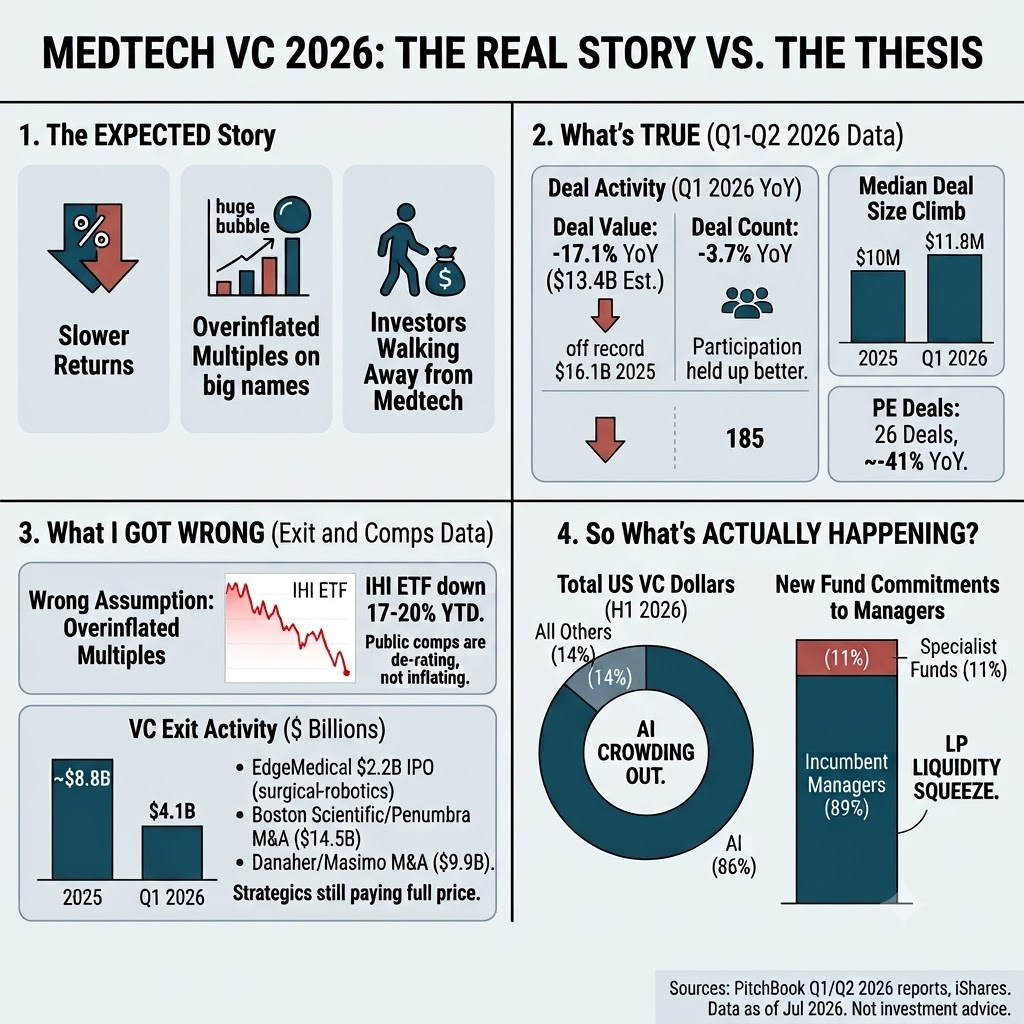
  • MedTech VC 2026: The Real Story vs. The Thesis

    MedTech VC 2026: The Real Story vs. The Thesis

    One thing I love about investing is that the best research often disproves your own assumptions.

    I kept hearing “medtech VC is in decline,” so I decided to dig into the data myself. I expected shrinking investor interest, inflated valuations, and a weak exit environment.

    Instead, I found a more nuanced story.

    What’s true:

    → Medtech VC deal value fell 17.1% YoY in Q1 2026, but off a record $16.1B in 2025.

    → Deal count fell only 3.7% YoY. Participation held up far better than dollars.

    → Median deal size climbed to $11.8M (from 2025’s already-record $10M). The money isn’t leaving, rather concentrating into fewer, larger checks.

    → Medtech PE deal count dropped ~41% YoY to 26 deals in Q1.

    What I got wrong:

    I assumed overinflated multiples were scaring VCs off. The opposite is true. IHI (iShares US Medical Devices ETF) is down 17–20% YTD, trading at a compressed multiple vs. its 2021 peak. Public medtech comps are de-rating, not inflating. If rich multiples were the brake, we wouldn’t be seeing this.

    I also missed the exit data. Medtech VC exits hit $4.1B in Q1 2026 alone, and nearly half of all of 2025, anchored by EdgeMedical’s $2.2B surgical-robotics IPO. Strategics are still paying full price for differentiated assets: Boston Scientific/Penumbra ($14.5B), Danaher/Masimo ($9.9B). Not a sector investors have given up on.

    So what’s actually happening?

    Medtech isn’t necessarily being rejected, but instead, being crowded out. AI absorbed 86% of all US VC dollars in H1 2026. And with LPs still starved for distributions, 89% of new fund commitments this year went to seasoned, incumbent managers. A tough backdrop for the smaller, specialist funds that anchor early-stage medtech.

    I’m living a version of this firsthand. My own company is raising a pre-seed round right now, and the pattern shows up everywhere in conversations with investors: the ones still writing early-stage medtech checks are stretched thin, and a lot of the specialist funds that used to anchor rounds like ours simply aren’t raising new funds of their own. A medtech-focused fund manager put it well at a recent industry conference: with early-stage medtech funds in short supply, it’s become a buyer’s market for the VCs still active at seed and Series A. That tracks with what I’m seeing. The investors still in the game aren’t necessarily writing bigger checks because they love the sector more, they’re writing bigger checks because there are fewer of them left standing, and they can afford to be more selective about who they back.

    There’s a second piece to this I initially missed too: strategics aren’t sitting on the sidelines waiting for VCs to de-risk deals for them anymore. Corporate venture arms like Medtronic Ventures, J&J’s JJDC, and Philips Ventures have all stepped up their early-stage activity, effectively filling part of the gap left by pulled-back generalist and specialist funds. That’s a meaningfully different capital structure than five years ago: less spray-and-pray from generalist funds chasing the next big multiple, more concentrated conviction from investors, traditional and corporate alike, who actually understand the regulatory and clinical path a device has to walk.

    The real picture coming out of the clouds isn’t “medtech VC is dying.” It’s capital discipline colliding with an AI supercycle and an LP liquidity squeeze, while the exit window is quietly reopening underneath the headlines.

    For founders building in this space right now, the takeaway is less “the money is gone” and more “the money got pickier.” Clinical validation, a clear regulatory pathway, and evidence of real hospital demand aren’t optional anymore. They’re the price of entry to get in front of the smaller pool of investors who are still writing checks.

    I’m pretty curious how others read this: is medtech’s Q1 pullback a temporary AI crowding-out effect, or the start of a more structural re-rating?

    Photo: drogatnev, Getty Images

    Jordan Lisnow

    Jordan Lisnow is COO and co-founder of CuffWay, a medtech startup building the first automated, adaptive cuff pressure controller for intubated patients. He is a three-time founder with two prior exits, and previously worked in venture capital at Traverse Ventures evaluating early-stage teams across AI, fintech, SaaS, and frontier tech.

    This post appears through the MedCity Influencers program. Anyone can publish their perspective on business and innovation in healthcare on MedCity News through MedCity Influencers. Click here to find out how.