Category: Health Tech

  • STAT+: Why this startup is taking its AI to predict breast cancer risk directly to patients

    STAT+: Why this startup is taking its AI to predict breast cancer risk directly to patients

    Waiting on doctors and insurers to get on board would have taken too long, Clairity says

    Adobe

    Katie covers the impact of health technology on patients, clinicians, and businesses. Her stories explore the price tag of clinical AI, digital health at the FDA, and the boom in direct-to-consumer telehealth. Confidential tips can be sent on Signal at palmer.01.

    You’re reading Part 5 of Paying for AI, a series examining how new clinical artificial intelligence tools influence the affordability of health care and patients’ long-term health. Here’s Part 1, Part 2, Part 3, and Part 4.

    “Don’t wait. Choose to be informed.” 

    That’s the call to action that patients will find on the site for digital health company Everlywell, which has offered at-home lab tests directly to consumers for a decade. But last week, it wasn’t marketing a prick to measure blood glucose or screen for celiac disease: It was launching one of a new generation of AI-based risk prediction algorithms for medical images. 

    STAT+ Exclusive Story

    Already have an account? Log in

    STAT+

    STAT+

    This article is exclusive to STAT+ subscribers

    Unlock this article — and get additional analysis of the technologies disrupting health care — by subscribing to STAT+.

    Already have an account? Log in

    View All Plans

    To read the rest of this story subscribe to STAT+.

    Subscribe

    1. Health Tech Correspondent

      Katie covers the impact of health technology on patients, clinicians, and businesses. Her stories explore the price tag of clinical AI, digital health at the FDA, and the boom in direct-to-consumer telehealth. Confidential tips can be sent on Signal at palmer.01.

  • Trilliant Health: Misaligned Incentives Are Undermining US Healthcare

    Trilliant Health: Misaligned Incentives Are Undermining US Healthcare

    The U.S. healthcare system is facing a tragedy of the commons, in which each stakeholder is incentivized to act in their own self-interest. That is the focus of Trilliant Health’s report released on Tuesday.

    Trilliant Health is a healthcare analytics and market research firm. The report examines six trends drawn from Trilliant’s claims database, price transparency data and government and industry sources.

    “The six different trends that we cover all really tie into the tragedy of the commons, which ultimately is this idea that incentives reward individual actors for their behavior that the collective cannot sustain, and this is just something that we see throughout our healthcare system,” said Trilliant Health’s Chief Research Officer Allison Oakes. “Unfortunately, everyone in the healthcare system is really incentivized to be managing and sort of optimizing for their own revenue and profits, and no one is entirely responsible for actually improving health.”

    The six trends include:

    1. The healthcare system isn’t functioning as a system: About 70% of Americans believe the healthcare system has major problems or is in a state of crisis, and healthcare costs are continuing to rise. Employee deductibles and premiums are increasing faster than wages and inflation.

    “Americans are more concerned about affording healthcare than they are about gas, housing, utilities, and groceries. … I think this affordability issue is really starting to hit a breaking point,” Oakes said.

    2. Population unwellness is a systemic failure: The U.S. population is increasingly becoming unwell due to poor diet, physical inactivity and social isolation. However, healthcare incentives continue to prioritize sick care over prevention.

    Pediatric behavioral health visits for pervasive developmental and anxiety disorders increased substantially from 2019 to 2025. In 2025, 6.4% of children were taking five or more medications, and more than 10% of patients in 11 states received opioid prescriptions from three or more providers. 

    3. Disconnect between demand and supply: Behavioral health and primary care physician supply is lacking. By 2038, the overall physician supply is projected to meet just 87.7% of demand, with adult psychiatrists and primary care physicians facing the largest shortages at 49.8% and 80.4% adequacy, respectively.

    In addition, advanced imaging and behavioral health visits grew faster than primary care from 2019 to 2025, while consumers increasingly turned to self-testing and other nontraditional approaches to meet their health needs.

    4. Value is not incentivized, nor measured or managed: CMS uses more than 800 active quality measures, but only 27% are tied to outcomes. In addition, hospital negotiated rates show little correlation with quality, with higher prices not necessarily associated with lower 30-day mortality rates, the report found.

    5. Fraud, waste and abuse: Misaligned incentives are contributing to fraud, waste and abuse, the report shows. From 2019 to 2024, the number of for-profit hospices rose 11.2%, and nonprofit hospices fell 2%. In addition, for-profit hospices saw a 13.7% Medicare margin in 2023, versus -1.3% for nonprofits.

    6. Negative-sum game: New medications are challenging the U.S. healthcare system’s traditional reliance on higher patient and procedure volumes to drive revenue. 

    The growing use of drugs such as GLP-1s and SGLT2 inhibitors has coincided with declines in certain procedures, suggesting that medications could increasingly replace or reduce demand for costly interventions.

    Photo: champc, Getty Images

  • Teladoc Health Adds Contactless Vitals and Ambient AI Scribe to Virtual Visit Platform

    Teladoc Health Adds Contactless Vitals and Ambient AI Scribe to Virtual Visit Platform

    telehealth telemedicine

    Teladoc Health announced Wednesday that it is launching two new AI-powered capabilities built into its Solo smart care platform for hospitals and health systems to be used during virtual visits. 

    SoloVitals, which captures patients’ heart rate and respiratory rate using only the camera on their device, will be available for private preview with select customers, with wider availability expected in December. The New York-based telemedicine company did not identify those customers. SoloScribe, an ambient, EHR-integrated documentation tool, is now generally available.

    Both tools integrate with the already-established Solo virtual care platform, so that the more than 15,000 global customers can smoothly integrate the new capabilities without the need to add new technology, according to the company’s news release. SoloVitals and SoloScribe aim to support patient care operations and reduce technology fragmentation across health systems so that providers can keep their focus where it’s truly needed – on the patient.

    “SoloVitals addresses a common gap many hospital virtual care teams experience, where they cannot collect real-time physiologic data from patients during a virtual visit,” said Joby McKenzie, general manager of North American health systems at Teladoc Health. 

    Danny Sanchez, vice president of technology and innovation at Teladoc Health, explained how SoloVitals collects patient vital signs contactlessly. 

    “During intake for a virtual visit, the patient uses the camera on their own device to capture supported vital signs of heart rate and respiration rate,” Sanchez said. “It uses remote photoplethysmography (“rPPG”) to detect very small changes in the color of the skin caused by blood flow. This data is combined with a computer vision assessment of patients’ fine movements and is then evaluated by sophisticated algorithms to return multiple physiologic measurements.”

    Results are then available for the provider before or during the virtual visit, offering real-time physiologic data which can help to inform care decisions. Sanchez noted that patients do not need to download a separate app, and that the process is guided by on-screen prompts to facilitate a smooth user experience. 

    SoloScribe offers ambient AI documentation – that alone is not unique, but what makes SoloScribe stand out is simple: it doesn’t require hospital systems to apply new technology. It works within the Solo platform that’s already integrated into the EHR – be it Epic or Oracle Health.

    “Most ambient scribe tools on the market ask hospitals to buy, install and manage one more piece of technology,” said Sanchez. “Our clients keep telling us they want the opposite: new capabilities built into the products and workflows they already know and use.”

    This goes to the heart of one of the biggest challenges health systems face today, that McKenzie identified as “technology fragmentation.” 

    She added that “each new capability comes with another vendor, another login, another device, or another workflow. The larger opportunity of integration is to help health systems move from a collection of disconnected tools to a more unified care environment.”

    Photo credit: Sorbetto, Getty Images

  • STAT+: Why health AI pilots in Utah may be on a collision course with the FDA

    STAT+: Why health AI pilots in Utah may be on a collision course with the FDA

    You’re reading the web edition of STAT’s AI Prognosis newsletter

    STAT/Adobe

    Brittany Trang, Ph.D., covers AI in health and medicine: Does it actually work? Who benefits, or might be harmed? She writes the weekly AI Prognosis newsletter. Follow her on Threads, Mastodon, and Bluesky. You can reach Brittany on Signal at btrang.01.

    Mario covers technology in health care, including FDA regulation of artificial intelligence; how Medicare pays for health tech; the use of AI in clinical care; mental health chatbots; and consumer wearables. He’s also the co-author of the free, twice weekly STAT Health Tech newsletter. You can reach Mario on Signal at mariojoze.13.

    This is the web edition of STAT’s AI Prognosis newsletter, our guide to artificial intelligence in health care and medicine. Sign up to get it delivered in your inbox every Wednesday. 

    I have refused to read or watch “The Love Hypothesis” — I referred to it as the “Title IX movie” the other day when I forgot its name. But the clips are inescapable on my Instagram feed, and the science gaffes seem … real bad. Absolute butchering of how academia works? The impossible chemistry on the poster? Wearing miniskirts in the lab? Vortexing a test tube? *shudders*

    Once again: I firmly believe STAT would allow me to consult on science-related elements on film sets. Offers for Hollywood gigs, health tech story tips, comments: [email protected]

    STAT+ Exclusive Story

    Already have an account? Log in

    STAT+

    STAT+

    This article is exclusive to STAT+ subscribers

    Unlock this article — plus in-depth analysis, newsletters, premium events, and news alerts.

    Already have an account? Log in

    View All Plans

    To read the rest of this story subscribe to STAT+.

    Subscribe

    1. Brittany Trang, Ph.D., covers AI in health and medicine: Does it actually work? Who benefits, or might be harmed? She writes the weekly AI Prognosis newsletter. Follow her on Threads, Mastodon, and Bluesky. You can reach Brittany on Signal at btrang.01.

    2. Health Tech Correspondent

      Mario covers technology in health care, including FDA regulation of artificial intelligence; how Medicare pays for health tech; the use of AI in clinical care; mental health chatbots; and consumer wearables. He’s also the co-author of the free, twice weekly STAT Health Tech newsletter. You can reach Mario on Signal at mariojoze.13.

  • Cybersecurity Experts to Hospital Leaders: Think Beyond Traditional Disaster-Recovery Planning

    Cybersecurity Experts to Hospital Leaders: Think Beyond Traditional Disaster-Recovery Planning


    As healthcare organizations increasingly lean on connected technology, hospital leaders need to think beyond traditional disaster-recovery planning and prepare for prolonged technology outages. That was the message of cybersecurity experts who met last week to discuss today’s most pressing threats to healthcare data and infrastructure at a healthcare summit hosted by Rubrik.

    Rubrik is a cybersecurity and data management company based in Palo Alto, California.

    The timing of this conversation is notable. Last month, senators reintroduced the Health Infrastructure Security and Accountability Act, which applies baseline minimum cybersecurity requirements for healthcare organizations, along with $1.3 billion to help hospitals bolster their defenses. In August, a cyberattack on Boston Scientific disrupted manufacturing and supply chains, highlighting how attacks can have far-reaching impacts on healthcare operations. 

    Throughout the summit, experts echoed the same concern: AI-driven cybersecurity attacks pose a new level of risk for hospitals and health systems. These supercharged attacks could disrupt clinical operations for weeks, potentially leaving patients waiting for care. 

    Nicole Perlroth, bestselling author and host of the To Catch a Thief podcast, expounded on her concerns regarding AI cyberattacks. 

    “What we can really expect is that any vulnerability or any misconfiguration or any human error that you have in managing your security estate will be discovered at machine speed and exploited at machine speed,” she said.

    John Riggi, national adviser for cybersecurity and risk at the American Hospital Association, added to the gloomy picture, calling cyberattacks on healthcare organizations a “threat to life”. He called out how these attacks can disrupt operations in every step of the healthcare delivery workflow, to the point that patient care is badly delayed – which could be life-threatening.

    When technology fails due to some design failure because it wasn’t designed securely, “but which the bad guys have exploited or found today at machine speed — when those systems go down, there is an immediate disruption and delay to healthcare delivery,” Riggi warned.

    Cybersecurity threats are also manifold in that they can come from a variety of sources: they could emanate from foreign actors in Russia, China, North Korea, and Iran who want to target healthcare entities, particularly now that AI tools offer less-sophisticated attackers the opportunity to launch significant operations. 

    Speakers suggested interventions to bolster cybersecurity within healthcare systems. They emphasized that hospitals must be prepared to operate without IT for prolonged periods of 30 days or more, and encouraged regular testing of downtime and continuity plans, as well as strengthening backup systems. 

    However, this heightened era of threats could also have a positive outcome in the future of healthcare cybersecurity.

    “Long term, I hope that we basically get to a place we’ve never been before,” Perlroth said. “That this forces us to do the things we have talked about to death over the past few years in terms of secure-by-design, formal methods, patching, backups, real time backups, backup intelligence, et cetera.”

    Photo: Traitov, Getty Images

  • STAT+: FDA spells out 2027 AI guidance plans

    STAT+: FDA spells out 2027 AI guidance plans

    You’re reading the web edition of STAT’s Health Tech newsletter

    Stock photo of The FDA logo displayed on the screen of a smartphone with blue and black background
    Adobe

    Mario covers technology in health care, including FDA regulation of artificial intelligence; how Medicare pays for health tech; the use of AI in clinical care; mental health chatbots; and consumer wearables. He’s also the co-author of the free, twice weekly STAT Health Tech newsletter. You can reach Mario on Signal at mariojoze.13.

    You’re reading the web edition of STAT’s Health Tech newsletter, our guide to how technology is transforming the life sciences. Sign up to get it delivered in your inbox every Tuesday and Thursday.

    Good morning health tech readers!

    Just one week until the STAT Summit in Boston. I’ll be on stage. If you are interested in coming but are on the fence, give me a shout.

    STAT+ Exclusive Story

    Already have an account? Log in

    STAT+

    STAT+

    This article is exclusive to STAT+ subscribers

    Unlock this article — plus in-depth analysis, newsletters, premium events, and news alerts.

    Already have an account? Log in

    View All Plans

    To read the rest of this story subscribe to STAT+.

    Subscribe

    1. Health Tech Correspondent

      Mario covers technology in health care, including FDA regulation of artificial intelligence; how Medicare pays for health tech; the use of AI in clinical care; mental health chatbots; and consumer wearables. He’s also the co-author of the free, twice weekly STAT Health Tech newsletter. You can reach Mario on Signal at mariojoze.13.

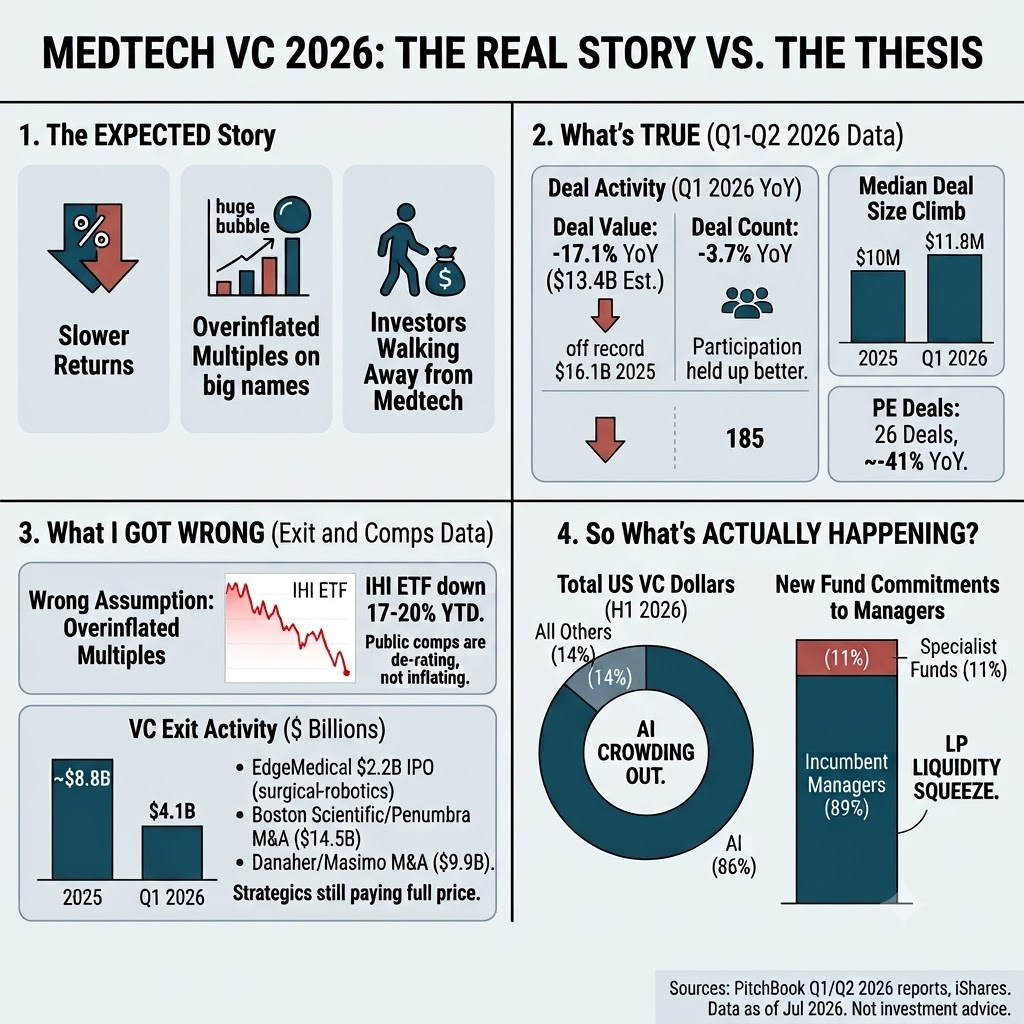
  • MedTech VC 2026: The Real Story vs. The Thesis

    MedTech VC 2026: The Real Story vs. The Thesis

    One thing I love about investing is that the best research often disproves your own assumptions.

    I kept hearing “medtech VC is in decline,” so I decided to dig into the data myself. I expected shrinking investor interest, inflated valuations, and a weak exit environment.

    Instead, I found a more nuanced story.

    What’s true:

    → Medtech VC deal value fell 17.1% YoY in Q1 2026, but off a record $16.1B in 2025.

    → Deal count fell only 3.7% YoY. Participation held up far better than dollars.

    → Median deal size climbed to $11.8M (from 2025’s already-record $10M). The money isn’t leaving, rather concentrating into fewer, larger checks.

    → Medtech PE deal count dropped ~41% YoY to 26 deals in Q1.

    What I got wrong:

    I assumed overinflated multiples were scaring VCs off. The opposite is true. IHI (iShares US Medical Devices ETF) is down 17–20% YTD, trading at a compressed multiple vs. its 2021 peak. Public medtech comps are de-rating, not inflating. If rich multiples were the brake, we wouldn’t be seeing this.

    I also missed the exit data. Medtech VC exits hit $4.1B in Q1 2026 alone, and nearly half of all of 2025, anchored by EdgeMedical’s $2.2B surgical-robotics IPO. Strategics are still paying full price for differentiated assets: Boston Scientific/Penumbra ($14.5B), Danaher/Masimo ($9.9B). Not a sector investors have given up on.

    So what’s actually happening?

    Medtech isn’t necessarily being rejected, but instead, being crowded out. AI absorbed 86% of all US VC dollars in H1 2026. And with LPs still starved for distributions, 89% of new fund commitments this year went to seasoned, incumbent managers. A tough backdrop for the smaller, specialist funds that anchor early-stage medtech.

    I’m living a version of this firsthand. My own company is raising a pre-seed round right now, and the pattern shows up everywhere in conversations with investors: the ones still writing early-stage medtech checks are stretched thin, and a lot of the specialist funds that used to anchor rounds like ours simply aren’t raising new funds of their own. A medtech-focused fund manager put it well at a recent industry conference: with early-stage medtech funds in short supply, it’s become a buyer’s market for the VCs still active at seed and Series A. That tracks with what I’m seeing. The investors still in the game aren’t necessarily writing bigger checks because they love the sector more, they’re writing bigger checks because there are fewer of them left standing, and they can afford to be more selective about who they back.

    There’s a second piece to this I initially missed too: strategics aren’t sitting on the sidelines waiting for VCs to de-risk deals for them anymore. Corporate venture arms like Medtronic Ventures, J&J’s JJDC, and Philips Ventures have all stepped up their early-stage activity, effectively filling part of the gap left by pulled-back generalist and specialist funds. That’s a meaningfully different capital structure than five years ago: less spray-and-pray from generalist funds chasing the next big multiple, more concentrated conviction from investors, traditional and corporate alike, who actually understand the regulatory and clinical path a device has to walk.

    The real picture coming out of the clouds isn’t “medtech VC is dying.” It’s capital discipline colliding with an AI supercycle and an LP liquidity squeeze, while the exit window is quietly reopening underneath the headlines.

    For founders building in this space right now, the takeaway is less “the money is gone” and more “the money got pickier.” Clinical validation, a clear regulatory pathway, and evidence of real hospital demand aren’t optional anymore. They’re the price of entry to get in front of the smaller pool of investors who are still writing checks.

    I’m pretty curious how others read this: is medtech’s Q1 pullback a temporary AI crowding-out effect, or the start of a more structural re-rating?

    Photo: drogatnev, Getty Images

    Jordan Lisnow

    Jordan Lisnow is COO and co-founder of CuffWay, a medtech startup building the first automated, adaptive cuff pressure controller for intubated patients. He is a three-time founder with two prior exits, and previously worked in venture capital at Traverse Ventures evaluating early-stage teams across AI, fintech, SaaS, and frontier tech.

    This post appears through the MedCity Influencers program. Anyone can publish their perspective on business and innovation in healthcare on MedCity News through MedCity Influencers. Click here to find out how.

  • Hidden Risks and Costs of Maternal/Infant Health that Health Plans Miss

    Hidden Risks and Costs of Maternal/Infant Health that Health Plans Miss

    baby fertility pregnancy

    Pregnancy and neonatal care are complex healthcare journeys requiring specialized insight to address and navigate the unique challenges involved. From clinical risks to social and non-clinical drivers of health, member engagement to the potential for overbilling, the need to control costs and improve outcomes has never been greater.

    Access to reliable transportation can be an overlooked but critical barrier to maternal care. A missed prenatal visit can lead to complications that send the mother into labor well ahead of the due date, leading to a prolonged NICU stay. A long NICU stay can generate high medical costs, not to mention the stress on families potentially facing substantial medical expenses, the future health of the mother and child, and billing complexities. ProgenyHealth sees the bigger picture and understands how to work with health plans to manage these risks.

    A new report from ProgenyHealth offers a window into how the business works with commercial and Medicaid health plans to close gaps in maternity and NICU care management that traditional programs overlook. Health plans benefit from the company’s experience and insight to address these challenges. 

    The process involves turning information gathered from extensive claims and clinical data, as well as case management interactions, into timely interventions that enhance the member experience, improve outcomes and manage costs. To download the white paper Beneath the Surface: The Hidden Risks and Costs Commercial and Medicaid plans Are Missing, fill in the form below:

    Photo: Morten Falch Sortland, Getty Images

  • Opinion: I’m a doctor. Here’s what I want the public to know about AI tools and health care costs

    Opinion: I’m a doctor. Here’s what I want the public to know about AI tools and health care costs

    When Blue Cross Blue Shield recently published research suggesting that hospitals use artificial intelligence tools to extract more money from insurers without providing additional care, people were mad. Amid growing concerns about AI, one glimmer of hope has been its potential to improve health — and yet, here it was: inflating health care costs without yielding any benefits.

    As a doctor who has used the kinds of tools being criticized, I’m frustrated, too: We can document honestly and still wind up inflating hospital bills. This is because comorbidities function as an on-off switch with respect to billing, even though they affect patient care in nuanced ways.

    Although the problem warrants a systemic fix, the best short-term solution is for hospitals to create more nuanced documentation tools, and for clinicians to exercise judgment when using them.

    What did the research show?

    BCBS suggested hospitals are using automated tools to document secondary diagnoses — like anemia, malnutrition, and low sodium — which allow them to charge more for caring for these patients.

    For instance, a patient might be admitted for diverticulitis (primary diagnosis), but found on post-op labs to have acute blood-loss anemia (secondary diagnosis). Hospitals can use these secondary diagnoses to label a patient as having a comorbidity or a complication, allowing them to bill more for the hospitalization, whether or not they treated the patient’s anemia. These “bump codes” have cost BCBS hundreds of millions of dollars over the past two years, and these costs are presumably passed along to patients in the form of higher premiums.

    BCBS claims that bump coding has become more widespread because hospitals are using AI tools to identify secondary diagnoses. Automated tools can skim a patient’s chart and prompt physicians to document that the patient is, for instance, anemic, and what they are doing about it.

    Are doctors to blame?

    A few weeks after I started medical residency, I began getting emails from hospital administrators I had never met, whose signatures said they were risk adjustment specialists. The emails were generic and polite, advising me to review clinical documentation integrity (CDI) queries on inpatients I was caring for. If I didn’t respond quickly, the request would be forwarded to the attending physician supervising me. A typical CDI query would point out that my note hadn’t commented on, say, a patient’s low sodium level, and would ask me to document that they had low sodium and what (if anything) we were doing about it.

    Like most residents, I was already spending far more time on my computer than I was with my patients. Soon, CDI queries streamed into my inbox with such regularity that I turned to a more senior doctor to ask how I might stave them off. That doctor showed me an automated tool that I could include in my notes. This tool would assess a patient’s lab results, automatically detect any additional diagnoses a patient had (like anemia, malnutrition, or low sodium), and prompt me to specify whether we were monitoring, evaluating, or treating.

    I assumed it was lucrative to the hospital for me to document these diagnoses (why else would they be paying risk adjustment specialists to email me about them?), but we almost always were at least monitoring the secondary diagnosis in question, and I accurately documented as much.

    Including this tool’s outputs in my notes kept the risk adjustment specialists from hounding me and won me back several minutes of each day — enough time to poke my head into a patient’s room before I went home, or call a patient’s family member to give a quick update. I always answered the questions included in my tool honestly, but in the back of my mind, I wondered whether I was doing my patients a disservice: Was I inflating the cost of their hospitalizations without actually improving their care?

    Where bump codes come from

    In general, hospitals are reimbursed for hospitalizing patients on the basis of diagnosis-related groups, or DRGs. DRG payments are set by the Centers for Medicare and Medicaid Services by analyzing claims data. (Medicare uses DRGs to set payments, while many commercial insurers, including BCBS, use the DRG system to negotiate reimbursement rates with hospitals.) Let’s say a patient is admitted with diverticulitis requiring surgery (typically billed as DRG 331 if there are no complications). CMS has estimated how much it usually costs to care for one of these patients and insurers prospectively pay hospitals on that basis; a hospital generally won’t get reimbursed more for keeping the patient longer, administering more drugs, placing more IVs, and so on.

    However, some hospitals care for sicker patients than others. The typical diverticulitis patient at a tertiary medical center in a poor area will require more support than a diverticulitis patient at a community hospital in an affluent area. The government does not want to penalize hospitals that see more complex patients, and so it allows hospitals to seek additional reimbursement forcomorbidities or complications that increase the cost of their care.

    This is where bump codes come from: Hospitals can bill more complex diverticulitis admissions as DRG 330, which is reimbursed at a higher rate. Not all comorbidities or complications count: In 2007, the last time DRGs were substantially changed, CMS analyzed claims data and used this analysis to decide which conditions qualify and set reimbursement rates. CMS pays hospitals more for patients with conditions like low sodium because it has found that it costs hospitals more to care for these patients (perhaps because they tend to be hospitalized longer and more often require ICU admissions).

    However, although CMS adjusts DRG payments from year to year, the list of bump codes hasn’t been overhauled in nearly two decades.

    Bump codes can help identify complex patients and ensure hospitals are paid more for caring for them. These are good things, in part because they reduce hospitals’ incentive to seek out healthier, more advantaged patients. While BCBS claims that hospitals are increasingly using these codes to bill more without actually providing more care, hospitals would presumably counter that they were being insufficiently reimbursed before, and that their coding is accurate. After all, the BCBS study does not claim that hospitals are engaging in fraud; the question is just whether the lab abnormalities hospitals are billing for warrant higher reimbursements.

    So who’s right?

    This issue boils down to the following question: How much more does it cost to care for a patient with a secondary condition, and do current coding rules accurately reflect this?

    The answer is that it depends. For instance, not all low sodium levels are created equal. If a patient briefly has a sodium level that falls below the normal range, but their sodium immediately corrects once they’re able to eat again, they probably don’t require any additional resources, and hospitals shouldn’t be reimbursed more for caring for them.

    By contrast, a patient with dangerously low sodium levels requiring an ICU stay, frequent lab checks, and carefully titrated IV fluids undoubtedly does use more resources.

    This leaves doctors in a tough spot: Risk adjustment specialists ask us to document real diagnoses that we know could increase the cost of a patient’s bill, but we have no idea by how much. Moreover, there’s no medical school module on how much any of these comorbidities affects the true cost of the hospitalization. Against this backdrop, it makes sense that doctors try to just tell the truth: yes, this patient has low sodium, and we are monitoring it, even though this probably allows hospitals to code some patients as being more resource-intensive than they truly are.

    What we can agree on

    This entire enterprise — risk adjustment specialists spamming doctors, who are already nose-deep in documentation burden, to document diagnoses that often do not affect patient care, while insurers publish reports that fail to capture the nuance of the issue, leaving the public angry and confused — highlights a more general problem with respect to how the U.S. health care system works.

    By design, hospitals and insurers are meant to compete with each other, with hospitals trying to collect as much money as they can for providing care, and insurers trying to pay as little as possible. Hospitals bolster their side by hiring risk adjustment specialists and employing AI tools, while health insurers hire payment integrity specialists and employ different AI tools.

    Patients lose out because the administrative bloat inflates the cost of medical care, while making costs less transparent and harder to contest. Ultimately, the fix should be structural: At a minimum, we need to overhaul the list of secondary conditions that are eligible for bump coding. CMS attempted to do this in 2019, when it proposed downgrading or eliminating many bump codes based on new data showing they were not associated with increased costs. But hospitals pushed back, and the effort eventually stalled.

    What should we do in the meantime?

    Secondary diagnoses are supposed to be billed only when they are clinically significant — for instance, when they require further evaluation, treatment, diagnostic procedures, or monitoring. But in practice, the bar for clinical significance is probably lower than it should be. (Even rechecking a lab may qualify as monitoring.) Accordingly, I suspect the BCBS study is tracking a real problem, and that much of the documentation of secondary diagnoses isn’t linked to patient complexity.

    Early in residency, I was caring for an immunosuppressed patient who kept spiking fevers. My colleagues and I wondered whether he might have an indolent infection lurking somewhere and ordered an echocardiogram to rule out endocarditis. His heart valves showed no signs of bacterial growth, but trace backflow was detected across one of his valves, a finding present in most people.

    Soon, I received a CDI query inviting me to document his valve dysfunction in my note. I did not do this, because his incidental valve finding was irrelevant to his hospitalization. Instead, I typed out a response indicating as much. However, it would have been easier and quicker to click through the check boxes, and, despite answering them honestly, potentially inflate the patient’s bill.

    At least some CDI tools built into electronic medical records — including the one I have used — default to including secondary diagnoses in ways that are likely to lead to bump coding. One way to improve the status quo would be to ensure that such tools give physicians the option to document whether a secondary diagnosis is clinically significant or not, rather than simply asking them how they are addressing it (on the presumption that it is clinically significant).

    Hospitals should build such tools, and regulators should ensure they do. In the meantime, I’ll exercise clinical judgment when using my CDI tool — if the low sodium seems important, I’ll document it, and if it doesn’t, I’ll politely decline when a risk adjustment specialist invariably asks me to.

    Leah Pierson is a resident physician.

  • Investing in Community Health: A New Model for Safety-Net Healthcare Innovation

    Investing in Community Health: A New Model for Safety-Net Healthcare Innovation

    Community health centers (CHCs) are one of healthcare’s most important yet overlooked care delivery establishments. Despite being a crucial link to healthcare for the communities they serve, CHCs are often asked to adopt new health technology after the fact, rather than being invited to help to shape it. 

    The launch of Facktor Ventures last week is an effort to change that dynamic.

    As a new early-stage venture fund focused on technology and services for CHCs and the broader healthcare safety net, Facktor Ventures is taking a new approach to healthcare investing: it’s structured so that the organizations delivering care on the ground collectively become majority owners of the fund as limited partners. 

    This makes them a different kind of an investment organization compared with traditional venture capital firms that have deep-pocketed entities as their limited partners.

    This distinct model gives participating organizations a mechanism to help influence investment decisions and then potentially earn returns that could be re-invested in their missions – something which can be difficult for CHCs to do given their financial constraints and competing demands on limited resources. 

    “We built Facktor Ventures so health centers and other safety-net organizations can collectively hold majority ownership as limited partners,” said Michael Ceballos, partner at Facktor Ventures, and senior director at Facktor in an interview. “That connects capital with the experience of the organizations closest to patients, giving them an opportunity to inform innovation and share in its financial success.”

    Facktor Ventures is the venture arm of Los Angeles-based Facktor, a healthcare consulting firm that works directly with more than 360 health centers to advance community-based care. Facktor Ventures plans to invest primarily at the Seed and Series A stages for companies that create healthcare software, digital health, and other healthcare services to support safety-net care. The fund’s areas of investment include patient access, revenue cycle performance, care management, workforce capacity, and cybersecurity. Ceballos declined to provide the size of the fund.

    Community health centers are nonprofit organizations that offer affordable, high-quality primary care to people living in areas where that care is difficult to access. CHCs serve 33 million Americans, and a total of 90% of their patients live at or below 200% of the federal poverty level, with many either uninsured or covered by Medicare or Medicaid. 

    These safety-net organizations face distinct needs and challenges, and more common investment strategies may overlook these realities, resulting in products and services that are poorly aligned with their needs or difficult to scale. CHCs bring firsthand knowledge of their patients’ needs and operational workflows, helping to clarify investment decisions. In this context, the investments made by the new fund could potentially have a significant impact.

    Ceballos explained in an interview why he believes this setup carries potential for CHCs to expand their missions.

    “What makes this idea so consequential is the combination of scale and ownership. Community health centers collectively form the nation’s largest primary care network, caring for millions of Americans, many with low incomes and limited options for care. When those organizations help shape innovation and have a stake in its success, the potential reaches far beyond any individual investment. We want the people closest to patients to help build the future of healthcare and the value created to help sustain their mission.”

    Rather than focusing on CHCs simply adopting technology built by others, the venture aims to drive innovation that prioritizes their most pressing needs, from reducing staff burden to improving patient access and addressing the realities of budget and insurance constraints.

    “We want safety-net patients and the organizations caring for them to influence innovation from the beginning,” Ceballos said. “The ambition is big: help the community health movement become an owner and architect of its future, with a voice in the innovation it helps make successful and an opportunity to share in the value created.”

    The idea is to change the role of community health centers in healthcare innovation. Instead of waiting for startups to build products and then deciding whether to adopt them, CHCs could help shape those products and services from the start. Facktor Ventures is putting safety-net organizations closer to the source of the capital, with hopes of producing technology that works better for the people and providers who need it most.