Category: Daily

  • Teladoc Health Adds Contactless Vitals and Ambient AI Scribe to Virtual Visit Platform

    Teladoc Health Adds Contactless Vitals and Ambient AI Scribe to Virtual Visit Platform

    telehealth telemedicine

    Teladoc Health announced Wednesday that it is launching two new AI-powered capabilities built into its Solo smart care platform for hospitals and health systems to be used during virtual visits. 

    SoloVitals, which captures patients’ heart rate and respiratory rate using only the camera on their device, will be available for private preview with select customers, with wider availability expected in December. The New York-based telemedicine company did not identify those customers. SoloScribe, an ambient, EHR-integrated documentation tool, is now generally available.

    Both tools integrate with the already-established Solo virtual care platform, so that the more than 15,000 global customers can smoothly integrate the new capabilities without the need to add new technology, according to the company’s news release. SoloVitals and SoloScribe aim to support patient care operations and reduce technology fragmentation across health systems so that providers can keep their focus where it’s truly needed – on the patient.

    “SoloVitals addresses a common gap many hospital virtual care teams experience, where they cannot collect real-time physiologic data from patients during a virtual visit,” said Joby McKenzie, general manager of North American health systems at Teladoc Health. 

    Danny Sanchez, vice president of technology and innovation at Teladoc Health, explained how SoloVitals collects patient vital signs contactlessly. 

    “During intake for a virtual visit, the patient uses the camera on their own device to capture supported vital signs of heart rate and respiration rate,” Sanchez said. “It uses remote photoplethysmography (“rPPG”) to detect very small changes in the color of the skin caused by blood flow. This data is combined with a computer vision assessment of patients’ fine movements and is then evaluated by sophisticated algorithms to return multiple physiologic measurements.”

    Results are then available for the provider before or during the virtual visit, offering real-time physiologic data which can help to inform care decisions. Sanchez noted that patients do not need to download a separate app, and that the process is guided by on-screen prompts to facilitate a smooth user experience. 

    SoloScribe offers ambient AI documentation – that alone is not unique, but what makes SoloScribe stand out is simple: it doesn’t require hospital systems to apply new technology. It works within the Solo platform that’s already integrated into the EHR – be it Epic or Oracle Health.

    “Most ambient scribe tools on the market ask hospitals to buy, install and manage one more piece of technology,” said Sanchez. “Our clients keep telling us they want the opposite: new capabilities built into the products and workflows they already know and use.”

    This goes to the heart of one of the biggest challenges health systems face today, that McKenzie identified as “technology fragmentation.” 

    She added that “each new capability comes with another vendor, another login, another device, or another workflow. The larger opportunity of integration is to help health systems move from a collection of disconnected tools to a more unified care environment.”

    Photo credit: Sorbetto, Getty Images

  • Constant Vigilance is the Watchword for Healthcare AI Governance 

    Constant Vigilance is the Watchword for Healthcare AI Governance 

    A webinar moderated by MedCity News Editor-in-Chief Arundhati Parmar delved into findings of the recently published Healthcare AI Readiness Index. Panelists discussed how best to balance AI adoption, governance, how to scale AI at healthcare institutions and best practices for doing so. Sponsored by Cotiviti, the webinar included perspectives from Cotiviti CIO Sean Warren and Thomasina Anane, Associate Vice President, Enterprise Analytics, with the Alliance of Community Health Plans.

    Cotiviti turns fragmented data into actionable insights. It helps healthcare organizations reduce waste, fraud, and abuse, and works with them to simplify their operations.

    “In many ways, what we’ve become is the connective tissue that helps healthcare work more efficiently across all of the payers, providers, and other stakeholders,“ Warren said.

    Anane referenced a recent annual meeting of ACHP, which included a candid discussion on AI governance.

    “One theme that really came through clearly is that AI governance has to start well before deployment and evolve along the use case. Many of our health plans are grappling with issues like: What is my state saying about AI use? What does that look like federally and what does that look like as a health plan?….What data are actually involved? What decision is being influenced? What happens when the output is wrong?”

    The biggest challenge with AI governance in a clinical and payer setting is the need for constant vigilance, a point made by both Anane and Warren. 

    “Deployment is really not the finish line,” Warren said. “It’s constant follow-up, constant security checks, and we have a lot of human-in-the-loop and human oversight with observability. It’s ten times more important when we add AI to the mix to be able to know what that AI is doing. Do you have the guardrails around what the AI is doing in your environment? Do you have the ability to undo it? Do you have the ability to follow and trace every transaction?” 

    The webinar discussion also touched on other issues such as:

    • What should leaders assess before moving an AI use case from pilot to enterprise deployment?
    • Are traditional vendor questionnaires and point-in-time assessments still sufficient?
    • What is driving shadow AI use?
    • Important considerations for Chinese AI models and frontier AI models.
    • Why might traditional cybersecurity controls be necessary, but insufficient in the new threat environment healthcare organizations face?

    To access a recording of the webinar, fill in the form below:

    Photo: Sandwish, Getty Images

  • From Distributor to Disruptor: Amazon’s Healthcare Flex

    From Distributor to Disruptor: Amazon’s Healthcare Flex

    Could this be Big Tech’s ultimate healthcare flex? For years, Amazon’s ambitions in this $4 trillion market were focused on distribution: acquire a pharmacy here, a primary care network there, and offer convenience.

    But more recently, rather than deploying capital to expand its fulfillment engine, Amazon exercised its cloud and AI muscle to launch tools that enable it to be a “front door” for consumers and patients. From the looks of it, the e-commerce giant has shifted, from competing for a piece of the healthcare journey to collapsing the entire journey into one company.

    In any case, pharma commercialization teams may need to think about Amazon less as a new distributor and more as a disruptor of how patients, prescribers, and payers connect.

    Analyzing the moves

    Big Tech has upended many industries, but the highly regulated and complex healthcare industry has seemed impervious to their influence. Judging by Amazon’s most recent forays, however, this sector may not represent an innovator’s “white whale” for much longer.

    Amazon has closed the “last mile” between writing a prescription and filling it. At One Medical clinics (Amazon’s primary care venture), pharmacy kiosks now let a patient walk out of an appointment with medication in hand, filled by the same company that just diagnosed them. Its oral GLP-1 management program, a recently introduced offering, takes this even further. 

    This year, One Medical also launched an AI-enabled assistant, with access to test results, medical history, and more. The AI agent, dubbed Health AI, can help book medical appointments or provide medical information, such as an explanation of lab results. This clearly strengthens One Medical’s abilities as a provider and can help in enhancing the patient experience all the way through drug dispensing.

    More critically to pharma, Amazon’s Health AI also automatically applies manufacturer coupons and copay assistance programs for eligible patients. On the HCP side, Amazon’s integration with DoseSpot and eNavvi places patient net out-of-pocket at the point of prescribing.

    Health AI subsequently moved beyond the One Medical app, embedding directly into Amazon.com and its mobile app, marking the first time the tool has been available at scale to general consumers, and further enmeshing the patient experience into the overall Amazon environment. These offerings are available to anyone, regardless of being a One Medical member.

    4 potential shake-ups

    The result: Screening, prescribing, fulfillment, and ongoing renewal all happen inside one Amazon-run loop. No outside touchpoint is required.

    That loop doesn’t just change where a patient enters the system and picks up a prescription. It changes the nature of a healthcare “provider,” how care is delivered (including drug fulfillment), and who sees the full picture of a patient’s care. 

    In other words, this shift isn’t just a single disruption; it’s four separate ones. Here’s the “where” and “how” of those potential shake-ups:

    • The HCP relationship: Who manages a condition over time, not just who writes the first script?
    • Channel and patient experience: Who owns the point of fill, and how seamless is the drug-fulfillment experience?
    • Price transparency and patient OOP: How much of a role does real-world price play, for both prescribers and patients, and how do coupon and copay assistance programs need to adapt?
    • Data visibility: Does the full patient journey, from diagnosis to refill, sit outside the purview of traditional pharma data sources, or is it somehow still captured? 

    The four categories aren’t equally mature. And that has real implications for where pharma commercialization teams focus first. 

    Where pharma should focus

    The first two of the above categories are already live with the GLP-1 program. That is, ongoing management of a chronic condition now sits inside Amazon’s own clinical protocol, not a patient’s existing PCP or specialist. And prescribing, fulfillment, and refill take place in a channel pharma doesn’t traditionally call upon.

    GLP-1 is a favorable starting point for this model because it’s heavily consumer-driven and manageable in primary care, so the loop doesn’t need specialist judgment to run. And the GLP-1 cash-pay models give Amazon room to control pricing directly. Moreover, weight-loss management is a long-term, recurring relationship, which is exactly the kind of retention Amazon’s model is built for. 

    Beyond the cash market, Amazon’s ability to automatically apply coupons and copay assistance offers the opportunity for accelerated product uptake, accompanied by significant downside risks to product gross-to-net.  

    If your brand touches a condition that could be managed this way, GLP-1 isn’t a case study to read with curiosity. It’s a preview. Teams should be asking if and how this loop affects prescribing and fulfillment for their therapeutic area; that’s the immediate gap to close. 

    Conditions that depend on specialist diagnosis, complex or in-clinic administration, or those with reimbursement complexity, are a much harder fit for this model (at least for now). The therapeutic areas to watch first are protocol-friendly, primary-care-managed, chronic, and with a cash-pay market underneath.

    Payers and data

    Amazon’s impact on the payer space is at an earlier stage, but the signals are worth tracking closely. Amazon has already become the exclusive home delivery pharmacy for select PBM partners, including its own employee health plan. While that’s a narrow footprint today, whether it stays narrow or expands to further erode the traditional PBM mail-order business is the open question. Every new deal is a data point worth logging.

    Data visibility is the slowest mover of the four categories, and possibly the hardest to predict. Cash-pay markets already have data holes. Adherence and outcomes in these markets have always been harder to capture, since the transaction doesn’t run through the claims and pharmacy systems pharma is used to watching. 

    The bigger exposure is what happens if this extends into broader chronic disease management. Even losing part of a patient’s journey, say the fulfillment and refill half, is enough to break the continuity pharma relies on for adherence programs and tracking the various outcome measures of marketed treatments. 

    Other industries offer a useful, if uncomfortable, reference point. Retail went through its own version of this: Vertically integrated fulfillment that started as a convenience play eventually became infrastructure that competitors couldn’t easily match on price or speed. 

    That pattern is worth keeping in mind, not as a prediction of exactly how this plays out in life sciences, but as a reminder that the “early and narrow” phase doesn’t stay that way indefinitely.

    None of this is a call to panic. It’s a case for watching the right signals. The clearest one: which therapeutic area Amazon’s loop expands into next.

    Photo: undefined undefined, Getty Images

    Adrienne Lovink

    As CEO, Adrienne Lovink is leading Beghou’s next phase of growth and building on its reputation as a trusted commercialization partner in life sciences. She is focused on expanding into new areas of client demand; advancing the firm’s data, AI, analytics, and technology innovation; and investing in its people and culture. Adrienne has over 25 years of experience partnering with pharmaceutical and medical device companies to advance commercialization, market access, forecasting, digital health, real-world data, and advanced analytics, including as a Partner at Trinity Life Sciences and Global Head of Real-World Data and Advanced Analytics at DRG / Clarivate.

    This post appears through the MedCity Influencers program. Anyone can publish their perspective on business and innovation in healthcare on MedCity News through MedCity Influencers. Click here to find out how.

  • Cybersecurity Experts to Hospital Leaders: Think Beyond Traditional Disaster-Recovery Planning

    Cybersecurity Experts to Hospital Leaders: Think Beyond Traditional Disaster-Recovery Planning


    As healthcare organizations increasingly lean on connected technology, hospital leaders need to think beyond traditional disaster-recovery planning and prepare for prolonged technology outages. That was the message of cybersecurity experts who met last week to discuss today’s most pressing threats to healthcare data and infrastructure at a healthcare summit hosted by Rubrik.

    Rubrik is a cybersecurity and data management company based in Palo Alto, California.

    The timing of this conversation is notable. Last month, senators reintroduced the Health Infrastructure Security and Accountability Act, which applies baseline minimum cybersecurity requirements for healthcare organizations, along with $1.3 billion to help hospitals bolster their defenses. In August, a cyberattack on Boston Scientific disrupted manufacturing and supply chains, highlighting how attacks can have far-reaching impacts on healthcare operations. 

    Throughout the summit, experts echoed the same concern: AI-driven cybersecurity attacks pose a new level of risk for hospitals and health systems. These supercharged attacks could disrupt clinical operations for weeks, potentially leaving patients waiting for care. 

    Nicole Perlroth, bestselling author and host of the To Catch a Thief podcast, expounded on her concerns regarding AI cyberattacks. 

    “What we can really expect is that any vulnerability or any misconfiguration or any human error that you have in managing your security estate will be discovered at machine speed and exploited at machine speed,” she said.

    John Riggi, national adviser for cybersecurity and risk at the American Hospital Association, added to the gloomy picture, calling cyberattacks on healthcare organizations a “threat to life”. He called out how these attacks can disrupt operations in every step of the healthcare delivery workflow, to the point that patient care is badly delayed – which could be life-threatening.

    When technology fails due to some design failure because it wasn’t designed securely, “but which the bad guys have exploited or found today at machine speed — when those systems go down, there is an immediate disruption and delay to healthcare delivery,” Riggi warned.

    Cybersecurity threats are also manifold in that they can come from a variety of sources: they could emanate from foreign actors in Russia, China, North Korea, and Iran who want to target healthcare entities, particularly now that AI tools offer less-sophisticated attackers the opportunity to launch significant operations. 

    Speakers suggested interventions to bolster cybersecurity within healthcare systems. They emphasized that hospitals must be prepared to operate without IT for prolonged periods of 30 days or more, and encouraged regular testing of downtime and continuity plans, as well as strengthening backup systems. 

    However, this heightened era of threats could also have a positive outcome in the future of healthcare cybersecurity.

    “Long term, I hope that we basically get to a place we’ve never been before,” Perlroth said. “That this forces us to do the things we have talked about to death over the past few years in terms of secure-by-design, formal methods, patching, backups, real time backups, backup intelligence, et cetera.”

    Photo: Traitov, Getty Images

  • MedTech VC 2026: The Real Story vs. The Thesis

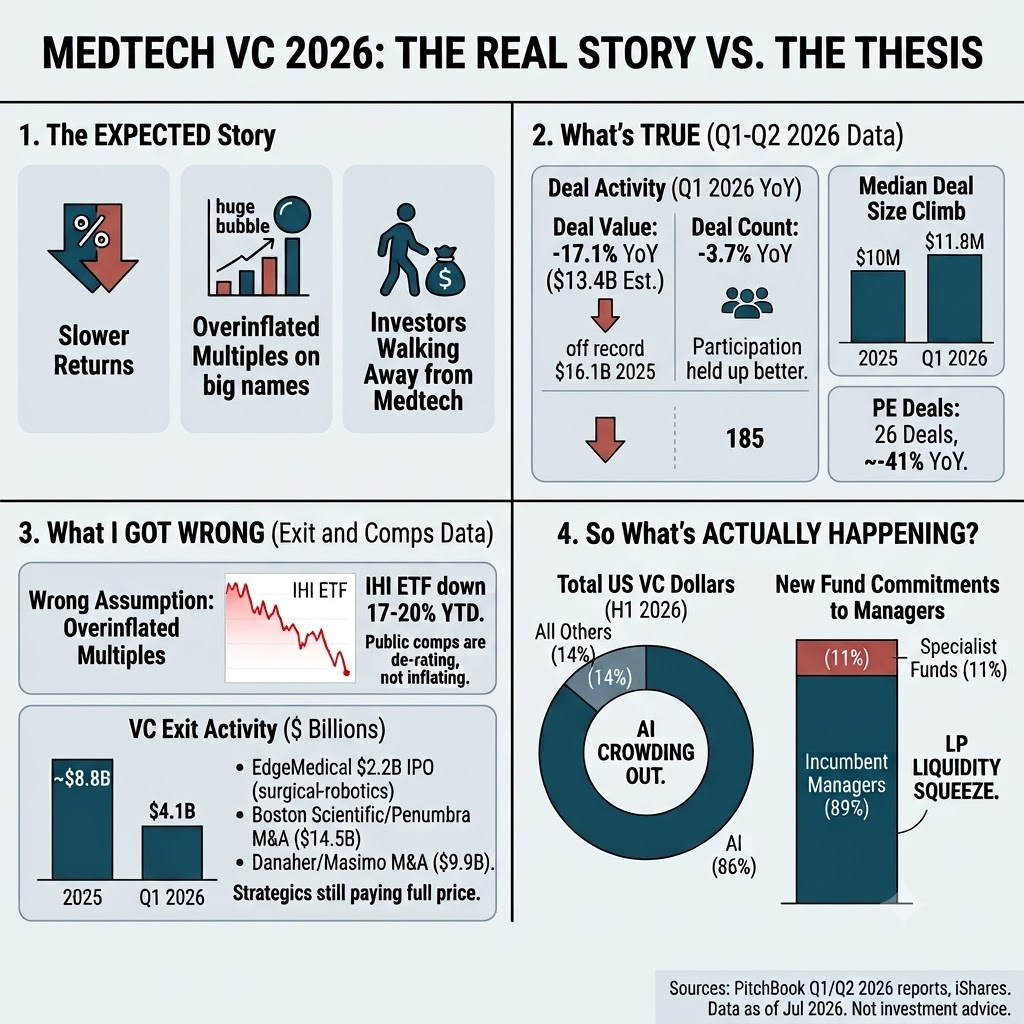
    MedTech VC 2026: The Real Story vs. The Thesis

    One thing I love about investing is that the best research often disproves your own assumptions.

    I kept hearing “medtech VC is in decline,” so I decided to dig into the data myself. I expected shrinking investor interest, inflated valuations, and a weak exit environment.

    Instead, I found a more nuanced story.

    What’s true:

    → Medtech VC deal value fell 17.1% YoY in Q1 2026, but off a record $16.1B in 2025.

    → Deal count fell only 3.7% YoY. Participation held up far better than dollars.

    → Median deal size climbed to $11.8M (from 2025’s already-record $10M). The money isn’t leaving, rather concentrating into fewer, larger checks.

    → Medtech PE deal count dropped ~41% YoY to 26 deals in Q1.

    What I got wrong:

    I assumed overinflated multiples were scaring VCs off. The opposite is true. IHI (iShares US Medical Devices ETF) is down 17–20% YTD, trading at a compressed multiple vs. its 2021 peak. Public medtech comps are de-rating, not inflating. If rich multiples were the brake, we wouldn’t be seeing this.

    I also missed the exit data. Medtech VC exits hit $4.1B in Q1 2026 alone, and nearly half of all of 2025, anchored by EdgeMedical’s $2.2B surgical-robotics IPO. Strategics are still paying full price for differentiated assets: Boston Scientific/Penumbra ($14.5B), Danaher/Masimo ($9.9B). Not a sector investors have given up on.

    So what’s actually happening?

    Medtech isn’t necessarily being rejected, but instead, being crowded out. AI absorbed 86% of all US VC dollars in H1 2026. And with LPs still starved for distributions, 89% of new fund commitments this year went to seasoned, incumbent managers. A tough backdrop for the smaller, specialist funds that anchor early-stage medtech.

    I’m living a version of this firsthand. My own company is raising a pre-seed round right now, and the pattern shows up everywhere in conversations with investors: the ones still writing early-stage medtech checks are stretched thin, and a lot of the specialist funds that used to anchor rounds like ours simply aren’t raising new funds of their own. A medtech-focused fund manager put it well at a recent industry conference: with early-stage medtech funds in short supply, it’s become a buyer’s market for the VCs still active at seed and Series A. That tracks with what I’m seeing. The investors still in the game aren’t necessarily writing bigger checks because they love the sector more, they’re writing bigger checks because there are fewer of them left standing, and they can afford to be more selective about who they back.

    There’s a second piece to this I initially missed too: strategics aren’t sitting on the sidelines waiting for VCs to de-risk deals for them anymore. Corporate venture arms like Medtronic Ventures, J&J’s JJDC, and Philips Ventures have all stepped up their early-stage activity, effectively filling part of the gap left by pulled-back generalist and specialist funds. That’s a meaningfully different capital structure than five years ago: less spray-and-pray from generalist funds chasing the next big multiple, more concentrated conviction from investors, traditional and corporate alike, who actually understand the regulatory and clinical path a device has to walk.

    The real picture coming out of the clouds isn’t “medtech VC is dying.” It’s capital discipline colliding with an AI supercycle and an LP liquidity squeeze, while the exit window is quietly reopening underneath the headlines.

    For founders building in this space right now, the takeaway is less “the money is gone” and more “the money got pickier.” Clinical validation, a clear regulatory pathway, and evidence of real hospital demand aren’t optional anymore. They’re the price of entry to get in front of the smaller pool of investors who are still writing checks.

    I’m pretty curious how others read this: is medtech’s Q1 pullback a temporary AI crowding-out effect, or the start of a more structural re-rating?

    Photo: drogatnev, Getty Images

    Jordan Lisnow

    Jordan Lisnow is COO and co-founder of CuffWay, a medtech startup building the first automated, adaptive cuff pressure controller for intubated patients. He is a three-time founder with two prior exits, and previously worked in venture capital at Traverse Ventures evaluating early-stage teams across AI, fintech, SaaS, and frontier tech.

    This post appears through the MedCity Influencers program. Anyone can publish their perspective on business and innovation in healthcare on MedCity News through MedCity Influencers. Click here to find out how.

  • Hidden Risks and Costs of Maternal/Infant Health that Health Plans Miss

    Hidden Risks and Costs of Maternal/Infant Health that Health Plans Miss

    baby fertility pregnancy

    Pregnancy and neonatal care are complex healthcare journeys requiring specialized insight to address and navigate the unique challenges involved. From clinical risks to social and non-clinical drivers of health, member engagement to the potential for overbilling, the need to control costs and improve outcomes has never been greater.

    Access to reliable transportation can be an overlooked but critical barrier to maternal care. A missed prenatal visit can lead to complications that send the mother into labor well ahead of the due date, leading to a prolonged NICU stay. A long NICU stay can generate high medical costs, not to mention the stress on families potentially facing substantial medical expenses, the future health of the mother and child, and billing complexities. ProgenyHealth sees the bigger picture and understands how to work with health plans to manage these risks.

    A new report from ProgenyHealth offers a window into how the business works with commercial and Medicaid health plans to close gaps in maternity and NICU care management that traditional programs overlook. Health plans benefit from the company’s experience and insight to address these challenges. 

    The process involves turning information gathered from extensive claims and clinical data, as well as case management interactions, into timely interventions that enhance the member experience, improve outcomes and manage costs. To download the white paper Beneath the Surface: The Hidden Risks and Costs Commercial and Medicaid plans Are Missing, fill in the form below:

    Photo: Morten Falch Sortland, Getty Images

  • Investing in Community Health: A New Model for Safety-Net Healthcare Innovation

    Investing in Community Health: A New Model for Safety-Net Healthcare Innovation

    Community health centers (CHCs) are one of healthcare’s most important yet overlooked care delivery establishments. Despite being a crucial link to healthcare for the communities they serve, CHCs are often asked to adopt new health technology after the fact, rather than being invited to help to shape it. 

    The launch of Facktor Ventures last week is an effort to change that dynamic.

    As a new early-stage venture fund focused on technology and services for CHCs and the broader healthcare safety net, Facktor Ventures is taking a new approach to healthcare investing: it’s structured so that the organizations delivering care on the ground collectively become majority owners of the fund as limited partners. 

    This makes them a different kind of an investment organization compared with traditional venture capital firms that have deep-pocketed entities as their limited partners.

    This distinct model gives participating organizations a mechanism to help influence investment decisions and then potentially earn returns that could be re-invested in their missions – something which can be difficult for CHCs to do given their financial constraints and competing demands on limited resources. 

    “We built Facktor Ventures so health centers and other safety-net organizations can collectively hold majority ownership as limited partners,” said Michael Ceballos, partner at Facktor Ventures, and senior director at Facktor in an interview. “That connects capital with the experience of the organizations closest to patients, giving them an opportunity to inform innovation and share in its financial success.”

    Facktor Ventures is the venture arm of Los Angeles-based Facktor, a healthcare consulting firm that works directly with more than 360 health centers to advance community-based care. Facktor Ventures plans to invest primarily at the Seed and Series A stages for companies that create healthcare software, digital health, and other healthcare services to support safety-net care. The fund’s areas of investment include patient access, revenue cycle performance, care management, workforce capacity, and cybersecurity. Ceballos declined to provide the size of the fund.

    Community health centers are nonprofit organizations that offer affordable, high-quality primary care to people living in areas where that care is difficult to access. CHCs serve 33 million Americans, and a total of 90% of their patients live at or below 200% of the federal poverty level, with many either uninsured or covered by Medicare or Medicaid. 

    These safety-net organizations face distinct needs and challenges, and more common investment strategies may overlook these realities, resulting in products and services that are poorly aligned with their needs or difficult to scale. CHCs bring firsthand knowledge of their patients’ needs and operational workflows, helping to clarify investment decisions. In this context, the investments made by the new fund could potentially have a significant impact.

    Ceballos explained in an interview why he believes this setup carries potential for CHCs to expand their missions.

    “What makes this idea so consequential is the combination of scale and ownership. Community health centers collectively form the nation’s largest primary care network, caring for millions of Americans, many with low incomes and limited options for care. When those organizations help shape innovation and have a stake in its success, the potential reaches far beyond any individual investment. We want the people closest to patients to help build the future of healthcare and the value created to help sustain their mission.”

    Rather than focusing on CHCs simply adopting technology built by others, the venture aims to drive innovation that prioritizes their most pressing needs, from reducing staff burden to improving patient access and addressing the realities of budget and insurance constraints.

    “We want safety-net patients and the organizations caring for them to influence innovation from the beginning,” Ceballos said. “The ambition is big: help the community health movement become an owner and architect of its future, with a voice in the innovation it helps make successful and an opportunity to share in the value created.”

    The idea is to change the role of community health centers in healthcare innovation. Instead of waiting for startups to build products and then deciding whether to adopt them, CHCs could help shape those products and services from the start. Facktor Ventures is putting safety-net organizations closer to the source of the capital, with hopes of producing technology that works better for the people and providers who need it most. 

  • The Biggest Healthcare Fix Might Not Come From a Vendor

    The Biggest Healthcare Fix Might Not Come From a Vendor

    Healthcare has one recurring diagnosis when it comes to software: the people who see the problem most clearly are almost never the ones allowed to fix it. A front-desk lead knows exactly which scheduling step causes no-shows. A billing manager can tell you, to the minute, where a claim stalls. But turning that knowledge into a working tool has always required someone else, like a developer, a vendor, or a build queue.

    Vibe coding is starting to close that gap, and we’re seeing the successes beginning to emerge in dental tech. The idea is simple: describe what you want in plain language, and an AI system generates a working version of it, refined through conversation instead of code. It’s spread quickly across general software development. What’s less understood is what happens when it reaches an industry where the stakes and regulations are much higher.

    Why healthcare needed this more than most

    For twenty years, fixing a broken workflow has followed the same script. A clinician or administrator flags the problem, hands it off to a software team, and waits, often a year or more, for something to come back. What comes back rarely matches what was described, because something always gets lost in the handoff between the person who understands the problem and the person who has to build around a secondhand account of it.

    That handoff exists because coding ability has always gated who gets to build software. Knowing what’s wrong and knowing how to fix it in code have been two separate jobs, held by two different people. Vibe coding doesn’t erase the second job. It shrinks how much of it you need on day one, which means far more people can now act directly on problems they already understand instead of routing that understanding through someone else.

    That distinction matters most in an industry where the shortage was never insight. Ask anyone working the floor of a dental practice or a billing office what’s actually broken, and they’ll answer instantly. It’s the 20-minute hold with an insurer. It’s the note written twice: once for the chart, once for the payor. It’s the referral that vanishes into a fax or email and resurfaces three weeks later. Nobody has ever needed convincing on what to fix. What they’ve lacked is a way to act on it themselves, in something close to real time instead of on a vendor’s roadmap.

    Faster, but also different

    The old chain — request, prioritization meeting, development sprint, rollout — usually delivered a solution well after the problem had stopped being anyone’s top concern. Vibe coding shortens that chain by letting the person who lives inside the workflow build the first working version of the fix, often in less time than it used to take to write up the request.

    In an industry where administrative burden is a leading driver of clinician burnout, that’s not just a speed gain. It changes who gets to build, and how much distance sits between spotting a problem and doing something about it.

    Guardrails have to come first, not after

    None of this holds up if it’s treated as a way around rigor. Healthcare data carries real consequences when it’s handled carelessly, and a tool that makes it easy for a non-engineer to build something can just as easily make it easy for that same person to build something unsafe, unless the guardrails are already there before they start.

    That responsibility doesn’t disappear. It relocates. It moves off the individual builder and onto the platform they’re building on. Permissions, data boundaries, and security can’t be configuration steps left to a first-time builder. They have to be the default setting, invisible until something goes wrong. Clinical accuracy carries its own version of this: automating a claims dashboard is a low-risk build, but a tool touching clinical documentation or decision support is a different category entirely, and no amount of conversational ease should let it skip validation.

    The organizations that get this right won’t be the ones that threw the door open widest. They’ll be the ones that made opening it safe in the first place.

    Already taking shape

    We’re seeing this show up in small, unglamorous ways like a dental clinic manager building the exact claims view her team needs instead of waiting on a vendor’s one-size-fits-all dashboard, or a practice leader building a reporting layout that matches how her organization actually runs, rather than reshaping her operations to fit someone else’s software. None of these, on their own, looks like a revolution. Together, they point to a new default: the person who spots the problem is the one who builds the solution, instead of a request sitting in a queue for someone who has to imagine it from a distance.

    That shift is likely to outlast any single new app healthcare adopts this year. The industry was never short on people who understood what needed fixing. What it lacked was a way to let that understanding go straight to work, without a long wait for someone else’s turn, and without trading one risk for another in the process.

    Photo: Tom Werner, Getty Images

    This post appears through the MedCity Influencers program. Anyone can publish their perspective on business and innovation in healthcare on MedCity News through MedCity Influencers. Click here to find out how.